
AERO-360 · Lesson 1 of 12 · 26 min
Material requirements in aerospace
Every kilogram of structure on an aircraft is a kilogram of payload or fuel it cannot carry, and every material on it must keep working through decades of loads, temperatures, moisture and inspections. That combination makes aerospace materials selection unusual among engineering fields. A bridge designer can add steel when in doubt; an aircraft designer cannot. This course follows Prairiewind Aerospace's materials and processes group in Wichita as it supports the Tern Block 2 hybrid and the Swift 900 business jet study. The group is led by Dr. Odile Marchetti, a metallurgist who spent fifteen years in engine overhaul before moving to airframes, and Arjun Mehta, now an engineer in training, joins it for a six-month rotation from the propulsion group.
Odile's first lesson to every newcomer is that a material is never chosen alone. It comes with a manufacturing process, a joining method, a corrosion protection scheme, an inspection method and a body of test data that a regulator will accept. A strong alloy that cannot be welded, inspected or repaired in the field may be worth less than a weaker one that can. This lesson sets out the requirements that drive those choices and introduces the tools engineers use to compare materials fairly.
What the structure has to do
Aircraft structures must carry the limit loads, the largest loads expected in service, without permanent deformation, and the ultimate loads, limit loads times a factor of safety of 1.5, without failure. AERO-310 used those rules to size the Tern's wing box. Materials enter the calculation through their allowables: the strengths, moduli and bearing values the designer may use. Allowables are not average test results. They are statistically based values, typically an A-basis value that 99 percent of the material is expected to exceed with 95 percent confidence, used for single load paths, or a B-basis value that 90 percent is expected to exceed, used where loads can redistribute if one member fails.
Strength is only the start. Most aircraft structure is sized by stiffness, buckling, fatigue or damage tolerance rather than by static strength. A skin panel that buckles under compression, a control surface that flutters because it is too flexible, or a fuselage that cracks at fastener holes after twenty thousand pressurization cycles fails the aircraft just as surely as a part that breaks on the first flight. The materials group therefore lists for each part the property that actually governs it, and that list changes the answer.
| Requirement | Property that matters | Typical governing parts |
|---|---|---|
| Static strength | Yield and ultimate strength, A- or B-basis | Fittings, lugs, landing gear |
| Stiffness and buckling | Elastic modulus, density | Upper wing skins, spars, control surfaces |
| Fatigue | Fatigue strength, notch sensitivity | Lower wing skins, fuselage joints |
| Damage tolerance | Fracture toughness, crack growth rate | Pressurized fuselage, lower wing |
| Temperature | Strength retention, creep, oxidation | Engine parts, nacelles, exhaust areas |
| Environment | Corrosion and moisture resistance | Bilges, landing gear bays, galleys |
Specific properties and the Ashby index
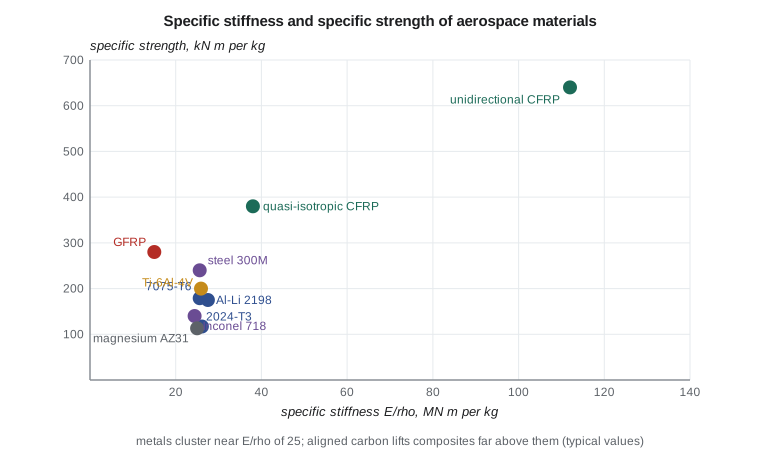
Because weight matters, aerospace engineers compare materials per unit mass. Specific stiffness is the elastic modulus divided by density, \(E/\rho\), and specific strength is strength divided by density, \(\sigma/\rho\). A striking fact appears at once: almost every structural metal, from aluminum through titanium to steel, has a specific stiffness close to 25 MN m per kg. A steel part is three times stiffer than an aluminum part of the same size, but also three times heavier. Metals cannot buy stiffness with weight; only composites, by lining up stiff fibers in the load direction, break out of that band.
Specific properties are only the right comparison for a bar in tension. A part loaded in bending or buckling behaves differently because its stiffness depends on thickness squared or cubed. Michael Ashby's material indices capture this. For a beam of fixed length and stiffness whose size can change, the mass is minimized by the material with the largest \(E^{1/2}/\rho\). For a flat panel of fixed span and bending stiffness, the index is \(E^{1/3}/\rho\). For strength-limited panels in bending, it is \(\sigma^{2/3}/\rho\). Plotting materials on a chart of modulus against density with lines of constant index lets a designer see at once which families can do a job lightly.
# Material selection for the Tern Block 2 aileron spar: specific properties and Ashby indices.
# Values are typical handbook-style numbers for teaching, not design allowables.
mats = {  # name: (E GPa, yield or strength MPa, density kg/m3, relative cost per kg)
    "2024-T3":            (73.1, 345, 2780, 1.0),
    "7075-T6":            (71.7, 503, 2810, 1.2),
    "Al-Li 2198-T8":      (76.0, 440, 2700, 2.0),
    "Ti-6Al-4V":          (114.0, 880, 4430, 6.0),
    "steel 300M":         (200.0, 1690, 7830, 1.5),
    "quasi-iso CFRP":     (60.0, 600, 1580, 8.0),
}
print(f"{'material':16s} {'E/rho':>7s} {'s/rho':>7s} {'E^0.5/rho':>10s} {'E^(1/3)/rho':>12s} {'s^(2/3)/rho':>12s}")
for n, (E, s, rho, c) in mats.items():
    print(f"{n:16s} {E*1e3/rho:7.1f} {s*1e3/rho:7.0f} {E**0.5/rho*1e3:10.2f} {E**(1/3)/rho*1e3:12.3f} {s**(2/3)/rho*1e3:12.1f}")
# Light stiff beam of fixed length and stiffness: minimize mass, index M = E^0.5 / rho.
base = mats["2024-T3"]
print("\nmass of a stiffness-limited beam relative to 2024-T3 (index E^0.5/rho):")
for n, (E, s, rho, c) in mats.items():
    m_rel = (base[0]**0.5 / base[2]) / (E**0.5 / rho)
print(f" {n:16s} mass {m_rel:5.2f} material cost {m_rel*rho/base[2]*c:5.2f}")material E/rho s/rho E^0.5/rho E^(1/3)/rho s^(2/3)/rho 2024-T3 26.3 124 3.08 1.504 17.7 7075-T6 25.5 179 3.01 1.478 22.5 Al-Li 2198-T8 28.1 163 3.23 1.569 21.4 Ti-6Al-4V 25.7 199 2.41 1.095 20.7 steel 300M 25.5 216 1.81 0.747 18.1 quasi-iso CFRP 38.0 380 4.90 2.478 45.0 mass of a stiffness-limited beam relative to 2024-T3 (index E^0.5/rho): 2024-T3 mass 1.00 material cost 1.00 7075-T6 mass 1.02 material cost 1.24 Al-Li 2198-T8 mass 0.95 material cost 1.85 Ti-6Al-4V mass 1.28 material cost 12.20 steel 300M mass 1.70 material cost 7.19 quasi-iso CFRP mass 0.63 material cost 2.85
The program shows why the Tern's aileron spar cap in AERO-310 was carbon fiber. For a stiffness-limited beam, quasi-isotropic carbon fiber reinforced plastic, CFRP, weighs about 63 percent of a 2024-T3 aluminum beam, and a laminate with more fibers along the span would do even better. Al-Li 2198 saves about 5 percent. Titanium and steel are heavier, by 28 and 70 percent, because their stiffness per unit mass is no better than aluminum's while their density is much higher. Material cost per part tells the other side: the CFRP beam costs almost three times as much in raw material, before the extra cost of laying it up and curing it.
Beyond weight: the other requirements
Temperature limits narrow the choice quickly. Aluminum alloys lose strength above about 120 °C and are rarely used above 150 °C. Epoxy composites are limited by their resin, typically to about 120 °C wet for a 180 °C cure system. Titanium serves to about 350 to 550 °C depending on the alloy, and nickel superalloys carry turbine blades and discs at 650 to 1100 °C metal temperatures with cooling. The Tern's turboshaft generator, its exhaust area and the Swift 900 study's engine pylons need materials from the hot end of that list.
Environment matters just as much. Aircraft sit on wet ramps, fly through salt air near coasts and collect condensation inside the fuselage. Toilets and galleys spill fluids. De-icing fluids and hydraulic fluids attack sealants and some resins. Lightning strikes composite skins, which need conductive mesh to carry the current. Ultraviolet light degrades unprotected resin. Each environment adds a requirement that may eliminate an otherwise attractive material or add a protection scheme that brings its own weight and maintenance.
Manufacturability and supportability close the list. A material must be available in the product forms needed, sheet, plate, extrusion, forging, prepreg or powder, from more than one qualified source if possible. It must be machinable or formable at an acceptable cost, joinable, inspectable and repairable by airlines and maintenance shops around the world. the Wichita airframe plants and the National Institute for Aviation Research at Wichita State University offer Prairiewind Aerospace deep experience in aluminum and composite manufacturing, which is one reason the Tern program leaned on those materials.
Cost, supply and sustainability
A material that saves weight is only worth choosing if the weight saved is worth more than it costs. Airlines and operators value a kilogram of empty weight by the fuel and payload it costs over the aircraft's life. For a business jet the figure can be several hundred dollars per kilogram; for a long-range airliner flying many hours a day it is higher still. A small turboprop such as the Tern, flying shorter routes, values weight less. Odile's group therefore attaches a weight value, in US dollars per kilogram saved, to each trade study, and a more expensive material wins only when its cost per kilogram saved is below that value.
Supply risk is part of the cost. Titanium sponge, some alloying elements such as lithium and scandium, carbon fiber precursor and certain resins come from a small number of producers, and lead times for forgings and titanium plate have stretched to many months during busy production years. A material with only one qualified supplier is a program risk, so certification plans often qualify a second source early. Sustainability adds newer questions. Aluminum is easy to recycle and recycled aluminum needs only a small fraction of the energy of primary metal. Thermoset composites are hard to recycle, although reclaimed fiber is increasingly used in non-structural parts, and thermoplastic composites that can be remelted are gaining ground. Life-cycle assessments weigh the energy and emissions of making a material against the fuel it saves in service; for flying structure the in-service fuel almost always dominates.
The table of requirements, the material indices and the cost per kilogram saved together give a disciplined first screening. The detailed choice then comes down to the families covered in the rest of this course: aluminum alloys, titanium, steels and superalloys, polymer composites and ceramics, and the processes that turn each of them into parts.
Allowables, specifications and certification
No material can go on a certified aircraft simply because a supplier's data sheet says it is strong. The applicant must show the regulator, the FAA, that the material's properties are established on a statistical basis, that its specifications control its quality, and that the processes used to make parts from it are controlled. For metals, much of this work is shared across the industry in the Metallic Materials Properties Development and Standardization handbook, MMPDS, the successor to the older military handbook MIL-HDBK-5, which lists A- and B-basis allowables for thousands of alloy, temper and product combinations. For composites, which depend heavily on the process, the Composite Materials Handbook, CMH-17, gives the methods, and shared databases allow companies to use qualified material systems without repeating every test.
Material specifications, such as the SAE Aerospace Material Specifications, AMS, define composition, heat treatment, properties and testing for each product form. Process specifications control heat treatment, plating, bonding, painting and inspection. Many of these special processes are audited across the industry through Nadcap, an accreditation program run by the Performance Review Institute for aerospace prime contractors, so that a heat-treat shop qualified for one aircraft builder can serve others.
Worked problem
Specific stiffness
Titanium alloy Ti-6Al-4V has a modulus of 114 GPa and a density of 4430 kg/m³. Find its specific stiffness and compare it with 7075-T6 at 71.7 GPa and 2810 kg/m³.
Show solution
- Ti-6Al-4V: \(E/\rho = 114 \times 10^9 / 4430 = 25.7 \times 10^6\) N m/kg, or 25.7 MN m per kg.
- 7075-T6: \(71.7 \times 10^9 / 2810 = 25.5\) MN m per kg.
Answer: Almost identical. Titanium earns its place by strength, temperature capability and corrosion resistance, not by stiffness per unit mass.
Worked problem
Beam index
A stiffness-limited beam is made of 2024-T3. By what factor does its mass change in quasi-isotropic CFRP with E = 60 GPa and density 1580 kg/m³? For 2024-T3 use E = 73.1 GPa and 2780 kg/m³.
Show solution
- Index \(E^{1/2}/\rho\): 2024-T3 \(\sqrt{73.1}/2780 = 3.08 \times 10^{-3}\); CFRP \(\sqrt{60}/1580 = 4.90 \times 10^{-3}\).
- Mass ratio \(= 3.08/4.90 = 0.63\).
Answer: The CFRP beam weighs about 63 percent as much.
Worked problem
A-basis and B-basis
A fitting is the only load path for an engine mount. Which allowable basis applies, and why?
Show solution
- A single load path whose failure would cause loss of the structure needs the more conservative A-basis value.
- B-basis values apply where a failed member's load can redistribute to others.
Answer: A-basis, because there is no alternative path for the load.
Common mistakes
MistakeComparing materials only by strength.
InsteadMost aircraft parts are sized by stiffness, buckling, fatigue or damage tolerance; use the property that governs.
MistakeUsing specific stiffness for a panel in bending.
InsteadFor bending and buckling the right indices are \(E^{1/2}/\rho\) for beams and \(E^{1/3}/\rho\) for panels.
MistakeDesigning with a supplier's typical values.
InsteadCertified structure uses statistically based A- or B-basis allowables from controlled specifications.
MistakeChoosing the material before the process.
InsteadProduct form, manufacturing, joining, protection and inspection come with the material and can decide the choice.
Summary and key terms
- Aerospace materials must carry limit and ultimate loads at minimum weight and keep working through fatigue, damage, temperature and environment for decades.
- Specific stiffness and strength compare materials per unit mass; metals all sit near 25 MN m per kg in specific stiffness.
- Ashby indices such as \(E^{1/2}/\rho\) for beams and \(E^{1/3}/\rho\) for panels pick the lightest material for bending and buckling.
- Certified structure uses A- and B-basis allowables from MMPDS and CMH-17 methods, controlled by material and process specifications and audited special processes.
- Allowable
- A statistically based material property that may be used in design calculations.
- A-basis
- A value that at least 99 percent of the population is expected to exceed with 95 percent confidence.
- B-basis
- A value that at least 90 percent of the population is expected to exceed with 95 percent confidence.
- Specific stiffness
- Elastic modulus divided by density.
- Material index
- A combination of properties, such as the square root of modulus over density, whose largest value gives the lightest part for a given loading.
- Special process
- A manufacturing process, such as heat treatment or bonding, whose result cannot be fully checked by inspection afterwards and must therefore be controlled.
Practice problems
Work each problem on paper first, then reveal the answer to check.
In the program, which material gives the lightest stiffness-limited beam, and what is its mass relative to 2024-T3?
Show answer
Quasi-isotropic CFRP, at about 0.63.
Why can steel not save weight in a stiffness-limited part compared with aluminum?
Show answer
Its specific stiffness is about the same, so the same stiffness needs about the same mass, and in bending its higher density makes it heavier.
Name two requirements other than strength and stiffness that can rule out a material.
Show answer
Examples: temperature capability, corrosion resistance, manufacturability, inspectability or repairability.
What handbook lists metallic allowables used in certification?
Show answer
MMPDS, the successor to MIL-HDBK-5.
Which index applies to a flat panel of fixed bending stiffness?
Show answer
\(E^{1/3}/\rho\).
Why is heat treatment called a special process?
Show answer
Its result cannot be fully verified afterwards by inspection, so the process itself must be controlled.
Lesson quiz · 5 questions
Score 60% or more to complete this lesson.
Create a free account to save your progress, take quizzes and earn a certificate.