
AERO-360 · Lesson 11 of 12 · 24 min
Corrosion and protection
Corrosion is one of the main reasons aircraft structure is repaired, and on older aircraft it can decide when an airframe is retired. It is slow, often hidden in joints and under floors, and it interacts with fatigue: a corrosion pit is a stress concentration that can start a crack, and a crack is a crevice where corrosion can grow. This lesson covers why aircraft metals corrode, the special case of galvanic corrosion between metals and carbon fiber, and the layers of protection that keep structure sound for decades. It follows Odile Marchetti's group as it reviews the corrosion protection plan for the Tern Block 2's new composite rear fuselage cone, where carbon meets aluminum, and the main landing gear.
How metals corrode
Aqueous corrosion is an electrochemical cell. At the anode, metal atoms give up electrons and dissolve as ions; at the cathode, the electrons reduce oxygen or hydrogen ions; an electrolyte, usually a thin film of water with dissolved salts, carries ions between them; and the metal carries electrons. Remove any one of the four, and corrosion stops. That simple model explains most protection methods: coatings and sealants keep the electrolyte away, sacrificial coatings make another metal the anode, and drainage and ventilation keep surfaces dry.
Aircraft corrosion takes several forms. General or uniform corrosion thins exposed surfaces evenly and is easy to see. Pitting forms deep local holes, often in aluminum exposed to chlorides from sea air or de-icing fluids. Crevice corrosion grows in tight gaps such as lap joints and under fastener heads, where trapped water becomes acidic and loses oxygen. Intergranular corrosion attacks grain boundaries, and in rolled aluminum it can develop into exfoliation, in which the metal swells and splits into layers like pages of a book. Filiform corrosion creeps under paint in thread-like paths. Stress corrosion cracking, the combined effect of tensile stress and a corrosive environment on a susceptible alloy and temper, is the most dangerous because it can crack a part without visible corrosion products; it is why 7075-T6 in thick sections was replaced by over-aged tempers.
Galvanic corrosion
When two different conducting materials touch in an electrolyte, the more active one, the one with the more negative corrosion potential, becomes the anode and corrodes faster, while the more noble one is protected. The galvanic series ranks materials by their potential in sea water. Magnesium and zinc are most active, aluminum alloys next, then steel, stainless steels, titanium and, at the noble end, graphite. The farther apart two materials are, and the larger the cathode area compared with the anode, the faster the anode corrodes. A small aluminum fastener in a large carbon fiber skin is the worst possible combination.
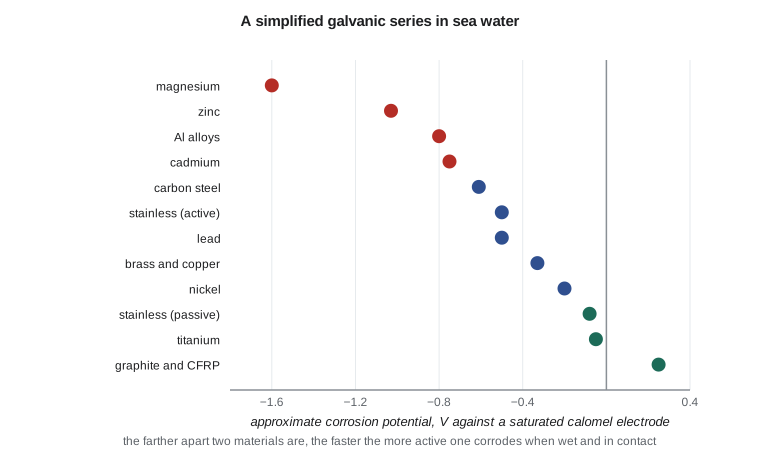
Carbon fiber composites made galvanic corrosion a central design issue. Carbon is noble and conducts electricity, so wherever aluminum touches CFRP with moisture present, the aluminum corrodes. Designers prevent it in three ways: by choosing compatible materials, titanium and corrosion-resistant steel fasteners and fittings; by isolating dissimilar materials, with a ply of glass fiber fabric on the composite surface at the interface, sealant on faying surfaces and primer on the metal; and by installing fasteners wet with sealant so no water can enter the joint. Military and civil design standards list which material pairs are compatible and which need isolation.
# Corrosion: galvanic couples on the Tern and a coating-life estimate for the main landing gear steel.
pot = {"magnesium": -1.6, "zinc": -1.03, "aluminum 2024": -0.80, "cadmium": -0.75, "carbon steel": -0.61,
       "stainless 304 passive": -0.08, "titanium": -0.05, "CFRP": 0.25}
def couple(a, b, limit=0.35):
    dv = abs(pot[a] - pot[b]); anode = a if pot[a] < pot[b] else b
    return dv, anode, ("acceptable if sealed" if dv <= limit else "isolate: barrier ply, sealant, wet-installed fasteners")
for a, b in (("aluminum 2024", "CFRP"), ("titanium", "CFRP"), ("aluminum 2024", "cadmium"), ("aluminum 2024", "stainless 304 passive")):
    dv, an, act = couple(a, b)
    print(f"{a:22s} + {b:22s} dV {dv:4.2f} V, anode {an:16s} {act}")
# Coating life: barrier plus sacrificial layer; general corrosion of exposed steel once the coating fails
coat_life_yr, steel_rate_um_yr, allow_um = 8.0, 60.0, 250.0
print(f"\nexposed 300M after coating failure loses about {steel_rate_um_yr:.0f} um/yr; "
      f"allowable {allow_um:.0f} um reached {allow_um / steel_rate_um_yr:.1f} yr after the coating fails")
print(f"inspection interval chosen so coating damage is found well before {coat_life_yr + allow_um / steel_rate_um_yr:.0f} yr")aluminum 2024 + CFRP dV 1.05 V, anode aluminum 2024 isolate: barrier ply, sealant, wet-installed fasteners titanium + CFRP dV 0.30 V, anode titanium acceptable if sealed aluminum 2024 + cadmium dV 0.05 V, anode aluminum 2024 acceptable if sealed aluminum 2024 + stainless 304 passive dV 0.72 V, anode aluminum 2024 isolate: barrier ply, sealant, wet-installed fasteners exposed 300M after coating failure loses about 60 um/yr; allowable 250 um reached 4.2 yr after the coating fails inspection interval chosen so coating damage is found well before 12 yr
The program flags the aluminum frame against the CFRP cone, with a potential difference of about 1.05 V, and aluminum against passive stainless at 0.72 V, as pairs needing isolation; titanium on CFRP and aluminum against cadmium-plated parts are acceptable when sealed. The Tern's rear cone joint therefore uses a glass fabric isolation ply on the cone's inner surface at the joint, a polysulfide sealant on all faying surfaces, titanium lockbolts installed wet, and primed and sealed aluminum. Odile adds a drainage requirement: the lowest point of the cone joint gets a drain path so water cannot stand against the interface.
Protection systems for aluminum
Aluminum structure is protected by layers. The first is the metal itself: clad sheet and corrosion-resistant tempers. The second is a conversion coating or anodizing. Chromate conversion coatings and chromic acid anodizing were standard for decades because hexavalent chromium inhibits corrosion and heals scratches, but hexavalent chromium is carcinogenic and is being phased out under environmental and worker safety rules; trivalent chromium conversion coatings and boric-sulfuric or thin-film sulfuric acid anodizing are the main replacements. The third layer is primer, traditionally chromated epoxy, now increasingly chromate-free with alternative inhibitors. The fourth is topcoat, usually polyurethane paint, which keeps out water and ultraviolet light. Inside the airframe, corrosion-inhibiting compounds, thin waxy or oily films sprayed into joints and bilges, displace water and are renewed at maintenance checks.
Design details matter as much as coatings. Drain holes at the low points of every bay, sloped floors in galleys and lavatories, sealed floor panels, and avoidance of moisture traps such as upward-facing channels prevent water from standing. Faying surfaces in joints are sealed. Aircraft that operate near the sea, from wet climates or with de-icing fluids every winter, such as the Tern on its northern routes, are given extra protection in the most exposed areas.
Protection for steel and other metals
High-strength steel landing gear is protected by a sacrificial coating, traditionally cadmium and now increasingly zinc-nickel, plus primer and paint, and by sealing and lubrication of moving joints. Wear surfaces carry hard coatings. Because these steels are very sensitive to hydrogen embrittlement, as Lesson 4 explained, every plating and stripping step is controlled and followed by baking. Magnesium, still used in some gearboxes and castings, is the most active structural metal and needs conversion coatings, sealed primers and isolation from every other metal. Titanium and stainless steels need little protection, but stainless steels can pit and crack in chloride environments, and titanium suffers fretting and galling in joints, which coatings or lubricants prevent.
Corrosion control programs
Aircraft maintenance programs include corrosion prevention and control programs that set inspection zones, intervals, and the levels of corrosion that trigger repair. Light corrosion found and treated early costs little; corrosion that has grown past the limits allowed in the structural repair manual means a patch or a replaced part. Programs classify findings by level: corrosion within allowable limits on one inspection, corrosion beyond limits, and corrosion that is an airworthiness concern needing prompt action and reporting. If corrosion keeps recurring at one location, the program's interval or protection is changed. For the main landing gear, the program's estimate in the code above shows why inspections must find coating damage early: once the coating fails, exposed 300M can lose its allowable 250 µm in about four years in a wet, salty environment.
| Layer | Aluminum structure | Steel landing gear | CFRP structure |
|---|---|---|---|
| Material choice | clad sheet, over-aged tempers | corrosion-resistant grades where possible | inherently resistant |
| Surface treatment | conversion coating or anodizing | zinc-nickel or cadmium plating, baked | none needed |
| Primer | epoxy, chromate-free where approved | epoxy primer | primer for paint adhesion |
| Topcoat | polyurethane paint | polyurethane paint | polyurethane paint, UV protection |
| Joints | sealant on faying surfaces, wet fasteners | sealed, lubricated pins | glass isolation ply, titanium fasteners |
| In service | corrosion-inhibiting compounds, drainage | overhaul and recoating | check for disbond and erosion |
Environment, inspection and the cost of corrosion
How quickly corrosion develops depends heavily on where and how an aircraft operates. Aircraft based near the sea, in hot humid climates or at airports that use de-icing fluids and runway chemicals heavily corrode much faster than those in dry inland regions. Galleys, lavatories, cargo bays carrying seafood or livestock, and the bilge areas under floors where water and fluids collect are the classic hot spots. Wheel wells and landing gear see water, grit and de-icing chemicals on every winter landing. Battery compartments see electrolyte, and areas around engine exhausts see heat and combustion products. Maintenance programs target these zones with shorter intervals and require extra corrosion-inhibiting compound after every heavy check.
Corrosion is found mainly by detailed visual inspection, helped by the signs it leaves: bulging or pillowing between lap joint sheets as corrosion products swell, blistered or flaking paint, white powder on aluminum, rust streaks, and popped fastener heads. Eddy current and ultrasonic thickness measurements quantify metal loss, and some operators use radiography or thermography to look for hidden corrosion in lap joints. Once found, corrosion is removed by blending with abrasives until clean metal remains, the remaining thickness is measured against the structural repair manual's limits, and the area is treated, primed, sealed and painted. If too much metal has gone, a doubler or a new part is installed.
The cost is large. Corrosion inspection and repair account for a significant share of structural maintenance hours on older aircraft, and corrosion damage is one of the reasons fleets are retired. Designing for corrosion resistance, with corrosion-resistant tempers, careful detail design, good sealing and drainage, and composite structure where it suits, therefore pays back over the aircraft's life, which is why Odile's review of the Tern Block 2 gives as much attention to drain paths and sealant as to the choice of alloy.
Worked problem
Galvanic difference
Using the series in the figure, find the potential difference between an aluminum alloy (−0.80 V) and CFRP (+0.25 V).
Show solution
- \(\Delta V = 0.25 - (-0.80) = 1.05\) V.
- Aluminum is the anode.
Answer: About 1.05 V, a severe couple that needs full isolation.
Worked problem
Area effect
Why is a small aluminum rivet in a large carbon skin worse than a large aluminum plate with one carbon fastener?
Show solution
- The corrosion current is limited by the cathode reaction, so a large cathode drives a large current.
- Concentrated on a small anode, the same current dissolves the rivet quickly.
Answer: Small anode and large cathode give the fastest local attack.
Worked problem
Allowable loss
Exposed steel corrodes at 60 µm per year and the repair limit allows 250 µm of loss. How long after coating failure is the limit reached?
Show solution
- \(250/60 = 4.2\) years.
Answer: About four years, so the inspection interval must be shorter.
Common mistakes
MistakeFastening CFRP with aluminum rivets.
InsteadAluminum corrodes against carbon; use titanium or corrosion-resistant steel fasteners with isolation.
MistakeRelying on paint alone.
InsteadProtection needs layers: material, surface treatment, primer, topcoat, sealant and drainage.
MistakeIgnoring stress corrosion because no corrosion is visible.
InsteadStress corrosion cracking can crack susceptible tempers with almost no visible corrosion products.
MistakeStripping and replating high-strength steel without baking.
InsteadPlating and stripping add hydrogen; baking prevents embrittlement.
Summary and key terms
- Corrosion is an electrochemical cell of anode, cathode, electrolyte and metallic path; removing any part stops it.
- Aircraft see general, pitting, crevice, intergranular, exfoliation, filiform and stress corrosion.
- Galvanic corrosion attacks the more active metal of a dissimilar pair, and aluminum against carbon fiber is severe, so CFRP joints use titanium fasteners, glass isolation plies and wet sealant.
- Aluminum is protected by cladding, conversion coatings or anodizing, primer, topcoat, sealants, corrosion-inhibiting compounds and drainage, with chromate systems being replaced.
- Steel landing gear uses sacrificial plating with baking.
- Corrosion control programs set zones, intervals and levels for repair.
- Galvanic corrosion
- Accelerated corrosion of the more active of two dissimilar conductors in contact in an electrolyte.
- Galvanic series
- A ranking of materials by corrosion potential in a given electrolyte, usually sea water.
- Exfoliation
- Intergranular corrosion that splits rolled metal into layers.
- Stress corrosion cracking
- Cracking caused by tensile stress and a corrosive environment in a susceptible material.
- Conversion coating
- A thin chemical film formed on metal to resist corrosion and improve paint adhesion.
- Faying surface
- A surface in contact with another part in a joint.
Practice problems
Work each problem on paper first, then reveal the answer to check.
In the program, which pairs need isolation?
Show answer
Aluminum with CFRP and aluminum with passive stainless steel.
Name the four parts of a corrosion cell.
Show answer
Anode, cathode, electrolyte and metallic path.
Why is hexavalent chromium being replaced?
Show answer
It is carcinogenic; trivalent and chromate-free systems replace it.
What does a glass fabric ply do at a CFRP-aluminum joint?
Show answer
It electrically isolates the aluminum from the carbon.
Why are drain holes placed at the low points of bays?
Show answer
So water cannot stand and form an electrolyte.
What happens when corrosion keeps recurring at one location?
Show answer
The inspection interval or protection scheme is changed.
Lesson quiz · 5 questions
Score 60% or more to complete this lesson.
Create a free account to save your progress, take quizzes and earn a certificate.