
AERO-360 · Lesson 4 of 12 · 25 min
Steels and superalloys
Steel makes up only a few percent of an aircraft's weight, but it carries some of its highest loads. Landing gear, flap tracks, engine mounts, actuator rods, bearings and high-strength bolts are steel because no lighter metal matches its strength in a compact part. At the hot end of the engine, nickel and cobalt superalloys carry turbine discs and blades at temperatures where every other structural metal would melt or creep away. This lesson covers both families and the special care they demand. Dr. Teresa Nakamura's propulsion group joins Odile Marchetti's materials team for the second half, to review the hot section of the Tern Block 2's turboshaft generator.
Ultra-high-strength steels
Aircraft steels are low-alloy steels quenched and tempered to tensile strengths of 1500 to 2000 MPa, three or four times the strength of structural building steel. The classic alloys are 4340, a nickel-chromium-molybdenum steel, and 300M, a 4340 modified with silicon and vanadium that reaches about 1930 MPa ultimate and is used for main landing gear on many airliners. Newer secondary-hardening steels such as AerMet 100 combine similar strength with much better toughness and stress corrosion resistance, at higher cost. Precipitation-hardening stainless steels such as 15-5PH and 17-4PH, at 1000 to 1300 MPa, serve fittings and actuator parts where corrosion resistance matters more than maximum strength.
Strength comes from martensite. The steel is austenitized at about 870 °C, quenched in oil to form hard, brittle martensite, and then tempered at a few hundred degrees to restore toughness. The tempering temperature sets the final strength: lower tempering gives higher strength but lower toughness. Heat treatment of landing gear is a tightly controlled special process because a few degrees too low or too high moves the part outside its specification.
Hydrogen embrittlement
The great enemy of high-strength steel is hydrogen. Atomic hydrogen, absorbed from electroplating, acid cleaning, corrosion or welding, diffuses to regions of high stress and allows cracks to grow under sustained load at stresses far below the strength of the steel. The failure can occur hours or weeks after the part is loaded, with no warning. Susceptibility rises steeply with strength; steels above about 1400 MPa are highly sensitive. Plating processes for high-strength steels are therefore followed by a baking treatment, typically several hours at about 190 °C within a few hours of plating, to drive hydrogen out, and plating processes themselves are chosen to admit as little hydrogen as possible.
Corrosion protection compounds the problem. Landing gear steel was traditionally protected with cadmium plating, which corrodes sacrificially. Cadmium is toxic, and aerospace is moving to replacements such as zinc-nickel plating, with careful embrittlement testing. Wear surfaces such as axles and actuator pistons are often coated with hard chromium or, increasingly, with thermally sprayed tungsten carbide coatings that avoid hexavalent chromium. Shot peening the surface before coating adds compressive residual stress that resists fatigue crack initiation.
Superalloys and the hot section
Superalloys are nickel, cobalt or iron-nickel alloys designed to keep their strength, resist creep and resist oxidation at temperatures above about 600 °C. Nickel superalloys owe their strength to a high volume fraction of gamma prime, an ordered nickel-aluminum-titanium phase that precipitates in the nickel matrix and, unusually, becomes stronger as temperature rises over part of its range. Chromium gives oxidation and hot corrosion resistance, and refractory elements such as tungsten, molybdenum, tantalum and rhenium strengthen the matrix.
The products range from wrought alloys to single crystals. Inconel 718, an iron-nickel superalloy strengthened by a different precipitate, gamma double prime, is the workhorse for discs, shafts and casings up to about 650 °C because it can be forged, welded and machined. Waspaloy and powder metallurgy alloys carry hotter discs. Turbine blades, the hottest and most highly stressed parts, are investment cast. Directionally solidified blades have grains running along the blade, removing the transverse grain boundaries where creep cracks start, and single-crystal blades have no grain boundaries at all. Blades also carry internal cooling passages and thermal barrier coatings, covered in Lesson 7, so that gas temperatures can exceed the metal's melting point.
Creep and the Larson-Miller parameter
At high temperature, metals deform slowly under constant stress, a process called creep. A turbine disc rim or blade will gradually stretch and eventually rupture even if its stress stays below yield. Designers need to know how long a part will last at a given stress and temperature, but testing for the actual service life of tens of thousands of hours is impractical. The Larson-Miller parameter solves this by combining temperature and time into one variable, \(P = T(C + \log_{10} t)/1000\), with \(T\) in kelvin, \(t\) in hours and \(C\) about 20 for many alloys. Rupture tests at many temperatures and times fall on one master curve of stress against \(P\). A short test at higher temperature can then predict the life at a lower temperature, as long as the mechanism of creep does not change.
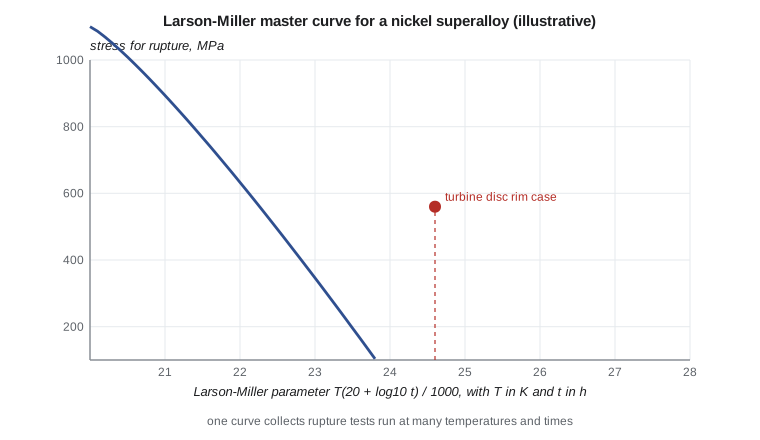
# Larson-Miller parameter for creep rupture of a nickel superalloy turbine part (illustrative master curve).
import math
C = 20.0
def lmp(T_C, t_h): return (T_C + 273.15) * (C + math.log10(t_h)) / 1000
def stress_from_lmp(P):                     # illustrative fit of a master curve, MPa
    return 1100 - 0.9 * ((P - 20) * 100) ** 1.18
def life(T_C, stress):                      # solve for rupture time by bisection on P
    lo, hi = 20.0, 28.0
    for _ in range(60):
        mid = (lo + hi) / 2
        if stress_from_lmp(mid) > stress: lo = mid
        else: hi = mid
    P = (lo + hi) / 2
    return 10 ** (P * 1000 / (T_C + 273.15) - C), P
for T, s in ((650, 560), (700, 560), (650, 450), (730, 400)):
    t, P = life(T, s)
    print(f"T {T} C, stress {s} MPa: LMP {P:5.2f}, rupture life about {t:9.0f} h")
# Equivalent conditions: same LMP means same damage, so a short hot test predicts a long cool life.
P = lmp(760, 100)
print(f"\n100 h at 760 C has LMP {P:.2f}; at 650 C the same LMP corresponds to {10**(P*1000/923.15 - C):.0f} h")T 650 C, stress 560 MPa: LMP 22.26, rupture life about 13018 h T 700 C, stress 560 MPa: LMP 22.26, rupture life about 751 h T 650 C, stress 450 MPa: LMP 22.65, rupture life about 33987 h T 730 C, stress 400 MPa: LMP 22.82, rupture life about 557 h 100 h at 760 C has LMP 22.73; at 650 C the same LMP corresponds to 41827 h
The program shows how unforgiving temperature is. At 560 MPa the predicted rupture life falls from about 13 000 hours at 650 °C to about 750 hours at 700 °C, a factor of seventeen for 50 degrees. Dropping the stress at 650 °C from 560 to 450 MPa nearly triples the life. A 100-hour test at 760 °C has the same parameter as about 42 000 hours at 650 °C, which is the kind of extrapolation the method allows. Teresa adds that real engine life limits combine creep with low-cycle fatigue from every start and stop, and that both are proved with full-scale engine tests and a certification program under the engine rules of the FAA.
| Alloy | Family | Typical use | Approximate temperature limit |
|---|---|---|---|
| 4340, 300M | low-alloy steel | landing gear, high-strength fittings | about 200 C |
| 15-5PH, 17-4PH | precipitation-hardening stainless | actuators, fittings | about 300 C |
| Inconel 718 | nickel-iron superalloy, wrought | discs, shafts, casings | about 650 C |
| Waspaloy | nickel superalloy, wrought | hotter discs and rings | about 750 C |
| CMSX-4 type | nickel superalloy, single crystal | high-pressure turbine blades | above 1000 C metal with coating |
| Haynes 188 type | cobalt superalloy | combustor liners | about 1000 C sheet |
Stainless steels and tooling
Corrosion-resistant steels deserve a final note. Austenitic stainless steels such as 321 and 347 are used for exhaust ducts, firewalls and hydraulic tubing because they resist oxidation and are easy to weld. Martensitic and precipitation-hardening grades serve fittings, bearings and fasteners. None of them is immune: stainless steels can suffer pitting and crevice corrosion where chlorides collect, and some precipitation-hardening grades become brittle if aged at the wrong temperature. As always, the material choice comes with a heat treatment and protection specification that the drawing must call out.
Steel also appears in a less obvious role: as tooling. The dies that forge aluminum and titanium parts, the molds that shape thermoplastic clips, and many composite tools for small parts are made of tool steels or Invar. Their wear, thermal expansion and repair are part of the cost of every airframe part, and a worn forging die can change the grain flow and properties of the parts it makes, which is why die condition is part of a forging's process control.
Inspection and life management of hot and high-strength parts
Steels and superalloys carry many of the parts whose failure would be catastrophic, so they are managed by life rather than by condition. Landing gear has a certified life in landings, set by fatigue tests of the actual gear, and is overhauled at set intervals: it is stripped, inspected by magnetic particle and other methods, re-plated, re-peened and returned to service. Engine discs are life-limited parts with a fixed number of start and stop cycles, and they are retired when that limit is reached even if they look perfect, because a burst disc cannot be contained by the engine casing.
Turbine blades are inspected by borescope during routine maintenance, looking for coating loss, burning, cracks and creep elongation, and replaced on condition or at shop visits. Hot section repairs are a specialty in their own right: blades can be stripped, recoated and their tips rebuilt by welding with matching superalloy filler, and combustor liners can be patched, all under repair specifications approved by the engine maker and the regulator. Shops near large fleets, including engine repair centers that service turboprops and turboshafts of the Tern's class, make this work routine.
Material quality underlies all of it. Superalloy discs are made from vacuum-melted, often triple-melted metal, and many are made by powder metallurgy, which gives a fine, uniform structure but brings its own risk of ceramic inclusions from the powder process. Every disc is ultrasonically inspected, and its forging and heat treatment records are kept for the life of the part. When an inclusion is found in service, the investigation may trace it back through the records to the melt heat, and other parts from that heat may be inspected or retired.
The Tern's hot section
The Tern Block 2's turboshaft generator, a derivative of an existing small turboshaft, uses an Inconel 718 compressor rear stage and shaft, a cast nickel superalloy single-stage gas generator turbine, and a power turbine with directionally solidified blades. Because the engine is an existing certified type, the materials group's job is to check that the new duty cycle, with long periods at constant power driving a generator instead of the varied power of a helicopter, does not consume the life of hot parts faster than the engine's published limits allow. Teresa's group finds that constant high power raises blade creep consumption but cuts the number of large throttle cycles, which reduces low-cycle fatigue. The net effect leaves blade life within limits at the planned turbine inlet temperature, but with less margin than the helicopter version.
Worked problem
Larson-Miller equivalence
A creep test runs for 100 h at 760 °C. With C = 20, find the equivalent life at 650 °C.
Show solution
- \(P = (760 + 273.15)(20 + \log_{10}100)/1000 = 1033.15 \times 22/1000 = 22.73\).
- At 650 °C: \(\log_{10} t = 22.73 \times 1000/923.15 - 20 = 4.62\), so \(t = 10^{4.62} \approx 42\,000\) h.
Answer: About 42 000 hours, if the creep mechanism is the same at both temperatures.
Worked problem
Specific strength of landing gear steel
300M has an ultimate strength of 1930 MPa and a density of 7830 kg/m³. Compare its specific strength with Ti-6Al-4V at 950 MPa and 4430 kg/m³.
Show solution
- 300M: \(1930 \times 10^6/7830 = 246\) kN m/kg.
- Ti-6Al-4V: \(950 \times 10^6/4430 = 214\) kN m/kg.
Answer: 300M is higher per unit mass and much more compact, which matters in a landing gear bay.
Worked problem
Bake after plating
Why must a 1900 MPa steel bolt be baked soon after zinc-nickel plating?
Show solution
- Plating admits atomic hydrogen into the steel.
- High-strength steel is very sensitive to hydrogen embrittlement, so the hydrogen must be driven out before it causes delayed cracking.
Answer: Baking removes hydrogen and prevents delayed brittle fracture under load.
Common mistakes
MistakeTreating hydrogen embrittlement as a corrosion problem only.
InsteadHydrogen from plating and cleaning can crack high-strength steel under sustained load with no visible corrosion.
MistakeExtrapolating Larson-Miller curves across a change in mechanism.
InsteadThe method assumes the same creep mechanism at test and service conditions.
MistakeAssuming superalloys never oxidize.
InsteadThey rely on chromium and coatings; hot corrosion and oxidation still limit life.
MistakeUsing a higher tempering temperature to gain strength.
InsteadHigher tempering lowers strength and raises toughness in quenched and tempered steel.
Summary and key terms
- Ultra-high-strength steels such as 4340, 300M and AerMet 100 carry landing gear and highly loaded fittings; precipitation-hardening stainless steels serve corrosion-prone fittings.
- Their strength comes from quenched and tempered martensite, and their main danger is hydrogen embrittlement, controlled by low-hydrogen plating and baking.
- Nickel superalloys, strengthened by gamma prime, carry turbine discs and blades; directionally solidified and single-crystal blades remove grain boundaries.
- The Larson-Miller parameter combines temperature and time to predict creep rupture life from shorter tests.
- Martensite
- A hard, strong steel structure formed by quenching from austenite.
- Hydrogen embrittlement
- Loss of ductility and delayed cracking caused by absorbed hydrogen, especially in high-strength steel.
- Superalloy
- A nickel, cobalt or iron-nickel alloy that keeps strength and resists oxidation above about 600 °C.
- Gamma prime
- The ordered nickel-aluminum-titanium precipitate that strengthens nickel superalloys.
- Creep
- Slow, time-dependent deformation under constant stress at high temperature.
- Larson-Miller parameter
- A combination of temperature and log time used to collapse creep rupture data onto one curve.
Practice problems
Work each problem on paper first, then reveal the answer to check.
In the program, how much does rupture life fall when temperature rises from 650 to 700 °C at 560 MPa?
Show answer
From about 13 000 h to about 750 h.
Why are single-crystal turbine blades used?
Show answer
They have no grain boundaries, where creep cracks start.
What replaces cadmium for landing gear protection?
Show answer
Zinc-nickel plating, with embrittlement testing.
Which superalloy is the workhorse for discs and casings up to about 650 °C?
Show answer
Inconel 718.
How did the Tern's duty cycle change the turbine blade life?
Show answer
Constant power raised creep consumption but cut low-cycle fatigue; life stayed within limits with less margin.
Why is shot peening applied to landing gear steel?
Show answer
It adds compressive residual stress that resists fatigue cracking.
Lesson quiz · 5 questions
Score 60% or more to complete this lesson.
Create a free account to save your progress, take quizzes and earn a certificate.