
ACCT-499 · Lesson 5 of 12 · 28 min
Reporting issues review: revenue, provisions, impairment and estimates
The financial analysis pointed to several balances that may be misstated: year-end revenue, the warranty provision, the receivables allowance, slow-moving inventory and the goodwill from the Merrow Lane acquisition. In this workstream the team examines each issue as a professional accountant would: identify the relevant facts, apply the requirements of US GAAP, quantify the effect and assess whether it matters. ACCT-211, ACCT-212, ACCT-311 and ACCT-470 taught the standards. This lesson shows how to apply them under time pressure to a real set of facts, and how to communicate a conclusion that differs from management's without overstepping the team's role.
A reminder about that role. The team is not the auditor and does not decide what Bluestem's financial statements should say. Management prepares them, and Pellham Vance LLP audits them. The team's job is to identify judgments that look questionable, explain why, estimate the possible effect and recommend that management and the audit committee consider them. Its report will use phrases such as "we believe management should reconsider" and "based on the information we reviewed", not "the financial statements are misstated."
A structure for each issue
Professional case responses in CPA programs use a consistent structure for accounting issues, and the team adopts it for its working papers: the issue in one sentence; the relevant facts; the requirements of the standard; an analysis applying the requirements to the facts, including the arguments on both sides where judgment is involved; a conclusion; and the effect on the financial statements. Writing each issue this way prevents the most common weaknesses, which are reciting the standard without applying it and reaching a conclusion without explaining it.
Issue 1: the year-end bill-and-hold sale
In the last week of December 2026, Bluestem invoiced a municipal utility 4.8 million for sensors and data loggers for a new treatment plant and recognized the revenue and a cost of sales of 3.1 million. The goods were not shipped until January 2027, when the plant was ready to receive them. The customer's purchase order did not mention storage. Bluestem's sales director requested the arrangement in an email to the utility on December 20, noting that "it would help us both to finalize this before year end". The goods sat in Bluestem's main warehouse, mixed with general stock, until they were picked in January.
Under ASC 606, revenue is recognized when control of the goods transfers to the customer. In a bill-and-hold arrangement, the customer may obtain control before physical delivery, but only if all of these criteria are met: the reason for the arrangement is substantive (for example, the customer requested it); the product has been identified separately as belonging to the customer; the product is currently ready for physical transfer; and the entity cannot use the product or direct it to another customer. The general indicators of control transfer must also point to the customer. SEC staff have long scrutinized bill-and-hold arrangements, which featured in several enforcement cases.
Applying the criteria, the arrangement fails on at least two counts. The reason was not substantive from the customer's side: Bluestem requested it, and its stated motive was its own year end. And the goods were not separately identified; they were mixed with general stock and could have been shipped to anyone. Control did not pass in 2026. The revenue and cost of sales should be recognized in January 2027, which reduces 2026 revenue by 4.8 million and operating income by 1.7 million. The team also notes that this one arrangement explains part of the December spike in receivables found in Lesson 4, and that a control over bill-and-hold approvals failed. Lesson 6 follows up.
Issue 2: the warranty provision
Bluestem gives a two-year warranty on hardware. The provision fell slightly from 2.7 to 2.6 million in 2026 while hardware sales grew. Management explained that the new sensor generation is more reliable, so it reduced its estimate of claims. But the claims system shows that the actual claim rate in 2026 was 6.2 percent of units, higher than in earlier years, because the new generation had a firmware problem that required technicians to visit about 400 sites. The average cost of a claim, including parts, travel and technician time, is about 5,000 dollars.
A warranty that assures the product works as specified is an assurance-type warranty, accounted for as a loss contingency under ASC 450 and disclosed under ASC 460. A liability is accrued when it is probable that an obligation exists and the amount can be reasonably estimated; for a large population of items, companies estimate expected claims from historical and current experience. ASC 460 also requires a reconciliation of the warranty liability for the period. Management's estimate should reflect current information, including recent claims experience, rather than hoped-for improvements.
Quantifying the issues
The program below quantifies the three issues the team considers most significant: the warranty provision based on units still under warranty and the current claim rate, the reversal of the bill-and-hold sale, and the impairment test of the Merrow Lane unit.
# Bluestem Water Instruments Inc. (invented), in thousands of dollars, years ended December 31.
YEARS = [2024, 2025, 2026]
IS = {'Hardware revenue': [138000, 149500, 161200], 'Subscription revenue': [44000, 55600, 69800],
      'Hardware cost of sales': [82800, 92700, 104800], 'Subscription cost of sales': [11000, 13300, 16100],
      'Selling, general and admin': [42000, 48500, 56900], 'Research and development': [18200, 21000, 23600],
      'Depreciation': [6200, 6900, 7600], 'Amortization of intangibles': [3000, 4800, 4800],
      'Interest expense': [2100, 3900, 4600], 'Income tax expense': [3300, 2500, 2500]}
BS = {  # balances at December 31, 2023 to 2026
      'Cash': [18000, 24200, 25500, 23400], 'Receivables': [26000, 30000, 39800, 52100],
      'Inventories': [22000, 26000, 31500, 41900], 'Other current assets': [2800, 3000, 3600, 4100],
      'Property, plant and equipment': [45000, 48000, 51000, 53500], 'Right-of-use assets': [13000, 12000, 15500, 14800],
      'Intangible assets': [9000, 6000, 19200, 14400], 'Goodwill': [8000, 8000, 24000, 24000],
      'Payables': [15000, 17000, 19500, 22700], 'Accrued liabilities': [8000, 9000, 10500, 11200],
      'Deferred revenue': [11000, 14000, 18500, 21000], 'Warranty provision': [2300, 2500, 2700, 2600],
      'Income taxes payable': [1200, 1300, 900, 700], 'Lease liabilities': [13500, 13000, 16800, 16300],
      'Borrowings': [28000, 25000, 57000, 60000], 'Deferred tax liabilities': [1800, 2000, 2300, 2700],
      'Share capital': [40000, 40000, 40000, 42000], 'Retained earnings': [23000, 33400, 41900, 49000]}
CF = {'Cash from operations': [20900, 15900, 5800], 'Capital expenditure': [-8000, -8400, -8400],
      'Acquisition of Merrow Lane': [0, -34000, 0], 'Dividends paid': [-3000, -3000, -3000]}
def rev(i): return IS['Hardware revenue'][i] + IS['Subscription revenue'][i]
def cogs(i): return IS['Hardware cost of sales'][i] + IS['Subscription cost of sales'][i]
def ebit(i): return rev(i) - cogs(i) - sum(IS[k][i] for k in ('Selling, general and admin', 'Research and development', 'Depreciation', 'Amortization of intangibles'))
def ni(i): return ebit(i) - IS['Interest expense'][i] - IS['Income tax expense'][i]
ASSETS = ['Cash', 'Receivables', 'Inventories', 'Other current assets', 'Property, plant and equipment', 'Right-of-use assets', 'Intangible assets', 'Goodwill']
CUR_A = ASSETS[:4]
CUR_L = ['Payables', 'Accrued liabilities', 'Deferred revenue', 'Warranty provision', 'Income taxes payable']
LIABS = CUR_L + ['Lease liabilities', 'Borrowings', 'Deferred tax liabilities']
def tot(keys, t): return sum(BS[k][t] for k in keys)

# Lesson 5: quantify three reporting issues the team found (US GAAP view; amounts in thousands).
# 1. Warranty accrual under ASC 460: expected claims on units still under the two-year warranty.
units = {2025: 9800, 2026: 10700}          # hardware units shipped (invented)
claim_rate, cost_per_claim = 0.062, 5.0    # thousands of dollars per claim (parts, travel, technician time)
remaining = {2025: 0.35, 2026: 0.85}       # share of warranty period still to run at Dec 31, 2026
need = sum(units[y] * claim_rate * cost_per_claim * remaining[y] for y in units)
print(f"1. Warranty: required accrual {need:,.0f} vs recorded {BS['Warranty provision'][3]:,} -> increase {need - BS['Warranty provision'][3]:,.0f}")
# 2. Bill-and-hold sale to a municipal utility shipped in January 2027 but recognized in December 2026.
bh_rev, bh_cost = 4800, 3100
print(f"2. Bill-and-hold: the customer did not request the arrangement and the units were not separately identified, "
      f"so control had not passed -> reverse revenue {bh_rev:,} and cost {bh_cost:,} (operating income -{bh_rev - bh_cost:,})")
# 3. Goodwill of the Merrow Lane reporting unit under ASC 350: fair value from a market participant DCF.
cf = [1700, 2000, 2250, 2450, 2600]; r, g = 0.110, 0.025
fv = sum(c / (1 + r) ** (k + 1) for k, c in enumerate(cf)) + cf[-1] * (1 + g) / (r - g) / (1 + r) ** 5
carrying = 16000 + 12600 + 2100          # Merrow Lane goodwill, its intangibles, other net assets
undiscounted = sum(cf) + cf[-1] * 5      # ASC 360 recoverability of the intangible asset group (simplified)
print(f"   ASC 360 first: undiscounted cash flows {undiscounted:,} vs asset group {12600 + 2100:,} -> recoverable, no asset impairment")
loss = min(16000, max(0, carrying - fv))
print(f"3. Merrow Lane reporting unit: carrying amount {carrying:,}, fair value {fv:,.0f} -> goodwill impairment {loss:,.0f}")
pretax = (need - BS['Warranty provision'][3]) + (bh_rev - bh_cost) + loss
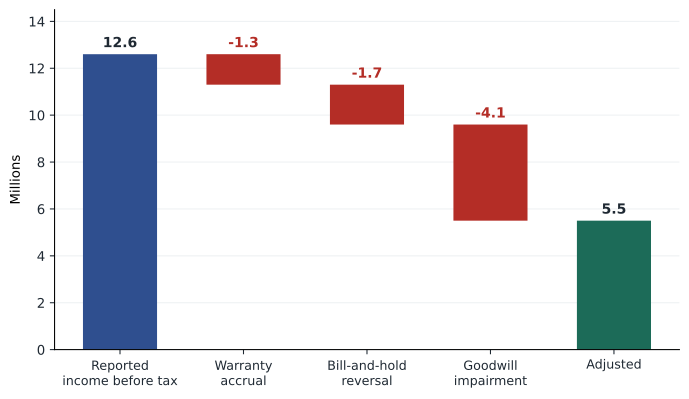
print(f"\nCombined effect on 2026 income before tax: -{pretax:,.0f} (reported {ebit(2) - IS['Interest expense'][2]:,})")
for rate in (0.100, 0.110, 0.120):
    v = sum(c / (1 + rate) ** (k + 1) for k, c in enumerate(cf)) + cf[-1] * (1 + g) / (rate - g) / (1 + rate) ** 5
print(f" discount rate {rate:.1%}: fair value {v:,.0f}, impairment {min(16000, max(0, carrying - v)):,.0f}")1. Warranty: required accrual 3,883 vs recorded 2,600 -> increase 1,283 2. Bill-and-hold: the customer did not request the arrangement and the units were not separately identified, so control had not passed -> reverse revenue 4,800 and cost 3,100 (operating income -1,700) ASC 360 first: undiscounted cash flows 24,000 vs asset group 14,700 -> recoverable, no asset impairment 3. Merrow Lane reporting unit: carrying amount 30,700, fair value 26,563 -> goodwill impairment 4,137 Combined effect on 2026 income before tax: -7,119 (reported 12,600) discount rate 10.0%: fair value 30,240, impairment 460 discount rate 11.0%: fair value 26,563, impairment 4,137 discount rate 12.0%: fair value 23,664, impairment 7,036
The warranty calculation multiplies the units shipped in each of the last two years by the claim rate, the cost per claim and the share of the warranty period still to run. It produces a required balance of about 3.9 million against 2.6 million recorded, an increase of about 1.3 million. Management's argument that the new generation is more reliable is not supported by the claims data; the opposite is true for 2026. The team recommends that management rebuild the estimate from claims data each quarter and document the basis for any assumption that differs from experience.
Issue 3: the Merrow Lane goodwill
Bluestem paid 34 million for Merrow Lane in 2025 and recognized about 16 million of goodwill and 18 million of identifiable intangibles, now 12.6 million after amortization. The acquisition model assumed Merrow Lane's analytics would raise subscription prices by 8 percent and add 6 million of revenue by 2026. Actual 2026 revenue from Merrow Lane products was 2.1 million, the price increase was delayed to 2027, and two of Merrow Lane's founders left in 2026. These are indicators of impairment.
Under ASC 360, the long-lived assets of the asset group are tested first for recoverability on an undiscounted basis; Merrow Lane's intangibles pass, as the output shows. Goodwill is then tested under ASC 350 by comparing the reporting unit's fair value with its carrying amount; the excess, limited to the goodwill, is the impairment. Bluestem treats Merrow Lane as a separate reporting unit because it is a component with discrete information that segment management reviews. Management's own test used a fair value based on a forecast that assumes Merrow Lane revenue triples by 2028. The team rebuilt the forecast from the current pipeline using market participant assumptions and a rate of 11 percent. Its fair value of about 26.6 million is below the carrying amount of 30.7 million, indicating a goodwill impairment of about 4.1 million. The sensitivity in the output shows how much the answer depends on the rate: at 10 percent, the impairment is 0.5 million; at 12 percent, 7.0 million.
The impairment conclusion is the most judgmental of the three, and the team presents it as such. It does not say management is wrong; it says that management's forecast is significantly more optimistic than recent results and the current pipeline support, that its discount rate does not reflect the risk of the unit, and that a reasonable alternative set of assumptions produces an impairment. It recommends that the audit committee ask management and the auditor to revisit the test. This is the kind of issue that the auditor will likely already have identified as a key or critical audit matter, and the team's role is to make sure the committee understands the judgment.
Other estimates the team reviewed
Two further estimates are smaller but worth raising. The first is the allowance for credit losses. Under the CECL model in ASC 326, Bluestem should recognize lifetime expected credit losses on trade receivables from the outset, using historical loss information adjusted for current conditions and reasonable and supportable forecasts. Its allowance has stayed at about one percent of receivables while balances more than 90 days past due rose from 7 to 18 percent, and 6 million of milestone billings are disputed. Disputes are partly a revenue question and partly a credit question, and the team recommends a separate review. The second is inventory. The 3.9 million of slow-moving old-model stock may need a write-down to net realizable value under ASC 330; if it can be sold only at the 40 percent discount the sales team suggests, the write-down would be about 1.6 million.
Does it matter? Materiality
The team considers whether the issues are material, using the approach from ACCT-331 and ACCT-470. A common benchmark for a profitable listed company is about five percent of profit before tax, which for Bluestem is about 630,000 dollars. Each of the three main issues exceeds it on its own, and together they would cut 2026 profit before tax by more than half. Qualitative factors point the same way: the bill-and-hold sale affects a revenue trend that is central to the company's story and to executive bonuses, and an impairment would contradict management's public statements about the acquisition.
The team does not conclude that the financial statements are materially misstated; that is the auditor's judgment, and the auditor may have information the team lacks. It concludes that the issues are significant enough to bring to the audit committee, with a recommendation that management reconsider them and discuss them with Pellham Vance LLP. If the statements have already been issued, management would also need to consider whether any correction is required under ASC 250.
| Issue | Team's estimate | Strength of evidence | Recommended action |
|---|---|---|---|
| Bill-and-hold sale | Revenue -4.8 million; operating income -1.7 million | Strong: criteria clearly not met | Recognize in 2027; tighten approval control |
| Warranty provision | +1.3 million | Strong: claims data contradict the assumption | Rebuild estimate quarterly from claims data |
| Merrow Lane goodwill | Impairment of about 4.1 million | Moderate: depends on forecast and rate | Revisit forecast and rate with the auditor |
| Receivables allowance | Not quantified | Moderate | Rebuild provision matrix; review disputes |
| Slow-moving inventory | About 1.6 million | Moderate: depends on discount | Assess net realizable value |
Worked problem
Testing a bill-and-hold arrangement
Suppose instead that the utility had requested the arrangement in writing because its plant was delayed, Bluestem had tagged and stored the goods separately, and they were ready to ship. Could revenue be recognized in December?
Show solution
- The reason is substantive: the customer requested it for its own business reason.
- The goods are separately identified as the customer's and ready for physical transfer.
- Bluestem cannot use them or redirect them to another customer.
- If the other indicators of control (such as title and acceptance) also point to the customer, control has passed.
Answer: Yes, if all the criteria and control indicators are met; Bluestem would also consider whether storage is a separate performance obligation.
Common mistakes
MistakeReciting the standard without applying it to the facts.
InsteadAnalyze each criterion against the specific facts and explain the conclusion.
MistakeConcluding that the statements are misstated.
InsteadPresent the issue, the evidence and a reasonable alternative, and recommend that management and the auditor reconsider.
MistakeAccepting management's assumption that a new product is more reliable.
InsteadTest assumptions against current data such as claims experience.
MistakeUsing the group's cost of capital to test a riskier unit.
InsteadUse a rate that reflects the specific risks of the unit.
MistakeIgnoring the interaction between issues.
InsteadLink revenue timing to receivables, controls and incentives.
Summary and key terms
- Structure each issue: facts, requirements, analysis, conclusion and effect.
- The year-end bill-and-hold sale fails the criteria; 4.8 million of revenue belongs in 2027.
- Claims data support a warranty provision of about 3.9 million, 1.3 million above the recorded amount.
- A reasonable fair value test indicates a Merrow Lane goodwill impairment of about 4.1 million.
- The receivables allowance and slow-moving inventory also need review.
- The team assesses significance and recommends reconsideration; it does not conclude on misstatement.
- Reporting unit
- An operating segment or one level below, the level at which goodwill is tested.
- Recoverability test
- The ASC 360 comparison of an asset group's carrying amount with undiscounted cash flows.
- Bill-and-hold arrangement
- A contract under which an entity bills a customer for goods it continues to hold until a later date.
- Assurance-type warranty
- A warranty that assures the product meets agreed specifications, accounted for as a provision or accrual.
- Impairment indicator
- An event or change that suggests an asset or unit may be impaired.
- Materiality
- The threshold above which a misstatement could reasonably influence users' decisions.
Practice problems
Work each problem on paper first, then reveal the answer to check.
List the four bill-and-hold criteria.
Show answer
Substantive reason (such as the customer's request); goods separately identified as the customer's; ready for physical transfer; entity cannot use or redirect them.
Which two criteria does Bluestem's arrangement fail?
Show answer
The reason was not substantive from the customer's side, and the goods were not separately identified.
Recalculate the warranty requirement for units shipped in 2026 alone.
Show answer
10,700 x 6.2% x 5.0 thousand x 85% = about 2.8 million.
Why did management's Merrow Lane fair value exceed the carrying amount?
Show answer
Its forecast assumes revenue triples by 2028, far above recent results and the pipeline.
What is the combined effect of the three main issues on 2026 profit before tax?
Show answer
About 7.1 million, reducing it from 12.6 to about 5.5 million.
What materiality benchmark did the team use?
Show answer
About five percent of profit before tax, roughly 630,000 dollars.
Why should the team avoid saying the statements are misstated?
Show answer
That is the auditor's judgment; the team reports issues, evidence and recommendations.
Name two qualitative factors that make the bill-and-hold issue important.
Show answer
It affects the revenue trend central to the company's story and to executive bonuses.
How much inventory write-down results from selling 3.9 million of old stock at a 40 percent discount?
Show answer
About 1.6 million (40 percent of 3.9 million).
Why are disputed milestone billings both a revenue and a credit issue?
Show answer
Revenue may have been recognized too early, and the amounts may not be collectible.
Lesson quiz · 5 questions
Score 60% or more to complete this lesson.
Create a free account to save your progress, take quizzes and earn a certificate.