
ACCT-499 · Lesson 12 of 12 · 25 min
Presenting to the client and reflecting on the program
The engagement ends where professional work usually ends: in a room with the client. In week 12 the team presents its findings and recommendations to Bluestem's chief financial officer and audit committee, answers their questions, and hands over the final report and the analytics scripts. Then the team evaluates its own work, members evaluate each other, and each student reflects on what the engagement and the program have taught them. This final lesson covers the presentation, the question-and-answer session, peer evaluation, professional development and the path to becoming a CPA, and closes with a look back at the whole program.
Planning the presentation
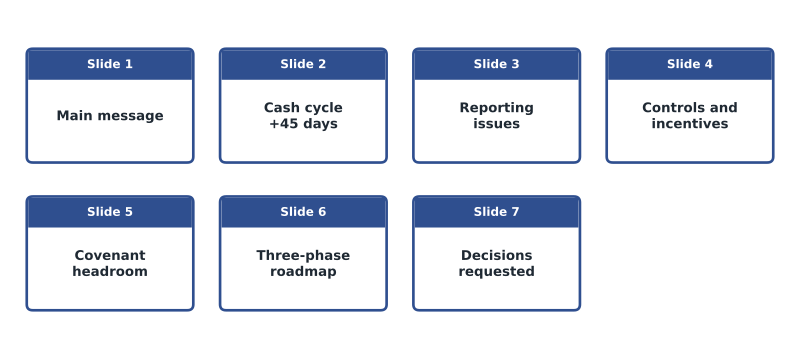
The audit committee has given the team 30 minutes: 15 for the presentation and 15 for questions. That is enough for the main message and four themes, not for every finding. The team plans backwards from what the committee needs to decide: whether to ask management to revisit the 2026 accounting judgments with the auditor, whether to endorse the quick wins, and whether to refer the incentive and platform recommendations to the full board. Every slide must help with one of those decisions.
| Minutes | Content | Presenter |
|---|---|---|
| 0 to 2 | Purpose, scope and the main message | Amara |
| 2 to 5 | Growth is consuming cash: the cash conversion cycle and 22 million tied up | Liam |
| 5 to 8 | Reporting judgments: bill-and-hold, warranty, goodwill, and the effect on profit | Liam and Priya |
| 8 to 10 | Controls and incentives: period-end overrides, access conflicts, measures that reward revenue | Priya and Sofia |
| 10 to 12 | Financing: covenant headroom under realistic accounting | Jonah |
| 12 to 15 | Recommendations and roadmap; decisions requested | Amara |
Slides follow the same principles as the report's exhibits: one message per slide, stated in the title; a chart or a few words, not paragraphs; numbers rounded for speech. The team prepares a short appendix of backup slides for likely questions, such as the goodwill sensitivity table and the covenant calculation, which it shows only if asked. It rehearses twice in front of Professor Adeyemi and once in front of another team, timing each section. Rehearsal is where a presentation is made: the first run-through took 24 minutes, and cutting it to 15 forced the team to decide what really mattered.
Delivering it
Good delivery is mostly preparation. Each presenter knows their section well enough to speak from the slides rather than reading notes, looks at the committee rather than the screen, and hands over cleanly to the next speaker. The team agrees in advance who will answer which kinds of questions, so that five people do not try to answer at once. Amara opens by thanking Ms. Marsh and her staff for their time and access, states the scope and limitations in one sentence, and gives the main message before anything else: "Bluestem's growth is consuming cash and has been reported somewhat optimistically; nine actions in three phases, starting with three quick wins this quarter, would restore profitable, cash-generating growth and protect the company's financing."
Handling questions
Questions are where the committee tests the team's understanding, and they often matter more than the presentation. The team prepares by listing the 20 questions it most expects and drafting short answers. During the session it listens to the whole question, answers briefly and directly, and offers to follow up in writing when it does not know. It does not guess, and it does not become defensive when challenged.
The committee asked six questions. The chair asked whether the team was saying the financial statements were wrong. Liam answered as Lesson 5 prepared him to: "No. We are saying that three judgments look questionable on the evidence we reviewed, that a reasonable alternative view would reduce 2026 profit materially, and that management should revisit them with the auditor, who may have information we did not." A director asked whether the bill-and-hold sale was fraud. Priya answered that the team had found no evidence of intent to deceive, that the arrangement did not meet the accounting criteria and bypassed a control, and that the incentives explained why such arrangements happen. Another director asked how confident the team was in the goodwill number; Liam showed the sensitivity slide and explained the range. The chief executive, attending as a guest, challenged the commission recommendation; Sofia acknowledged the risk of losing sales staff and explained the phased transition. Each answer was short, factual and within the team's role.
After the presentation
The engagement does not end when the meeting does. The team sends the final report within two days, incorporating any factual corrections raised in the meeting, together with the scripts and instructions for the analytics. It confirms the return or destruction of client data. It sends a short thank-you note to each person who helped. And it asks Ms. Marsh for feedback on the engagement, which goes to Professor Adeyemi and forms part of the assessment. In Bluestem's case, the committee asked management to discuss the three judgments with Pellham Vance LLP before the 2026 financial statements were finalized and endorsed the quick wins; the incentive and platform recommendations went to the board's next strategy session.
Peer evaluation
Team projects raise a fairness problem: members contribute unequally, but a single grade rewards them equally. The course addresses it with confidential peer evaluations. Each member rates every other member on contribution, quality, reliability and collaboration, and the ratings adjust each member's share of the team grade within limits. Raters differ in how generous they are, so raw averages are unfair: a member rated by generous colleagues looks better than one rated by harsh ones. The program normalizes each rater's scores before averaging, so that every rater counts equally.
# Lesson 12: normalizing peer evaluations so harsh and generous raters count equally.
import statistics as st
team = ['Amara', 'Liam', 'Priya', 'Jonah', 'Sofia']
scores = {  # rater: scores given to each teammate out of 10 (self excluded)
    'Amara': {'Liam': 9, 'Priya': 9, 'Jonah': 8, 'Sofia': 9},
    'Liam':  {'Amara': 7, 'Priya': 7, 'Jonah': 6, 'Sofia': 7},
    'Priya': {'Amara': 10, 'Liam': 9, 'Jonah': 9, 'Sofia': 10},
    'Jonah': {'Amara': 8, 'Liam': 8, 'Priya': 9, 'Sofia': 6},
    'Sofia': {'Amara': 9, 'Liam': 8, 'Priya': 9, 'Jonah': 7},
}
z = {m: [] for m in team}
for rater, given in scores.items():
    mu, sd = st.mean(given.values()), st.pstdev(given.values()) or 1
    for m, s in given.items(): z[m].append((s - mu) / sd)
raw = {m: st.mean(scores[r][m] for r in scores if m in scores[r]) for m in team}
adj = {m: st.mean(v) for m, v in z.items()}
print(f"{'Member':8}{'Raw mean':>10}{'Normalized':>12}  Grade factor")
for m in team:
    factor = max(0.85, min(1.05, 1 + 0.05 * adj[m]))
    print(f"{m:8}{raw[m]:>10.2f}{adj[m]:>12.2f}  {factor:.2f}")
print("Grade factor = 1 + 0.05 x normalized score, capped between 0.85 and 1.05 (course policy, invented)")Member Raw mean Normalized Grade factor Amara 8.50 0.68 1.03 Liam 8.50 -0.12 0.99 Priya 8.50 0.80 1.04 Jonah 7.50 -1.49 0.93 Sofia 8.00 0.14 1.01 Grade factor = 1 + 0.05 x normalized score, capped between 0.85 and 1.05 (course policy, invented)
The output shows why normalization matters. Liam, Amara and Priya all have raw averages of 8.5, but Liam's ratings came mostly from generous raters, while Amara's and Priya's stood out within each rater's own range. After normalization Liam is slightly below the team average, and Jonah, rated lowest by most colleagues, receives a grade factor of 0.93. The course caps factors between 0.85 and 1.05 so that peer ratings adjust grades without dominating them, and Professor Adeyemi reviews the comments behind any large adjustment. Peer evaluation works best when it is expected from the start, which is why the team charter in Lesson 1 mentioned it, and when members give each other informal feedback during the term, so that the final ratings contain no surprises.
Reflecting
Each student writes a short reflection on the engagement: what went well, what they would do differently, what they learned about themselves as a professional, and what they want to develop next. Reflection is not a formality. Professional bodies require members to plan and record their continuing professional development, and the habit of honest self-assessment starts here. Bluestem's team identified, among other things, that they should have requested the full journal extract in week 2 rather than week 5, that the interim meeting was the most valuable point in the engagement because it let the client correct misunderstandings early, and that writing the report took twice as long as planned even with a generous budget.
Becoming a professional accountant
For students in the United States, the next step is usually the Uniform CPA Examination and licensure through a state board, here the North Carolina State Board of CPA Examiners. As ACCT-480 described, the exam follows the CPA Evolution model with three core sections and one discipline section, and candidates must pass all four within a credit window that NASBA's uniform rules set at 30 months in most jurisdictions. Licensure also requires education and experience; many states adopted an alternative pathway in 2024 to 2026 that allows a bachelor's degree plus two years of experience instead of the traditional 150 semester hours plus one year. Check your state board's current rules, because they vary and have been changing.
Whatever the route, the qualities that made Bluestem's engagement succeed are the qualities employers look for: technical competence across areas, the ability to find the issues that matter, judgment under uncertainty, clear writing, calm presentation, and integrity when a client applies pressure. Your capstone report and presentation are evidence of those qualities. Keep them, with the client's permission and with confidential details removed, as examples for interviews.
Looking back at the program
The accounting program began with the recording of transactions in ACCT-101 and ends with an engagement in which every earlier course played a part. Financial accounting let the team judge revenue, provisions and impairment. Management accounting let it trace margins and design measures. Audit taught it to evaluate controls and evidence. Data analytics let it test whole populations. Tax and finance let it connect accounting judgments to covenants and value. Forensic accounting taught it to recognize red flags without jumping to accusations. And the case courses taught it to integrate all of these into advice a client can use.
The single most important lesson of the capstone may be this: the numbers in financial statements are the result of judgments, processes and incentives, and understanding those three things is what turns an accountant into a trusted adviser. Bluestem's revenue was real, but some of it was early; its warranty provision was calculated, but on an assumption the data did not support; its controls existed, but were bypassed under pressure created by its own incentive system. Seeing those connections, and explaining them fairly and clearly, is the work this program has prepared you to do.
Worked problem
Answering a hostile question
A director says: "You're students. Why should we believe your goodwill number over management's?" How should Liam respond?
Show solution
- Acknowledge the point without defensiveness: the team is a student team and its work is advisory.
- Explain the basis: the team rebuilt the forecast from the current pipeline and recent results and used a rate reflecting the unit's risk; both are documented.
- Show the range: the sensitivity table shows that the conclusion holds across reasonable rates, though the amount varies.
- Return to the recommendation: the team is not asking the committee to accept its number, but to ask management and the auditor to revisit the test.
Answer: Acknowledge the team's role, explain the evidence and range, and restate the recommendation: revisit the judgment with the auditor.
Common mistakes
MistakeTrying to present every finding.
InsteadPlan backwards from the decisions the client must make and present the main message and themes.
MistakeReading slides aloud or writing paragraphs on them.
InsteadUse one message per slide, stated in the title, and speak to the audience.
MistakeGuessing when a question goes beyond the team's knowledge.
InsteadAnswer what you know and offer to follow up in writing.
MistakeAveraging raw peer ratings.
InsteadNormalize for rater generosity and cap the adjustment.
MistakeTreating reflection as a formality.
InsteadWrite honestly about what to repeat, change and develop.
Summary and key terms
- Plan the presentation around the decisions the client must make; rehearse until it fits the time.
- One message per slide, stated in the title, with backup slides for expected questions.
- Answer questions briefly, factually and within the team's advisory role.
- Follow up with the final report, scripts, data confirmation and thanks.
- Normalized peer evaluation adjusts grades fairly for unequal contributions.
- The CPA license follows the Uniform CPA Examination, education and experience, with rules that vary by state.
- Understanding judgments, processes and incentives is what turns an accountant into a trusted adviser.
- Storyboard
- A sketch of a presentation's slides and their messages before the slides are built.
- Backup slide
- A slide prepared to answer a likely question, shown only if needed.
- Peer evaluation
- Confidential ratings by team members of each other's contribution.
- Normalization
- Adjusting ratings so that each rater's scale counts equally.
- Continuing professional development (CPD)
- The ongoing learning professional bodies require members to plan and record.
- Reflection
- A structured, honest review of one's own performance and development.
Practice problems
Work each problem on paper first, then reveal the answer to check.
What three decisions did the presentation aim to support?
Show answer
Revisiting the 2026 judgments with the auditor, endorsing the quick wins, and referring incentive and platform recommendations to the board.
Why plan the presentation backwards from decisions?
Show answer
So every slide helps the committee decide, within the time available.
How did Liam answer whether the financial statements were wrong?
Show answer
Three judgments look questionable, an alternative view would reduce profit materially, and management should revisit them with the auditor.
What should a presenter do when they do not know an answer?
Show answer
Say so, answer what they know, and offer to follow up in writing.
List three follow-up actions after the presentation.
Show answer
Send the final report with corrections, hand over scripts, confirm data return or destruction, send thanks, request feedback.
Why do raw peer averages need normalizing?
Show answer
Raters differ in generosity, so raw averages favor members rated by generous colleagues.
What grade factor did Jonah receive, and why?
Show answer
About 0.93, because most colleagues rated him below their own average.
Why cap peer adjustments between 0.85 and 1.05?
Show answer
So peer ratings adjust grades without dominating them.
What alternative licensure pathway did many states adopt?
Show answer
A bachelor's degree plus two years of experience instead of 150 hours plus one year.
State the capstone's main lesson in one sentence.
Show answer
Financial statements result from judgments, processes and incentives, and understanding them makes an accountant a trusted adviser.
Lesson quiz · 5 questions
Score 60% or more to complete this lesson.
Create a free account to save your progress, take quizzes and earn a certificate.