
ACCT-499 · Lesson 10 of 12 · 26 min
Developing recommendations: prioritization, roadmap, change and sustainability readiness
By week 8 the team has findings in every workstream: revenue timing, the warranty provision and goodwill; weak controls over approvals, access and changes; working capital that consumes cash; a tax position with thin documentation; covenant headroom that would nearly vanish under realistic accounting; and incentives that reward the wrong behavior. Findings alone do not help a client. This lesson is about turning them into recommendations that management can act on: specific, prioritized, sequenced, owned and realistic about cost and resistance. It also covers one area the audit committee asked about specifically, Bluestem's readiness for sustainability reporting.
What makes a good recommendation
A good recommendation answers five questions. What exactly should be done? Who should do it? By when? What will it cost, in money and effort? And how will the client know it worked? "Improve controls over revenue" answers none of them. "Configure the ERP workflow so that no invoice with non-standard payment terms or bill-and-hold status can be issued without finance approval; owner: controller; by the end of the first quarter of 2027; cost: about 40 hours of the ERP partner's time; measure: zero unapproved non-standard invoices in quarterly exception reports" answers all five. The difference is the difference between a report that sits on a shelf and one that changes the business.
Each recommendation should also trace back to a finding, and each significant finding should lead to a recommendation. The team builds a simple matrix with findings as rows and recommendations as columns to check coverage. Two findings, the thin research credit documentation and the outdated transfer pricing study, map to a single recommendation to review tax documentation with advisers. One recommendation, the faster month-end close, addresses findings in three workstreams: the missed cut-off review, the manual journals and the late detection of the warranty problem.
Prioritizing
Bluestem cannot do everything at once, and neither can any client. The team prioritizes its nine recommendations by impact (the size of the risk addressed or value created) and effort (cost, time and disruption), scored from 1 to 5 in a workshop with Ms. Marsh and her controller. The program ranks them and places each in a quadrant.
# Bluestem Water Instruments Inc. (invented), in thousands of dollars, years ended December 31.
YEARS = [2024, 2025, 2026]
IS = {'Hardware revenue': [138000, 149500, 161200], 'Subscription revenue': [44000, 55600, 69800],
      'Hardware cost of sales': [82800, 92700, 104800], 'Subscription cost of sales': [11000, 13300, 16100],
      'Selling, general and admin': [42000, 48500, 56900], 'Research and development': [18200, 21000, 23600],
      'Depreciation': [6200, 6900, 7600], 'Amortization of intangibles': [3000, 4800, 4800],
      'Interest expense': [2100, 3900, 4600], 'Income tax expense': [3300, 2500, 2500]}
BS = {  # balances at December 31, 2023 to 2026
      'Cash': [18000, 24200, 25500, 23400], 'Receivables': [26000, 30000, 39800, 52100],
      'Inventories': [22000, 26000, 31500, 41900], 'Other current assets': [2800, 3000, 3600, 4100],
      'Property, plant and equipment': [45000, 48000, 51000, 53500], 'Right-of-use assets': [13000, 12000, 15500, 14800],
      'Intangible assets': [9000, 6000, 19200, 14400], 'Goodwill': [8000, 8000, 24000, 24000],
      'Payables': [15000, 17000, 19500, 22700], 'Accrued liabilities': [8000, 9000, 10500, 11200],
      'Deferred revenue': [11000, 14000, 18500, 21000], 'Warranty provision': [2300, 2500, 2700, 2600],
      'Income taxes payable': [1200, 1300, 900, 700], 'Lease liabilities': [13500, 13000, 16800, 16300],
      'Borrowings': [28000, 25000, 57000, 60000], 'Deferred tax liabilities': [1800, 2000, 2300, 2700],
      'Share capital': [40000, 40000, 40000, 42000], 'Retained earnings': [23000, 33400, 41900, 49000]}
CF = {'Cash from operations': [20900, 15900, 5800], 'Capital expenditure': [-8000, -8400, -8400],
      'Acquisition of Merrow Lane': [0, -34000, 0], 'Dividends paid': [-3000, -3000, -3000]}
def rev(i): return IS['Hardware revenue'][i] + IS['Subscription revenue'][i]
def cogs(i): return IS['Hardware cost of sales'][i] + IS['Subscription cost of sales'][i]
def ebit(i): return rev(i) - cogs(i) - sum(IS[k][i] for k in ('Selling, general and admin', 'Research and development', 'Depreciation', 'Amortization of intangibles'))
def ni(i): return ebit(i) - IS['Interest expense'][i] - IS['Income tax expense'][i]
ASSETS = ['Cash', 'Receivables', 'Inventories', 'Other current assets', 'Property, plant and equipment', 'Right-of-use assets', 'Intangible assets', 'Goodwill']
CUR_A = ASSETS[:4]
CUR_L = ['Payables', 'Accrued liabilities', 'Deferred revenue', 'Warranty provision', 'Income taxes payable']
LIABS = CUR_L + ['Lease liabilities', 'Borrowings', 'Deferred tax liabilities']
def tot(keys, t): return sum(BS[k][t] for k in keys)

# Lesson 10: prioritizing the team's recommendations by impact and effort (scores 1-5 agreed in workshop).
recs = [('R1 Tighten revenue cut-off and bill-and-hold approval', 5, 2, 1),
        ('R2 Remove conflicting ERP roles and add quarterly access reviews', 5, 2, 1),
        ('R3 Rebuild warranty provision model from claims data', 4, 2, 1),
        ('R4 Collections plan for municipal receivables', 4, 3, 2),
        ('R5 SKU rationalization and obsolete inventory review', 4, 3, 2),
        ('R6 Shift sales incentives toward subscriptions', 4, 4, 3),
        ('R7 Cloud data platform for subscriptions', 5, 5, 3),
        ('R8 Sustainability disclosure readiness project', 3, 3, 2),
        ('R9 Faster month-end close', 3, 3, 2)]
def quad(i, e): return 'quick win' if i >= 4 and e <= 2 else 'major project' if i >= 4 else 'fill-in' if e <= 2 else 'reconsider'
ranked = sorted(recs, key=lambda r: (-(r[1] / r[2]), -r[1]))
print(f"{'Recommendation':66}{'Impact':>7}{'Effort':>7}{'Ratio':>7}  Quadrant      Phase")
for name, i, e, ph in ranked:
print(f"{name:66}{i:>7}{e:>7}{i / e:>7.1f} {quad(i, e):13} {ph}")Recommendation Impact Effort Ratio Quadrant Phase R1 Tighten revenue cut-off and bill-and-hold approval 5 2 2.5 quick win 1 R2 Remove conflicting ERP roles and add quarterly access reviews 5 2 2.5 quick win 1 R3 Rebuild warranty provision model from claims data 4 2 2.0 quick win 1 R4 Collections plan for municipal receivables 4 3 1.3 major project 2 R5 SKU rationalization and obsolete inventory review 4 3 1.3 major project 2 R7 Cloud data platform for subscriptions 5 5 1.0 major project 3 R6 Shift sales incentives toward subscriptions 4 4 1.0 major project 3 R8 Sustainability disclosure readiness project 3 3 1.0 reconsider 2 R9 Faster month-end close 3 3 1.0 reconsider 2
Three recommendations are quick wins: high impact, low effort. Tightening revenue cut-off and bill-and-hold approval, removing conflicting ERP roles, and rebuilding the warranty model can all be done within weeks by the finance team with modest outside help, and together they address the issues most likely to affect the 2027 financial statements. Four are major projects: high impact but demanding. The collections plan and inventory rationalization would release more than 20 million of cash but need changes in sales and operations practices. Shifting sales incentives and building the cloud platform are strategic changes that need board decisions. Two, the sustainability readiness project and the faster close, score lower on impact for now but have deadlines or dependencies that matter, so the team keeps them in the roadmap rather than dropping them.
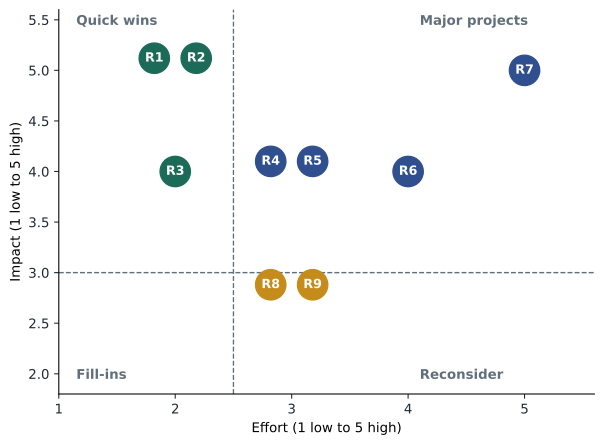
Scoring is a tool for discussion, not a formula. The workshop changed several scores: the controller pointed out that the warranty model needs claims data from a system the operations team owns, which raised its effort, and Ms. Marsh raised the impact of the faster close because the audit committee had complained about late board packs. Recording why scores changed makes the final ranking credible.
Sequencing: the roadmap
Priorities become a roadmap when they are placed in time with dependencies. Bluestem's roadmap has three phases. Phase 1, in the first quarter of 2027, contains the quick wins and the decisions the board must take: approve the accounting adjustments with the auditor, fix approvals and access, rebuild the warranty model, and agree the incentive changes for 2027. Phase 2, through the third quarter, contains the working capital plan of collections and inventory improvements, the faster close and sustainability readiness. Phase 3, from the fourth quarter, contains the first phase of the cloud platform, funded by the cash released in phase 2.
| Phase and timing | Recommendations | Owner | Success measure |
|---|---|---|---|
| 1: Q1 2027 | R1 approval workflow; R2 access cleanup and quarterly reviews; R3 warranty model | Controller; IT manager; operations director | No unapproved non-standard invoices; no role conflicts; warranty estimate reconciled to claims quarterly |
| 1: Q1 2027 | Board decisions on adjustments, incentives and covenant discussion | CFO; compensation committee | Decisions minuted; lender meeting held |
| 2: Q2 to Q3 2027 | R4 collections plan; R5 inventory rationalization; R9 faster close | Credit manager; operations director; controller | DSO below 70 days; inventory days below 110; close in 8 days |
| 2: Q2 to Q3 2027 | R8 sustainability readiness | CFO with operations | Scope 1 and 2 inventory for 2026; gap assessment complete |
| 3: from Q4 2027 | R6 incentive redesign in full; R7 cloud platform phase 1 | CEO; CTO | Pilot tier launched; cash released covers phase 1 |
Dependencies drive the order. The platform depends on cash from working capital, which depends on the collections and inventory work, which depends partly on the incentive changes that remove the pressure to extend terms. The access cleanup must precede reliance on automated controls. Showing these links helps the board see why the team proposes this order rather than starting with the most exciting project.
Costs, benefits and risks
Every recommendation has costs and risks, and the report states them. The collections plan may strain relationships with municipal customers used to paying slowly; the team suggests offering a small early-payment discount and involving account managers rather than sending demands from finance. The incentive changes may cause some sales staff to leave; the team suggests phasing in the cash-based commission over two quarters with a transition guarantee. Booking the accounting adjustments will reduce reported 2026 profit and may affect the share price; the team notes that delaying recognition would make the eventual correction larger and could damage credibility with investors and regulators. Stating these risks shows judgment and makes the recommendations more credible, not less.
Managing change
Recommendations fail more often from resistance than from bad analysis. Kotter's model of change, familiar from management courses, offers practical lessons for a capstone team: create urgency by showing the cost of inaction, which the covenant analysis does vividly; build a guiding coalition, here the chief financial officer, the audit committee chair and the operations director; communicate a clear vision; remove obstacles such as the system that allows overrides; and generate short-term wins, which is exactly what the quick wins are for. The team cannot manage Bluestem's change itself, but it can design its recommendations so that change is easier: early wins, named owners, simple measures and a sequence that builds momentum.
Stakeholders matter too. The sales director will resist the approval workflow and the commission changes. The team meets him before the final report, hears his concerns, and adjusts one recommendation: instead of requiring finance approval for every non-standard term, it proposes pre-approved ranges for common cases, with finance approval only outside them. He still disagrees with paying commission on cash collected, and the report records his view alongside the team's reasoning. Recording dissent honestly is better than pretending to consensus.
Sustainability reporting readiness
The audit committee asked whether Bluestem is ready for sustainability reporting. As a water-monitoring company with customers in the public sector, Bluestem faces growing questions from investors, lenders and customers about its own emissions and climate risks, and some public procurement now asks for supplier emissions data. The regulatory position varies by country and was changing in 2025 and 2026.
In the United States, the SEC adopted a climate disclosure rule in 2024 but stopped defending it in court in March 2025, so there is no federal requirement. California's climate disclosure laws (SB 253 and SB 261) require large companies doing business in the state to report emissions (SB 253, for revenue above 1 billion dollars) and climate-related financial risks (SB 261, above 500 million dollars); the California Air Resources Board set November 10, 2026 for the first SB 253 reports, and SB 261 has been blocked pending appeal. Bluestem is below both thresholds. Its customers, lenders and investors may still ask for emissions data, and the ISSB's IFRS S1 and S2 are used voluntarily by many companies. The team recommends a readiness project rather than full reporting: build a reliable Scope 1 and Scope 2 greenhouse gas inventory for 2026, assess the gaps against IFRS S2, and identify climate-related risks and opportunities, of which Bluestem has many on the opportunity side.
The readiness project is also a controls project. Sustainability data that may one day be assured needs the same disciplines as financial data: defined boundaries, documented methods, reviewed calculations and system controls. Starting now, while the stakes are low, avoids the scramble that companies faced when financial reporting controls were first required. The team suggests the finance team own the project with operations providing data, because finance already knows how to build controlled processes.
Worked problem
Turning a finding into a recommendation
Finding: two former employees still had active ERP accounts six months after leaving. Write a recommendation that answers the five questions.
Show solution
- What: disable the two accounts immediately, and link the ERP termination process to the HR system so that accounts are disabled on the last working day.
- Who: IT manager, with HR providing termination notices.
- When: accounts disabled within one week; process change by the end of the first quarter of 2027.
- Cost: about 20 hours of internal IT time and a small configuration change by the ERP partner.
- Measure: zero active accounts for leavers in the quarterly access review.
Answer: A specific, owned, dated, costed and measurable recommendation tied to the access finding.
Common mistakes
MistakeWriting vague recommendations such as "improve controls".
InsteadSpecify what, who, when, cost and the measure of success.
MistakePresenting recommendations without priorities.
InsteadScore impact and effort with the client and sequence the work.
MistakeIgnoring dependencies between recommendations.
InsteadShow which actions must come first and why.
MistakeHiding the costs and risks of change.
InsteadState them and propose ways to manage them.
MistakePretending everyone agrees.
InsteadRecord significant dissent alongside the team's reasoning.
Summary and key terms
- Good recommendations are specific, owned, dated, costed and measurable, and trace to findings.
- Impact and effort scoring, done with the client, identifies quick wins and major projects.
- A three-phase roadmap sequences quick wins, working capital improvements and the platform.
- State costs, risks and stakeholder views honestly; design for change with early wins.
- There is no federal US climate rule in 2026 and Bluestem is below California's thresholds; a readiness project builds an emissions inventory and gap assessment.
- Treat sustainability data with the same controls as financial data.
- Quick win
- A recommendation with high impact and low effort that can be delivered early.
- Roadmap
- A sequenced plan of recommendations with timing, owners and dependencies.
- Dependency
- A requirement that one action be completed before another can succeed.
- Change management
- Planning and leading the people side of organizational change.
- Scope 1 and Scope 2 emissions
- Direct emissions from owned sources and indirect emissions from purchased energy.
- Gap assessment
- A comparison of current practice with the requirements of a standard.
Practice problems
Work each problem on paper first, then reveal the answer to check.
What five questions should a good recommendation answer?
Show answer
What, who, by when, at what cost, and how success will be measured.
Which three recommendations are quick wins?
Show answer
Revenue cut-off and bill-and-hold approval, removing conflicting ERP roles, and rebuilding the warranty model.
Why does the cloud platform come in phase 3?
Show answer
It depends on cash released by the working capital improvements in phase 2.
How did the workshop change the warranty model's score?
Show answer
Its effort rose because it needs claims data from a system owned by operations.
How did the team respond to the sales director's objections?
Show answer
It adjusted the approval recommendation to use pre-approved ranges and recorded his remaining dissent.
Name two of Kotter's steps that the roadmap uses.
Show answer
Creating urgency and generating short-term wins.
Is Bluestem required to report under California's SB 253 in 2026?
Show answer
No; Bluestem is below the 1-billion-dollar revenue threshold.
What should the sustainability readiness project produce first?
Show answer
A reliable Scope 1 and Scope 2 greenhouse gas inventory for 2026 and a gap assessment.
Why should finance own the sustainability project?
Show answer
Finance knows how to build controlled, reviewable processes that could later be assured.
Why state the risk that booking adjustments may affect the share price?
Show answer
Because honest trade-offs make recommendations credible; delay would make the correction larger.
Lesson quiz · 5 questions
Score 60% or more to complete this lesson.
Create a free account to save your progress, take quizzes and earn a certificate.