
ACCT-421 · Lesson 8 of 12 · 28 min
Pricing II: target costing, life-cycle costing and competitive pricing
Lesson 7 worked from cost and demand toward a price. Target costing reverses the direction: it starts from the price the market will bear and the margin the company requires, and works back to the cost the product must achieve. This lesson develops target costing and the related ideas of value engineering and kaizen costing, then life-cycle costing, which looks at a product's costs and revenues over its whole life rather than one year at a time. It continues with pricing strategies for new and established products, and finishes with the legal and ethical limits on pricing. GrainSense, now priced at 449 dollars, remains the example.
Target costing
Target costing was developed by Japanese manufacturers, notably Toyota, and is now used widely in automotive, electronics and machinery industries. The process has four steps. First, determine the target price from market research and competitors' prices. Second, subtract the target profit margin to arrive at the target cost, the maximum cost at which the product can be made and still earn the required return. Third, estimate the cost of the current design and calculate the gap. Fourth, close the gap through design changes, supplier negotiations and process improvements before production begins. If the gap cannot be closed, the product should be redesigned or abandoned.
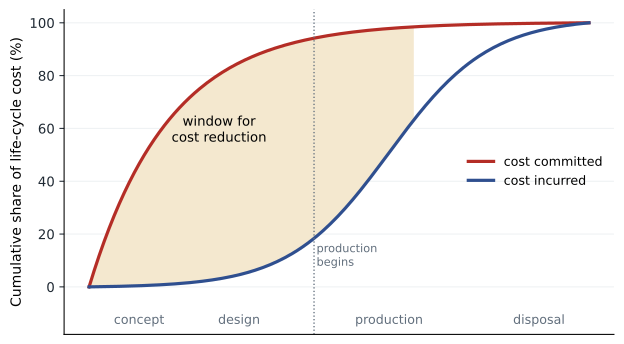
Target costing is fundamentally a design discipline rather than an accounting technique. Studies of product development commonly find that the great majority of a product's life-cycle cost, often quoted as 70 to 90 percent, is committed by decisions made during design, even though most of it is incurred later in production, service and disposal. Once the design is fixed, there is little room left to reduce cost. Target costing puts cost alongside function, quality and timing as a design requirement from the start, and it requires cross-functional teams of engineers, purchasing, production, marketing and accounting staff working together.
Applying target costing to GrainSense
Northgate requires new products to earn a margin of 30 percent of price on full cost, where full cost includes variable cost and the product line's fixed costs spread over planned volume. At a target price of 449 dollars, the target cost is 314.30 dollars. The engineering team's current design costs more.
# Target costing and life-cycle profit for the GrainSense kit (invented data).
target_price, target_margin = 449.0, 0.30
target_cost = target_price * (1 - target_margin)
variable = {'sensor module': 78, 'gateway share': 44, 'housing and cable': 31, 'power pack': 22,
            'assembly': 21, 'cloud service': 18, 'warranty': 12, 'distribution': 12}
fixed_per_kit = 0.62e6 / 5000      # annual product-line fixed costs spread over 5,000 planned kits
current = sum(variable.values()) + fixed_per_kit
print(f"Variable cost {sum(variable.values())} + fixed cost per kit {fixed_per_kit:.0f}")
print(f"Target cost {target_cost:.2f}; current design {current:.2f}; gap {current - target_cost:.2f}")
ideas = {'one-piece housing': 9, 'combined sensor board': 18, 'longer-life battery, no solar': 7,
         'renegotiated cloud contract': 8, 'better sealing, fewer claims': 6}
saved = sum(ideas.values())
print(f"Value engineering ideas save {saved}; revised full cost {current - saved:.2f}; "
      f"{'meets' if current - saved <= target_cost else 'misses'} target")
# life-cycle budget, in dollars, years 0 to 7
units = [0, 2500, 4200, 5200, 5000, 3800, 2000, 0]
rate = 0.10
cash, rows = [], []
unit_cost = sum(variable.values()) - saved   # variable cost per kit after value engineering
for t, q in enumerate(units):
    price = target_price * (0.97 ** max(t - 2, 0))      # price erodes 3% a year from year 3
    ucost = unit_cost * (0.98 ** max(t - 1, 0))         # learning lowers unit cost 2% a year
    upfront = 1.4e6 + 0.5e6 if t == 0 else 0            # design, testing and tooling
    launch = 0.35e6 if t == 1 else 0
    support = 0.28e6 if 1 <= t <= 6 else 0
    retire = 0.15e6 if t == 7 else 0
    cf = q * (price - ucost) - upfront - launch - support - retire
    cash.append(cf)
    rows.append((t, q, price, cf))
for t, q, price, cf in rows:
    print(f"  year {t}: units {q:5d}  price {price:6.1f}  cash flow {cf:12,.0f}")
npv = sum(cf / (1 + rate) ** t for t, cf in enumerate(cash))
print(f"Life-cycle profit (undiscounted): {sum(cash):,.0f}   NPV at 10%: {npv:,.0f}")
pre = 1.9e6
spend = pre + 0.35e6 + 6 * 0.28e6 + 0.15e6 + sum(q * unit_cost for q in units)
print(f"Share of life-cycle costs incurred before launch: {pre / spend:.0%}")Variable cost 238 + fixed cost per kit 124 Target cost 314.30; current design 362.00; gap 47.70 Value engineering ideas save 48; revised full cost 314.00; meets target year 0: units 0 price 449.0 cash flow -1,900,000 year 1: units 2500 price 449.0 cash flow 17,500 year 2: units 4200 price 449.0 cash flow 823,760 year 3: units 5200 price 435.5 cash flow 1,035,881 year 4: units 5000 price 422.5 cash flow 938,188 year 5: units 3800 price 409.8 cash flow 611,253 year 6: units 2000 price 397.5 cash flow 171,503 year 7: units 0 price 385.6 cash flow -150,000 Life-cycle profit (undiscounted): 1,548,085 NPV at 10%: 615,145 Share of life-cycle costs incurred before launch: 23%
The current design costs 362 dollars per kit: 238 dollars of variable cost plus 124 dollars of fixed cost per kit at the planned volume of 5,000 kits a year. The gap to target is 47.70 dollars. The cross-functional team identifies five changes, each tested against function and reliability. A one-piece housing replaces a two-part design with gaskets, saving 9 dollars. Combining the sensor and radio electronics on one board saves 18 dollars. A longer-life battery removes the need for a small solar panel, saving 7 dollars. A renegotiated contract with the cloud hosting provider saves 8 dollars per kit over its life. Better sealing is expected to reduce warranty claims, saving 6 dollars. Together the changes save 48 dollars, bringing full cost to 314 dollars, just under the target.
Two features of the process are worth noting. First, the target is a constraint, not a suggestion: a product whose costs cannot reach target does not proceed to production in its current form. Second, value engineering, the systematic examination of each component's function and cost, looks for savings that do not reduce what customers value. Removing the solar panel was accepted only after field tests showed the new battery lasted at least four seasons; a cheaper but less reliable sensor was rejected because reliability is central to the uptime strategy.
| Technique | When | Focus | Northgate example |
|---|---|---|---|
| Target costing | Before production | Design the product to meet a cost derived from price | GrainSense full cost cut from 362 to 314 dollars |
| Value engineering | Design stage | Remove cost without removing value to customers | One-piece housing; combined sensor board |
| Kaizen costing | During production | Continuous small reductions in production cost | Annual 2% reduction target from learning and process changes |
| Life-cycle costing | Whole life | All costs and revenues from design to disposal | Seven-year GrainSense budget |
Kaizen costing continues the effort after launch. Instead of standard costs that remain fixed for a year, production teams are given targets for continuous, incremental reductions, often a percentage per year. Japanese practice links kaizen costing to the improvement activities of production teams; in Western companies it often appears as annual cost-reduction targets built into budgets and supplier contracts. For GrainSense, the team assumes a 2 percent reduction in variable cost each year after the first from learning effects and process improvements.
Life-cycle costing
Conventional accounting reports a product's profit one year at a time. For products with heavy up-front development costs, rapid technological change or significant end-of-life costs, annual figures can mislead. A product can show losses in its first years and profits later, or profits throughout production followed by large costs for warranty, support or disposal after sales end. Life-cycle costing assembles all of a product's costs and revenues over its life, from research and design to final support and disposal, so that the product can be evaluated as a whole.
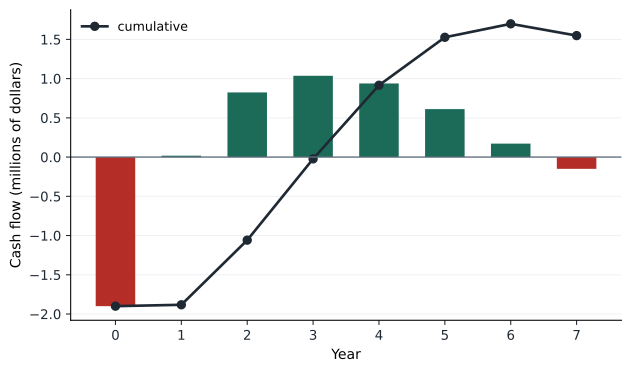
The life-cycle budget in the program covers eight years. In year 0, Northgate spends 1.9 million on design, testing and tooling. Sales begin in year 1 with a launch marketing campaign, rise to 5,200 kits in year 3 and fall as newer technology arrives, ending in year 6. Prices are expected to fall 3 percent a year from year 3 as competitors enter, partly offset by learning in production. Product support runs through year 6, and in year 7 the company pays to support remaining customers' devices and to take back batteries for recycling.
The budget shows a cash outflow of 1.9 million before launch, a small positive cash flow in year 1 after launch costs, strong cash flows in years 2 to 5, and outflows at the end of life. Over the whole life, the product earns about 1.55 million undiscounted, and its NPV at 10 percent is about 0.62 million. That is positive but thin: the product returns its investment with a modest margin. About 23 percent of total life-cycle costs are incurred before the first kit is sold, which illustrates why the design decisions in target costing matter so much: by the time production starts, the main cost drivers are fixed.
Life-cycle costing has practical uses beyond evaluating a single product. It supports decisions about whether to spend more on design to reduce later warranty and support costs. It supports pricing over the product's life, including when to cut prices as the market matures. It helps buyers, too: public sector organizations and many businesses use life-cycle cost, sometimes called total cost of ownership, when choosing between equipment with different purchase prices, operating costs and lives. Northgate's own dealers use a life-cycle comparison when they persuade farmers that a more expensive auger with longer bearing life costs less over ten years than a cheaper import.
Pricing strategies for new products
For a new product, two contrasting strategies are common. Price skimming sets a high initial price to capture the willingness to pay of early adopters, then lowers it over time to reach more price-sensitive customers. It suits products with strong differentiation, limited initial capacity, uncertain costs or high development costs that must be recovered quickly. Penetration pricing sets a low initial price to build market share quickly, deter competitors or reach a large market. It suits products with elastic demand, strong economies of scale or network effects, or where early adoption creates switching costs.
GrainSense has features of both situations. It is differentiated by its integration with Northgate's equipment and service, which favors skimming, but a competitor already sells a simpler product at 449 dollars and the monitoring subscription creates switching costs, which favors penetration. Northgate's choice of 449, close to the profit-maximizing price from lesson 7, is a middle course, with an introductory offer of a free first year of monitoring to encourage early adoption.
| Strategy | Description | Suits |
|---|---|---|
| Skimming | High launch price, lowered over time | Differentiated products, early adopters, limited capacity |
| Penetration | Low launch price to build share | Elastic demand, scale economies, network effects |
| Premium pricing | Price above competitors to signal quality | Strong brands, quality-sensitive buyers |
| Bundling | Several products sold together at one price | Complementary products with varied valuations |
| Price discrimination | Different prices for different segments | Segments with different elasticities that can be kept apart |
| Dynamic pricing | Prices change with demand and supply | Perishable capacity, digital channels |
Bundling and price discrimination
Bundling sells two or more products together at a single price, usually below the sum of the separate prices. It can raise profit when customers value the products differently, because the bundle captures more of the total willingness to pay than separate prices would. Northgate offers an uptime package that bundles a conveyor with a three-year service contract and a GrainSense kit, priced about 8 percent below the separate items. The package increases service contract penetration, one of Northgate's strategic KPIs, and protects equipment sales from the low-cost importer, which cannot offer a comparable service network.
Price discrimination charges different prices to different customers for the same product, based on differences in their willingness to pay. Examples include volume discounts, early-order discounts and different prices in different regions or channels. It works only when segments can be identified and kept separate, so that customers paying low prices cannot resell to those paying high prices. Northgate's early-order program, which gives dealers a discount for orders placed in the autumn for spring delivery, is a form of price discrimination that also smooths production and reduces the pressure on the paint line in spring.
Dynamic pricing and ethics
Dynamic pricing changes prices frequently in response to demand, supply, time or customer characteristics. Airlines, hotels and ride-sharing services use it widely, and algorithmic pricing tools have made it accessible to many sellers. Its ethical and legal risks have grown with it. Charging more during an emergency can be seen as exploitation and is restricted by price-gouging laws in many jurisdictions. Algorithms that set prices using personal data can produce discriminatory outcomes. And when competitors use the same pricing software, regulators have raised concerns that algorithms may facilitate coordination that would be unlawful if done by people.
Northgate does not use dynamic pricing for equipment, but its parts business faces a version of the question every harvest. When a farmer's auger breaks during harvest, demand for a replacement gearbox is extremely inelastic. Northgate's policy is to keep parts prices stable through the season and to publish them, on the view that dealers' and farmers' trust is worth more than the short-run margin, and that exploiting breakdowns would undermine the uptime strategy.
Pricing and competition law
Competition law sets limits on pricing. In the United States, Section 1 of the Sherman Act prohibits agreements in restraint of trade; price fixing between competitors is treated as illegal per se and can be prosecuted criminally. Section 2 prohibits monopolization and attempted monopolization, which can include predatory pricing in limited circumstances. The Robinson-Patman Act restricts price discrimination between competing purchasers of commodities where it may harm competition, and the Federal Trade Commission has revived enforcement of it in recent years. The FTC Act prohibits unfair or deceptive practices, and an FTC rule on unfair or deceptive fees, which took effect in 2025, requires the total price to be shown for live-event tickets and short-term lodging. Many states also have price-gouging laws that apply during declared emergencies.
For Northgate, the practical implications include the following: its dealers set their own resale prices, and Northgate may publish suggested prices but should take legal advice before imposing resale price policies; it must not discuss prices with competitors, including at industry association meetings; and its volume discount schedule must be justified by cost differences or available to competing dealers on equal terms. The FP&A team's pricing analysis is reviewed by legal counsel before major changes.
Worked problem
Target cost from a lower price
If competition forced the GrainSense price down to 420 dollars, with the same 30 percent target margin, what cost reduction would be needed from the revised design?
Show solution
- Target cost = 420 × (1 − 0.30) = 294 dollars.
- Revised full cost after value engineering is 314 dollars.
- Further reduction needed: 314 − 294 = 20 dollars per kit.
Answer: About 20 dollars per kit more, or Northgate must accept a lower margin.
Common mistakes
MistakeSetting a target cost after the design is fixed.
InsteadApply target costing during design, when most costs are committed.
MistakeCutting cost by removing features customers value.
InsteadUse value engineering to remove cost without reducing value.
MistakeJudging a product on its first-year profit.
InsteadUse life-cycle costing to evaluate all costs and revenues over the product's life.
MistakeIgnoring end-of-life costs such as support, recycling and warranty.
InsteadInclude them in the life-cycle budget.
MistakeUsing dynamic or discriminatory pricing without considering trust and law.
InsteadAssess legal limits, fairness and the effect on customer relationships.
MistakeDiscussing prices with competitors at industry events.
InsteadNever discuss prices with competitors; take legal advice on pricing policies.
Summary and key terms
- Target cost equals target price less target margin; GrainSense's target cost is 314.30 dollars.
- Most life-cycle costs are committed during design, so target costing must happen before production.
- Value engineering cut GrainSense's full cost from 362 to 314 dollars without reducing value to customers.
- Kaizen costing sets targets for continuous cost reduction during production.
- Life-cycle costing evaluates a product over its whole life; GrainSense has an NPV of about 0.62 million.
- Skimming and penetration are contrasting launch strategies; bundling and price discrimination capture more value.
- Dynamic pricing raises ethical and legal concerns, especially during emergencies or with personal data.
- Competition law prohibits price fixing between competitors and restricts resale price maintenance and some discrimination.
- Target cost
- The maximum cost at which a product can be made and still earn the required margin at the target price.
- Value engineering
- Systematic review of a product's functions and components to reduce cost without reducing value.
- Kaizen costing
- Continuous, incremental cost reduction during the production phase.
- Life-cycle costing
- Accumulating a product's costs and revenues over its whole life.
- Total cost of ownership
- The full cost to a buyer of acquiring, operating, maintaining and disposing of an asset.
- Price skimming
- Launching at a high price and lowering it over time.
- Penetration pricing
- Launching at a low price to build market share quickly.
- Bundling
- Selling two or more products together at a single price.
- Price maintenance
- A supplier's attempt to influence a reseller's price upward or discourage price reductions.
Practice problems
Work each problem on paper first, then reveal the answer to check.
What is GrainSense's target cost at a price of 449 and a 30% margin?
Show answer
314.30 dollars.
What was the gap between the current design and the target cost?
Show answer
47.70 dollars per kit.
Name two of the value engineering changes and their savings.
Show answer
Combined sensor board (18 dollars) and one-piece housing (9 dollars), among others.
Why was a cheaper but less reliable sensor rejected?
Show answer
Reliability is central to the uptime strategy; value engineering should not remove value.
What is GrainSense's life-cycle NPV at 10%?
Show answer
About 0.62 million.
Change the price erosion in the program from 3% to 6% a year. What happens to NPV?
Show answer
It falls substantially, because later years' margins shrink.
What share of life-cycle costs is incurred before launch?
Show answer
About 23%.
When does penetration pricing make most sense?
Show answer
When demand is elastic, there are scale economies or network effects, or early adoption creates switching costs.
Why does Northgate keep parts prices stable during harvest?
Show answer
To protect trust with dealers and farmers and support the uptime strategy.
Give one pricing practice competition law prohibits.
Show answer
Agreeing prices with competitors.
Lesson quiz · 5 questions
Score 60% or more to complete this lesson.
Create a free account to save your progress, take quizzes and earn a certificate.