
ACCT-421 · Lesson 4 of 12 · 28 min
Constrained decisions: product mix, theory of constraints and throughput accounting
Lesson 3 showed that the opportunity cost of scarce capacity can reverse a decision. This lesson looks more closely at what happens when capacity is scarce. It begins with two common product decisions, whether to keep or drop a product line and whether to sell a product as it is or process it further, and then turns to the central problem of product mix under a binding constraint. It introduces the theory of constraints, developed by Eliyahu Goldratt, and throughput accounting, a management accounting approach built around it. At Northgate, the paint line is the bottleneck that limits how many augers, conveyors and bin sweeps the Farm Systems plant can ship in the spring peak, and the analysis in this lesson leads to the capital proposal for a second paint booth.
Keeping or dropping a product line
Product lines and segments that report losses are often candidates for elimination. The relevant question is not whether the segment reports a loss after allocated costs, but whether the organization would be better off without it. That depends on the contribution the segment earns, the fixed costs that would actually be avoided if it were dropped, and any effects on other products, such as customers who buy a complete range from one supplier.
Northgate's Farm Systems division sells a small line of grain cleaners that reported a loss of 180,000 dollars in fiscal 2026 after allocated plant and selling overhead. The line earned contribution of 460,000 dollars. Of the 640,000 dollars of fixed costs charged to it, only 210,000 dollars would be avoided if it were dropped: a product manager, a dedicated test rig lease and specific advertising. Dropping the line would therefore reduce company profit by 250,000 dollars, the contribution lost less the fixed costs avoided. In addition, several large dealers buy cleaners together with augers, so some auger sales might be lost too. The line stays, but the team notes that if the plant were short of capacity that the cleaners use, the conclusion could change, because then the cleaners would be displacing more profitable work.
Sell or process further
Some products can be sold at an intermediate stage or processed further into a more valuable product. The rule is simple: process further if the incremental revenue exceeds the incremental cost of further processing. Costs incurred before the split-off point are irrelevant, because they are incurred either way. ACCT-222 applied the same rule to joint products, where the allocation of joint costs is irrelevant to the further-processing decision.
Industrial Drives sells bare gearboxes to equipment makers for 780 dollars each, but could fit a motor, controls and guard to sell a complete drive unit for 1,640 dollars. Fitting costs 610 dollars in parts and 140 dollars in assembly time per unit. The incremental revenue of 860 dollars exceeds the incremental cost of 750 dollars, so further processing adds 110 dollars a unit, provided assembly capacity is available. If assembly time is scarce, the comparison has to include what else that time could produce, which brings us to the general problem of scarce resources.
Product mix with one binding constraint
When a single resource limits output and demand exceeds what that resource can supply, the organization must choose which products to make. The rule is to rank products by contribution per unit of the scarce resource, not by contribution per unit of product, and to make products in that order until the resource is used up. Ranking by contribution per unit ignores how much of the scarce resource each product consumes.
Northgate's paint line has 5,200 hours available in the coming year. Every auger, conveyor and bin sweep must pass through it, and full dealer demand for the three products would need 6,400 hours. Grace compares the two ranking rules.
# Constrained product mix: the paint line is Northgate's bottleneck (invented data).
paint_hours = 5200                      # paint line hours available next year
products = {
    #             price, material, other variable, paint hrs/unit, max demand
    'Auger A10':   (4200, 1720, 890, 2.0, 1400),
    'Conveyor C8': (6900, 2950, 1250, 4.0, 520),
    'Bin sweep S3': (2600, 980, 560, 0.8, 1900),
}
rows = []
for name, (p, mat, var, h, dem) in products.items():
    cm = p - mat - var                  # contribution margin per unit
    tp = p - mat                        # throughput per unit (price less materials)
    rows.append((name, cm, cm / h, tp, tp / h, h, dem))
print(f"{'product':13s} {'CM/unit':>8s} {'CM/hour':>8s} {'TP/hour':>8s} {'demand':>7s}")
for r in rows:
    print(f"{r[0]:13s} {r[1]:8,.0f} {r[2]:8,.0f} {r[4]:8,.0f} {r[6]:7d}")
print(f"Paint hours needed for full demand: {sum(r[5] * r[6] for r in rows):,.0f} (available {paint_hours:,})")

def plan(key):
    left, total, mix = paint_hours, 0.0, {}
    for r in sorted(rows, key=key, reverse=True):
        q = min(r[6], int(left // r[5]))
        mix[r[0]] = q; left -= q * r[5]; total += q * r[1]
    return mix, total

for label, key in [('CM per unit', lambda r: r[1]), ('CM per paint hour', lambda r: r[2])]:
    mix, total = plan(key)
    print(f"Rank by {label:18s}: {mix}  contribution {total:,.0f}")
# throughput accounting ratio for the whole factory
factory_cost = 6.9e6                    # all operating costs except materials, treated as fixed
mix, _ = plan(lambda r: r[2])
throughput = sum(mix[r[0]] * r[3] for r in rows)
print(f"Throughput {throughput:,.0f}; TA ratio = throughput per hour / factory cost per hour "
f"= {throughput / factory_cost:.2f}")product CM/unit CM/hour TP/hour demand
Auger A10 1,590 795 1,240 1400
Conveyor C8 2,700 675 988 520
Bin sweep S3 1,060 1,325 2,025 1900
Paint hours needed for full demand: 6,400 (available 5,200)
Rank by CM per unit : {'Conveyor C8': 520, 'Auger A10': 1400, 'Bin sweep S3': 399} contribution 4,052,940
Rank by CM per paint hour : {'Bin sweep S3': 1900, 'Auger A10': 1400, 'Conveyor C8': 220} contribution 4,834,000
Throughput 7,419,000; TA ratio = throughput per hour / factory cost per hour = 1.08Ranked by contribution per unit, the conveyor looks best at 2,700 dollars a unit, and making all 520 conveyors and 1,400 augers leaves room for only 399 bin sweeps. Total contribution is about 4.05 million. Ranked by contribution per paint hour, the bin sweep is best at 1,325 dollars an hour, because it needs only 0.8 hours of paint; the auger is second at 795 dollars an hour, and the conveyor is last at 675 dollars an hour, because it needs 4 hours. Making all the demand for bin sweeps and augers and using the remaining hours for 220 conveyors gives contribution of about 4.83 million, almost 800,000 dollars more from the same paint line.
The difference is large because the products use very different amounts of the scarce resource. Each conveyor displaces five bin sweeps on the paint line; its contribution of 2,700 dollars is less than the 5,300 dollars those bin sweeps would earn. The analysis also explains a puzzle the sales team had raised: why did the plant seem to resist large conveyor orders in spring? Supervisors were responding, imperfectly, to the constraint, without anyone having quantified it.
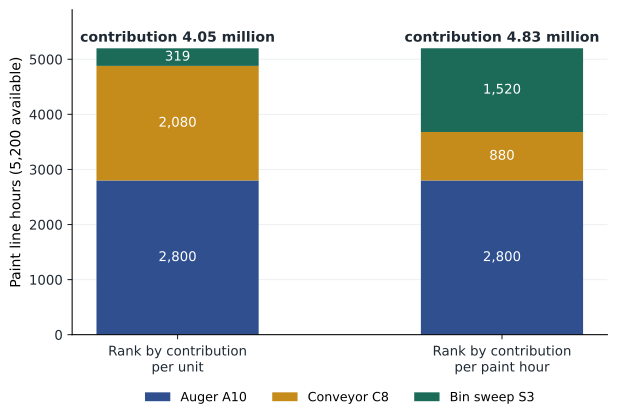
In practice, the ranking is only the start. Northgate cannot simply refuse to supply most of the conveyors dealers want, because dealers who cannot get conveyors may buy their whole line from a competitor. The team uses the ranking to set the default mix, then adjusts for strategic commitments, which lesson 5 handles formally with minimum quantities in a linear program. The more important insight is that the constraint is worth a great deal: every extra paint hour in the spring is worth about 675 dollars, the contribution per hour of the marginal product, the conveyor.
The theory of constraints
Goldratt's theory of constraints, set out in his 1984 business novel The Goal, starts from the observation that every system's output is limited by at least one constraint, and that improving anything other than the constraint does not increase output. An hour lost at the bottleneck is an hour lost for the whole system; an hour saved at a non-bottleneck is a mirage. Goldratt proposed five focusing steps.
| Step | Meaning | Northgate paint line |
|---|---|---|
| 1. Identify the constraint | Find the resource that limits throughput | Paint line: 6,400 hours of demand for 5,200 available |
| 2. Exploit the constraint | Get the most from it without major spending | Rank products by throughput per paint hour; avoid idle time at shift changes; inspect before painting, not after |
| 3. Subordinate everything else | Pace other operations to the constraint | Release welding jobs only as the paint line needs them; keep a buffer of parts ready to paint |
| 4. Elevate the constraint | Add capacity if it is still binding | Second paint booth, overtime, or outsource painting of some parts |
| 5. Repeat | Find the next constraint and avoid inertia | After a second booth, steel supply or welding may bind |
Step 2 is easy to overlook because it costs little. At Northgate, the paint line lost about 40 minutes a shift to color changes and to rework of parts that were found to be defective only after painting. Sequencing jobs by color and moving weld inspection ahead of the paint line recovered roughly 300 hours a year, worth about 200,000 dollars at the marginal contribution per hour, for almost no spending. Step 3 is counter-intuitive: it means deliberately letting non-bottleneck operations such as welding sit idle at times, because producing ahead of the paint line only builds inventory. A welding supervisor measured on utilization will dislike this, which is one reason the theory of constraints challenges traditional cost accounting measures.
Goldratt's scheduling method, called drum-buffer-rope, follows from the same logic. The constraint is the drum that sets the pace for the whole plant. A time buffer of work waiting in front of it protects it from disruptions upstream, so that it never starves. The rope is a signal that releases raw materials into the process only at the rate the drum consumes them. The method limits work in progress and inventory, which also improves capital turnover, one of the drivers in lesson 1's value tree.
Throughput accounting
Throughput accounting, developed from the theory of constraints, simplifies the classification of costs into three groups. Throughput is sales revenue less totally variable costs, which in most manufacturing settings means materials only. Operating expense is every other cost of running the business, including direct labor, which throughput accounting treats as fixed in the short run. Investment, sometimes called inventory, is the money tied up in assets. The goal is to raise throughput while holding operating expense and investment steady or reducing them.
Products are ranked by throughput per hour of the bottleneck, which in Northgate's case gives the same order as contribution per paint hour: bin sweeps first, then augers, then conveyors. The throughput accounting ratio compares the throughput earned per hour with the factory costs incurred per hour. A ratio above one means the products are earning more than the cost of running the factory; below one, the factory loses money on its products. For the paint line products, Northgate's ratio is 1.08 on the optimal mix, which is positive but thin, and is one reason the team takes the second paint booth seriously.
| Feature | Conventional contribution analysis | Throughput accounting |
|---|---|---|
| Variable costs | Materials, direct labor, variable overhead | Materials only |
| Direct labor | Variable | Part of operating expense, treated as fixed |
| Inventory | Asset valued at production cost | Investment; building it is not a gain |
| Key ratio | Contribution per unit of scarce resource | Throughput per bottleneck hour; TA ratio |
| Best use | Short-term decisions with genuinely variable labor | Short-term decisions in bottleneck-dominated plants |
Throughput accounting has critics. Treating labor as fixed is reasonable over weeks or months at a plant with a stable workforce, but less so over longer periods or where temporary staff are used. Focusing on short-run throughput can neglect long-run product costs, which lesson 8's life-cycle costing addresses. And ranking by throughput per bottleneck hour can mislead if the bottleneck moves, which lesson 5 shows can happen quickly. Its great strength is focus: it directs management attention to the constraint and to the money tied up in inventory, both of which conventional absorption costing tends to obscure.
Absorption costing and the inventory trap
Under absorption costing, fixed production overhead is included in inventory values. Producing more units than are sold moves some of the period's fixed overhead into the balance sheet, which raises reported profit even though nothing has been sold. A plant manager evaluated on absorption-cost profit therefore has an incentive to overproduce, especially at non-bottleneck operations, which is exactly what the theory of constraints warns against. ACCT-222 showed the arithmetic of absorption and variable costing; the point here is behavioral. Northgate's welding area was rewarded for high utilization and produced well ahead of the paint line, filling the plant with partly finished frames. Cutting this work in progress by aligning welding with the paint line released about 1.8 million dollars of inventory, part of the inventory reduction in the capstone's ROCE bridge.
Worked problem
Value of an extra paint hour
Northgate can rent a mobile paint booth for the spring that adds 200 paint hours at a cost of 90,000 dollars. Is it worthwhile?
Show solution
- The marginal product on the paint line is the conveyor, which earns 675 dollars of contribution per paint hour.
- 200 extra hours would allow 50 more conveyors: 200 ÷ 4.
- Extra contribution: 200 × 675 = 135,000 dollars.
- Net gain: 135,000 − 90,000 = 45,000 dollars, assuming dealers want the extra conveyors and no other resource becomes binding.
Answer: Yes, it adds about 45,000 dollars, but lesson 5 shows the assumption about other resources needs checking.
Common mistakes
MistakeDropping a product line because it reports a loss after allocated costs.
InsteadCompare the contribution lost with the fixed costs actually avoided and the effects on other sales.
MistakeIncluding pre-split-off costs in a further-processing decision.
InsteadCompare only incremental revenue with incremental processing cost.
MistakeRanking products by contribution per unit when a resource is scarce.
InsteadRank by contribution or throughput per unit of the scarce resource.
MistakeImproving efficiency at non-bottleneck operations to raise output.
InsteadFocus on the constraint; producing ahead of it only builds inventory.
MistakeRewarding non-bottleneck areas for high utilization.
InsteadMeasure them on supporting the constraint and on inventory levels.
MistakeAssuming the bottleneck stays in the same place after it is relieved.
InsteadRepeat the analysis; the constraint may move to another resource.
Summary and key terms
- Keep a product line if its contribution exceeds the fixed costs that dropping it would avoid, allowing for effects on other sales.
- Process further if incremental revenue exceeds incremental processing cost; pre-split-off costs are irrelevant.
- With one binding constraint, rank products by contribution per unit of the scarce resource.
- At Northgate, ranking by contribution per paint hour adds about 0.8 million of contribution over ranking by contribution per unit.
- The theory of constraints applies five focusing steps: identify, exploit, subordinate, elevate and repeat.
- Drum-buffer-rope scheduling paces the plant to the constraint and limits work in progress.
- Throughput accounting treats only materials as variable and ranks products by throughput per bottleneck hour.
- Absorption costing can reward overproduction at non-bottlenecks, building inventory without adding value.
- Binding constraint
- A resource whose limited capacity restricts total output or profit.
- Contribution per limiting factor
- Contribution earned per unit of a scarce resource used.
- Theory of constraints
- A management approach that focuses improvement on the resource limiting system output.
- Five focusing steps
- Identify, exploit, subordinate to, elevate and then re-examine the constraint.
- Drum-buffer-rope
- A scheduling method in which the constraint sets the pace, a buffer protects it and work is released at its rate.
- Throughput
- Sales revenue less totally variable costs, usually materials.
- Throughput accounting ratio
- Throughput per factory hour divided by factory cost per factory hour.
- Split-off point
- The stage at which joint or intermediate products can be sold or processed further.
Practice problems
Work each problem on paper first, then reveal the answer to check.
Why does dropping the grain cleaner line reduce profit?
Show answer
It loses 460,000 of contribution but avoids only 210,000 of fixed costs.
Should Industrial Drives sell bare gearboxes or complete drive units, assuming spare assembly capacity?
Show answer
Complete drive units, which add 110 dollars of contribution per unit.
Which product earns the most contribution per paint hour?
Show answer
The bin sweep, at about 1,325 dollars an hour.
How many bin sweeps does one conveyor displace on the paint line?
Show answer
Five: 4.0 hours divided by 0.8 hours.
Change paint hours in the program to 6,400. What mix is produced?
Show answer
Full demand for all three products: 1,400 augers, 520 conveyors and 1,900 bin sweeps.
What is step 3 of the five focusing steps, and why is it uncomfortable?
Show answer
Subordinate everything else to the constraint; it means letting non-bottlenecks sit idle at times.
What does throughput accounting treat as variable cost?
Show answer
Materials only, or more generally totally variable costs.
What does a TA ratio below 1 indicate?
Show answer
Products are not earning enough throughput to cover factory costs.
How can absorption costing encourage overproduction?
Show answer
Producing more than is sold defers fixed overhead into inventory, raising reported profit.
What is the value of an extra paint hour at the optimal mix?
Show answer
About 675 dollars, the contribution per hour of the conveyor.
Lesson quiz · 5 questions
Score 60% or more to complete this lesson.
Create a free account to save your progress, take quizzes and earn a certificate.