
ACCT-222 · Lesson 6 of 12 · 25 min
Support department and other cost allocations
Every organization has departments that do not make products themselves but support those that do. At Halden, the maintenance department keeps the casting and machining equipment running, and the information technology (IT) department runs the enterprise resource planning (ERP) system, the plant network and the shop-floor terminals. Their costs are real costs of making pumps, so for inventory valuation and for full-cost pricing they must eventually reach the products. The question this lesson addresses is how: by which route, at which rates, and with what consequences for the managers who use and supply the services. The lesson also covers allocating costs shared by two divisions, and the special rules that apply when costs are recovered under government contracts.
Why allocate support costs at all?
Allocations serve four purposes, and the best method depends on which one matters most. First, they support economic decisions, such as whether to outsource maintenance or whether a product's price covers its full cost. Second, they motivate managers: charging production departments for the maintenance they use encourages them to use it wisely and gives the maintenance manager an incentive to control costs. Third, they are required to measure inventory and cost of goods sold for financial reporting, because support costs inside the factory are manufacturing overhead. Fourth, they determine reimbursement and prices under cost-based contracts, where the customer pays cost plus a fee and the allocation directly changes revenue.
Good allocation bases share a common feature: they reflect cause and effect, or at least benefits received. Maintenance costs are driven by maintenance hours or by the size and complexity of the equipment served; IT costs are driven by users, transactions or computing capacity. When no cause-and-effect base exists, fairness or ability to bear are sometimes used, but these are weaker justifications and can distort decisions.
Halden's support and production departments
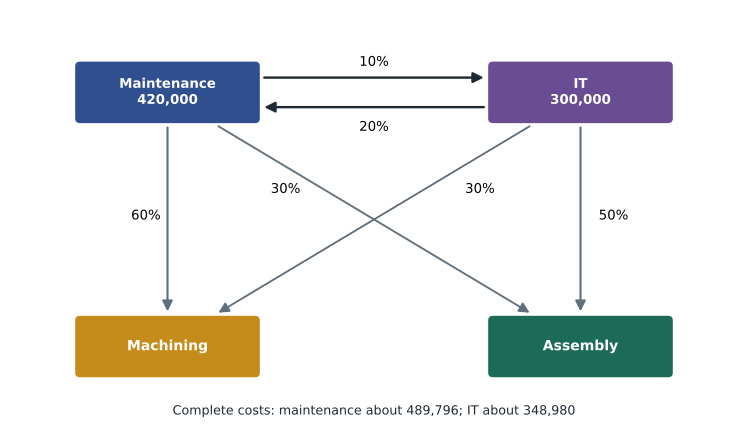
Halden's manufacturing division has two support departments (maintenance and IT) and two production departments (machining and assembly). Each support department serves the other as well as the production departments: maintenance services the server room cooling and the shop-floor terminals' power supplies, and IT supports the maintenance department's work-order system.
| Maintenance | IT | Machining | Assembly | Total | |
|---|---|---|---|---|---|
| Direct department costs | $420,000 | $300,000 | $780,000 | $450,000 | $1,950,000 |
| Share of maintenance hours used | — | 10% | 60% | 30% | 100% |
| Share of IT support tickets used | 20% | — | 30% | 50% | 100% |
There are three standard methods for allocating support department costs to production departments: the direct method, the step-down (sequential) method and the reciprocal method. They differ only in how they treat the services that support departments provide to each other.
The direct method
The direct method ignores services between support departments and allocates each support department's cost only to the production departments, in proportion to their use. Maintenance's $420,000 is split between machining and assembly in the ratio 60:30, that is two-thirds and one-third. IT's $300,000 is split 30:50, that is three-eighths and five-eighths. The method is simple and widely used, but it ignores the fact that maintenance uses 20 percent of IT's effort, so maintenance's true cost is understated.
The step-down method
The step-down method recognizes some services between support departments. It allocates support departments one at a time, in a chosen sequence; once a department's costs have been allocated, it receives no further allocations. A common rule is to start with the support department that provides the largest percentage of its services to other support departments. IT provides 20 percent of its services to maintenance, while maintenance provides 10 percent to IT, so IT goes first. IT's $300,000 is allocated 20:30:50 to maintenance, machining and assembly. Maintenance then has $420,000 + $60,000 = $480,000 to allocate, which goes only to the production departments in the ratio 60:30, because IT has already been closed out.
The sequence matters. Starting with maintenance would give different results, and there is no single correct order, which is one reason accountants prefer the reciprocal method when the support departments serve each other heavily.
The reciprocal method
The reciprocal method fully recognizes the services support departments provide to each other. It does so by computing each support department's complete reciprocated cost: its own direct cost plus its share of the other support department's complete cost. For Halden, that gives two simultaneous equations, where M and T stand for the complete reciprocated costs of maintenance and IT:
Substituting the second equation into the first gives M = 420,000 + 0.20(300,000 + 0.10M) = 480,000 + 0.02M, so M = 480,000 ÷ 0.98 ≈ $489,796 and T ≈ $348,980. These complete costs exceed the departments' direct costs because they include services received from each other. Each complete cost is then allocated to all departments that use the service, including the other support department, using the full percentages. The amounts allocated to the production departments always total the $720,000 of support costs, because the internal flows between support departments cancel out.
# Support department allocations: direct, step-down and reciprocal (illustrative)
import numpy as np
maint, it = 420_000, 300_000
# shares of each support department's services: (to other support, machining, assembly)
m_use = {"IT": 0.10, "Machining": 0.60, "Assembly": 0.30}
t_use = {"Maint": 0.20, "Machining": 0.30, "Assembly": 0.50}

def show(label, mach, assy):
    print(f"{label:<11} machining {mach:>9,.0f}  assembly {assy:>9,.0f}  total {mach + assy:,.0f}")

# Direct method
show("Direct", maint * 0.60 / 0.90 + it * 0.30 / 0.80,
               maint * 0.30 / 0.90 + it * 0.50 / 0.80)

# Step-down: IT first (it serves the other support department more)
to_maint = it * 0.20
m_total = maint + to_maint
show("Step-down", it * 0.30 + m_total * 0.60 / 0.90,
                  it * 0.50 + m_total * 0.30 / 0.90)

# Reciprocal: solve M = 420,000 + 0.2T and T = 300,000 + 0.1M
A = np.array([[1.0, -0.20], [-0.10, 1.0]])
M, T = np.linalg.solve(A, np.array([maint, it]))
print(f"Complete reciprocated costs: maintenance {M:,.0f}, IT {T:,.0f}")
show("Reciprocal", M * 0.60 + T * 0.30, M * 0.30 + T * 0.50)Direct machining 392,500 assembly 327,500 total 720,000 Step-down machining 410,000 assembly 310,000 total 720,000 Complete reciprocated costs: maintenance 489,796, IT 348,980 Reciprocal machining 398,571 assembly 321,429 total 720,000
| Method | Allocated to machining | Allocated to assembly | Total allocated |
|---|---|---|---|
| Direct | $392,500 | $327,500 | $720,000 |
| Step-down (IT first) | $410,000 | $310,000 | $720,000 |
| Reciprocal | $398,571 | $321,429 | $720,000 |
In this example the three methods differ by less than $20,000 in each department, because the services between support departments are modest. When support departments serve each other heavily, as in hospitals and universities with many interlinked service units, the differences can be large, and the reciprocal method gives the most defensible answer. Spreadsheets and matrix algebra make it no harder to compute than the other two methods, even with many departments.
Using the complete reciprocated cost for decisions
The complete reciprocated cost is not the cost Halden would save by outsourcing a support department. Suppose an outside firm offers to provide all of Halden's maintenance for $450,000 a year, which is less than the complete reciprocated cost of about $489,796. If Halden closed its maintenance department, it would save maintenance's direct costs of $420,000 (if all are avoidable), plus the IT services maintenance consumed that IT could then stop supplying: 20 percent of IT's variable costs. But it would still need maintenance for IT's equipment, which the outside firm would supply as part of the contract. The relevant comparison is the outside price against the costs actually avoided, which is usually less than the complete reciprocated cost. Allocations are tools for measuring costs, not substitutes for relevant-cost analysis.
Single-rate and dual-rate allocation
Support department costs have fixed and variable parts, and charging them with one combined rate can send misleading signals. Under a single-rate method, all costs are pooled and charged at one rate per unit of service actually used. Under a dual-rate method, variable costs are charged at a rate per unit of actual use, while fixed costs are charged according to the capacity each user department requested when the department was sized, regardless of how much it uses in a particular period.
Halden's maintenance department has $300,000 of fixed costs (salaried technicians, tools, the workshop) and $120,000 of variable costs (parts and overtime), based on 6,000 budgeted maintenance hours. The department was sized to provide 4,200 hours a year to machining and 1,800 to assembly. In the year, machining actually used 3,600 hours and assembly 2,400.
# Single-rate versus dual-rate allocation of maintenance (illustrative)
fixed, variable_budget, budget_hours = 300_000, 120_000, 6_000
var_rate = variable_budget / budget_hours                  # $20 per hour
capacity = {"Machining": 4_200, "Assembly": 1_800}       # long-run requested hours
used = {"Machining": 3_600, "Assembly": 2_400}           # actual hours used

single_rate = (fixed + variable_budget) / budget_hours     # $70 per hour
print(f"Single rate ${single_rate:.2f} per hour; variable rate ${var_rate:.2f}")
for d in used:
    single = single_rate * used[d]
    dual = var_rate * used[d] + fixed * capacity[d] / sum(capacity.values())
print(f"{d:<10} single-rate {single:>9,.0f} dual-rate {dual:>9,.0f}")Single rate $70.00 per hour; variable rate $20.00 Machining single-rate 252,000 dual-rate 282,000 Assembly single-rate 168,000 dual-rate 138,000
Under the single rate of $70 an hour, assembly's charge rises sharply when it uses more hours and machining's falls, even though the department's fixed costs are the same. Under the dual rate, each department bears the fixed cost of the capacity it asked for ($210,000 for machining and $90,000 for assembly) plus $20 for each hour it actually uses. The dual rate gives better signals: departments cannot escape fixed costs by using less service in a given year, which discourages them from under-forecasting their needs to keep the department small and then complaining about slow response; and it shows that an extra hour of maintenance costs only $20 in the short run, not $70.
Budgeted versus actual rates
A second design choice is whether to charge users at budgeted or actual rates. Charging budgeted rates, set before the year begins, lets user departments plan their costs and protects them from the supplier's inefficiency: if maintenance overspends, the overrun stays in maintenance, where its manager is accountable. Charging actual rates passes the supplier's inefficiencies through to users, who cannot control them. Most companies therefore charge budgeted rates for planning and control, and dispose of any under- or over-recovered amount at year-end, much as underapplied overhead is closed out.
Budgeted quantities matter too. If fixed costs are charged on actual usage, one department's usage affects the charge to every other department: when machining uses less maintenance, assembly's share of fixed cost rises even though assembly did nothing differently. Charging fixed costs on budgeted or capacity quantities, as in the dual-rate method, removes this interdependence.
Allocating common costs between divisions
Some costs are shared by two or more users rather than flowing through a support department. Halden's ERP license and hosting cost $240,000 a year and are used by both the manufacturing division and Halden Service. If each division had bought a system on its own, manufacturing would have paid about $200,000 and Service about $100,000. Two common methods split the shared cost:
- The stand-alone method allocates in proportion to each user's stand-alone cost: manufacturing bears 200 ÷ 300 × $240,000 = $160,000 and Service bears $80,000. Each user shares the $60,000 saving in proportion to its stand-alone cost.
- The incremental method ranks the users. The primary user bears its full stand-alone cost, and the others bear only the extra cost their participation causes. If manufacturing is primary, it bears $200,000 and Service bears $40,000; if Service is primary, it bears $100,000 and manufacturing $140,000.
The stand-alone method is generally seen as fairer and is less contentious, because the incremental method gives the whole saving to the lower-ranked users and invites each division to argue that it should be the incremental one. Some organizations use the Shapley value, which averages each user's incremental cost over all possible rankings; with two users, it gives manufacturing ($200,000 + $140,000) ÷ 2 = $170,000 and Service ($40,000 + $100,000) ÷ 2 = $70,000.
Allocations in government contracts
When Halden sells pumps to a government agency under a cost-reimbursable contract, the allocation rules are set by the contract and by regulation, and auditors check them. The principles are similar on both sides of the border: costs must be reasonable, allocable to the contract in proportion to the benefit it receives, and not expressly unallowable. The details differ.
For US federal contracts, Federal Acquisition Regulation (FAR) Part 31 defines allowable costs as those that are reasonable, allocable, consistent with the Cost Accounting Standards (CAS) where they apply, and not expressly unallowable; FAR 31.205 lists many specific cost items, such as entertainment, fines and most interest. The CAS go further and prescribe how costs must be measured, assigned to periods and allocated, and require large contractors to file a Disclosure Statement describing their practices. The CAS Board finalized major changes effective 1 October 2026: the basic CAS threshold rose from $2.5 million to $35 million, the threshold for full coverage and Disclosure Statements doubled from $50 million to $100 million, and most of CAS 407 (standard costs) was rescinded because it duplicated GAAP and CAS 401. Contractors should check which version of the rules their contracts incorporate.
Cost-based contracts create a temptation to shift costs. If Halden has both fixed-price commercial work and cost-reimbursable government work, every dollar of overhead allocated to the government contract is reimbursed, while every dollar allocated to commercial work comes out of Halden's margin. Choosing allocation bases, or changing them mid-year, to load costs onto cost-reimbursable work is not only an ethical breach but can lead to repayment, penalties and, in serious cases, fraud charges. Consistent, documented allocation practices are the best protection for both the contractor and the customer.
Common mistakes
MistakeUsing the direct method when support departments serve each other heavily.
InsteadUse the reciprocal method, which recognizes all services between support departments.
MistakeTreating the complete reciprocated cost as the saving from outsourcing.
InsteadCompare the outside price with the costs actually avoided.
MistakeCharging fixed support costs on actual usage.
InsteadCharge fixed costs on budgeted or capacity quantities so one department's usage does not change another's charge.
MistakeCharging users at actual rates that include the supplier's inefficiency.
InsteadUse budgeted rates so the supplier manager stays accountable for overruns.
MistakeChanging allocation bases to shift overhead onto cost-reimbursable contracts.
InsteadApply consistent, documented bases; contract cost rules and ethics both forbid cost shifting.
Summary and key terms
- Support costs are allocated for decisions, motivation, inventory measurement and cost-based reimbursement.
- The direct method ignores services between support departments; the step-down method recognizes some; the reciprocal method recognizes all.
- The reciprocal method solves simultaneous equations for complete reciprocated costs and is easy with matrix tools.
- Complete reciprocated cost is not the avoidable cost of a support department.
- Dual-rate allocation charges variable costs on actual use and fixed costs on capacity requested, giving better signals than a single rate.
- Budgeted rates protect users from supplier inefficiency; common costs can be split by stand-alone, incremental or Shapley methods.
- Government contracts impose rules on allowable and allocable costs, and cost shifting is both unethical and unlawful.
- Support department
- A department that provides services to other departments rather than making products.
- Direct method
- Allocating support costs only to production departments, ignoring services between support departments.
- Step-down method
- Allocating support departments in sequence, recognizing some services between them.
- Reciprocal method
- Allocating support costs while fully recognizing services between support departments.
- Complete reciprocated cost
- A support department's own cost plus its share of other support departments' complete costs.
- Dual-rate method
- Charging variable costs on actual use and fixed costs on budgeted or capacity use.
- Stand-alone method
- Allocating a common cost in proportion to each user's stand-alone cost.
- Incremental method
- Allocating a common cost by ranking users and charging later users only their incremental cost.
- Allowable cost
- A cost that may be recovered under a contract because it is reasonable, allocable and not excluded.
- Cost Accounting Standards
- US rules governing measurement, assignment and allocation of costs on covered federal contracts.
Practice problems
Work each problem on paper first, then reveal the answer to check.
Using the direct method, allocate maintenance's $420,000 between machining and assembly.
Show answer
Machining $280,000; assembly $140,000.
Using the direct method, allocate IT's $300,000.
Show answer
Machining $112,500; assembly $187,500.
Under step-down with maintenance first, how much of maintenance's cost goes to IT?
Show answer
$42,000 (10 percent).
Complete the step-down with maintenance first: what reaches machining in total?
Show answer
Maintenance: 252,000; IT then has 342,000 allocated 30/80 → 128,250; machining total $380,250.
Solve the reciprocal equations if IT used 30 percent of maintenance and maintenance used 20 percent of IT.
Show answer
M = 420,000 + 0.2T; T = 300,000 + 0.3M; M ≈ $510,638; T ≈ $453,191.
Why does the reciprocal method still allocate exactly $720,000 to production departments?
Show answer
Services between support departments are internal flows that cancel out.
Under dual-rate allocation, what does assembly pay if it uses 2,000 maintenance hours?
Show answer
$40,000 variable + $90,000 fixed = $130,000.
Two divisions would pay $150,000 and $50,000 on their own for a shared system costing $160,000. Allocate it by the stand-alone method.
Show answer
$120,000 and $40,000.
Allocate the same cost by the incremental method with the larger division primary.
Show answer
$150,000 and $10,000.
Name two costs typically unallowable under government contract cost rules.
Show answer
Entertainment and fines; also donations and most interest.
Lesson quiz · 5 questions
Score 60% or more to complete this lesson.
Create a free account to save your progress, take quizzes and earn a certificate.