
ACCT-222 · Lesson 1 of 12 · 28 min
Cost accounting systems and cost management
ACCT-102 introduced the main ideas of managerial accounting: cost behavior, cost-volume-profit analysis, job and process costing, a first look at activity-based costing, budgets and basic variances. This course goes deeper into the machinery that produces cost numbers. A cost accounting system is the set of rules, records and calculations that measures what it costs to make a product, deliver a service or serve a customer. Those numbers feed inventory values on the balance sheet, cost of goods sold on the income statement, prices quoted to customers, bids on government contracts, decisions to outsource or automate, and the performance evaluation of every manager in the plant. When the system is well designed, managers trust its numbers and act on them. When it is poorly designed, it quietly misleads them, often for years.
Throughout the course we follow one invented company, Halden Pumps. Halden is a mid-sized manufacturer of water pumps with two divisions. The manufacturing division makes three product lines in one plant: the S-100 Standard pump, a high-volume residential model; the P-300 Pro pump, a commercial model made in medium volumes; and the C-900 Custom pump, an engineered-to-order industrial model made in small batches. The service division, Halden Service, installs and maintains pumps for contractors, municipalities and building owners. All Halden figures in this course are illustrative and chosen for teaching; they are not drawn from any real company.
| Product line | Annual units | Direct materials per unit | Direct labor hours per unit | Typical batch |
|---|---|---|---|---|
| S-100 Standard | 20,000 | $60 | 1.0 | 500 units |
| P-300 Pro | 5,000 | $140 | 2.0 | 80 units |
| C-900 Custom | 500 | $520 | 6.0 | 5 units |
What a cost accounting system must do
Every cost system answers three linked questions. First, what are we measuring the cost of? The thing whose cost we want is the cost object: a product, a batch, a customer order, a service call, a department or a whole division. Second, which costs belong to that object? Direct costs can be traced to the object economically, such as the materials in a pump or the hours a technician records on a job. Indirect costs cannot, such as plant rent, the salary of the production planner or the depreciation of a casting furnace that serves every product. Third, how should the indirect costs be assigned? Indirect costs are grouped into cost pools and assigned to cost objects with an allocation base, also called a cost driver when it reflects what actually causes the cost.
Cost systems serve several purposes at once, and the purposes pull in different directions. External financial reporting needs inventory and cost of goods sold measured consistently under accounting standards, with all manufacturing costs included. Pricing and product mix decisions need costs that reflect how each product consumes resources, including some costs that financial reporting excludes, such as design, distribution and customer support. Cost control needs timely information about the costs a particular manager can influence. Government and regulated contracts need costs computed under specific rules that a contracting officer or auditor can verify. Few companies run a separate system for each purpose. Instead, they design one system with enough detail that each purpose can be served by rearranging the same underlying data.
| Purpose | What it needs from the cost system | Typical users |
|---|---|---|
| External reporting | Full manufacturing cost of inventory and cost of goods sold under the applicable standards | Controller, auditors, investors |
| Pricing and product mix | Costs that follow resource consumption across the value chain | Sales, product managers, executives |
| Cost control and performance evaluation | Timely costs by responsibility center, compared with standards or budgets | Supervisors, plant manager |
| Contract costing and reimbursement | Allowable, allocable and reasonable costs computed under contract rules | Contracts office, government auditors |
| Strategic decisions | Long-run costs of products, customers and capacity | Executives, board |
Job, process and hybrid systems
The first design choice is how costs accumulate. A job-order costing system accumulates costs for each distinct job or batch, which suits work that differs from one order to the next. Halden's C-900 Custom pumps are built to customer specifications, so each order receives a job cost sheet that collects its materials, labor and applied overhead. A process costing system accumulates costs by department or process for a period and divides them by the equivalent units produced, which suits identical units flowing through the same steps. If Halden made only the S-100, one process system with casting, machining and assembly departments would be enough. ACCT-102 lessons 5 and 6 covered the basic mechanics of both systems.
Real factories rarely fit either pure model. Halden's S-100 and P-300 pumps share the same casting and machining departments, where the work is the same for every unit, but they use different materials, components and assembly steps. An operation costing system, also called a hybrid system, handles this: direct materials are traced to each batch as in job costing, because materials differ between products, while conversion costs (labor and overhead) are assigned with a single rate per operation, as in process costing, because each operation performs the same work on every unit that passes through it. Many automotive suppliers, clothing makers and food processors use operation costing for exactly this reason.
Worked problem
Operation costing for two pump models
In a month, the machining operation incurs $264,000 of conversion cost and runs 8,800 machine hours. An S-100 batch of 500 pumps uses 250 machine hours and $30,000 of materials; a P-300 batch of 80 pumps uses 120 machine hours and $11,200 of materials. Find the cost of each batch through machining.
Show solution
- Machining conversion rate = $264,000 ÷ 8,800 machine hours = $30 per machine hour.
- S-100 batch: materials $30,000 + conversion 250 × $30 = $7,500; total $37,500, or $75.00 per pump.
- P-300 batch: materials $11,200 + conversion 120 × $30 = $3,600; total $14,800, or $185.00 per pump.
Answer: Materials follow each batch directly, while both models share one conversion rate for the machining operation.
Cost pools, drivers and the level of detail
The second design choice is how finely to divide indirect costs. The simplest system uses one plantwide overhead rate, for example total manufacturing overhead divided by total direct labor hours. A more refined system uses departmental rates, with a separate pool and base for each production department. An activity-based system goes further and uses a pool for each significant activity, such as machine set-ups, inspections or engineering changes, each with a driver that reflects what causes the cost. Lessons 4 and 5 develop activity-based costing and its time-driven variant in depth.
More detail is not automatically better. Each additional pool requires data collection, maintenance and explanation, and the benefit of extra accuracy depends on how diverse the products are and how much overhead the company has. A company that makes one product in one process gains nothing from fifty activity pools. A company like Halden, whose products differ widely in volume, batch size and engineering support, may be badly misled by a single plantwide rate. The design question is therefore one of costs and benefits: refine the system until the cost of further refinement exceeds the value of better decisions.
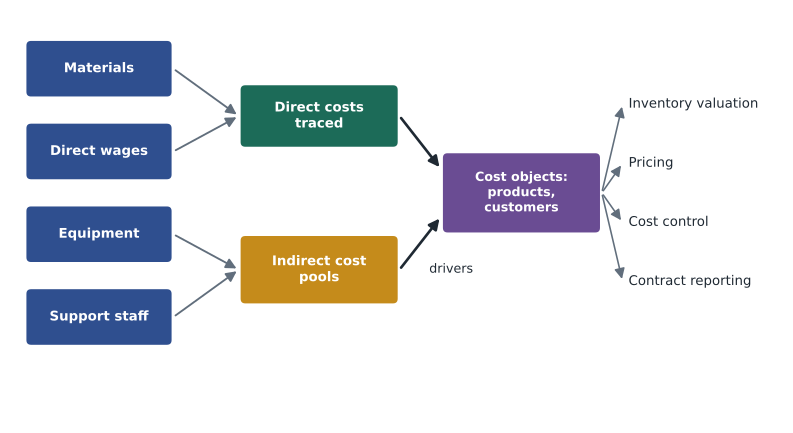
Signals that a cost system needs redesign
Cost systems age. A system designed when a plant made a few high-volume products with heavy direct labor may still be in use after the plant has automated and added dozens of low-volume variants. Common warning signs include the following:
- Managers routinely ignore the reported product costs and rely on their own estimates.
- The company wins bids on complex, low-volume work but loses bids on simple, high-volume products it should make efficiently.
- Competitors offer prices on simple products that the cost system says would cause losses.
- Reported margins on low-volume specialty products look excellent, yet profits fall as their share of sales grows.
- Overhead has grown much faster than direct labor, so overhead rates per labor hour have become very large.
- Accounting cannot easily explain where support costs go or what drives them.
Halden shows several of these signs. Its plantwide rate of $50 per direct labor hour was set when the S-100 made up almost all production. Since then the company has added the P-300 and C-900 lines, each needing more set-ups, more engineering and more inspection per unit. Sales staff complain that the S-100 is priced too high to compete, while the C-900 appears very profitable on paper. Lesson 4 shows how much the plantwide rate distorts these product costs.
# Halden Pumps: plantwide overhead rate and reported unit costs (illustrative)
products = {           # units, DM per unit, DL hours per unit
    "S-100": (20_000, 60, 1.0),
    "P-300": (5_000, 140, 2.0),
    "C-900": (500, 520, 6.0),
}
overhead = 1_650_000
wage = 32                      # direct wage per hour, illustrative
total_dlh = sum(u * h for u, _, h in products.values())
rate = overhead / total_dlh
print(f"Total direct hours: {total_dlh:,.0f}   plantwide rate: ${rate:.2f} per hour")
for name, (units, dm, h) in products.items():
    unit_cost = dm + h * wage + h * rate
    print(f"{name}: DM {dm:>4}  DL {h * wage:>6.2f}  OH {h * rate:>7.2f}  "
f"unit cost {unit_cost:>8.2f}")Total direct hours: 33,000 plantwide rate: $50.00 per hour S-100: DM 60 DL 32.00 OH 50.00 unit cost 142.00 P-300: DM 140 DL 64.00 OH 100.00 unit cost 304.00 C-900: DM 520 DL 192.00 OH 300.00 unit cost 1012.00
The plantwide system reports unit costs of $142 for the S-100, $304 for the P-300 and $1,012 for the C-900. Overhead is assigned in proportion to direct labor hours, so a C-900 receives six times as much overhead as an S-100 because it takes six times as long to assemble. Whether that proportion reflects how the pumps actually use set-ups, engineering, inspection and machine time is the question the rest of this course investigates.
Cost management, not just cost measurement
Measuring costs is only half the job. Cost management uses cost information to make the organization more efficient and more profitable: redesigning products so they need fewer parts, simplifying processes so they need fewer set-ups, choosing which customers to serve and on what terms, and planning capacity so that expensive resources are not left idle. The tools in this course support cost management at different stages of a product's life. Target costing and life-cycle costing (lesson 11) work before production starts, when most costs are still controllable. Activity-based management (lesson 4) and the cost of quality (lesson 11) work during production. Standard costs and variances (lessons 8 to 10) monitor whether operations run as planned. Customer profitability analysis (lesson 5) looks beyond the factory at the costs of serving each customer.
A useful framing is the value chain: research and development, design, production, marketing, distribution and customer service. Financial reporting counts only production costs as product costs. For pricing and strategy, managers need the full value-chain cost, because a product that looks profitable at the factory door may lose money once its design changes, warranty claims and service calls are included. Halden Service's installation and maintenance work makes this point vivid: the C-900 generates far more service calls per unit than the S-100, and those costs never appear in the manufacturing cost of the pump.
| Value-chain stage | Example Halden costs | In inventory under accounting standards? |
|---|---|---|
| Research and development | Impeller testing, new seal designs | No (expensed; development may qualify for capitalization as an intangible under IFRS) |
| Design | Engineering change orders for custom pumps | Only when part of producing specific inventory |
| Production | Materials, direct labor, plant overhead | Yes |
| Marketing | Trade shows, dealer incentives | No |
| Distribution | Freight to dealers, warehousing of finished pumps | No, except costs to bring inventory to its present location |
| Customer service | Warranty repairs, technical support | No |
The professional context
In the United States, many management accountants hold the Certified Management Accountant (CMA) credential from the Institute of Management Accountants (IMA), and many also hold the Certified Public Accountant (CPA) license from their state board. The IMA Statement of Ethical Professional Practice sets out the principles of honesty, fairness, objectivity and responsibility, with standards of competence, confidentiality, integrity and credibility. CPAs in industry are also bound by the AICPA Code of Professional Conduct and their state rules. Cost numbers are especially vulnerable to pressure, because they rest on judgment: which costs go in which pool, which drivers to use and which capacity level to assume. An accountant who chooses allocation methods to make a favored product look profitable, or to shift costs onto a cost-reimbursed government contract, violates these standards even if no accounting rule is broken.
The same judgment appears whenever a cost system is redesigned. Changing from a plantwide rate to activity-based costing will raise the reported cost of some products and lower others, and the managers responsible for each product will notice. The accountant's job is to design the system that best reflects how resources are consumed, to document the reasons, and to explain the results clearly, not to protect any one manager's numbers.
A roadmap for the course
The course moves from measurement to management. Lessons 2 and 3 deepen process costing: the FIFO method, transferred-in costs, and the treatment of spoilage, rework and scrap. Lessons 4 to 7 deal with assigning indirect and shared costs: activity-based costing, time-driven ABC and customer profitability, support department allocations, and joint products. Lessons 8 to 10 develop standard costing in depth: mix and yield variances, the four-way analysis of overhead, journal entries, sales variances and the effect of capacity choices on reported income and inventory. Lesson 11 covers cost estimation, learning curves and strategic cost management. Lesson 12 brings everything together in a redesign of Halden's cost system. ACCT-321 later builds management control systems, transfer pricing and the balanced scorecard on this foundation, and ACCT-421 takes up performance management.
Common mistakes
MistakeTreating the cost system as a single number per product that serves every purpose.
InsteadDesign one system with enough detail that external reporting, pricing, control and contract costing can each use the appropriate costs.
MistakeAssuming more cost pools always give better information.
InsteadRefine the system only while the value of better decisions exceeds the cost of collecting and maintaining the data.
MistakeUsing job costing for every product because it seems more precise.
InsteadMatch the system to the work: job costing for distinct jobs, process costing for identical units, operation costing for batches that share operations.
MistakeJudging product profitability from manufacturing cost alone.
InsteadInclude design, distribution and customer service costs when deciding prices, product mix and customer terms.
MistakeChoosing allocation methods to make a favored product look good.
InsteadBase drivers on cause and effect and document the reasoning; professional ethics require objectivity in cost measurement.
Summary and key terms
- A cost accounting system measures the cost of products, services, customers and other cost objects.
- Direct costs are traced; indirect costs are pooled and assigned with allocation bases or cost drivers.
- One system usually serves external reporting, pricing, cost control, contract costing and strategy.
- Job costing suits distinct jobs, process costing suits identical units, and operation costing combines job-style materials with process-style conversion costs.
- Plantwide, departmental and activity-based systems differ in how finely they divide overhead; refinement is a cost-benefit decision.
- Red flags such as ignored cost reports and unexplained competitor prices suggest a system needs redesign.
- Cost management uses cost information across the value chain, guided by professional ethics.
- Cost accounting system
- The rules, records and calculations used to measure the cost of cost objects.
- Cost object
- Anything whose cost is measured, such as a product, batch, customer or department.
- Cost pool
- A grouping of individual indirect costs assigned together.
- Cost driver
- A factor that causes a cost to change and can be used as an allocation base.
- Operation costing
- A hybrid system that traces materials to batches and assigns conversion costs with a rate per operation.
- Plantwide rate
- A single overhead rate used for the whole plant.
- Departmental rate
- A separate overhead rate for each production department.
- Value chain
- The sequence of business functions that add value to products or services.
- Cost management
- Actions that use cost information to improve efficiency and profitability.
- Allocation base
- The measure used to assign an indirect cost pool to cost objects.
Practice problems
Work each problem on paper first, then reveal the answer to check.
Name the cost object, a direct cost and an indirect cost for a Halden Service installation job.
Show answer
Cost object: the installation job; direct cost: technician hours recorded on the job; indirect cost: the dispatch office or service van depreciation shared by many jobs.
Why might the same pump have a different "cost" for pricing than for inventory valuation?
Show answer
Pricing should include value-chain costs such as design, distribution and service, while inventory includes only production costs required by the standards.
Halden's machining operation incurs $280,000 of conversion cost and runs 8,000 machine hours. What is the cost through machining of a batch using 200 machine hours and $24,000 of materials?
Show answer
Rate $35; conversion $7,000; total $31,000.
Which type of system would a bakery making identical loaves use, and why?
Show answer
Process costing, because identical units flow through the same steps.
Give two reasons a company might keep a plantwide rate despite having diverse products.
Show answer
Low overhead relative to total cost, or the cost of a more detailed system exceeding the expected benefit; also simplicity for external reporting.
Using the plantwide rate, compute total overhead assigned to the C-900 line.
Show answer
500 × 6 × $50 = $150,000.
Why is the C-900 likely to be under-costed by the plantwide rate?
Show answer
It needs far more set-ups, engineering and inspection per unit than its labor hours suggest.
List three value-chain costs that are excluded from inventory.
Show answer
Research, marketing and customer service (also most distribution and general administration).
What ethical issue arises if an accountant shifts overhead onto cost-reimbursed contracts?
Show answer
It breaches integrity and objectivity and may violate contract cost rules, overcharging the customer.
Explain the cost-benefit test for refining a cost system.
Show answer
Add detail only while the value of better decisions exceeds the cost of collecting, maintaining and explaining the extra data.
Lesson quiz · 5 questions
Score 60% or more to complete this lesson.
Create a free account to save your progress, take quizzes and earn a certificate.