
ACCT-222 · Lesson 2 of 12 · 28 min
Process costing in depth: FIFO and transferred-in costs
Process costing assigns costs to identical units that flow through a sequence of departments. ACCT-102 lesson 6 introduced the weighted-average method, in which costs from the beginning work in process inventory are blended with costs added this period. This lesson develops the first-in, first-out (FIFO) method, explains why it gives better information for controlling a department, and shows how costs flow from one department to the next as transferred-in costs. We use Halden's casting and assembly departments, which make the S-100 pump housing and then assemble the pump.
Why a second method?
The weighted-average method treats the units in beginning inventory as if they had been started this period. It averages last period's costs with this period's, so the cost per equivalent unit reflects a blend of two periods. That is simple and is usually close enough for inventory valuation. It is less useful for evaluating how a department performed this month, because a good or bad month is partly hidden by the costs carried in from last month.
FIFO separates the work done this period from the work done last period. It assumes the units in beginning work in process are completed first, and it computes the cost per equivalent unit using only the costs and the work of the current period. Beginning inventory costs stay attached to those specific units. As a result, the FIFO cost per equivalent unit shows the department's current performance and can be compared directly with a budget or standard for the month. When input prices or efficiency change from period to period, the two methods give noticeably different answers; when they are stable, the answers are close.
The five steps, revisited
Both methods follow the same five steps. They differ only in how steps 2 and 3 treat beginning inventory.
- Step 1: summarize the flow of physical units, so that units to account for equal units accounted for.
- Step 2: compute equivalent units of work for each cost category, usually direct materials and conversion costs.
- Step 3: summarize the costs to account for.
- Step 4: compute the cost per equivalent unit for each cost category.
- Step 5: assign costs to units completed and transferred out and to ending work in process, and check that the costs balance.
In the casting department, all direct materials (alloy) are added at the start of the process, and conversion costs are added evenly as the castings are poured, cooled and fettled. October's data for the S-100 housing line are shown below.
| Item | Units | Direct materials | Conversion |
|---|---|---|---|
| Beginning work in process, 1 October (40% converted) | 2,000 | $96,000 | $30,400 |
| Started in October | 22,000 | ||
| Completed and transferred to assembly | 21,000 | ||
| Ending work in process, 31 October (60% converted) | 3,000 | ||
| Costs added in October | $1,078,000 | $814,500 |
Equivalent units under FIFO
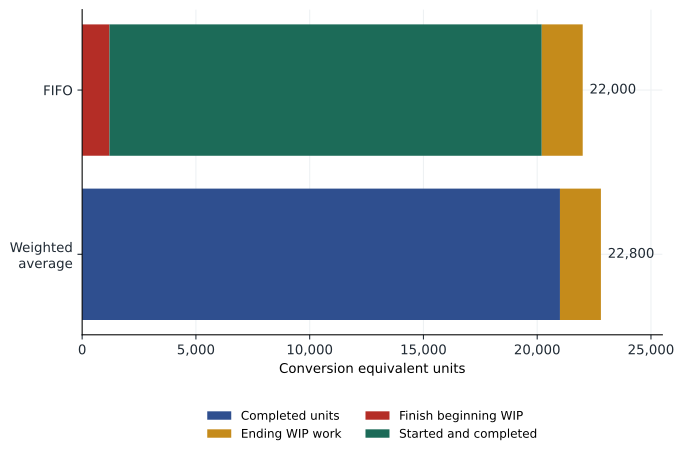
Under FIFO, units completed in October fall into two groups: the 2,000 units that were already in process on 1 October, and the 19,000 units that were started and completed during October (21,000 completed minus the 2,000 from beginning inventory). The equivalent units for October count only the work done in October on each group.
- Beginning inventory units needed no more materials (materials are added at the start) but needed the remaining 60 percent of conversion: 2,000 × 60% = 1,200 equivalent units of conversion.
- Units started and completed received all of their materials and all of their conversion in October: 19,000 equivalent units of each.
- Ending inventory units received all materials but only 60 percent of conversion: 3,000 materials units and 1,800 conversion units.
Total FIFO equivalent units are 22,000 for materials (0 + 19,000 + 3,000) and 22,000 for conversion (1,200 + 19,000 + 1,800). Under the weighted-average method, the equivalent units would be units completed plus the equivalent units in ending inventory: 24,000 for materials (21,000 + 3,000) and 22,800 for conversion (21,000 + 1,800). The difference is exactly the work already done on beginning inventory last period: 2,000 units of materials and 800 units of conversion (2,000 × 40%).
Cost per equivalent unit and the cost assignment
Under FIFO, the cost per equivalent unit uses only October's costs. Materials cost $1,078,000 ÷ 22,000 = $49.00 per equivalent unit, and conversion costs $814,500 ÷ 22,000 = $37.0227 (rounded to $37.02 in reports). The $126,400 of beginning inventory cost is not averaged in; it stays with the 2,000 units that carried it into October.
# Casting department, October: weighted-average versus FIFO (illustrative)
beg_units, beg_pct = 2_000, 0.40          # conversion done before October
beg_dm, beg_cc = 96_000, 30_400
completed, end_units, end_pct = 21_000, 3_000, 0.60
add_dm, add_cc = 1_078_000, 814_500

# Weighted average
wa_eu_dm = completed + end_units
wa_eu_cc = completed + end_units * end_pct
wa_dm = (beg_dm + add_dm) / wa_eu_dm
wa_cc = (beg_cc + add_cc) / wa_eu_cc
wa_out = completed * (wa_dm + wa_cc)
wa_end = end_units * wa_dm + end_units * end_pct * wa_cc

# FIFO
started_completed = completed - beg_units
fifo_eu_dm = started_completed + end_units
fifo_eu_cc = beg_units * (1 - beg_pct) + started_completed + end_units * end_pct
fifo_dm = add_dm / fifo_eu_dm
fifo_cc = add_cc / fifo_eu_cc
beg_finish = beg_dm + beg_cc + beg_units * (1 - beg_pct) * fifo_cc
fifo_out = beg_finish + started_completed * (fifo_dm + fifo_cc)
fifo_end = end_units * fifo_dm + end_units * end_pct * fifo_cc

total = beg_dm + beg_cc + add_dm + add_cc
print(f"Costs to account for: ${total:,.0f}")
print(f"WA   EU {wa_eu_dm:,}/{wa_eu_cc:,.0f}  per EU DM {wa_dm:.4f} CC {wa_cc:.4f}")
print(f"FIFO EU {fifo_eu_dm:,}/{fifo_eu_cc:,.0f}  per EU DM {fifo_dm:.4f} CC {fifo_cc:.4f}")
print(f"WA   transferred out ${wa_out:,.0f}  ending WIP ${wa_end:,.0f}")
print(f"FIFO transferred out ${fifo_out:,.0f}  ending WIP ${fifo_end:,.0f}")
print(f"FIFO cost of the 2,000 beginning units ${beg_finish:,.0f} "
      f"(${beg_finish / beg_units:.2f} each); started-and-completed "
f"${fifo_dm + fifo_cc:.2f} each")Costs to account for: $2,018,900 WA EU 24,000/22,800 per EU DM 48.9167 CC 37.0570 FIFO EU 22,000/22,000 per EU DM 49.0000 CC 37.0227 WA transferred out $1,805,447 ending WIP $213,453 FIFO transferred out $1,805,259 ending WIP $213,641 FIFO cost of the 2,000 beginning units $170,827 ($85.41 each); started-and-completed $86.02 each
The output shows how FIFO assigns costs. The 2,000 units from beginning inventory cost $126,400 brought forward plus 1,200 × $37.0227 = $44,427 to finish, a total of about $170,827, or about $85.41 each. The 19,000 units started and completed cost $86.02 each at October's rates. Together the completed units are transferred out at about $1,805,259, and ending inventory holds about $213,641. Both methods account for the same $2,018,900 of total cost; they simply split it differently between units transferred out and units still in process.
| Weighted average | FIFO | |
|---|---|---|
| Materials cost per EU | $48.92 | $49.00 |
| Conversion cost per EU | $37.06 | $37.02 |
| Cost transferred to assembly | $1,805,447 | $1,805,259 |
| Ending work in process | $213,453 | $213,641 |
| Total | $2,018,900 | $2,018,900 |
In this example the methods agree within about $200 because September's and October's costs per unit were similar. The difference grows when prices move. If alloy prices jumped in October, FIFO would show the jump clearly in the October cost per equivalent unit, while weighted average would dampen it by averaging in September's cheaper alloy.
Using FIFO for control
Because the FIFO cost per equivalent unit reflects only current-period work, it is the natural figure to compare with a budget or standard. Halden's casting supervisor is evaluated on conversion cost per equivalent unit. In October the standard was $36.50, and the FIFO actual of $37.02 shows an unfavorable difference of about $0.52 per unit, or about $11,500 for the month's 22,000 equivalent units. The weighted-average figure of $37.06 would have mixed in September's results and overstated the problem slightly. Lessons 8 and 9 replace this rough comparison with a full standard costing system, in which the difference is split into price and efficiency parts.
FIFO in practice is usually a modified FIFO. Units are not literally tracked one by one; beginning inventory is simply kept as a separate batch for the period. Once units leave the department, the next department receives a single average transferred-in cost per unit, because tracking several cost layers through every downstream department would add complexity without much benefit.
Transferred-in costs
When units move from one department to the next, their accumulated cost moves with them. To the receiving department, these transferred-in costs (also called previous-department costs) behave like direct materials added at the start of its process: every unit arriving in assembly carries a casting cost, and every unit in assembly's work in process is 100 percent complete with respect to transferred-in cost, whatever its stage of conversion in assembly.
Halden's assembly department receives housings from casting, adds components (motor, impeller, seals) when assembly is 50 percent complete, and adds conversion costs evenly. Its process costing report therefore has three cost categories: transferred-in costs, direct materials and conversion costs. The common mistake is to forget that transferred-in costs are always complete for every unit in assembly's inventory, or to treat the components as if they were added at the start.
| Item | Units | Transferred-in | Components | Conversion |
|---|---|---|---|---|
| Beginning WIP, 1 October (30% converted) | 1,500 | $129,000 | $0 | $9,450 |
| Received from casting in October | 21,000 | $1,805,259 | ||
| Completed in October | 20,500 | |||
| Ending WIP, 31 October (70% converted) | 2,000 | |||
| Costs added in October | $1,066,000 | $505,800 |
Worked problem
FIFO equivalent units in assembly
Compute October's FIFO equivalent units for each cost category in assembly.
Show solution
- Units started and completed = 20,500 − 1,500 = 19,000.
- Transferred-in: beginning WIP needs none (it arrived in September); 19,000 started and completed; 2,000 in ending WIP. Total 21,000.
- Components: beginning WIP at 30 percent has not reached the 50 percent point, so all 1,500 units receive components in October; 19,000 started and completed; ending WIP at 70 percent has passed the 50 percent point, so 2,000. Total 22,500.
- Conversion: 1,500 × 70% = 1,050 to finish beginning WIP; 19,000; 2,000 × 70% = 1,400. Total 21,450.
Answer: FIFO equivalent units are 21,000 transferred-in, 22,500 components and 21,450 conversion.
# Assembly department, October, FIFO (illustrative)
beg, beg_pct = 1_500, 0.30
beg_ti, beg_comp, beg_cc = 129_000, 0, 9_450
received, ti_cost = 21_000, 1_805_259
completed, end, end_pct = 20_500, 2_000, 0.70
comp_cost, cc_cost = 1_066_000, 505_800
point = 0.50                       # components added at the 50% stage

sc = completed - beg
eu_ti = sc + end
eu_comp = (beg if beg_pct < point else 0) + sc + (end if end_pct >= point else 0)
eu_cc = beg * (1 - beg_pct) + sc + end * end_pct
r_ti, r_comp, r_cc = ti_cost / eu_ti, comp_cost / eu_comp, cc_cost / eu_cc
print(f"EU: transferred-in {eu_ti:,}  components {eu_comp:,}  conversion {eu_cc:,.0f}")
print(f"Cost per EU: TI {r_ti:.4f}  components {r_comp:.4f}  conversion {r_cc:.4f}")

finish_beg = beg_ti + beg_comp + beg_cc + beg * r_comp + beg * (1 - beg_pct) * r_cc
out = finish_beg + sc * (r_ti + r_comp + r_cc)
ending = end * r_ti + end * r_comp + end * end_pct * r_cc
total = beg_ti + beg_comp + beg_cc + ti_cost + comp_cost + cc_cost
print(f"Transferred to finished goods ${out:,.0f} (${out / completed:.2f} per pump)")
print(f"Ending WIP ${ending:,.0f}; check {out + ending:,.0f} = {total:,.0f}")EU: transferred-in 21,000 components 22,500 conversion 21,450 Cost per EU: TI 85.9647 components 47.3778 conversion 23.5804 Transferred to finished goods $3,215,811 ($156.87 per pump) Ending WIP $299,698; check 3,515,509 = 3,515,509
The completed S-100 pumps leave assembly at about $156.87 each, made up of the casting cost, the components and assembly conversion. That figure becomes the cost of finished goods inventory and, when pumps are sold, cost of goods sold. Note that the casting cost per unit arriving in assembly ($1,805,259 ÷ 21,000 ≈ $85.96) is a single averaged figure, even though casting computed it with FIFO; this is the modified FIFO practice described above.
Journal entries for process costing
The accounting records follow the physical flow. Each department has its own work in process account, and costs move from account to account as units move. For October, Halden's entries (in summary form, rounded) are: debit Work in Process – Casting and credit Materials Inventory for $1,078,000 of alloy; debit Work in Process – Casting and credit Wages Payable and Manufacturing Overhead (applied) for $814,500 of conversion cost; debit Work in Process – Assembly and credit Work in Process – Casting for $1,805,259 transferred in; debit Work in Process – Assembly and credit Materials Inventory for $1,066,000 of components; debit Work in Process – Assembly and credit Wages Payable and Manufacturing Overhead (applied) for $505,800; and finally debit Finished Goods and credit Work in Process – Assembly for $3,215,816. The ending balance in each work in process account equals the ending inventory figure from that department's production cost report, which is a useful check that the report and the ledger agree.
The entries show why errors propagate. If casting overstates the completion of its ending inventory, it transfers too little cost to assembly; assembly's cost per unit then looks better than it should, and the understatement continues into finished goods and cost of goods sold. A good monthly close reconciles each department's report with its ledger account before costs are released downstream.
Choosing a method
Accounting standards permit either method for inventory valuation, provided it is applied consistently and the result approximates actual cost. Under IFRS and ASPE the cost formulas allowed for interchangeable items are FIFO and weighted average; US GAAP also allows LIFO for inventory valuation, but LIFO is rarely used inside process costing reports, and a company electing LIFO for taxes usually applies it as an adjustment at the inventory pool level rather than department by department. The choice inside the cost system is therefore mostly about information. Weighted average is simpler and smooths fluctuations. FIFO is better for performance evaluation and for spotting changes in input prices or efficiency. Companies with large swings in input prices, such as metal casting, food processing or refining, often prefer FIFO reports for managers even if they value inventory on another basis.
Two practical cautions apply to both methods. First, the estimates of percentage completion drive the equivalent units; a supervisor who overstates the completion of ending inventory lowers the reported cost per unit and flatters the month. Internal auditors therefore sample work in process counts and completion estimates. Second, process costing assumes all units are good. Real processes lose units through spoilage, evaporation or scrap, and lesson 3 shows how to account for those losses.
Common mistakes
MistakeIncluding beginning inventory work from last period in FIFO equivalent units.
InsteadFIFO counts only the work done this period: finish beginning inventory, start and complete new units, and start ending inventory.
MistakeAveraging beginning inventory costs into the FIFO cost per equivalent unit.
InsteadUse only current-period costs in the FIFO rate; beginning inventory costs stay with those units.
MistakeTreating transferred-in units in ending inventory as partly complete for transferred-in cost.
InsteadTransferred-in cost is 100 percent complete for every unit in the receiving department.
MistakeAssuming components added midway are in all units of ending inventory.
InsteadCheck the stage of completion against the point where materials are added.
MistakeUsing the weighted-average rate to evaluate this month's supervisor.
InsteadUse the FIFO rate, which reflects only current-period cost and work.
Summary and key terms
- FIFO separates current-period work from work done on beginning inventory in the prior period.
- FIFO equivalent units equal weighted-average equivalent units minus the prior-period work in beginning inventory.
- The FIFO cost per equivalent unit uses only current-period costs, which makes it suitable for performance evaluation.
- Completed units under FIFO carry beginning inventory cost plus the cost to finish them, and started-and-completed units at current rates.
- Transferred-in costs are treated like materials added at the start of the receiving department and are always 100 percent complete.
- Materials added part-way through are counted only in units that have passed that point.
- Both methods are acceptable for inventory if applied consistently; FIFO is more informative for control.
- FIFO process costing
- A method that assigns current-period costs to current-period work and keeps beginning inventory costs separate.
- Weighted-average process costing
- A method that averages beginning inventory costs with current costs.
- Equivalent units
- The number of complete units that could have been made with the work actually done.
- Started and completed
- Units begun and finished in the same period.
- Transferred-in costs
- Costs incurred in previous departments that move with the units to the next department.
- Modified FIFO
- FIFO within a department, with a single averaged transferred-out cost passed to the next department.
- Production cost report
- A report summarizing the five process costing steps for a department.
- Conversion costs
- Direct labor plus manufacturing overhead.
- Cost per equivalent unit
- Costs in a category divided by the equivalent units for that category.
- Stage of completion
- The estimated percentage of work done on units in process.
Practice problems
Work each problem on paper first, then reveal the answer to check.
Beginning WIP 1,000 units 25% converted; started 9,000; completed 8,500; ending WIP 1,500 units 40% converted. Materials at the start. Compute FIFO equivalent units.
Show answer
Materials 7,500 + 1,500 = 9,000; conversion 750 + 7,500 + 600 = 8,850.
For the same data, compute weighted-average equivalent units.
Show answer
Materials 10,000; conversion 8,500 + 600 = 9,100.
Explain the 250-unit difference in conversion equivalent units between the two methods.
Show answer
It is the 25% of conversion done on the 1,000 beginning units last period.
October conversion costs added are $177,000 with 8,850 FIFO conversion units. What is the cost per EU?
Show answer
$20.00.
Why does FIFO show an alloy price increase more clearly than weighted average?
Show answer
FIFO uses only current-period costs; weighted average blends in prior-period costs.
In assembly, components are added at 60%. Beginning WIP is 50% converted. Do those units receive components this period under FIFO?
Show answer
Yes; they had not reached 60%, so they receive components this period.
Ending WIP in assembly is 2,000 units, 70% converted. How many equivalent units of transferred-in cost does it hold?
Show answer
2,000, because transferred-in cost is always 100% complete.
Using the code, what happens to casting's FIFO conversion rate if ending WIP is 80% complete instead of 60%?
Show answer
Equivalent units rise to 22,600 and the rate falls to about $36.04.
Why might a supervisor be tempted to overstate completion of ending WIP?
Show answer
Higher equivalent units lower the reported cost per unit and make the month look better.
Which inventory cost formulas do IFRS and ASPE allow for interchangeable items?
Show answer
FIFO and weighted average.
Lesson quiz · 5 questions
Score 60% or more to complete this lesson.
Create a free account to save your progress, take quizzes and earn a certificate.