
ACCT-102 · Lesson 8 of 12 · 25 min
Variable and absorption costing
How much does a Classic chair cost? Lesson 2 gave two answers: $102 of variable manufacturing cost, or $132 if fixed manufacturing overhead is included at the normal volume. The choice is not academic. It determines the value of inventory on the balance sheet and, whenever production and sales differ, the operating income reported for the period. Absorption costing (also called full costing) treats all manufacturing costs, variable and fixed, as product costs. Variable costing (also called direct or marginal costing) treats only variable manufacturing costs as product costs and expenses fixed manufacturing overhead in the period incurred. This lesson compares the two, reconciles their incomes, explains why external reporting requires absorption costing, and shows how absorption costing can tempt managers to build inventory to raise reported profit.
The one difference: fixed manufacturing overhead
The two methods agree about every cost except one. Direct materials, direct labor and variable overhead are product costs under both. Selling and administrative costs, whether variable or fixed, are period costs under both. The only disagreement is fixed manufacturing overhead. Absorption costing attaches it to units and holds it in inventory until the units are sold. Variable costing treats it as a cost of having the capacity to produce in the period, like rent on a building, and expenses all of it immediately.
| Cost | Absorption costing | Variable costing |
|---|---|---|
| Direct materials | Product cost | Product cost |
| Direct labor | Product cost | Product cost |
| Variable manufacturing overhead | Product cost | Product cost |
| Fixed manufacturing overhead | Product cost (inventoried) | Period cost (expensed) |
| Variable selling and administrative | Period cost | Period cost |
| Fixed selling and administrative | Period cost | Period cost |
# Classic chair: unit product cost under each method (illustrative)
dm, dl, voh = 60, 30, 12
fixed_moh, normal_volume = 216_000, 7_200

variable_unit = dm + dl + voh
fixed_per_unit = fixed_moh / normal_volume
absorption_unit = variable_unit + fixed_per_unit
print(f"Variable costing unit cost:   ${variable_unit}")
print(f"Fixed overhead per unit:      ${fixed_per_unit:.0f}  (at {normal_volume:,} chairs)")
print(f"Absorption costing unit cost: ${absorption_unit:.0f}")Variable costing unit cost: $102 Fixed overhead per unit: $30 (at 7,200 chairs) Absorption costing unit cost: $132
Income statements when production exceeds sales
In its first year of operating the chair line at its present scale, Cedar Ridge makes 7,200 chairs (its normal volume) but sells 7,000, so 200 chairs go into finished goods inventory. There is no beginning inventory. The selling price is $180, variable selling cost is $6 per chair, fixed manufacturing overhead is $216,000 and fixed selling and administrative cost is $144,000. The two methods give different incomes.
| Variable costing | Amount | Absorption costing | Amount |
|---|---|---|---|
| Sales (7,000 × $180) | $1,260,000 | Sales (7,000 × $180) | $1,260,000 |
| Variable cost of goods sold (7,000 × $102) | $714,000 | Cost of goods sold (7,000 × $132) | $924,000 |
| Variable selling (7,000 × $6) | $42,000 | Gross margin | $336,000 |
| Contribution margin | $504,000 | Selling and administrative ($42,000 + $144,000) | $186,000 |
| Fixed manufacturing overhead | $216,000 | ||
| Fixed selling and administrative | $144,000 | ||
| Operating income | $144,000 | Operating income | $150,000 |
Absorption costing reports $6,000 more income. The reason is visible in the inventory: the 200 unsold chairs carry $30 each of fixed overhead, $6,000 in total, on the balance sheet under absorption costing. Under variable costing that $6,000 was expensed this year. Ending inventory is $26,400 (200 × $132) under absorption costing and $20,400 (200 × $102) under variable costing.
Reconciling the two incomes
The difference between the two incomes always equals the change in the fixed overhead held in inventory. When inventory rises, absorption income is higher, because some of this period's fixed overhead is deferred to future periods. When inventory falls, absorption income is lower, because fixed overhead from earlier periods is released into cost of goods sold. When production equals sales, the two incomes are equal (assuming the fixed overhead rate per unit does not change).
# Three years of chair results under both methods (illustrative)
price, v_mfg, v_sell = 180, 102, 6
fixed_moh, fixed_sa, normal = 216_000, 144_000, 7_200
rate = fixed_moh / normal                     # $30 per chair
years = [(7_200, 7_000), (6_800, 7_000), (7_000, 7_000)]   # (produced, sold)

inv = 0
for y, (made, sold) in enumerate(years, 1):
    sales = sold * price
    var_income = sales - sold * (v_mfg + v_sell) - fixed_moh - fixed_sa
    volume_variance = (normal - made) * rate  # unabsorbed fixed overhead, to COGS
    cogs = sold * (v_mfg + rate) + volume_variance
    abs_income = sales - cogs - sold * v_sell - fixed_sa
    beg, inv = inv, inv + made - sold
    print(f"Year {y}: made {made:,}, sold {sold:,}, ending inventory {inv:>3}  "
          f"variable ${var_income:,.0f}  absorption ${abs_income:,.0f}  "
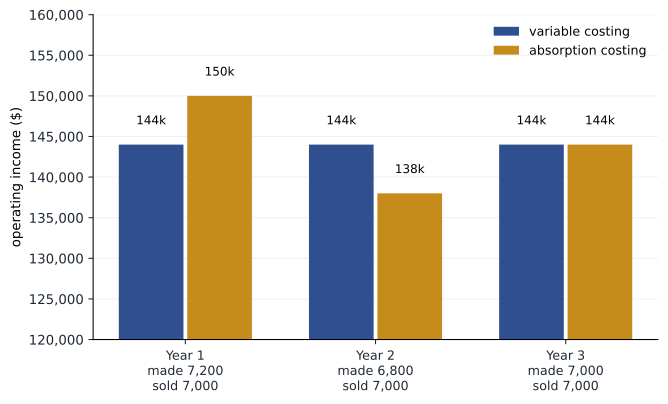
f"difference ${abs_income - var_income:+,.0f} = {inv - beg:+} x ${rate:.0f}")Year 1: made 7,200, sold 7,000, ending inventory 200 variable $144,000 absorption $150,000 difference $+6,000 = +200 x $30 Year 2: made 6,800, sold 7,000, ending inventory 0 variable $144,000 absorption $138,000 difference $-6,000 = -200 x $30 Year 3: made 7,000, sold 7,000, ending inventory 0 variable $144,000 absorption $144,000 difference $+0 = +0 x $30
Over the three years total production equals total sales (21,000 chairs), so total income is the same under both methods: $432,000. Absorption costing simply moves $6,000 of income from year 2 to year 1 by deferring fixed overhead in inventory. In year 2, Cedar Ridge makes only 6,800 chairs, below its normal volume of 7,200. The 400 chairs of unused capacity leave $12,000 of fixed overhead unabsorbed, which is charged to cost of goods sold as an unfavorable production volume variance (lesson 11 explains volume variances). That treatment follows the financial reporting rule, discussed below, that inventory should not absorb the cost of idle capacity.
Why the difference matters: incentives
Under variable costing, operating income moves with sales: if sales are flat, income is flat. Under absorption costing, income also responds to production. A manager whose bonus depends on absorption income can raise this year's profit simply by producing more than can be sold, deferring fixed overhead into inventory. The inventory then ties up cash, takes up warehouse space, risks obsolescence and damage, and eventually drags down income in a later year when it is sold or written down. This is one reason lean thinking (BUS-230 lesson 11) regards excess inventory as waste.
Worked problem
Overproducing to hit a target
Near year end, the plant manager forecasts absorption income of $144,000, below his $160,000 bonus target. He considers making 600 extra chairs that will not be sold this year. What happens?
Show solution
- The extra chairs absorb 600 × $30 = $18,000 of fixed overhead that would otherwise have been charged as an unfavorable volume variance or expensed.
- Absorption income rises by $18,000 to $162,000, above the target, with no extra sales.
- Variable costing income is unchanged at $144,000; the variable cost of the chairs sits in inventory under both methods.
- Cedar Ridge now holds 600 more chairs, tying up 600 × $102 = $61,200 of cash in variable production costs, plus storage and obsolescence risk.
Answer: The manager hits the target without creating any value. Variable costing reports, inventory limits or targets based on cash flow or contribution margin remove the incentive.
Companies limit the problem in several ways: evaluating managers on variable costing or contribution margin reports, setting targets for inventory levels or inventory turnover, charging a capital cost for inventory held (lesson 12 introduces residual income), and using multi-year rather than single-year bonus measures. Ethically, deliberately building unneeded inventory to manipulate reported results conflicts with the integrity standards discussed in lesson 1.
External reporting and tax
For external reporting, US GAAP (ASC 330, Inventory) requires absorption costing: inventory cost includes an allocation of fixed production overhead based on the normal capacity of the production facilities. Unallocated overhead from abnormally low production is expensed as incurred, exactly as the year 2 calculation does. Variable costing is therefore an internal tool. For federal income tax, the uniform capitalization rules of Internal Revenue Code section 263A generally require producers to capitalize direct costs and a share of indirect costs, including some costs that GAAP would expense, into inventory. Smaller businesses that meet the gross receipts test (indexed for inflation; about $31 million for 2025 and $32 million for 2026) are exempt.
| Use | Absorption costing | Variable costing |
|---|---|---|
| External financial statements | Required (US GAAP) | Not permitted |
| Income tax | Generally required (full cost) | Not generally accepted |
| CVP analysis and short-term decisions | Awkward; mixes fixed and variable | Natural fit; shows contribution margin |
| Performance evaluation | Can be manipulated by production | Income follows sales |
| Long-run pricing | Reminds managers fixed costs must be covered | Risk of ignoring fixed costs if used naively |
Arguments for each method
Supporters of variable costing argue that fixed manufacturing overhead is a cost of capacity, not of units: the factory lease is the same whether Cedar Ridge makes 6,800 or 7,200 chairs, so charging it to units is an arbitrary allocation that obscures cost behavior. Variable costing reports fit CVP analysis directly, make income follow sales, remove the incentive to overproduce, and are easier for non-accountants to understand.
Supporters of absorption costing argue that production is impossible without capacity, so fixed overhead is as much a cost of making a chair as the hardwood. They point out that over the long run prices must cover all costs, and that pricing from variable costs alone can lead to selling below full cost. Absorption costing also matches costs with revenues when inventory is built ahead of seasonal sales, and it is required externally, so using it internally avoids keeping two sets of numbers. In practice many companies keep their ledger on an absorption basis and produce contribution margin reports for internal use, which modern accounting systems make easy.
A third approach, throughput costing (also called super-variable costing), treats only direct materials as product costs and expenses all conversion costs. Its supporters argue that in the short run labor and overhead are largely fixed, and that throughput costing removes almost all incentive to build inventory. It is associated with the theory of constraints and is mainly an internal tool.
# Inventory value of 200 unsold chairs under three methods (illustrative)
unsold = 200
unit_costs = {"Absorption": 60 + 30 + 12 + 30,
              "Variable": 60 + 30 + 12,
              "Throughput": 60}
for method, cost in unit_costs.items():
print(f"{method:<11} ${cost:>4} per chair inventory ${unsold * cost:>7,}")Absorption $ 132 per chair inventory $ 26,400 Variable $ 102 per chair inventory $ 20,400 Throughput $ 60 per chair inventory $ 12,000
Segment reporting with variable costing
Variable costing extends naturally to segment reports, which show each product line's or division's contribution margin, then subtract the fixed costs traceable to that segment to give its segment margin, before common fixed costs that no single segment causes. Lesson 9 uses segment margins to decide whether to drop a product line, and lesson 12 uses them to evaluate managers. The key rule is not to allocate common fixed costs to segments when judging whether a segment is worth keeping, because those costs would remain even if the segment were dropped.
Common mistakes
MistakeBelieving the two methods treat selling costs differently.
InsteadSelling and administrative costs, fixed or variable, are period costs under both; only fixed manufacturing overhead differs.
MistakeExpecting absorption income to be higher every year.
InsteadIt is higher only when inventory rises; when inventory falls it is lower.
MistakeRaising the fixed overhead rate when production falls.
InsteadFrameworks require allocation at normal capacity; unabsorbed overhead is expensed.
MistakeUsing variable costing for external statements.
InsteadUS GAAP requires absorption costing.
MistakeRewarding managers on absorption income without inventory controls.
InsteadUse contribution or variable costing reports, inventory targets or capital charges to discourage overproduction.
Summary and key terms
- Absorption costing includes fixed manufacturing overhead in product cost; variable costing expenses it.
- All other costs are treated the same under both methods.
- The income difference equals the change in fixed overhead held in inventory.
- Absorption income exceeds variable income when inventory rises, and falls short when inventory falls.
- Absorption costing can reward overproduction; variable costing income follows sales.
- US GAAP requires absorption costing at normal capacity; tax rules (section 263A) generally require full costing.
- Variable costing supports CVP analysis, segment reporting and performance evaluation internally.
- Absorption costing
- A method that includes all manufacturing costs, including fixed overhead, in product cost.
- Variable costing
- A method that includes only variable manufacturing costs in product cost and expenses fixed overhead.
- Throughput costing
- A method that treats only direct materials as product costs.
- Normal capacity
- The production expected over a number of periods under normal circumstances, used to allocate fixed overhead.
- Production volume variance
- The difference between budgeted fixed overhead and fixed overhead applied to actual production.
- Unabsorbed overhead
- Fixed overhead not allocated to units because production was below normal capacity.
- Inventory build-up
- Producing more than is sold, increasing inventory.
- Segment margin
- Segment contribution margin minus traceable fixed costs.
- Common fixed cost
- A fixed cost that supports several segments and would not be avoided by dropping one.
- Gross margin
- Sales minus absorption cost of goods sold.
Practice problems
Work each problem on paper first, then reveal the answer to check.
Variable manufacturing cost is $40 per unit and fixed overhead is $90,000 at a normal volume of 9,000 units. Find unit cost under each method.
Show answer
Variable $40; absorption $50.
The company makes 9,000 and sells 8,500 units. Which method reports higher income and by how much?
Show answer
Absorption, by 500 × $10 = $5,000.
Next year it makes 8,800 and sells 9,300. Explain the income difference.
Show answer
Inventory falls by 500 units, releasing $5,000 of fixed overhead; absorption income is $5,000 lower (plus any volume variance effect, which affects both years' absorption figures).
Why are incomes equal when production equals sales?
Show answer
No fixed overhead is deferred into or released from inventory.
In Cedar Ridge's year 2, what is the unfavorable volume variance?
Show answer
(7,200 − 6,800) × $30 = $12,000.
Give two ways to discourage managers from overproducing.
Show answer
Evaluate on contribution margin or variable costing income; set inventory targets; charge for capital tied up in inventory.
Why might variable costing lead to underpricing?
Show answer
Prices set from variable cost alone may not cover fixed costs in the long run.
What is the inventory value of 200 chairs under throughput costing?
Show answer
200 × $60 = $12,000.
Which method is required for external reporting in your country?
Show answer
Absorption costing under US GAAP (ASC 330).
Change the program so year 1 production is 7,600. What is the year 1 difference?
Show answer
Inventory rises 600; absorption income is $18,000 higher (with a $12,000 favorable volume variance, absorption income is $162,000 against $144,000).
Lesson quiz · 5 questions
Score 60% or more to complete this lesson.
Create a free account to save your progress, take quizzes and earn a certificate.