
ACCT-102 · Lesson 2 of 12 · 30 min
Cost concepts and classifications
Managers use the word cost constantly, but it means different things in different settings. The cost of a chair for inventory purposes is not the same as the cost that matters when deciding whether to accept a discount order, and neither is the same as the cost that will appear in next year's budget. This lesson builds the vocabulary that the rest of the course depends on: what a cost object is, how costs are classified as direct or indirect, as product or period costs, and as variable or fixed, and how a manufacturer's income statement and balance sheet differ from those of the merchandiser studied in ACCT-101. It ends with the schedule of cost of goods manufactured, which links the factory's costs to the financial statements.
The key idea is that costs are classified for a purpose. There is no single correct label for a cost; the same factory supervisor's salary is indirect with respect to a chair, direct with respect to the chair department, a product cost for inventory valuation, fixed with respect to the number of chairs made, and possibly irrelevant to a decision about a one-time special order. The phrase often attributed to cost accountants, different costs for different purposes, summarizes the lesson.
Cost objects and direct and indirect costs
A cost is a resource given up to achieve a particular objective, measured in money. A cost object is anything for which managers want a separate measure of cost: a product (a Classic chair), a batch, a customer order (a boardroom table), a department (finishing), a customer, a project or an activity (machine set-ups). Choosing the cost object comes first, because whether a cost is direct or indirect depends on it.
A direct cost can be traced to the cost object in an economically feasible way. The hardwood in a chair and the wages of the worker who assembles it are direct costs of the chair. An indirect cost relates to the cost object but cannot be traced to it economically, so it must be allocated using some reasonable basis. The factory's electricity, the plant manager's salary and the depreciation of the building are indirect costs of a chair. Note the phrase economically feasible: glue and screws could be measured chair by chair, but the cost of doing so exceeds the benefit, so small items like these are usually treated as indirect materials.
| Cost | Cost object: one Classic chair | Cost object: the finishing department |
|---|---|---|
| Hardwood used in the chair | Direct | Direct (if finished in that department) or not applicable |
| Wages of the chair assembler | Direct | Indirect (assembler works in assembly) |
| Finishing supervisor's salary | Indirect | Direct |
| Glue, screws and sandpaper | Indirect (impractical to trace) | Direct if used only in finishing |
| Plant manager's salary | Indirect | Indirect |
| Depreciation on the spray booth | Indirect | Direct |
Manufacturing costs: materials, labor and overhead
A manufacturer's product costs fall into three elements. Direct materials are raw materials that become an identifiable part of the finished product and can be traced to it, such as Cedar Ridge's hardwood. Direct labor is the wages and related payroll costs of employees who work directly on the product, such as cutters, assemblers and finishers. Manufacturing overhead (also called factory overhead or indirect manufacturing cost) is every other cost of running the factory: indirect materials, indirect labor (supervisors, maintenance staff, material handlers), factory utilities, depreciation and insurance on the plant and equipment, property taxes on the factory, and repairs.
Two combinations are common. Prime cost is direct materials plus direct labor, the costs most directly tied to the product. Conversion cost is direct labor plus manufacturing overhead, the cost of converting raw materials into finished goods. Direct labor appears in both. In highly automated plants, direct labor has shrunk to a small share of total cost, and many companies now fold it into conversion cost rather than tracking it separately; lesson 7 explains why that shift prompted activity-based costing.
# Classic chair: prime cost and conversion cost per unit (illustrative)
dm, dl, voh = 60, 30, 12        # direct materials, DL, variable overhead
fixed_moh_per_unit = 30         # fixed overhead at the normal volume (lesson 8)
moh = voh + fixed_moh_per_unit

prime = dm + dl
conversion = dl + moh
full_mfg = dm + dl + moh
print(f"Prime cost per chair:       ${prime}")
print(f"Conversion cost per chair:  ${conversion}")
print(f"Manufacturing cost per chair: ${full_mfg}")
print(f"DL share of manufacturing cost: {dl / full_mfg:.1%}")Prime cost per chair: $90 Conversion cost per chair: $72 Manufacturing cost per chair: $132 DL share of manufacturing cost: 22.7%
Payroll costs need care. The direct labor rate of $20 per hour for Cedar Ridge is a fully loaded rate: it includes the employer's share of payroll taxes and benefits as well as wages. Overtime premiums are usually treated as overhead rather than charged to the particular chair that happened to be made during overtime, because the overtime is caused by the total volume of work, not by that chair. Idle time, such as waiting for a machine repair, is also usually overhead. These conventions keep product costs from depending on the accident of when a unit was made.
For a US employer, the loaded rate includes the employer's share of FICA (Social Security and Medicare), federal and state unemployment taxes, workers' compensation insurance premiums, paid leave and benefits such as health insurance. BUS-110 lesson 6 shows how payroll is calculated; rates and wage bases change each year, so the figures in this course are illustrative.
Product costs and period costs
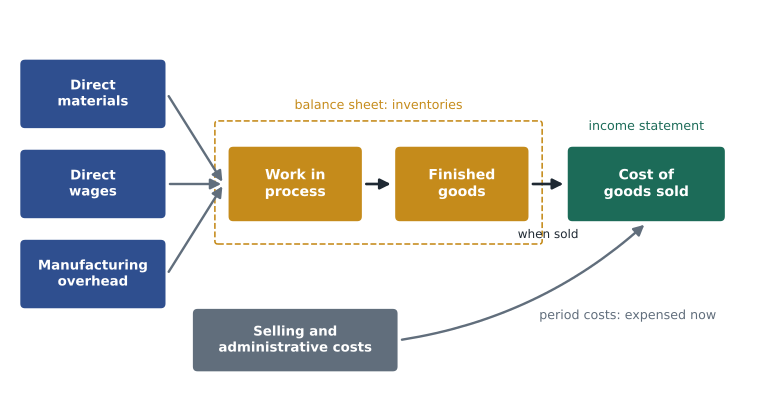
For financial reporting, costs are also classified by when they become expenses. Product costs (also called inventoriable costs) are the costs of making or buying goods for sale. For a manufacturer they are direct materials, direct labor and manufacturing overhead. They attach to the units produced and sit on the balance sheet as inventory until the units are sold, when they become cost of goods sold. Period costs are all other costs: selling costs such as advertising, sales salaries, commissions and outbound freight, and administrative costs such as head-office salaries, accounting and legal fees. They are expensed in the period incurred, regardless of when products are sold.
The distinction matters most when production and sales differ. If Cedar Ridge makes 7,200 chairs but sells 7,000, the product costs of the 200 unsold chairs stay in inventory, while all of the year's sales salaries are expensed. Lesson 8 shows how this affects reported income. A common trap is to treat a cost as a period cost because it is paid by head office; what matters is what the cost is for. Insurance on the factory is a product cost (overhead); insurance on the head-office building is a period cost.
| Cost | Product or period? | Element or category |
|---|---|---|
| Hardwood for chairs | Product | Direct materials |
| Assembler wages | Product | Direct labor |
| Factory supervisor salary | Product | Manufacturing overhead |
| Depreciation on CNC router | Product | Manufacturing overhead |
| Sales commissions | Period | Selling |
| Freight to deliver chairs to retailers | Period | Selling |
| Inbound freight on hardwood | Product | Direct materials (part of material cost) |
| Controller's salary | Period | Administrative |
| Factory property taxes | Product | Manufacturing overhead |
| Website and catalog costs | Period | Selling |
Variable, fixed and mixed costs: a first look
A third classification looks at how a cost behaves when activity changes. A variable cost changes in total in proportion to activity: hardwood cost doubles when chair production doubles, but the cost per chair stays at $60. A fixed cost stays the same in total over a relevant range of activity: the factory lease is the same whether Cedar Ridge makes 6,000 or 8,000 chairs, so the fixed cost per chair falls as volume rises. A mixed (semivariable) cost has both a fixed and a variable component, like a utility bill with a monthly service charge plus a charge per kilowatt-hour. Lesson 3 studies cost behavior in depth and shows how to estimate it; here the point is that behavior is a separate question from product versus period. Sales commissions are variable period costs; factory depreciation is a fixed product cost.
| Variable cost | Fixed cost | |
|---|---|---|
| Total cost as activity rises | Increases proportionally | Unchanged (within the relevant range) |
| Cost per unit as activity rises | Unchanged | Decreases |
| Cedar Ridge examples | Hardwood, direct labor, commissions | Factory lease, supervisor salaries, depreciation |
Worked problem
The per-unit fixed cost trap
The chair line's fixed manufacturing overhead is $216,000 a year. A sales manager notes that "fixed overhead is $30 per chair" and argues that an extra order of 500 chairs will add $15,000 of overhead. Is she right?
Show solution
- $216,000 ÷ 7,200 chairs = $30 per chair, but only at that volume.
- Within the relevant range, total fixed overhead stays at $216,000 whether the plant makes 7,200 or 7,700 chairs.
- At 7,700 chairs the fixed overhead per chair falls to $216,000 ÷ 7,700 ≈ $28.05.
- The extra order adds variable costs, not $15,000 of fixed overhead.
Answer: No. Unitized fixed costs behave as if they were variable only on paper; total fixed overhead does not rise with the order (lesson 9 develops this).
Other cost concepts for decisions
Several more terms appear in later lessons. A differential (incremental) cost is the difference in cost between two alternatives. An opportunity cost is the benefit forgone by choosing one alternative over the next best, such as the profit lost when a machine is used for one product rather than another; it does not appear in the accounts but matters for decisions. A sunk cost has already been incurred and cannot be changed by any decision, such as the price paid for a machine last year; it is irrelevant to future choices. Controllable costs are those a particular manager can significantly influence in a given period, which matters for judging performance (lesson 12). Lesson 9 puts these ideas to work.
| Concept | Meaning | Cedar Ridge example |
|---|---|---|
| Differential cost | Cost difference between alternatives | Buying cushions costs $3 more per chair than making them |
| Opportunity cost | Benefit given up by the choice made | Contribution lost on custom work when the CNC router makes chairs |
| Sunk cost | Past cost no decision can change | Amount paid for an old spray booth |
| Controllable cost | Cost a manager can influence | Overtime is controllable by the production supervisor |
| Out-of-pocket cost | Requires a future cash outlay | Rental of an extra kiln for a rush order |
Financial statements of a manufacturer
A merchandiser buys finished goods and has one inventory account. A manufacturer has three. Raw materials inventory holds materials not yet put into production. Work in process inventory holds partly finished units, carrying the materials, labor and overhead applied so far. Finished goods inventory holds completed units awaiting sale. All three appear in current assets. On the income statement, the merchandiser's purchases are replaced by the cost of goods manufactured: the cost of the units completed during the period.
The schedule of cost of goods manufactured shows how that figure is built. Start with the raw materials used (beginning raw materials plus purchases minus ending raw materials), separating direct from indirect materials. Add direct labor and manufacturing overhead to get total manufacturing costs incurred in the period. Add beginning work in process and subtract ending work in process to get the cost of goods manufactured. Then the income statement computes cost of goods sold as beginning finished goods plus cost of goods manufactured minus ending finished goods.
# Cedar Ridge chair line: schedule of cost of goods manufactured, last year (illustrative)
raw_beg, purchases, raw_end = 38_000, 452_000, 42_000
indirect_materials = 18_000
materials_used = raw_beg + purchases - raw_end
direct_materials = materials_used - indirect_materials

dl_total = 216_000
overhead = {"indirect materials": indirect_materials, "inDL": 96_000,
            "factory utilities": 54_000, "factory depreciation": 72_000,
            "factory insurance": 18_000, "repairs and maintenance": 42_000}
moh = sum(overhead.values())

total_mfg = direct_materials + dl_total + moh
wip_beg, wip_end = 64_000, 58_000
cogm = total_mfg + wip_beg - wip_end
fg_beg, fg_end = 85_000, 97_000
cogs = fg_beg + cogm - fg_end

print(f"Raw materials used        {materials_used:>10,}")
print(f"  Direct materials        {direct_materials:>10,}")
print(f"Direct wages (DL)         {dl_total:>10,}")
print(f"Manufacturing overhead    {moh:>10,}")
print(f"Total manufacturing costs {total_mfg:>10,}")
print(f"Cost of goods manufactured{cogm:>10,}")
print(f"Cost of goods sold {cogs:>10,}")Raw materials used 448,000 Direct materials 430,000 Direct wages (DL) 216,000 Manufacturing overhead 300,000 Total manufacturing costs 946,000 Cost of goods manufactured 952,000 Cost of goods sold 940,000
Read the output from top to bottom and the logic is the same as a T-account: what you start with plus what comes in, minus what is left, equals what went out. Raw materials used flow into work in process; goods manufactured flow out of work in process into finished goods; goods sold flow out of finished goods into cost of goods sold. Indirect materials are pulled out of materials used and shown in overhead so they are not counted twice.
Worked problem
Building cost of goods sold
Using the program's figures for the chair line, Cedar Ridge had chair sales of $1,380,000 and selling and administrative expenses of $310,000 last year. Prepare a condensed income statement.
Show solution
- Cost of goods manufactured is $952,000; cost of goods sold is $85,000 + $952,000 − $97,000 = $940,000.
- Gross margin = $1,380,000 − $940,000 = $440,000.
- Operating income = $440,000 − $310,000 = $130,000.
Answer: Sales $1,380,000; cost of goods sold $940,000; gross margin $440,000; selling and administrative $310,000; operating income $130,000.
| Balance sheet: current assets (excerpt) | Amount |
|---|---|
| Raw materials inventory | $42,000 |
| Work in process inventory | $58,000 |
| Finished goods inventory | $97,000 |
| Total inventories | $197,000 |
Service companies have little or no inventory, so almost all their costs are period costs for financial reporting. Managerial accountants still cost their services, such as an audit engagement, a hospital procedure or a software project, using the same ideas of direct and indirect costs. The custom shop at Cedar Ridge, which costs each order separately, is a bridge between the two worlds; lesson 5 shows how.
Common mistakes
MistakeCalling a cost direct or indirect without naming the cost object.
InsteadDirect and indirect only make sense relative to a cost object; the same cost can be both.
MistakeTreating factory insurance or factory utilities as period costs.
InsteadCosts of running the factory are manufacturing overhead, a product cost.
MistakeCharging overtime premiums to the units made during overtime.
InsteadOvertime premiums are normally overhead, spread across all production.
MistakeUsing a unitized fixed cost as if it were variable.
InsteadTotal fixed costs do not change within the relevant range; fixed cost per unit falls as volume rises.
MistakeDouble counting indirect materials.
InsteadRemove indirect materials from materials used and include them in overhead once.
Summary and key terms
- A cost object is anything whose cost managers want measured; costs are direct or indirect relative to it.
- Manufacturing costs are direct materials, direct labor and manufacturing overhead.
- Prime cost = direct materials + direct labor; conversion cost = direct labor + overhead.
- Product costs are inventoried and expensed as cost of goods sold; period costs are expensed when incurred.
- Variable costs change in total with activity; fixed costs are constant in total within the relevant range.
- Differential, opportunity, sunk and controllable costs are decision concepts used later.
- Manufacturers report raw materials, work in process and finished goods, and build cost of goods sold from the cost of goods manufactured.
- Cost object
- Anything for which a separate measurement of cost is desired.
- Direct cost
- A cost that can be traced to a cost object in an economically feasible way.
- Indirect cost
- A cost related to a cost object that must be allocated because it cannot be traced economically.
- Manufacturing overhead
- All manufacturing costs other than direct materials and direct labor.
- Prime cost
- Direct materials plus direct labor.
- Conversion cost
- Direct labor plus manufacturing overhead.
- Product cost
- A cost assigned to inventory and expensed as cost of goods sold when the goods are sold.
- Period cost
- A selling or administrative cost expensed in the period incurred.
- Cost of goods manufactured
- The cost of goods completed during a period and transferred to finished goods.
- Work in process
- Inventory of partly completed units, carrying the costs applied so far.
Practice problems
Work each problem on paper first, then reveal the answer to check.
Classify the wages of a forklift driver who moves lumber in the factory.
Show answer
Indirect labor; manufacturing overhead; product cost.
Classify advertising for the Classic chair.
Show answer
Period cost (selling).
A chair uses $60 of materials, $30 of direct labor and $42 of overhead. Compute prime and conversion cost.
Show answer
Prime $90; conversion $72.
Raw materials: beginning $20,000, purchases $95,000, ending $18,000; indirect materials used $4,000. Find direct materials used.
Show answer
$20,000 + $95,000 − $18,000 − $4,000 = $93,000.
Total manufacturing costs are $500,000, beginning WIP $40,000 and ending WIP $55,000. Find cost of goods manufactured.
Show answer
$485,000.
Cost of goods manufactured $485,000, beginning finished goods $30,000, ending $45,000. Find cost of goods sold.
Show answer
$470,000.
Why is the plant manager's salary indirect for a chair but direct for the plant?
Show answer
It cannot be traced to individual chairs, but it is incurred entirely for the plant.
Give an example of a fixed product cost and a variable period cost.
Show answer
Factory depreciation (fixed product); sales commissions (variable period).
Is inbound freight on hardwood a product or period cost?
Show answer
Product cost, included in the cost of direct materials.
Change the program so ending work in process is $70,000. What is the new cost of goods manufactured?
Show answer
$946,000 + $64,000 − $70,000 = $940,000.
Lesson quiz · 5 questions
Score 60% or more to complete this lesson.
Create a free account to save your progress, take quizzes and earn a certificate.