
ACCT-102 · Lesson 1 of 12 · 28 min
Managerial accounting and its role
Financial accounting, the subject of ACCT-101, tells outsiders what happened to a business: how much it earned, what it owns and what it owes. Managerial accounting answers a different set of questions, asked by the people who run the business. What does it cost to make one chair? How many chairs must we sell to break even? Should we accept a large order at a discount? Should we make a component ourselves or buy it? How much cash will we need in the spring? Why did last month's costs exceed the budget? These questions are about planning, controlling and deciding, and the answers are rarely found in published financial statements.
This lesson introduces managerial accounting: what it is for, how it differs from financial accounting, the management cycle it supports, the professionals who practice it, and the ethical standards that govern it. It also introduces the company that runs through the whole course, so that the numbers in later lessons connect. Like the rest of the course, it is educational and illustrative; it is not professional accounting, tax or investment advice, and all company figures are invented.
What managerial accounting is
Managerial accounting (also called management accounting) is the process of identifying, measuring, analyzing, interpreting and communicating information that helps managers pursue an organization's goals. Its raw material is largely the same as financial accounting's: invoices, payroll records, purchase orders, production logs and the general ledger. What changes is the purpose. Financial accounting asks whether the statements fairly present the company's position under a reporting framework. Managerial accounting asks whether a particular report will help a particular manager make a better decision.
That purpose explains its characteristic features. Managerial reports look forward as much as back, because planning and decision making are about the future. They focus on parts of the organization, such as a product line, a plant, a department, a customer or a project, rather than the whole. They are produced as often as needed: a production supervisor may look at a daily scrap report, while the board reviews an annual budget. They may use non-financial measures, such as hours, defect rates, on-time delivery and customer satisfaction, alongside dollars. And they follow no external rulebook: there is no standard that says how to allocate overhead for internal pricing decisions. The test is usefulness, weighed against the cost of producing the information.
| Feature | Financial accounting (ACCT-101) | Managerial accounting (this course) |
|---|---|---|
| Primary users | Investors, lenders, regulators, tax authorities | Managers, supervisors, employees, the board |
| Governing rules | US GAAP set by FASB; SEC rules for public companies | None required; internal policies and good practice |
| Time orientation | Mainly historical | Historical and forward-looking (budgets, forecasts) |
| Unit of analysis | The whole reporting entity | Products, departments, customers, projects, activities |
| Frequency | Quarterly or annual | Daily, weekly, monthly or as needed |
| Precision | Must be complete and verifiable | Timely and relevant estimates often preferred |
| Measures | Mostly monetary | Monetary and non-financial |
| Verification | Often audited or reviewed | Usually not audited |
| Required? | Yes, for many entities | No; justified by the value of better decisions |
The two branches are linked. The cost of inventory on the balance sheet, which financial accounting must report under its framework, is built from the product costing systems that managerial accountants design in lessons 5 to 8. A manager's decision to drop a product line will change next year's income statement. And the same general ledger feeds both. Good accounting systems are designed so that one set of records can serve both purposes without being entered twice.
The management cycle: planning, directing and controlling
Managers' work can be described as a repeating cycle. Planning means setting goals and deciding how to reach them: how many units to make, what prices to charge, what to spend. The main managerial accounting tool for planning is the budget (lessons 10 and 11). Directing means running the day-to-day operation: scheduling production, assigning staff, ordering materials. Managers need timely operational information to direct, such as current inventory levels or the cost of a rush job. Controlling means comparing actual results with the plan, finding out why they differ and taking corrective action. Performance reports, variance analysis and responsibility accounting (lessons 11 and 12) are the control tools. Decision making runs through all three stages: choosing among alternatives, such as whether to accept a special order or to outsource a part (lesson 9).
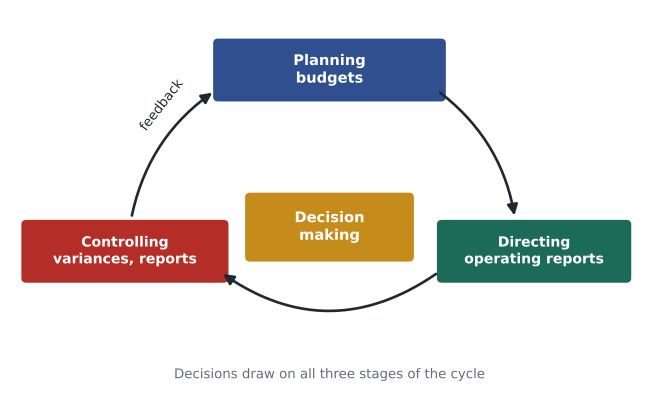
The cycle explains why managerial accountants care about cause and effect. A variance report that says costs were $20,000 over budget is of little use unless it also helps a manager see which costs, in which department, for what reason. A good managerial accountant is less a scorekeeper than a business partner who understands operations well enough to explain what the numbers mean.
Meet the course company
Throughout the course we follow Cedar Ridge Furniture Inc., an invented private manufacturer in Grand Rapids, Michigan. Cedar Ridge makes solid-wood furniture in two ways. Its production line makes a standard dining chair, the Classic, in large batches, and later in the course adds a matching trestle bench. Its custom shop builds one-off pieces, such as boardroom tables and reception desks, to customer order. The company reports under US GAAP, pays federal and state corporate income tax, and collects state sales tax where required. Its managers are about to prepare the budget for the coming year and want better cost information to do it.
The Classic chair's figures recur so often that they are worth stating now. Each chair sells to retailers for $180. Making one uses 5 board feet of hardwood at $12 per board foot ($60 of direct materials), 1.5 direct labor hours at $20 per hour ($30), and variable manufacturing overhead of $8 per direct labor hour ($12). Variable selling costs, mainly freight and sales commission, add $6 per chair. Fixed manufacturing overhead for the chair line is $216,000 a year and fixed selling and administrative costs are $144,000 a year. The company expects to sell 7,000 chairs next year. Every figure is invented for teaching, but the structure is typical of a small manufacturer.
| Classic chair: per-unit data | Amount |
|---|---|
| Selling price | $180 |
| Direct materials (5 board feet × $12) | $60 |
| Direct labor (1.5 hours × $20) | $30 |
| Variable manufacturing overhead (1.5 hours × $8) | $12 |
| Variable selling cost | $6 |
| Fixed manufacturing overhead per year | $216,000 |
| Fixed selling and administrative cost per year | $144,000 |
| Expected sales next year | 7,000 chairs |
# Cedar Ridge Furniture: a first look at the Classic chair (illustrative)
price = 180
variable = {"direct materials": 60, "DL": 30,
            "variable overhead": 12, "variable selling": 6}
fixed = {"fixed manufacturing overhead": 216_000,
         "fixed selling and admin": 144_000}
units = 7_000

vc = sum(variable.values())
cm_unit = price - vc
print(f"Variable cost per chair:       ${vc}")
print(f"Contribution margin per chair: ${cm_unit}")
print(f"Total fixed costs:             ${sum(fixed.values()):,}")
income = cm_unit * units - sum(fixed.values())
print(f"Operating income at {units:,} chairs: ${income:,}")Variable cost per chair: $108 Contribution margin per chair: $72 Total fixed costs: $360,000 Operating income at 7,000 chairs: $144,000
Even this small program raises managerial questions. Each chair contributes $72 toward fixed costs after its own variable costs are covered. At 7,000 chairs the line earns $144,000 of operating income. What happens if sales fall to 6,000? What if the price of hardwood rises by 10 percent? What if the company adds the bench? Lessons 3 and 4 build the tools to answer these questions quickly.
Managerial accounting in a changing business environment
Several trends have changed what managerial accountants do. Automation and data systems mean that transaction processing, once the bulk of accounting work, is largely done by enterprise resource planning (ERP) software. The managerial accountant's job has shifted toward analysis: building models, interpreting data and advising managers. Lean manufacturing and just-in-time inventory (BUS-230) reduced the inventory buffers that once hid inefficiency, which made timely cost information more valuable. Global supply chains and tariffs (BUS-230, lesson 12) made material costs more volatile, so budgets need more frequent revision. And sustainability reporting has added non-financial measures, such as energy use and waste per unit, to the managerial accountant's dashboard.
Data analytics deserves special mention. A modern cost analyst might use regression to separate fixed and variable costs (lesson 3), simulation to test a budget against uncertain sales (lesson 10), and dashboards to track variances in close to real time. Generative AI tools can draft analyses and summarize data, but they can also produce confident errors, so a professional must check the logic and the numbers and remains responsible for the result. ACCT-341 covers data analytics for accountants in depth; this course uses short Python programs to make the calculations transparent and repeatable.
| Trend | Effect on managerial accounting |
|---|---|
| ERP systems and automation | Less manual bookkeeping; more analysis, modeling and advice |
| Lean and just-in-time production | Smaller inventories; demand for timely, operational cost data |
| Activity-based thinking | Overhead traced to activities and customers, not just labor hours (lesson 7) |
| Volatile input costs and tariffs | More frequent re-forecasting and scenario budgets |
| Data analytics and AI tools | Regression, simulation and dashboards; need for professional skepticism |
| Sustainability measures | Non-financial metrics alongside costs in scorecards (BUS-450) |
The profession: who does managerial accounting
In the United States, management accountants commonly hold the Certified Management Accountant (CMA) credential awarded by the Institute of Management Accountants (IMA), the Certified Public Accountant (CPA) license issued by state boards of accountancy, or both. The CMA exam has two parts: Part 1 covers financial planning, performance and analytics, and Part 2 covers strategic financial management. Each part has 100 multiple-choice questions followed by a second section; from the September–October 2026 testing window, case-based questions replace the former essays, with the content unchanged. The CPA exam, developed by the AICPA, includes a Business Analysis and Reporting discipline option, and many CPAs work in industry as controllers, cost analysts, financial planning and analysis (FP&A) managers and chief financial officers.
| Role | Typical managerial accounting work |
|---|---|
| Cost accountant or cost analyst | Product costing, standard costs, inventory valuation, variance analysis |
| FP&A analyst or manager | Budgets, forecasts, scenario models, performance reporting |
| Controller | Runs the accounting function; owns internal reporting and controls |
| Chief financial officer | Financial strategy, capital allocation, investor and lender relations |
| Business partner (embedded in operations) | Advises a plant, region or product team on costs and decisions |
Ethics in managerial accounting
Because managerial reports are internal and unaudited, they depend heavily on the integrity of the people who prepare them. Pressure to meet a budget, earn a bonus or win approval for a pet project can tempt people to shade numbers: shifting costs between periods, padding budgets with slack, delaying the recognition of problems, or presenting only the analysis that supports a preferred decision. The consequences can be serious. Decisions based on manipulated information waste resources, and internal manipulation often spills into the external statements.
The IMA Statement of Ethical Professional Practice, which binds CMAs and IMA members, rests on four overarching principles: honesty, fairness, objectivity and responsibility. It sets four standards: competence, confidentiality, integrity and credibility. It also describes how to resolve an ethical conflict: follow the organization's policies, discuss the issue with an immediate supervisor (or the next level up if the supervisor is involved), consult an objective adviser such as the IMA ethics helpline, and consult a lawyer about legal obligations. CPAs are also bound by the AICPA Code of Professional Conduct and their state board's rules.
Worked problem
An ethical dilemma
Near year end, the production manager asks the cost analyst to record next month's large materials purchase as an expense now, because the plant is under budget this year and the manager wants to "use up" the budget so it is not cut next year.
Show solution
- Identify the issue: recording a cost in the wrong period misstates both years' results and misleads the people who rely on the reports.
- Identify the pressure: budget-use-it-or-lose-it incentives encourage wasteful timing games.
- Apply the standards: integrity and objectivity require reporting costs when incurred; the analyst should decline.
- Escalate if needed: explain the concern to the manager; if pressed, raise it with the controller under the company's policy.
- Suggest a better fix: budgets set on expected needs, not last year's spending, remove the incentive (lesson 10).
Answer: Decline to misstate the timing, explain why, escalate through proper channels if necessary, and propose a budgeting change that removes the incentive.
How this course is organized
The course moves from concepts to costing to decisions to planning and control. Lesson 2 builds the vocabulary of cost. Lesson 3 shows how costs behave as activity changes and how to estimate that behavior from data. Lesson 4 uses that knowledge for cost-volume-profit analysis, extending the break-even ideas introduced in BUS-110. Lessons 5 to 8 cover product costing: job-order costing for the custom shop, process costing for the chair line, an introduction to activity-based costing, and the difference between variable and absorption costing. Lesson 9 applies relevant costing to everyday decisions. Lessons 10 and 11 cover budgeting, flexible budgets and standard cost variances. Lesson 12 covers responsibility accounting and performance measurement and ends with a capstone planning and control package for Cedar Ridge.
Later accounting courses go deeper: ACCT-222 Cost Accounting (activity-based costing in depth, joint products, standard costing refinements), ACCT-321 Management Accounting and Control (control systems and transfer pricing), and ACCT-421 Performance Management. FIN-201 covers capital budgeting decisions that span many years, which this course mentions only in passing.
Common mistakes
MistakeThinking managerial accounting must follow IFRS, ASPE or US GAAP.
InsteadInternal reports follow no external standard; they are judged by usefulness. The inventory figures in external statements must still follow the reporting framework.
MistakeTreating managerial accountants as scorekeepers only.
InsteadThey are business partners who help plan, explain results and evaluate decisions.
MistakeWaiting for perfectly precise numbers before deciding.
InsteadA timely, reasonable estimate is often more useful than a perfect figure that arrives too late.
MistakeAssuming internal reports need no ethical care because they are not published.
InsteadProfessional codes apply to internal work; manipulated internal reports lead to bad decisions and often to misstated external reports.
MistakeAccepting an AI-generated cost analysis without checking it.
InsteadVerify the logic, data and arithmetic; the professional remains responsible for the result.
Summary and key terms
- Managerial accounting provides information to internal users for planning, directing, controlling and decision making.
- Unlike financial accounting, it is forward-looking, segment-focused, flexible in format and not governed by external standards.
- The management cycle links budgets (planning), operating reports (directing) and variance analysis (controlling).
- Cedar Ridge Furniture, an invented manufacturer with a chair line and a custom shop, runs through the course.
- Automation, lean production, data analytics and sustainability have shifted the role toward analysis and advice.
- In the US, management accountants often hold the IMA's CMA, a CPA license or both.
- Ethical codes require integrity and objectivity in internal reporting, and set out how to resolve conflicts.
- Managerial accounting
- Accounting that provides information to internal users for planning, control and decisions.
- Planning
- Setting goals and choosing the means to achieve them, expressed mainly in budgets.
- Directing
- Running daily operations using timely operating information.
- Controlling
- Comparing actual results with plans and taking corrective action.
- Performance report
- A report comparing actual results with budgeted or standard amounts.
- Budget
- A quantitative plan for a future period.
- Segment
- Any part of an organization for which costs or revenues are measured, such as a product line or department.
- Controller
- The officer responsible for an organization's accounting function and internal reporting.
- FP&A
- Financial planning and analysis: the function that prepares budgets, forecasts and performance analysis.
- Budgetary slack
- Deliberately understated revenue or overstated cost in a budget to make targets easier to meet.
Practice problems
Work each problem on paper first, then reveal the answer to check.
Give two ways managerial accounting differs from financial accounting.
Show answer
Any two: internal users; no external standards; forward-looking; segment focus; any frequency; non-financial measures.
Match each tool to a stage of the management cycle: budget, variance report, daily production log.
Show answer
Budget: planning; variance report: controlling; production log: directing.
Using the Classic chair data, what is the contribution margin per chair?
Show answer
$180 − ($60 + $30 + $12 + $6) = $72.
What operating income does Cedar Ridge expect at 7,000 chairs?
Show answer
7,000 × $72 − $360,000 = $144,000.
Why might a manager prefer a rough estimate today to a precise report next month?
Show answer
Decisions often cannot wait; a timely estimate allows action while it still matters.
Name two non-financial measures a furniture plant might track.
Show answer
Examples: defect rate, on-time delivery, labor hours per chair, board feet of waste per chair, safety incidents.
Why is budgetary slack harmful?
Show answer
It distorts plans, hides inefficiency and makes performance evaluation less meaningful.
What should an accountant do first when a supervisor asks for a misleading report?
Show answer
Decline, explain the concern, and follow the organization's policy for raising it with the next level.
How do ERP systems change a managerial accountant's work?
Show answer
They automate transaction processing, freeing time for analysis, modeling and advising.
Modify the Python program to show operating income at 6,000 chairs.
Show answer
6,000 × 72 − 360,000 = $72,000.
Lesson quiz · 5 questions
Score 60% or more to complete this lesson.
Create a free account to save your progress, take quizzes and earn a certificate.