
ACCT-102 · Lesson 6 of 12 · 27 min
Process costing
Cedar Ridge's Classic chairs are identical. It would be pointless to keep a separate cost sheet for each of the 7,000 chairs the line makes in a year, because every chair receives the same materials and the same work. Instead, the company accumulates costs by department for each period and divides by the number of units the department worked on. That is process costing, the system used by makers of chairs, paint, flour, cereal, pharmaceuticals, steel and electricity. The tricky part is that at the end of any period some units are only partly finished. This lesson introduces equivalent units to deal with partly finished units, works through the weighted-average method step by step, shows how costs are transferred between departments, compares the FIFO method briefly, and introduces spoilage. ACCT-222 covers FIFO, spoilage and joint products in depth.
How process costing differs from job costing
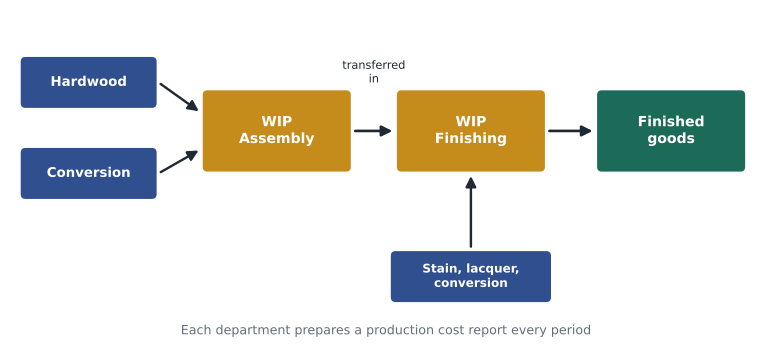
Process costing uses the same three cost elements and the same flow from raw materials to work in process to finished goods as job costing. Two things change. First, there is a separate work in process account for each processing department, and costs are accumulated by department, not by job. Second, unit costs are calculated by dividing each department's costs for the period by the units it produced, expressed as equivalent units. Cedar Ridge's chair line has two departments: Assembly, where boards are cut, shaped and assembled into chairs, and Finishing, where chairs are sanded, stained and lacquered. Chairs move from Assembly to Finishing, then to finished goods.
Equivalent units
Suppose Assembly worked on chairs during March and ended the month with 50 chairs that had all their wood but only 60 percent of their assembly work done. Those 50 partly finished chairs represent the same amount of conversion effort as 30 fully assembled chairs. Equivalent units express partly completed work as the number of whole units that could have been completed with the same effort: equivalent units = physical units × percentage complete. Because materials and conversion are often added at different times, equivalent units are computed separately for each cost element. At Cedar Ridge, all hardwood is issued at the start of Assembly, so units in Assembly are always 100 percent complete for materials. Conversion costs (direct labor and overhead) are added evenly through the process.
| Ending work in process | Physical units | % complete | Equivalent units |
|---|---|---|---|
| Materials (added at start) | 50 | 100% | 50 |
| Conversion (added evenly) | 50 | 60% | 30 |
The weighted-average method in five steps
The weighted-average method combines the cost of the beginning work in process with the costs added during the period and spreads the total over all units worked on, as if the beginning units had been started this period. It is simple and widely used. The calculation follows five steps, summarized in a production cost report: (1) account for physical units; (2) compute equivalent units for each cost element; (3) total the costs to account for; (4) compute the cost per equivalent unit; and (5) assign costs to units completed and transferred out and to ending work in process.
| Assembly department, March | Data |
|---|---|
| Beginning work in process | 80 chairs; materials 100%, conversion 40% |
| Beginning WIP costs | Materials $4,800; conversion $1,500 |
| Started during March | 600 chairs |
| Ending work in process | 50 chairs; materials 100%, conversion 60% |
| Costs added during March | Materials $36,000; conversion $30,180 |
Worked problem
Weighted-average production cost report
Prepare the Assembly department's production cost report for March using the weighted-average method.
Show solution
- Step 1, physical units: units to account for = 80 + 600 = 680. Completed and transferred = 680 − 50 = 630; ending WIP = 50.
- Step 2, equivalent units: materials = 630 + 50 × 100% = 680; conversion = 630 + 50 × 60% = 660.
- Step 3, costs to account for: materials 4,800 + 36,000 = $40,800; conversion 1,500 + 30,180 = $31,680; total $72,480.
- Step 4, cost per equivalent unit: materials 40,800 ÷ 680 = $60.00; conversion 31,680 ÷ 660 = $48.00; total $108.00.
- Step 5, assign costs: transferred out 630 × $108 = $68,040; ending WIP = 50 × $60 + 30 × $48 = $3,000 + $1,440 = $4,440.
- Check: $68,040 + $4,440 = $72,480, equal to the costs to account for.
Answer: Transferred to Finishing $68,040; ending work in process $4,440.
# Weighted-average production cost report: Assembly, March (illustrative)
beg_units, started, end_units = 80, 600, 50
end_pct = {"materials": 1.00, "conversion": 0.60}
beg_cost = {"materials": 4_800, "conversion": 1_500}
added = {"materials": 36_000, "conversion": 30_180}

completed = beg_units + started - end_units
eu = {k: completed + end_units * pct for k, pct in end_pct.items()}
total_cost = {k: beg_cost[k] + added[k] for k in added}
per_eu = {k: total_cost[k] / eu[k] for k in eu}

transferred = completed * sum(per_eu.values())
ending = sum(end_units * end_pct[k] * per_eu[k] for k in per_eu)

print(f"Completed and transferred: {completed} chairs")
for k in eu:
    print(f"{k:<11} EU {eu[k]:>5.0f}  cost {total_cost[k]:>7,}  per EU ${per_eu[k]:.2f}")
print(f"Transferred out ${transferred:,.0f}; ending WIP ${ending:,.0f}; "
f"total ${transferred + ending:,.0f}")Completed and transferred: 630 chairs materials EU 680 cost 40,800 per EU $60.00 conversion EU 660 cost 31,680 per EU $48.00 Transferred out $68,040; ending WIP $4,440; total $72,480
The program reproduces the hand calculation and makes it easy to test changes. For example, if ending work in process were only 20 percent complete for conversion, conversion equivalent units would fall to 640 and the conversion cost per unit would rise to $49.50, shifting a little more cost to the chairs transferred out.
Transferred-in costs and the second department
When chairs move to Finishing, their Assembly cost moves with them as transferred-in cost. To Finishing, transferred-in cost behaves like a raw material added at the start of its process: every unit in Finishing is 100 percent complete for transferred-in cost. Finishing then adds its own materials (stain and lacquer, which at Cedar Ridge are applied near the end of the process) and its own conversion costs. Finishing's production cost report therefore has three cost columns: transferred in, materials and conversion. The cost of the chairs Finishing completes carries all the costs from both departments.
# Finishing department, March: three cost elements (illustrative)
beg = {"units": 40, "transferred in": 4_310, "materials": 0, "conversion": 520}
received, end_units = 630, 30
end_pct = {"transferred in": 1.0, "materials": 0.0, "conversion": 0.5}   # lacquer added at end
added = {"transferred in": 68_040, "materials": 4_960, "conversion": 15_310}

completed = beg["units"] + received - end_units
total_unit_cost = 0
assigned_end = 0
for k in added:
    eu = completed + end_units * end_pct[k]
    cost = beg[k] + added[k]
    per = cost / eu
    total_unit_cost += per
    assigned_end += end_units * end_pct[k] * per
    print(f"{k:<15} EU {eu:>4.0f}  cost {cost:>7,}  per EU ${per:6.2f}")
print(f"Finished chairs: {completed} at ${total_unit_cost:.2f} = ${completed * total_unit_cost:,.0f}")
print(f"Ending WIP in Finishing: ${assigned_end:,.0f}")transferred in EU 670 cost 72,350 per EU $107.99 materials EU 640 cost 4,960 per EU $ 7.75 conversion EU 655 cost 15,830 per EU $ 24.17 Finished chairs: 640 at $139.90 = $89,538 Ending WIP in Finishing: $3,602
Each finished Classic chair costs about $140 by the time it reaches the warehouse in March: about $108 from Assembly and about $32 of Finishing materials and conversion. That is close to the $132 manufacturing cost per chair the company uses in its plans, which includes fixed overhead at the normal volume of 7,200 chairs a year; March's figure is slightly higher because March production of 640 finished chairs is part of a seasonal pattern and the fixed overhead charged to the month is spread over fewer chairs. Managers comparing monthly unit costs should watch for exactly this kind of volume effect, which lesson 8 explores.
Journal entries in a process costing system
| Event | Debit | Credit | Amount (March) |
|---|---|---|---|
| Hardwood issued to Assembly | Work in process: Assembly | Raw materials | $36,000 |
| Stain and lacquer issued to Finishing | Work in process: Finishing | Raw materials | $4,960 |
| Conversion costs (labor and applied overhead), Assembly | Work in process: Assembly | Wages payable; Manufacturing overhead | $30,180 |
| Conversion costs, Finishing | Work in process: Finishing | Wages payable; Manufacturing overhead | $15,310 |
| Chairs transferred to Finishing | Work in process: Finishing | Work in process: Assembly | $68,040 |
| Chairs completed | Finished goods | Work in process: Finishing | (from the report) |
| Chairs sold | Cost of goods sold | Finished goods | (units sold × unit cost) |
Overhead in process costing is still usually applied at a predetermined rate, by department, just as in job costing, and under- or overapplied overhead is cleared at year end in the same way (lesson 5).
The FIFO method in brief
The first-in, first-out (FIFO) method separates the work done on beginning inventory from the work done on units started this period. Equivalent units count only the work done this period: the work needed to finish the beginning units, plus the work on units started and completed, plus the work on ending work in process. Costs per equivalent unit use only the costs added this period, so they measure current-period performance without the influence of last period's costs. That makes FIFO better for evaluating this month's efficiency, at the price of more calculation.
# FIFO equivalent units and cost per EU for Assembly, March (illustrative)
beg_units, beg_pct_conv = 80, 0.40
started, end_units, end_pct_conv = 600, 50, 0.60
added = {"materials": 36_000, "conversion": 30_180}

started_completed = started - end_units
eu_mat = 0 * beg_units + started_completed + end_units           # materials already in beginning WIP
eu_conv = beg_units * (1 - beg_pct_conv) + started_completed + end_units * end_pct_conv
print(f"FIFO EU: materials {eu_mat:.0f}, conversion {eu_conv:.0f}")
print(f"FIFO cost per EU: materials ${added['materials'] / eu_mat:.2f}, "
f"conversion ${added['conversion'] / eu_conv:.2f}")FIFO EU: materials 600, conversion 628 FIFO cost per EU: materials $60.00, conversion $48.06
Under FIFO the materials cost per equivalent unit is $60 (the hardwood price did not change), but the conversion cost per equivalent unit is about $48.06, slightly higher than the weighted-average figure of $48, because beginning inventory carried conversion costs from February at a lower rate ($1,500 ÷ 32 equivalent units ≈ $46.88), which weighted average blends into the March figure. When prices and efficiency are stable, the two methods give nearly the same results. Both are acceptable for external reporting; companies choose based on the usefulness of the information and the cost of the calculation.
| Weighted average | FIFO | |
|---|---|---|
| Beginning WIP costs | Combined with current costs | Kept separate |
| Equivalent units | All work on units completed plus ending WIP | Only work done this period |
| Cost per EU reflects | Average of last period and this period | This period only |
| Best for | Simplicity; stable costs | Evaluating current performance |
| Assembly conversion cost per EU, March | $48.00 | about $48.06 |
Spoilage in brief
Some units are inevitably damaged or rejected: a chair leg splits, a finish blisters. Normal spoilage is the amount expected under efficient operating conditions; its cost is treated as part of the cost of the good units, because it is an unavoidable cost of producing them. Abnormal spoilage is spoilage beyond what is expected; its cost is charged to a loss account in the period, because it should not inflate the cost of good units and managers need to see it. If Cedar Ridge expects 2 percent of chairs to fail inspection and 5 percent fail one month, the extra 3 percent is abnormal and is reported separately. The detailed calculations belong to ACCT-222; the principle is that the accounting should make avoidable waste visible.
Worked problem
Normal and abnormal spoilage
Finishing inspects 670 chairs in a month. Normal spoilage is 2 percent of chairs inspected; 22 chairs fail inspection. Each spoiled chair has a full cost of $140 and no salvage value. How is the cost treated?
Show solution
- Normal spoilage = 2% × 670 = 13.4, about 13 chairs.
- Abnormal spoilage = 22 − 13 = 9 chairs.
- Normal spoilage: 13 × $140 = $1,820, added to the cost of the 648 good chairs.
- Abnormal spoilage: 9 × $140 = $1,260, charged to a loss from abnormal spoilage.
Answer: About $1,820 is absorbed by good units and $1,260 is reported as a loss for managers to investigate.
Common mistakes
MistakeDividing total department costs by physical units when work in process exists.
InsteadUse equivalent units, computed separately for each cost element.
MistakeAssuming materials and conversion have the same percentage of completion.
InsteadMaterials are often added at a point in the process; conversion is usually added evenly.
MistakeForgetting transferred-in costs in the second department.
InsteadTreat transferred-in cost as a separate element, 100 percent complete.
MistakeUsing only current-period costs under the weighted-average method.
InsteadWeighted average includes beginning WIP costs; FIFO uses only current-period costs.
MistakeBurying abnormal spoilage in the cost of good units.
InsteadCharge abnormal spoilage to a loss so managers see it.
Summary and key terms
- Process costing accumulates costs by department for each period and suits identical units.
- Equivalent units restate partly completed units as whole units, separately for each cost element.
- The weighted-average method combines beginning WIP costs with current costs.
- The five steps are: physical units, equivalent units, costs to account for, cost per EU, and assignment of costs.
- Transferred-in costs are a separate cost element for later departments.
- FIFO uses only current-period work and costs and is better for evaluating current performance.
- Normal spoilage is part of the cost of good units; abnormal spoilage is a period loss.
- Process costing
- A system that accumulates costs by department or process and averages them over units produced.
- Equivalent units
- Partly completed units expressed as the number of whole units that the work represents.
- Production cost report
- A department report showing physical units, equivalent units, costs and their assignment.
- Weighted-average method
- A process costing method that combines beginning inventory costs with current-period costs.
- FIFO method (process costing)
- A method that separates work on beginning inventory from current-period work.
- Transferred-in cost
- The cost of units received from a previous department.
- Conversion cost
- Direct labor plus manufacturing overhead.
- Normal spoilage
- Spoilage expected under efficient operations, treated as a product cost.
- Abnormal spoilage
- Spoilage beyond normal levels, charged to a loss in the period.
- Operation costing
- A hybrid system combining job costing for materials with process costing for conversion.
Practice problems
Work each problem on paper first, then reveal the answer to check.
100 units in ending WIP are 100% complete for materials and 25% for conversion. Compute equivalent units.
Show answer
Materials 100; conversion 25.
Completed 900 units; ending WIP 100 units, 40% converted. Find weighted-average conversion EU.
Show answer
900 + 40 = 940.
Conversion costs to account for are $47,000 and conversion EU are 940. Find the cost per EU.
Show answer
$50.
Materials cost per EU is $20 and conversion $50. What is the cost of 900 units transferred out?
Show answer
900 × $70 = $63,000.
Value ending WIP of 100 units (materials 100%, conversion 40%) using those rates.
Show answer
100 × $20 + 40 × $50 = $4,000.
Why is transferred-in cost 100 percent complete in the second department?
Show answer
Units arrive with all prior-department work already done, like materials added at the start.
In March, which method gives a higher conversion cost per EU, and why?
Show answer
FIFO ($48.06 against $48.00), because weighted average blends in February's lower conversion cost in beginning WIP.
Normal spoilage is 3 percent of 1,000 units inspected; 45 units are spoiled at $50 each. Split the cost.
Show answer
Normal 30 × $50 = $1,500 (product cost); abnormal 15 × $50 = $750 (loss).
Give two industries that use process costing.
Show answer
Examples: paint, cereal, oil refining, pharmaceuticals, beverages.
Change the Assembly program so ending WIP is 20 percent converted. What is the conversion cost per EU?
Show answer
EU = 630 + 10 = 640; 31,680 ÷ 640 = $49.50.
Lesson quiz · 5 questions
Score 60% or more to complete this lesson.
Create a free account to save your progress, take quizzes and earn a certificate.