
WLD-320 · Lesson 9 of 12 · 17 min
Uphill and downhill pipe welding
Everything Devon has welded on pipe so far has been uphill: start at the bottom, climb to the top. On a cold morning in the fourth week, Glen sends him with Rob Haldane to watch a pipeline crew tie Hartwell's Coldwater separator skid into a gas gathering line 12 km (7 mi) outside town. The crew welds downhill, from the top of the pipe to the bottom, with cellulosic electrodes, at a speed that astonishes him: the root on an NPS 8 joint is done by two welders working on opposite sides in less time than it takes him to run one half of an NPS 6 root uphill. This lesson explains the difference between uphill and downhill pipe welding, how pipeline crews are organized, and which codes govern their welds.
Two progressions
Progression is the direction of travel on a fixed joint. Uphill, or vertical-up, starts at the bottom and climbs; downhill, or vertical-down, starts at the top and descends. The two need different techniques and give different welds.
| Uphill | Downhill | |
|---|---|---|
| Travel speed | Slow | Fast, often two to three times faster |
| Pool | Larger, held up by the bead below | Small, kept ahead of the slag by arc force and speed |
| Penetration and fusion | Deep, forgiving of fit-up | Shallower; needs precise fit-up and technique |
| Heat input | Higher per pass | Lower per pass, more passes |
| Typical electrodes | Low-hydrogen fill and cap; cellulosic or GTAW root | Cellulosic for every pass; low-hydrogen downhill types on some lines |
| Typical use | Process piping, plant work, heavy wall | Cross-country pipelines |
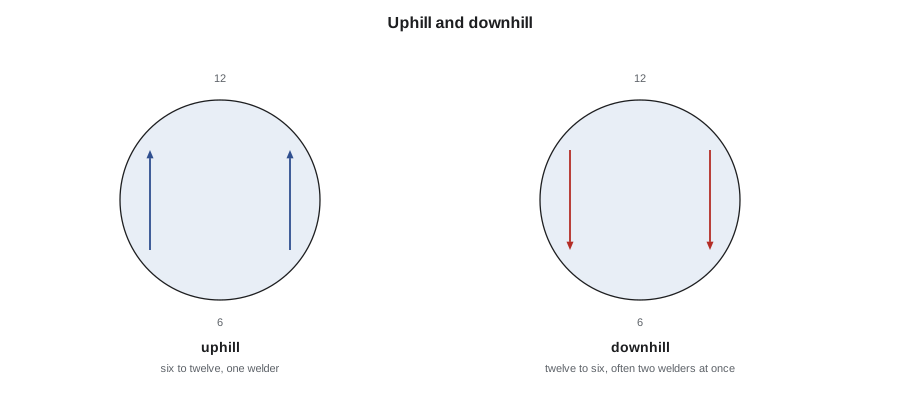
Downhill works because the pool is kept small and moves fast. The welder holds a short arc and a steep drag angle, pointing the electrode back up the joint, and the arc force pushes the molten metal and slag up behind the pool while the electrode races ahead. If he slows down, the slag runs ahead of the pool and is trapped under it; if he speeds up too much, the pool does not fuse the sidewalls. The window is narrow, and a downhill pipeline welder spends years in it.
Uphill is slower but more forgiving. The pool sits on the bead below it, the slag stays behind and above, and the welder has time to fuse the sidewalls and correct for variations in fit-up. That is why process piping, where joints vary, walls are heavy and every weld is a different size, is welded uphill.
Pipeline electrodes
Cross-country pipelines are traditionally welded downhill with cellulosic electrodes. The root, called the stringer bead on a pipeline, is run with an E4310 or E6010 type, and the hot pass, fill and cap with the same or with higher-strength cellulosic types, such as E5510 or E8010-P1, to match the strength of high-grade line pipe. On some lines, and on most large-diameter projects today, the fill and cap are welded with mechanized gas metal arc welding or with flux-cored wire, and low-hydrogen downhill electrodes are used where cracking is a concern. The crew Devon watches uses E4310 for the stringer and hot pass and E5510-P1 for the fill and cap on Grade 359 pipe.
Pipeline currents are higher than shop roots and the electrodes are larger. A 4.0 mm (5/32 in) E4310 or E6010 stringer is common on NPS 8 and above, at about 120 to 160 amps, and the hot pass follows at even higher current. Pipeline welders often use engine-driven welders on the back of their own trucks, and each welder tunes his machine to his own technique.
How a pipeline spread works
A pipeline is built by a spread, a moving construction crew that lays the pipe in a long sequence. Ahead of the welders, the right-of-way is cleared, graded and trenched, and the pipe is hauled, strung along the trench and bent to fit the ground. The welding crew is split into the front end and the back end. The front end lines up each joint with an internal line-up clamp and welds the stringer bead and hot pass, often with two or more welders on each joint at once. The back end, following behind, welds the fill and cap passes. Behind them come the inspectors, the radiography or ultrasonic crew, the coating crew, and the crews that lower the pipe into the trench and backfill it.
The front end sets the pace of the whole spread, because the line-up clamp cannot be released and moved to the next joint until enough of the stringer is complete. On a large project a front-end crew can weld more than a hundred joints in a day. A small gathering line like the Coldwater tie-in is built by a much smaller crew of a few welders, but the pattern is the same.
# Pipeline front end: how many joints a crew can root and hot-pass in a shift
import math
OD = 219.1                       # outside diameter, mm
welders = 2                     # welders on each joint, opposite sides
speed_root = 300               # downhill stringer travel speed, mm/min
speed_hot = 380                # hot pass travel speed, mm/min
setup = 6.0                     # minutes per joint for line-up, clamp and moving on
shift = 10 * 60                 # minutes
circ = math.pi * OD
per_welder = circ / welders     # length each welder covers per pass
t_joint = per_welder / speed_root + per_welder / speed_hot + setup
print(f"circumference {circ:.0f} mm, each welder covers {per_welder:.0f} mm per pass")
print(f"time per joint about {t_joint:.1f} min, about {int(shift / t_joint)} joints per shift")
uphill = per_welder / 100 + per_welder / 140 + setup
print(f"the same two passes uphill would take {uphill:.1f} min per joint")circumference 688 mm, each welder covers 344 mm per pass time per joint about 8.1 min, about 74 joints per shift the same two passes uphill would take 11.9 min per joint
The numbers show why pipelines are welded downhill. Each pass takes a welder about a minute on the NPS 8 tie-in line, and most of each joint's time goes into lining up and moving the clamp. The same passes uphill would take more than twice as long.
The tie-in welder
Not every pipeline weld is made on the main line. A tie-in joins two sections of line that were built separately, or joins the line to a valve, a crossing or a facility. Tie-ins are made in the ditch or a bell hole, with no line-up clamp, often with the pipe under some stress from its own weight and from bending. A tie-in welder is usually the most experienced on the crew, and tie-ins are often welded uphill, with more care, because conditions are poor and the joint cannot be rolled or lined up perfectly. The Coldwater tie-in is one of these: the gathering line rises out of the ditch to a flanged riser that Hartwell fabricated, and the last weld joins Hartwell's riser to the line.
The pipeline's welder makes that weld, not Rob or Devon, because Hartwell's welders are qualified to process piping procedures, not to the pipeline company's procedures and the pipeline code. Rob explains the boundary: Hartwell's riser is pressure piping built to the plant code up to the first flange, and the line beyond it belongs to the pipeline company and is built to the pipeline code.
Pipeline codes and qualification
In Canada, oil and gas pipelines are designed, built and operated to CSA Z662, which contains its own clauses on welding procedures, welder qualification, inspection and acceptance. In Alberta, the energy regulator enforces it for the pipelines it licenses. Pipeline welders qualify on the company's procedure under Z662, with tests that include radiography or destructive tests such as nick-break and bend specimens.
The nick-break test is the pipeline test most different from the process piping bend test. A strip is cut across the weld, notched on each edge at the weld centre, and broken, so that the fracture surface runs through the weld metal. The inspector examines the broken faces for porosity, slag and lack of fusion, which show up clearly on a fresh fracture. Bend tests are used too, and many pipeline codes allow radiography of the test weld instead of destructive testing.
Pipeline acceptance standards differ from process piping too. They were developed for welds made fast, downhill, on long runs of the same joint, and they allow some kinds and sizes of indications that a process piping code would reject, while being stricter about others. Pipeline codes also allow acceptance based on an engineering critical assessment, in which the size of defect the line can tolerate is calculated from its loads and toughness. A process piping welder going to a pipeline job, or the reverse, must learn the other code's rules as well as its technique.
Cold weather and the hot pass
On the tie-in morning, the air is well below freezing. The pipeline crew preheats each joint with a torch before the stringer and keeps the joint warm, because the procedure sets a minimum temperature and because moisture on cold pipe causes porosity and hydrogen cracking. They also get the hot pass on quickly after the stringer. A downhill stringer is thin, and as the pipe cools and the line moves, the stresses on it can crack it. The time between finishing the stringer and starting the hot pass is limited by the procedure, often to a few minutes.
Devon watches the crew's welding inspector check each joint's preheat, timing and visual quality and record it, and watches the ultrasonic crew test the welds behind them. He also notices how little the welders talk. Each knows his place on the joint, and a pair of stringer welders who have worked together for years start and finish their halves almost at the same moment.
Downhill in the shop
Hartwell does not weld production pipe downhill; all its procedures are uphill. But the downhill technique has a use in the shop: it is the fastest way to run a thin root or cap on light-wall pipe that does not need the penetration of uphill, and some owners' procedures for low-pressure services allow it. Marta has Devon run a few downhill roots on scrap NPS 6 so that he understands the technique, and she is frank about the results. His pools run away from him, he traps slag at every slowdown, and the inside of the root is patchy. She tells him that is what everyone's first week of downhill looks like, and that the pipeline welders he watched have done tens of thousands of joints.
Mechanized pipeline welding
On large-diameter, long-distance pipelines, manual downhill welding has largely given way to mechanized welding. A welding bug, a small carriage that runs on a band clamped around the pipe, carries a GMAW torch around the joint at a set speed and oscillation, controlled by an operator who watches the pool and adjusts the settings. The root may be welded from the inside by an internal welding machine that is part of the line-up clamp, or from the outside with a controlled short-circuit process. Mechanized systems weld faster, with fewer defects, and with consistent heat input, which matters on the high-strength steels used for large lines. Their welds are usually examined by automated ultrasonic testing, which scans the whole weld and records the result.
The pipeline welders on the Coldwater tie-in use stick electrodes, because the gathering line is small and short and a mechanized system would take longer to set up than the whole job takes to weld. Rob tells Devon that the welders on the big lines still learn stick first, because tie-ins, repairs and short runs are still welded by hand, and because the skills of reading a pool and controlling a root carry over to every process.
What Devon takes back to the shop
On the drive back, Devon tells Rob what struck him most. It was not the speed, although that was impressive, but how much the pipeline crew depended on preparation: every bevel was machined in the field by a bevelling machine on a track, every joint was lined up with the internal clamp until it was perfectly round and gapped, and the welders' work began only when the joint was ready. Rob says that is the same lesson as the shop, just at a faster pace. A pipe welder's root is decided by the people who cut, bevel and fit the joint as much as by the welder, and the best pipe welders check the preparation themselves before they strike an arc.
Common mistakes
MistakeWelding downhill with an uphill technique.
InsteadKeep the pool small and fast with a steep drag; slowing down traps slag.
MistakeWelding a pipeline tie-in to a plant procedure.
InsteadPipeline welds use the pipeline company's procedure and code.
MistakeLeaving a downhill stringer to cool before the hot pass.
InsteadStart the hot pass within the time the procedure allows.
MistakeAssuming pipeline and process acceptance standards are the same.
InsteadLearn the acceptance rules of the code on the job.
MistakeSkipping preheat on a cold morning because the wall is thin.
InsteadApply the procedure's minimum temperature and keep the joint dry.
Summary and key terms
- Uphill is slow and forgiving; downhill is fast and needs precise technique.
- Pipelines are traditionally welded downhill with cellulosic electrodes.
- Front-end crews line up joints and weld the stringer and hot pass; the back end fills and caps.
- Tie-ins are made without line-up clamps in poor conditions by experienced welders.
- CSA Z662 governs pipelines in Canada; API 1104 governs pipeline welding in the US.
- Nick-break tests and pipeline acceptance standards differ from process piping.
- Progression
- The direction of travel on a fixed joint, uphill or downhill.
- Stringer bead
- The root pass on a pipeline weld.
- Spread
- A pipeline construction crew and its equipment, moving along the line.
- Tie-in
- A weld that joins two sections of line or a line to a facility, made without a line-up clamp.
- Nick-break test
- A test in which a notched weld strip is broken to examine the fracture faces.
Practice problems
Work each problem on paper first, then reveal the answer to check.
How long does one welder take to run half of a 219 mm OD stringer at 300 mm/min?
Show answer
pi x 219 / 2 = 344 mm, 344 / 300 = about 1.1 minutes.
Why is the hot pass started quickly after a downhill stringer?
Show answer
The thin stringer can crack as the pipe cools and moves.
Which code governs oil and gas pipelines in Canada?
Show answer
CSA Z662.
Lesson quiz · 5 questions
Score 60% or more to complete this lesson.
Create a free account to save your progress, take quizzes and earn a certificate.