
WLD-320 · Lesson 4 of 12 · 16 min
Fit-up, alignment and tacking
A pipe welder's root bead is only as good as the fit-up underneath it. On the second Monday, Marta gives Devon two NPS 4 spool joints that another apprentice fitted the week before and asks him to find what is wrong with them before anyone welds them. On the first, the gap is 4 mm (5/32 in) at the top and 1.5 mm (1/16 in) at the bottom. On the second, the gap is perfect, but the inside of one pipe sits nearly 2.5 mm (3/32 in) lower than the other at six o'clock. Both joints would make roots with defects, and in both cases a welder could do everything right and still produce a weld that fails radiography. This lesson covers how pipe joints are set up, how alignment and gap are measured and controlled, and how tack welds hold the joint without spoiling the root.
What a good fit-up looks like
A good pipe fit-up has five qualities. The two pieces are on the same axis, so the line is straight. The gap is uniform all the way around, within the range in the procedure. The inside surfaces are aligned, so there is little or no step, called hi-lo or mismatch, between the two bores. The lands are clean and even. And the joint is held securely by tacks or by a clamp or clips, so that it does not close up or open as the root is welded. Each of these is checked and recorded before the first root pass, and on most code jobs the fit-up is a hold point the inspector can choose to witness.
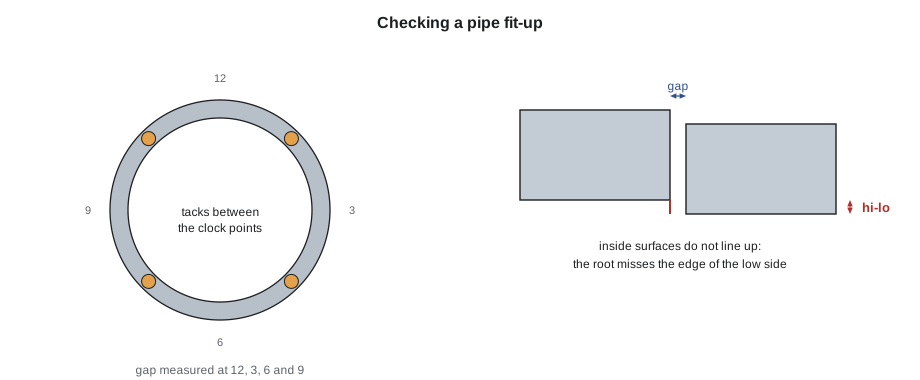
Gap
The root opening, or gap, is set to the procedure, typically about 2.5 to 3 mm (3/32 to 1/8 in) for open-root SMAW and GTAW on carbon steel pipe, a little tighter for small pipe and GTAW, and a little wider for downhill cellulosic welding on pipelines. A uniform gap lets the welder run the root at a steady rhythm. A gap that is too narrow does not penetrate; one that is too wide burns through or leaves a concave root. A gap that changes around the joint makes the welder change technique as he goes, and the transitions are where defects form.
Fitters set the gap with spacers. A common shop method is a gap rod or a bent piece of filler wire of the right diameter placed between the lands at several points while the joint is aligned and tacked, then removed. Some fitters use a bare electrode of the right size, with the flux knocked off. The gap closes slightly as tacks cool and shrink, so experienced fitters set it a little wider, often by about half a millimetre, or a sixty-fourth of an inch, on the side they will tack first.
Alignment and hi-lo
Hi-lo is the step between the inside surfaces of the two pieces. It comes from differences in the bore, from out-of-roundness, and from fitting the pieces off-centre. A small hi-lo makes the root harder to fuse on the high side. A large one leaves the edge of the low side unfused, because the root bead bridges from the high land to the face of the low pipe without melting its edge. On the radiograph, this shows as incomplete penetration due to high-low, and it is one of the most common causes of rejected pipe roots.
The allowed hi-lo comes from the procedure and the code. ASME B31.3 requires the inside surfaces to be aligned within the limits of the procedure and the engineering design, and many specifications for process piping set a limit of about 1.6 mm (1/16 in). Pipeline codes have their own limits for offset. Hartwell's procedures for the Unit 4 spools set 1.6 mm (1/16 in) maximum, and Lucia checks it with a hi-lo gauge, a small tool that hooks inside the bore of both pieces and reads the step directly. Where she cannot reach inside, she measures the outside and calculates from the walls.
When hi-lo is too large, the fitter has three options. The first is to rotate one piece, because pipe is rarely perfectly round, and turning a piece a quarter turn often brings the bores closer together. The second is to spread the mismatch evenly around the joint by centring the pieces, so that no single place has all of it. The third, when the bores are simply different, is to machine or grind a taper on the inside of the thicker piece. The procedure and the code set how the taper is made, typically a gradual slope, so that the weld joins two equal walls. Grinding inside a pipe to fix hi-lo must never take the wall below its minimum thickness, which is why it is the last option and is checked with an ultrasonic thickness gauge.
# Fit-up check: gap and hi-lo at four clock positions against the procedure limits
gap_min, gap_max = 2.4, 3.2       # mm, from the procedure
hilo_max = 1.6                       # mm
readings = {  # clock: (gap, hi-lo)
    '12': (3.0, 0.4), '3': (2.8, 0.8), '6': (2.6, 2.4), '9': (2.9, 0.9)}
ok = True
for clock, (g, h) in readings.items():
    flags = []
    if not gap_min <= g <= gap_max: flags.append('GAP')
    if h > hilo_max: flags.append('HI-LO')
    ok = ok and not flags
    print(f"{clock:>2} o'clock: gap {g} mm, hi-lo {h} mm {' '.join(flags) or 'ok'}")
gaps = [g for g, _ in readings.values()]
print(f"gap spread {max(gaps) - min(gaps):.1f} mm (keep it small for an even root)")
print('fit-up accepted' if ok else 'fit-up rejected: refit before welding')12 o'clock: gap 3.0 mm, hi-lo 0.4 mm ok 3 o'clock: gap 2.8 mm, hi-lo 0.8 mm ok 6 o'clock: gap 2.6 mm, hi-lo 2.4 mm HI-LO 9 o'clock: gap 2.9 mm, hi-lo 0.9 mm ok gap spread 0.4 mm (keep it small for an even root) fit-up rejected: refit before welding
These are the readings on the second of the two joints Marta gave Devon. The gap is fine everywhere, but the hi-lo at six o'clock is too large. Devon breaks the tacks, turns the elbow a quarter turn and refits it. The worst hi-lo drops to 1.0 mm (0.04 in), at four o'clock, and the joint passes.
Unequal walls
Sometimes the drawing calls for two pieces with different walls to be joined, such as a heavy-wall valve or fitting to lighter pipe. A large difference cannot be welded as a plain joint, because the root would meet a step. The thicker piece is tapered on the inside, the outside or both, so that the joint at the weld has equal walls and the transition is gradual. ASME B31.3 and B16.25 show the acceptable shapes. The fitter does not decide the taper; it is detailed on the drawing or in the procedure, and the inspector checks it before fit-up. Raj marks these joints on the Unit 4 isos with a note, and there are three of them in the package.
Holding the joint
Pipe joints are held for tacking in several ways. Small pipe is often aligned in a pipe vice or on a jig, or by hand with a straightedge across the joint at four points. Larger pipe is aligned with chain clamps or rim clamps that grip each side of the joint and have screws to adjust alignment and gap. In the field, pipeline crews use internal line-up clamps, which expand inside both pipes and pull them round and in line; the root is welded with the clamp in place, and it is removed only when enough of the root is complete to hold the joint. A straightedge laid along the pipe at two positions 90 degrees apart shows whether the line is straight.
For flanges and fittings, the orientation is set before tacking. A flange is set with a two-hole pin and a level, an elbow with a square and a level, and a branch with the angle on the drawing. A fitting tacked out of position must have its tacks ground out and be refitted, and on a spool with several fittings an error in the first one carries into all the others.
Tack welds
Tack welds hold the joint in place until the root is welded. On code work they are part of the finished weld, so they must be made by a qualified welder to a qualified procedure, with the same filler and preheat as the root. A tack that cracks, has porosity or does not fuse into the root becomes a defect in the finished weld.
There are two ways to tack a pipe joint. A root tack is a short length of root bead, about 13 to 25 mm (1/2 to 1 in) long, made in the groove. Before the root is welded, each tack is ground so that its ends taper to a feather edge, which lets the root bead fuse into the tack without a cold lap at each end. Many welders also grind the face of the tack thin and open the keyhole a little at each end so that the root bead penetrates fully through the tack. The second method uses bridge tacks, also called bullet tacks, or fitting clips: small pieces of bar or wedges welded to the outside of both pipes, or between the bevels above the root, so the root itself is not interrupted. Bridge tacks are removed as the root reaches them, and their marks are ground and examined. Hartwell uses root tacks on small pipe and bridge clips on large pipe and on stainless.
The number of tacks depends on the pipe size. NPS 2 and smaller usually takes two or three tacks; NPS 3 to 6 takes four, at the quarter points; larger pipe takes tacks about every 100 to 150 mm (4 to 6 in) of circumference. Tacks are placed so that the welder starts the root between tacks, not on one, and on fixed joints they are kept off the very bottom of the pipe, where the root is hardest to run and where a tack's tie-in is most likely to leave a defect.
# Tack plan for a pipe butt weld: number of tacks and spacing around the circumference
import math
def tack_plan(nps, od):
    circ = math.pi * od
    if nps <= 2: n = 3
    elif nps <= 6: n = 4
    else: n = max(4, math.ceil(circ / 125))
    return n, circ / n
for nps, od in [(2, 60.3), (4, 114.3), (6, 168.3), (12, 323.8)]:
    n, sp = tack_plan(nps, od)
print(f"NPS {nps:>2}: circumference {math.pi * od:7.0f} mm, {n:>2} tacks about {sp:.0f} mm apart")NPS 2: circumference 189 mm, 3 tacks about 63 mm apart NPS 4: circumference 359 mm, 4 tacks about 90 mm apart NPS 6: circumference 529 mm, 4 tacks about 132 mm apart NPS 12: circumference 1017 mm, 9 tacks about 113 mm apart
Preheat at fit-up
If the procedure calls for preheat, it applies to tacks as well as to the weld. A tack made on cold heavy-wall pipe or on chrome-moly without preheat cools fast and can crack, and the crack is then buried inside the root. Preheat is applied over a band on each side of the joint, measured with temperature-indicating crayons or a contact thermometer at the distance the procedure sets, and kept until the tacks and the root are complete. In cold weather, Hartwell's procedures for carbon steel call for the joint to be warmed above a minimum temperature, even where no preheat is otherwise needed, to drive off moisture. Lesson 7 covers preheat and interpass temperature in more detail.
The fit-up record
On the Unit 4 job, each fit-up is recorded on the weld log before the root is welded: weld number, fitter, date, gap and hi-lo readings, materials and heat numbers, and the procedure number. Lucia initials the fit-ups she inspects, which on this job is one in five, chosen without warning. Devon's first recorded fit-up is weld 4-107-03, an NPS 6 elbow to pipe. He measures the gap at four places, checks hi-lo at the same places, writes all eight numbers on the log and has Lucia look at it before he strikes an arc. She signs it and tells him he has just done the job most rejected welds skip.
Common mistakes
MistakeStarting the root on a tack.
InsteadStart between tacks and feather each tack before reaching it.
MistakeTacking with an unqualified welder or a different filler.
InsteadTacks are part of the weld; use a qualified welder and the procedure.
MistakeAccepting hi-lo at the bottom because the rest is fine.
InsteadRotate or centre the pieces until every point is within the limit.
MistakeGrinding the bore to fix hi-lo without checking the wall.
InsteadCheck the wall with a thickness gauge and grind only as the procedure allows.
MistakeSkipping preheat for tacks.
InsteadApply the procedure's preheat before tacking.
Summary and key terms
- A good fit-up is straight, evenly gapped, aligned, clean and held securely.
- Hi-lo is the step between bores; process piping specifications often limit it to about 1.6 mm (1/16 in).
- Fix hi-lo by rotating, centring, or tapering as the procedure allows.
- Unequal walls are joined with a taper shown on the drawing or procedure.
- Tacks are part of the weld: qualified welder, procedure filler and preheat, feathered ends.
- Record the fit-up before welding the root.
- Hi-lo
- The step between the inside surfaces of two pipes at a joint, also called mismatch.
- Root tack
- A short length of root bead in the groove that holds the joint and becomes part of the root.
- Bridge tack
- A small piece welded across the joint above or outside the root, removed as the root reaches it.
- Line-up clamp
- A clamp that aligns and holds two pipes for welding, inside or outside the pipe.
- Feathering
- Grinding the ends of a tack to a taper so the root fuses into it.
Practice problems
Work each problem on paper first, then reveal the answer to check.
What gap spread results if the gap is 3.2 mm at twelve o'clock and 2.4 mm at six?
Show answer
0.8 mm; the welder must change technique around the joint.
How many tacks for NPS 6 pipe under Hartwell's plan?
Show answer
Four, at the quarter points, about 132 mm apart.
A joint shows 2.0 mm of hi-lo at one point and 0.3 mm at the opposite point. What should the fitter try first?
Show answer
Rotate one piece or centre the joint to share the mismatch.
Lesson quiz · 5 questions
Score 60% or more to complete this lesson.
Create a free account to save your progress, take quizzes and earn a certificate.