
WLD-320 · Lesson 3 of 12 · 17 min
Pipe end preparation: cutting, bevels and cleaning
On plate, a welder who gets a poor bevel can often get away with it by changing the electrode angle or adding a pass. On pipe, the root bead is made from one side, around a curve, in every position, and it must come through to the inside evenly all the way around. Every flaw in the end preparation shows up in the root: a land that is thick on one side and thin on the other, a bevel that wanders, a nick from the cutting torch or a smear of mill scale. Glen Teskey puts it in terms of money. On the Unit 4 job, a cut-out and reweld of one NPS 6 butt weld costs more than preparing all the ends on a spool properly in the first place. This lesson covers how pipe is cut, how the bevel is made and checked, and how the ends are cleaned for welding.
The standard pipe weld bevel
Pipe butt welds use a single-V groove made by bevelling each pipe end. The standard end preparation for butt welding pipe and fittings is set out in ASME B16.25, and most procedures use it unless the designer calls for something else. For walls up to about 22 mm (7/8 in), the standard bevel is 37.5 degrees with a tolerance of plus or minus 2.5 degrees, measured from a line square to the pipe axis, with a root face, or land, of about 1.6 mm (1/16 in) plus or minus 0.8 mm (1/32 in). Two ends bevelled this way and fitted together make a groove with an included angle of 75 degrees. The root opening, or gap, is not part of the end preparation; it is set at fit-up to the value in the procedure, typically about 2.5 to 3 mm (3/32 to 1/8 in) for open-root SMAW and GTAW.
Thick-wall pipe uses a compound bevel. Above about 22 mm (7/8 in) of wall, a 37.5 degree bevel would make a very wide groove that takes a great deal of weld metal, so the bevel changes to a shallower angle, about 10 degrees, above a set depth. Some procedures use a J-groove for heavy wall for the same reason. Fittings from the manufacturer come with the B16.25 bevel already machined, so a fitter usually needs to prepare only the cut pipe ends to match.
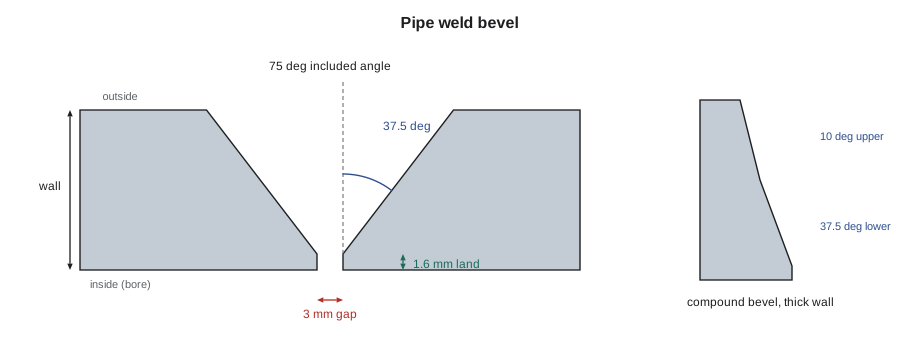
Each feature of the bevel has a job. The bevel angle opens the groove so that the electrode or torch can reach the root and the sidewalls can be fused. The land gives the root edge enough metal that it does not melt away before the root bead joins the two sides, and it gives the welder something to read: the keyhole forms where the two lands melt. The gap lets the root penetrate to the inside. Too thin a land, or a land that varies around the pipe, and the root burns through or sags in places. Too thick a land, and the root does not penetrate. Lesson 5 shows how the welder reads the root and corrects for small variations, but the welder cannot correct for a preparation that is out by a millimetre in one place and right in another.
Groove area and weld metal
The size of the groove sets the amount of weld metal a joint needs, which sets the time, the filler and the heat put into the pipe. For a single-V groove with a root face and a gap, the cross-sectional area of the groove, not counting the cap reinforcement or root reinforcement, is:
Here A is the groove area, g the root gap, t the wall thickness, f the root face and θ the bevel angle on each side, 37.5 degrees for the standard bevel. Multiplying the area by the length of the weld, which for a girth weld is about the circumference at the middle of the wall, gives the volume of weld metal. Multiplying by the density of steel gives its mass, and dividing by the amount of weld metal deposited by each electrode gives the number of electrodes. Cap and root reinforcement add roughly a fifth to a quarter to the groove volume on light wall.
# Groove area, weld metal and electrodes for one pipe butt weld (single V, B16.25 type bevel)
import math
OD = 168.3          # outside diameter, mm
t = 10.97            # wall, mm
f = 1.6            # root face, mm
g = 3.0            # root gap, mm
theta = 37.5       # bevel angle each side, degrees
A = g * t + (t - f) ** 2 * math.tan(math.radians(theta))         # groove area, square mm
L = math.pi * (OD - t)                                              # weld length at mid-wall, mm
vol = A * L * 1.20                                                  # add 20 % for root and cap reinforcement
mass = vol * 7.85e-6                                                  # kg
per_rod = 0.022                                                     # weld metal per electrode, kg
print(f"groove area {A:.1f} sq mm, weld length {L:.0f} mm")
print(f"weld metal about {mass:.2f} kg, about {math.ceil(mass / per_rod)} electrodes of 3.2 mm")
for ang in (35.0, 40.0):
    a2 = g * t + (t - f) ** 2 * math.tan(math.radians(ang))
print(f"bevel {ang} deg: area {a2:.1f} sq mm ({(a2 / A - 1) * 100:+.0f} %)")groove area 100.3 sq mm, weld length 494 mm weld metal about 0.47 kg, about 22 electrodes of 3.2 mm bevel 35.0 deg: area 94.4 sq mm (-6 %) bevel 40.0 deg: area 106.6 sq mm (+6 %)
The last lines show why the bevel tolerance matters. A bevel cut at 40 degrees instead of 37.5 needs almost a tenth more weld metal, and one cut at 35 degrees leaves a narrower groove that is harder to reach and fuse. The B16.25 tolerance of plus or minus 2.5 degrees is the range within which the procedure still works as written.
Cutting pipe
Pipe is cut to length in several ways. In the shop, a band saw or a cold saw cuts pipe square and clean, and is the first choice for carbon and stainless steel up to the capacity of the machine. An abrasive cut-off saw is fast on small pipe but leaves a burr and a heat-affected edge that must be ground. Oxyfuel cutting is used on carbon steel of any size and is the usual way to cut large pipe in the field; plasma cutting works on carbon steel, stainless and aluminum. A thermal cut leaves a layer of oxide and a narrow heat-affected zone that must be ground back to bright metal before welding, and on some materials, such as chrome-moly, the procedure sets how much must be removed.
For a square cut by hand, the fitter wraps the pipe with a wraparound, a flexible strip of heavy paper, plastic or leather that lies flat on the pipe and gives a straight line around the circumference. The line is marked with soapstone or a paint marker, and the cut is made to the line. On larger pipe, a pipe-cutting band or a track-mounted torch holds the torch at a fixed angle and travels around the pipe, so that it cuts and bevels in one pass.
Making the bevel
There are three common ways to make a pipe bevel. A portable bevelling machine, which clamps inside the bore or around the outside of the pipe and turns a cutting tool around the end, machines the bevel and the land at the same time. It gives the most accurate bevel and is used for stainless, alloy and heavy wall, and on most refinery work. A track or band torch cuts the bevel with an oxyfuel or plasma torch set at 37.5 degrees and is fast on carbon steel, after which the land and the cut face are ground. A hand-held torch and a grinder can make a bevel on carbon steel, but it takes skill to keep the angle and land even, and Hartwell uses it only for repairs and odd jobs.
Devon's first afternoon on the Unit 4 spools is on the bevelling machine. Marta shows him how to set the mandrel square in the bore, how to set the tool to the bevel angle and the land, and how to feed slowly enough that the cut is smooth. The machine leaves a uniform land all the way round, which Devon checks with a land gauge at four places, at twelve, three, six and nine o'clock. On a hand-ground bevel, he would check eight places.
| Method | Best for | Watch for |
|---|---|---|
| Portable bevelling machine (ID or OD mount) | Stainless, alloy, heavy wall, critical work | Square mounting; sharp tool; coolant on stainless |
| Track or band torch, then grind | Carbon steel, larger pipe, field work | Slag and oxide on the cut; land ground even |
| Hand torch and grinder | Repairs, small jobs on carbon steel | Uneven angle and land; takes time to get right |
| Lathe or shop bevelling machine | Small pipe in volume | Capacity of the machine |
Checking the preparation
Every prepared end is checked before it goes to fit-up. The checks are the bevel angle, with a bevel protractor or a fixed gauge; the land, with a land gauge or a small rule; the squareness of the end, with a square or by measuring the length at several points; and the condition of the bevel face, which must be free of notches, laminations and cutting defects. A lamination is a layer of non-metallic material inside the pipe wall from the mill, which appears as a thin line on the bevel face parallel to the surfaces. A lamination on a bevel can open up during welding, and it must be reported rather than welded over.
Squareness matters more on pipe than on plate. An end cut a degree off square on NPS 6 pipe leaves the gap about 3 mm (1/8 in) wider on one side of the joint than the other, which no amount of welder skill will fix in the root. Pipe ends that are not square are recut, or ground true, before they are fitted.
Cleaning
The bevel face, the land and a band of the pipe inside and outside, at least 25 mm (1 in) back from the bevel, must be cleaned to bright metal. Mill scale, rust, paint, oil and moisture all cause porosity and lack of fusion, and on the inside of the pipe they can be fused into the root, where they cannot be removed. On carbon steel, a flap disc or a wire wheel on a grinder cleans the outside and the bevel, and a small internal grinder or a flapper wheel cleans the inside of the land. Oil and marking ink are removed with a solvent that leaves no residue, allowed to dry before welding.
Stainless steel is cleaned only with tools that have never touched carbon steel: stainless wire brushes, grinding discs marked for stainless, and clean files. Particles of carbon steel left on stainless rust and start corrosion. Hartwell keeps its stainless tools in a separate cabinet with a red tag, and Lucia checks the cabinet when she checks the stainless spools.
Pipe that has been in service needs more. Lines that carried hydrocarbons can hold residue in the pores of the metal that comes out as smoke and porosity when the joint is heated, and lines from sour service can hold hydrogen. The plant's maintenance procedures set the cleaning, and some require the pipe to be baked out or the bevel ground back further before welding.
Marking and storing prepared ends
Once an end is bevelled and checked, it must stay that way until it is fitted. Prepared ends are capped with plastic end caps or taped, so that dirt, rain and grinding dust do not get onto the bevel or inside the pipe, and stored on racks or timbers rather than on the floor. A bevel that is dropped or dragged across the floor gets dented or nicked, and the damage shows up as a gap or a step in the root. On stainless, the end caps also keep carbon steel dust off the bevel.
Each prepared piece is marked with its spool number, its piece mark from the iso, and the heat number, so that the fitter can find it and the inspector can trace it. Hartwell paints the piece marks on the outside of the pipe away from the weld zone, never on the bevel, because paint on a bevel burns into the weld. When Devon finishes his first day on the bevelling machine, his twenty-two prepared ends are capped, marked and racked by spool, and Glen notices that the fitters do not have to ask him where anything is.
Common mistakes
MistakeAccepting a bevel with an uneven land because it looks close.
InsteadCheck the land at several points; an uneven land gives an uneven root.
MistakeWelding over a lamination on the bevel face.
InsteadReport it; the pipe end may need to be cut back or replaced.
MistakeCleaning stainless with a carbon steel wire brush.
InsteadUse dedicated stainless tools only.
MistakeFitting an end that is not square.
InsteadRecut or grind it square so the gap is even.
MistakeLeaving oxide from a thermal cut on the bevel.
InsteadGrind every thermally cut face back to bright metal.
Summary and key terms
- The standard pipe bevel is 37.5 degrees plus or minus 2.5 with a land of about 1.6 mm (1/16 in).
- Thick walls use a compound bevel to reduce weld metal.
- Groove area sets weld metal, time and heat; bevel angle changes it noticeably.
- Saws, bevelling machines and torches each suit different jobs.
- Check angle, land, squareness and the bevel face before fit-up.
- Clean the bevel and a band at least 25 mm (1 in) wide inside and out to bright metal.
- Land
- The flat root face at the bottom of a bevel, also called the root face.
- Included angle
- The total angle of a V groove, twice the bevel angle for a symmetrical joint.
- Compound bevel
- A bevel that changes to a shallower angle part way up a thick wall.
- Lamination
- A flat layer of non-metallic material inside the plate or pipe wall.
- Wraparound
- A flexible strip wrapped around pipe to mark a square cut line.
Practice problems
Work each problem on paper first, then reveal the answer to check.
What is the included angle of a groove made from two 37.5 degree bevels?
Show answer
2 x 37.5 = 75 degrees.
What is the groove area for a 10 mm wall, 1.6 mm land, 3 mm gap and 37.5 degree bevels?
Show answer
3 x 10 + 8.4 squared x tan 37.5 = 30 + 54.1 = about 84 square millimetres.
How far back from the bevel must the pipe be cleaned?
Show answer
At least 25 mm, inside and out.
Lesson quiz · 5 questions
Score 60% or more to complete this lesson.
Create a free account to save your progress, take quizzes and earn a certificate.