
WLD-320 · Lesson 1 of 12 · 16 min
Pipe welding in industry
Devon Okafor starts his last level at Hartwell Fabrication with two qualifications on the board beside his name. In the SMAW course he passed the all-position plate test with backing, and in the GTAW course he passed a flat stainless pipe test and welded his first purged process line. What he has not done is weld a pipe joint with an open root in a fixed position, which is the skill most refinery, plant and pipeline work depends on. Marta Kowalchuk tells him the same thing she told her own apprentices: plate teaches you to run a bead, but pipe teaches you to keep running it while the joint turns under you, and you are the one doing the turning. This course takes Devon from cutting and preparing pipe through open roots in SMAW and GTAW, fill and cap passes, the fixed positions, pipeline practice and socket welds, to the 6G test and a production spool package for the Unit 4 turnaround.
Where pipe welders work
Pipe carries almost everything that industry moves: water, steam, oil, natural gas, chemicals, compressed air and refrigerants. A refinery has thousands of kilometres of it when every line is counted, a power station has high-pressure steam lines that run at hundreds of degrees, and a gas plant has lines at high pressure that carry flammable and sometimes toxic gas. Pipe is also the main product of the pipeline industry, where long-distance lines are welded joint by joint across the country. Wherever pipe carries pressure or a hazardous fluid, a failed weld can release energy or product, so pipe welds are among the most closely controlled welds in the trade.
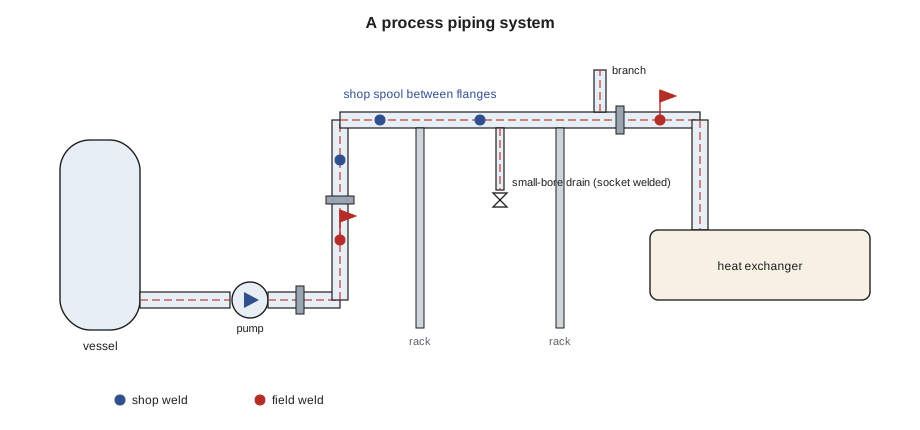
Pipe welders work in several settings. In a fabrication shop such as Hartwell's, pipe is cut, bevelled and welded into spools, which are prefabricated sections of piping that are shipped to site and bolted or welded into place. Shop welding lets much of the work be done with the pipe rolled on stands so that the welder can stay in the flat position. In the field, the same spools are joined to each other and to equipment, and the joints are fixed: the welder must work all the way around a pipe that cannot move. On a pipeline, crews of welders move along the right-of-way welding each joint in turn, often downhill with cellulosic electrodes, at a pace set by the whole spread. Plant maintenance welders repair and replace piping during shutdowns, often in tight spaces with the line drained but not new.
The codes that govern pipe welding
Every pipe weld on a pressure system is made to a code. The code that applies depends on the service, not on the welder's preference. The main piping codes used in North America are written by the American Society of Mechanical Engineers as the B31 series. ASME B31.3 Process Piping covers refineries, chemical plants, gas processing and similar plants, and is the code for the Unit 4 spools. ASME B31.1 Power Piping covers steam and boiler external piping in power plants and many industrial boiler plants. Long-distance oil and gas pipelines are built to ASME B31.4 and B31.8 in the United States, with welding to API 1104, and to CSA Z662 in Canada, which contains its own welding requirements.
For welding procedures and welder qualification, the B31 codes refer to ASME Section IX, Welding, Brazing and Fusing Qualifications. Section IX sets the tests and the essential variables but leaves the acceptance of production welds to the construction code. Lesson 11 shows how the two fit together. In Alberta, pressure piping is registered with ABSA, the provincial pressure equipment safety authority, under the CSA B51 code and the provincial regulations, and welders who weld pressure piping must hold the qualifications those rules require. Hartwell's quality program, which ABSA has accepted, sets out how Hartwell qualifies procedures and welders and keeps the records.
The codes do not just set rules for the weld. They set rules for who designs the system, who inspects it, what examinations are done and what pressure test proves it. A welder who understands where his weld fits into that chain understands why the inspector wants the weld number marked on the pipe and why a heat number on a fitting matters.
Shop work and field work
Most piping is designed so that as much of it as possible is welded in the shop, because shop welds are cheaper and easier to make well. In the shop, the pipe can be rolled so that the welder works on the top of the joint, in the flat position. This is called rolled welding, or 1G in the position system that lesson 8 describes. A spool designer tries to plan spools so that only the last few welds on each spool, and the welds that join spools in the field, must be made in a fixed position.
A field weld is made where the pipe is installed, often at height on a rack or in a congested unit. The pipe cannot be rotated, so the welder welds the bottom, the sides and the top of the joint in one continuous sequence of positions. A horizontal pipe that cannot rotate is the 5G position, a vertical pipe with a horizontal joint is 2G, and a pipe fixed at 45 degrees is 6G, which combines both. The 6G test is the one that qualifies a welder for pipe in all positions, which is why it is the target of this course.
| Shop | Field | |
|---|---|---|
| Position | Mostly rolled (1G) on stands | Fixed: 5G, 2G or 6G |
| Access | Open, at a comfortable height | Racks, trenches, congested units |
| Weather | Inside, controlled | Wind, rain and cold need shelters and preheat |
| Productivity | High | Two to four times slower per joint |
| Inspection | Easier to examine and repair | Harder access for radiography and repairs |
Pipe materials a welder meets
Most industrial piping is carbon steel, usually seamless pipe to ASTM A106 Grade B or the similar A53 and API 5L grades, with fittings to ASTM A234 WPB and flanges to A105. Stainless steel, mostly 304L and 316L, is used for corrosive and clean services, and Devon welded it in the GTAW course. Chromium-molybdenum steels such as P11 and P22 carry high-temperature steam and hydrogen service and need preheat and post-weld heat treatment. Low-temperature carbon steels such as A333 Grade 6 are used where the line may see cold, and are welded with controlled heat input so that the weld keeps its toughness. Each material has its own procedure, and a welder who picks up the wrong rod for the material can produce a weld that looks perfect and fails in service.
Measuring pipe welding work
Because pipe joints come in many sizes, estimators need a common unit for the amount of welding in a job. The one most used in industrial piping is the diameter-inch, sometimes called the weld inch or inch-diameter. One diameter-inch is one butt weld on NPS 1 pipe; a butt weld on NPS 6 is six diameter-inches, and on NPS 12 it is twelve. The unit works because the length of a girth weld is proportional to the pipe diameter. Heavier walls take more passes, so estimators apply a factor for schedule, and they add factors for material such as alloy or stainless, for position and for field conditions.
Glen Teskey estimates the Unit 4 spool package in diameter-inches before Devon has seen a drawing. A competent pipe welder in a shop, on carbon steel standard-wall pipe with the spool rolled, might complete 60 to 100 diameter-inches in a shift; the same welder in the field on fixed joints might complete half or a third of that. These are planning numbers, not targets, and Glen uses Hartwell's own records from past jobs to set them.
# Diameter-inch estimate for a spool package: weld count by size and schedule, with position factors
welds = [  # (NPS, schedule, count, position)
    (2, '80', 14, 'rolled'), (3, '40', 10, 'rolled'), (4, '40', 12, 'rolled'),
    (6, '40', 6, 'rolled'), (6, '40', 4, 'fixed'), (8, '40', 2, 'fixed')]
sched_factor = {'40': 1.0, '80': 1.3}
pos_factor = {'rolled': 1.0, 'fixed': 2.0}
rate = 70                     # equivalent diameter-inches per welder-shift (Hartwell records)
total_di = equiv = 0
for nps, sch, n, pos in welds:
    di = nps * n
    eq = di * sched_factor[sch] * pos_factor[pos]
    total_di += di; equiv += eq
    print(f"NPS {nps:>2} sch {sch} x {n:>2} {pos:<6}: {di:>3} diameter-inches, {eq:6.1f} equivalent")
print(f"total {total_di} diameter-inches, {equiv:.1f} equivalent")
print(f"about {equiv / rate:.1f} welder-shifts at {rate} per shift (shop carbon steel)")NPS 2 sch 80 x 14 rolled: 28 diameter-inches, 36.4 equivalent NPS 3 sch 40 x 10 rolled: 30 diameter-inches, 30.0 equivalent NPS 4 sch 40 x 12 rolled: 48 diameter-inches, 48.0 equivalent NPS 6 sch 40 x 6 rolled: 36 diameter-inches, 36.0 equivalent NPS 6 sch 40 x 4 fixed : 24 diameter-inches, 48.0 equivalent NPS 8 sch 40 x 2 fixed : 16 diameter-inches, 32.0 equivalent total 182 diameter-inches, 230.4 equivalent about 3.3 welder-shifts at 70 per shift (shop carbon steel)
The calculation shows how quickly fixed welds add up. The four fixed NPS 6 joints and two fixed NPS 8 joints are only a fifth of the diameter-inches, but they take almost a third of the time. That is why Raj Bhullar, who details the spools, works hard to turn field welds into shop welds by adjusting where the spool breaks fall.
What a pipe welder needs to know
Pipe welding brings together everything a welder has learned and adds several skills of its own. The joint is curved, so the welder's body position, the electrode angle and the travel direction change continuously. The root must be welded from one side only and must penetrate fully, with an acceptable bead on the inside of a pipe the welder cannot see. The joint must be fitted with a uniform gap and very little misalignment, because the root bead cannot bridge a step. The welds are examined, often by radiography, which finds internal defects that a plate welder might never learn about. And the work is controlled by documents: procedures, weld maps, material records and inspection reports, which the welder must read and help complete.
Marta writes Devon's plan for the level on the whiteboard in the booth: two weeks on cutting, preparing and fitting; three weeks of SMAW open roots, first on plate strips and then on pipe in 2G and 5G; two weeks of GTAW roots on carbon steel pipe with SMAW fill and cap; a week of socket welds and small bore; a day on the pipeline spread at a gas gathering tie-in; and then practice coupons in 6G until he passes every bend in a row. After the test, he joins the Unit 4 spool crew.
Priya Natarajan adds two lines of her own to the board. Pipe welding brings back every hazard from the safety course, with some extra: grinding and cutting pipe ends, working inside and around purged lines, welding at height on racks, and hot work in operating units where a permit and a gas test are needed before every shift. She also reminds Devon that the pipe he grinds may have held hydrocarbons, and that a pipe from a line that has been in service is never cut or heated without a cleaning certificate.
The documents on a pipe job
A pipe welder on a code job works from a set of documents. The isometric drawing, often called an iso, shows a line in three dimensions on a single sheet, with dimensions, fittings and the location of every weld. The weld map, often marked on the iso, gives each weld a number. The welding procedure specification, or WPS, lists the process, filler, preheat, interpass limit and other variables for the joint, and the welder must work within it. The traveller or weld log records, for each weld, who welded it, when, with what procedure and what examinations it received.
Devon learns that a weld number is not paperwork for its own sake. When a radiograph shows a defect, the weld number traces it to the welder and the procedure, and the code then requires more of that welder's welds to be examined. When a line fails years later, the weld record shows how the weld was made. Lucia Ferreira, the shop's inspector, tells Devon that she can usually tell how good a pipe crew is from how complete its weld log is.
Common mistakes
MistakeTreating every pipe weld the same, whatever the code.
InsteadFind which code governs the line and which procedure applies to each weld.
MistakePlanning a spool with many fixed welds.
InsteadWork with the detailer so that most welds are rolled in the shop.
MistakeAssuming a pipe that held product is safe to cut.
InsteadGet a cleaning certificate and a gas test before cutting or heating used pipe.
MistakeLeaving the weld number off the pipe.
InsteadMark every weld with its number and the welder's identification as the job requires.
MistakeEstimating pipe welding by joint count alone.
InsteadUse diameter-inches with factors for schedule, material and position.
Summary and key terms
- Pipe welds carry pressure and hazardous fluids and are closely controlled.
- ASME B31.3 covers process piping, B31.1 power piping, and API 1104 and CSA Z662 cover pipelines.
- ASME Section IX qualifies procedures and welders; the construction code sets examination and acceptance.
- Shop welds are rolled where possible; field welds are fixed and slower.
- Diameter-inches measure pipe welding work, with factors for schedule and position.
- Isometrics, weld maps, procedures and weld logs control the work.
- Spool
- A prefabricated section of piping welded in the shop and installed as a unit.
- Rolled weld
- A pipe weld made while the pipe is rotated so that the welder stays in the flat position.
- Diameter-inch
- A unit of pipe welding work equal to one butt weld on NPS 1 pipe.
- Isometric
- A single-line, three-dimensional drawing of a piping line used for fabrication.
- Weld map
- A drawing or list that gives each weld a number for tracking and inspection.
Practice problems
Work each problem on paper first, then reveal the answer to check.
How many diameter-inches are ten butt welds on NPS 4 pipe?
Show answer
4 x 10 = 40 diameter-inches.
Which ASME code covers refinery process piping?
Show answer
ASME B31.3 Process Piping.
Why are fixed welds planned out of spools where possible?
Show answer
They are slower, harder to make well and harder to inspect than rolled shop welds.
Lesson quiz · 5 questions
Score 60% or more to complete this lesson.
Create a free account to save your progress, take quizzes and earn a certificate.