
WLD-320 · Lesson 5 of 12 · 16 min
Open-root technique with SMAW
Devon's backed plate test in the SMAW course taught him to run a root onto a steel bar that held the pool. On pipe there is nothing behind the root but air. The root bead must melt both lands, bridge the gap and form a small, even bead on the inside of the pipe, all from the outside, while the welder moves around the joint and the pool's position changes from flat to vertical to overhead. The traditional way to do this with stick electrodes is with a cellulosic electrode, E4310 in CSA designations or E6010 in AWS terms, run uphill on fixed joints in a shop and downhill on pipelines. Marta starts Devon on plate strips with an open root, then moves him to NPS 6 pipe in the 2G and 5G positions. This lesson covers the electrode, the keyhole, the angles and movements around the pipe, and the stops, starts and tie-ins where most root defects form.
Why cellulosic electrodes for the root
Cellulosic electrodes have a coating rich in cellulose, which burns in the arc to produce a gas shield with a lot of hydrogen. The hydrogen raises the arc voltage and gives a forceful, digging arc that penetrates deeply and burns through the lands into the inside of the pipe. The slag is thin and freezes fast, so the pool can be controlled out of position. These properties make E4310 and E4311, or E6010 and E6011, the classic root electrodes for open-root pipe. E4310 runs on DCEP, E4311 on AC or DC.
The hydrogen that makes the arc work is also the electrode's weakness. Cellulosic electrodes are not low-hydrogen, and on steels that harden, or on thick wall and high-strength pipe, the weld can absorb enough hydrogen to crack. Process piping procedures often specify a low-hydrogen fill and cap over a cellulosic root, and on higher-strength or thicker materials they may call for a GTAW root instead, which lesson 6 covers. Low-hydrogen electrodes, E4918 or E7018, can also be run as an open root, but they have less penetrating force and need a tighter, more consistent fit-up; Hartwell's procedures use them for the root only on a few heavy-wall joints.
Cellulosic electrodes are stored differently from low-hydrogen ones. They need some moisture in the coating to work and must not be baked in a rod oven; a cellulosic electrode dried out in the oven runs hot and erratic, with poor penetration control. They are kept in their sealed containers at room temperature and kept dry. Hartwell keeps its 3.2 mm E4310 in a closed steel box beside the booth, well away from the E4918 oven.
The keyhole
An open root is run with a keyhole: a small hole at the front of the pool where the arc has melted through both lands into the inside of the pipe. The keyhole is the welder's window on penetration. If it stays about one and a half times the gap wide, with the lands melting back evenly on both sides, the root is penetrating fully and the inside bead will be about right. If the keyhole closes, the root is not penetrating; if it grows, the root is running hot and will sag inside or burn through. The welder holds the keyhole steady by changing the electrode angle, the arc length and the travel speed, and by small whipping or stepping movements, rather than by changing the current, which is set at the start and left.
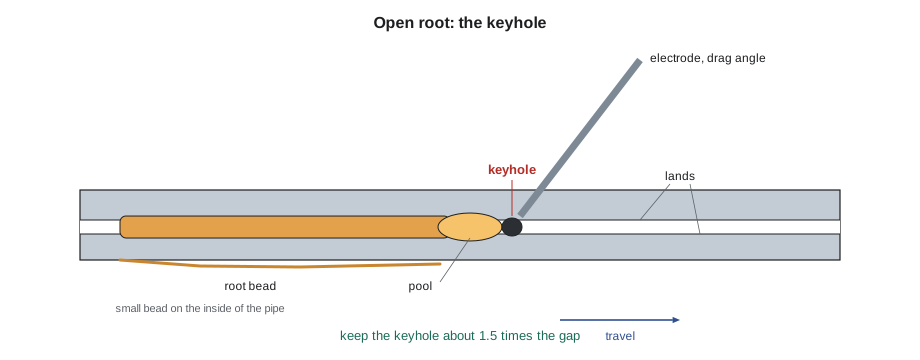
The arc length on an open root is short, with the electrode almost touching the lands and often pushed into the gap so that the arc burns through to the inside. A long arc on a root spreads the heat, closes the keyhole and leaves the lands unfused. On the bottom of a fixed joint, where the welder pushes the electrode up into the joint, a short arc also keeps the pool from sagging.
Uphill on a fixed joint
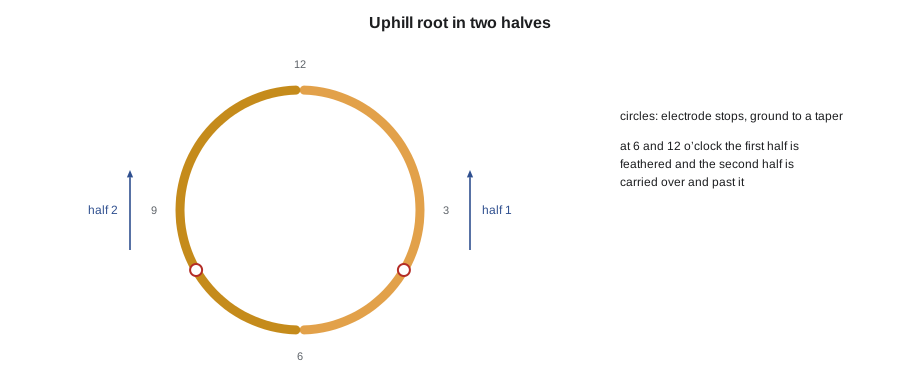
In a fabrication shop, fixed pipe joints in the 5G and 6G positions are usually welded uphill, from the bottom to the top on each side. The welder starts just past six o'clock, runs up one side to just past twelve, then starts again at the bottom and runs up the other side, tying into the first half at each end. Uphill gives a hotter, more penetrating root that is easier to fuse, and it is the progression used by most process piping procedures.
The electrode angle changes continuously around the pipe. At the bottom, the welder is welding overhead, with the electrode pointing almost straight up into the joint and a slight drag. Up the sides, the electrode tilts so that it points slightly upward into the direction of travel, and the pool is held by the edges of the joint. Near the top, the welder is welding flat, with the electrode pointing almost straight down and dragging slightly. The rule Marta teaches is to keep the electrode at a steady angle to the pipe surface where the arc is, not to the room, so the welder's wrist and body have to turn as the joint turns.
| Clock position | Position of weld | Electrode angle to the pipe | Common problems |
|---|---|---|---|
| 5:30 to 7:00 | Overhead | Nearly square into the joint, slight drag, pushed in | Concave root, cold start, slag at the start |
| 7:00 to 10:00 and 2:00 to 5:00 | Vertical up | Pointing slightly up the joint, 5 to 15 degrees drag | Keyhole growing; sagging on the inside |
| 10:00 to 2:00 | Flat | Nearly square, slight drag | Burn-through near the top; excessive inside bead |
On the 2G joint, a vertical pipe with a horizontal weld, the root is run around the pipe in the horizontal position. The electrode points slightly up into the joint, at about 5 to 15 degrees above horizontal, with a small drag, so that the arc force holds the pool against gravity. The top land melts more readily than the bottom one, and the inside bead tends to sag toward the lower pipe, so the welder directs the arc slightly toward the lower land.
Movement and rhythm
Cellulosic roots are often run with a whip-and-pause or a stepping motion. The welder holds the arc in the keyhole for a moment to melt the lands, then lifts the electrode forward and slightly out of the pool for a fraction of a second, letting the pool freeze at its edge, and brings it back into the keyhole. The movement controls heat on thin wall and in the flat position, where the pool tends to run away. Other welders run a steady drag with no whip, using the travel speed alone. Marta tells Devon there is no single right motion; the right one is the motion that keeps his keyhole the same size all the way round.
Current and travel speed set the size of the root. A typical root with a 3.2 mm (1/8 in) E4310 or E6010 runs at about 75 to 95 amps on carbon steel pipe, with travel speeds of 75 to 125 mm (3 to 5 in) per minute uphill. A root bead about 3 mm (1/8 in) thick is the target: thin enough to keep the heat low, thick enough not to crack or burn through when the hot pass goes in. A root that is too thin can be burned through by the hot pass; one that is too thick is slow and traps slag at its edges.
Stops, starts and tie-ins
Most root defects form where the bead stops and starts. Each electrode lasts only part of the way around a pipe, so a root on NPS 6 might take four or five electrodes, and every change is a stop and a start. A good stop is made by moving the arc slightly back over the finished root, or by making a small keyhole and breaking the arc quickly, so that the crater sits over the keyhole and does not form a shrinkage hole. Before the next electrode is started, the welder grinds the stop to a taper with a thin disc, so that the restart can fuse smoothly into it.
The restart is struck a short distance behind the end of the last bead, on the tapered stop, and carried forward to the keyhole, where the welder pauses to let it reopen before continuing. Starting directly at the keyhole with a cold electrode leaves a cold lap and often a slag inclusion at each restart. Tie-ins, where the root reaches a tack or the start of the other half, are made the same way: the tack or the start is ground to a feather edge, and the welder slows as the arc reaches it, makes sure the keyhole opens into the feathered end, and carries the bead over and past it before stopping.
How far one electrode goes
For planning electrode changes, the welder can work out how far each electrode will run. The length of weld around part of a pipe is the circumference at the root times the fraction of the circle:
Here s is the length of weld along the joint, D the diameter at the root, which for a girth weld is close to the inside diameter, and θ the angle in degrees. A welder who knows his electrode runs about a set length at his current and speed can place his stops where he can reach and see them, away from the bottom and top of the pipe.
# Root pass around a fixed NPS 6 joint: weld length per clock section, electrodes and arc time
import math
D = 146.3                    # diameter at the root, mm
run = 110                # weld length one electrode gives in the root, mm
speed = {'overhead': 75, 'vertical': 100, 'flat': 125}  # travel speed, mm/min
sections = [('overhead', 6.0, 7.0), ('vertical', 7.0, 10.0), ('flat', 10.0, 12.0)]
total_len = total_t = 0
for name, a, b in sections:
    theta = (b - a) * 30 * 2                     # both halves, degrees of circle
    s = math.pi * D * theta / 360
    t = s / speed[name]
    total_len += s; total_t += t
    print(f"{name:<9} {a:>4.1f}-{b:<4.1f} o'clock (both sides): {s:6.0f} mm, {t:4.1f} min arc time")
print(f"root length {total_len:.0f} mm, about {math.ceil(total_len / run)} electrodes, {total_t:.1f} min arc time")overhead 6.0-7.0 o'clock (both sides): 77 mm, 1.0 min arc time vertical 7.0-10.0 o'clock (both sides): 230 mm, 2.3 min arc time flat 10.0-12.0 o'clock (both sides): 153 mm, 1.2 min arc time root length 460 mm, about 5 electrodes, 4.5 min arc time
On NPS 6 schedule 80, the root is about 460 mm (18 in) long and takes four or five electrodes. Devon plans his first stops at about eight and four o'clock, where he can see the joint, so that the tie-ins at six and twelve are made with fresh electrodes.
Cleaning the root
Before the next pass, the root is cleaned. Cellulosic slag is thin and comes off with a chipping hammer and a wire wheel, but the edges of the root, where it meets the bevel faces, often have small slag lines in the wagon tracks: grooves along each side of a convex root. These are removed by grinding the face of the root with a thin disc until it is flat or slightly concave and the wagon tracks are gone. Pipe welders call this cleaning the root or grinding the root, and on cellulosic roots it is almost always done. The grinding must not cut through the root; on a 3 mm (1/8 in) root bead, a careless grinder can thin it until the hot pass burns through it.
Devon's first week of open roots on pipe produces a pile of coupons cut open with the band saw. Marta reads the inside of each one with him: here the keyhole closed and the root did not come through; here the bead sagged at seven o'clock where he paused too long; here a restart left a small hole. By the Friday, three of his five 5G roots are clean from end to end, and she lets him move on to the hot pass.
Common mistakes
MistakeDrying cellulosic electrodes in the rod oven.
InsteadKeep them in sealed containers at room temperature; they need their moisture.
MistakeRunning the root with a long arc.
InsteadKeep a short arc, pushed into the joint, to hold the keyhole.
MistakeRestarting directly at the keyhole.
InsteadGrind the stop to a taper and strike back on it, then carry forward.
MistakeTying into a square-ended tack.
InsteadFeather the tack and slow as the keyhole reaches it.
MistakeGrinding the root until it is thin.
InsteadRemove the wagon tracks and keep the root about 3 mm (1/8 in) thick.
Summary and key terms
- Cellulosic electrodes give a penetrating root but are not low-hydrogen.
- A steady keyhole about one and a half times the gap gives full, even penetration.
- Shop fixed joints are usually welded uphill in two halves from six to twelve o'clock.
- Keep the electrode angle steady relative to the pipe as the position changes.
- Most root defects form at stops, starts and tie-ins; taper, feather and carry past.
- Grind out the wagon tracks before the hot pass without thinning the root.
- Keyhole
- The small hole at the front of an open-root pool where the arc has melted through both lands.
- Cellulosic electrode
- An electrode with a coating high in cellulose, giving a deep, gas-shielded arc.
- Wagon tracks
- Slag lines trapped along both edges of a convex root bead.
- Tie-in
- The place where a bead joins a tack or another bead.
- Uphill
- Welding a fixed joint from the bottom toward the top.
Practice problems
Work each problem on paper first, then reveal the answer to check.
How long is the root between six and nine o'clock on one side of a pipe with a 146 mm root diameter?
Show answer
pi x 146 x 90 / 360 = about 115 mm.
If one electrode runs 110 mm, how many does a 460 mm root need?
Show answer
460 / 110 = 4.2, so five electrodes.
What does a closing keyhole tell the welder?
Show answer
The root is not penetrating; shorten the arc, slow down or steepen the angle.
Lesson quiz · 5 questions
Score 60% or more to complete this lesson.
Create a free account to save your progress, take quizzes and earn a certificate.