
VIS-110 · Lesson 7 of 12 · 24 min
Colour temperature, white balance and colour rendering
Our eyes adjust so quickly to the colour of light that a white shirt looks white under candlelight, office fluorescents, noon sun and blue shade. Cameras do not adjust automatically in the same way; they must be told how to interpret the light, and when they are told wrongly, images turn orange, blue, green or magenta. Light sources also differ in how faithfully they render colours, which affects skin tones, products and artwork. This lesson explains colour temperature and the blackbody idea, the Kelvin scale for common sources, the green-magenta (tint) axis, white balance in cameras, mireds and correction gels, strategies for mixed lighting, colour rendering metrics such as CRI, TLCI and TM-30, and flicker from artificial light sources.
Colour temperature
When an ideal object called a blackbody is heated, it glows with a colour determined only by its temperature: dull red around 1,000 K, orange around 2,000 K, warm white around 3,000 K, neutral white around 5,000 to 6,000 K, and increasingly blue above that. Colour temperature describes a light source's colour by the temperature, in kelvin (K), of the blackbody that would look the same. For sources that are not true thermal radiators, such as LEDs and fluorescents, the term correlated colour temperature (CCT) refers to the nearest blackbody colour.
Counter-intuitively, "warm" light (orange) has a lower colour temperature and "cool" light (blue) a higher one, because the warm-cool language comes from emotional associations, not from physics.
| Source | Approximate colour temperature |
|---|---|
| Candle flame | 1,800 to 1,900 K |
| Household warm white LED or incandescent | 2,700 to 3,000 K |
| Studio tungsten and halogen lamps | 3,200 K |
| Sunlight one hour after sunrise | About 3,500 to 4,500 K |
| Midday sun with blue sky (photographic daylight) | 5,500 to 5,600 K |
| Overcast sky | 6,500 to 7,500 K |
| Open shade under blue sky | 7,000 to 10,000 K or more |
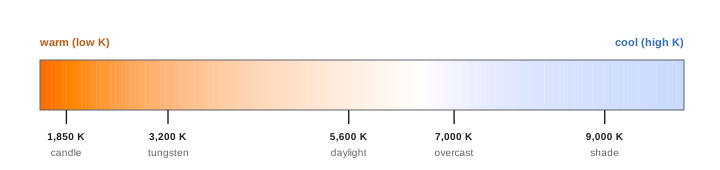
The green-magenta axis
Colour temperature describes only one direction of colour variation, from orange to blue. Many artificial sources also deviate along a perpendicular axis, toward green or magenta. Fluorescent tubes and some LEDs often have a green cast; some LEDs are slightly magenta. Camera white balance therefore usually includes a tint control (green-magenta) in addition to Kelvin, and lighting fixtures may offer green-magenta adjustment. Lighting gels for this axis are called plus green (to add green to lights so they match fluorescents) and minus green (magenta, to remove green from fluorescents or match them to tungsten and daylight). The distance of a source from the blackbody curve is described by Duv; values close to zero indicate a natural-looking white.
White balance in cameras
White balance tells the camera which colour of light should be rendered as neutral. Options include:
- Presets for common sources (daylight, cloudy, shade, tungsten, fluorescent, flash).
- A Kelvin setting entered directly, often with a tint adjustment.
- Custom (manual) white balance: photograph or point the camera at a neutral white or grey target in the scene's light and let it calculate the correction.
- Automatic white balance, which estimates the light from the image content. It is convenient but can drift between shots, and it may "correct" deliberate colour such as a warm sunset.
For still photographers shooting raw, white balance can be changed freely afterward, but setting it reasonably in camera helps judge images and saves time. For video, where many formats bake white balance into the recording, setting it correctly and consistently on set is more important, and many cinematographers set Kelvin values manually so that all shots match, rather than relying on automatic adjustment. A grey card or colour chart photographed at the start of each setup gives a reference for colour correction later.
White balance is also a creative tool. Setting the camera to a lower Kelvin than the light (for example 3,200 K in daylight) makes the image blue, a common way to suggest night or cold; setting a higher Kelvin makes it warmer. Many cinematographers choose a single camera setting, often 3,200 K, 4,300 K or 5,600 K, and then gel the lights to create intended colour contrasts relative to it.
Mireds and correction gels
Correcting colour temperature with gels is easier with mireds (micro reciprocal degrees):
Gels shift colour by a roughly constant number of mireds regardless of the starting temperature. Full colour temperature orange (CTO) adds about +159 mireds, converting 5,600 K daylight (179 mireds) to about 3,200 K (338 mireds) tungsten. Full colour temperature blue (CTB) subtracts about −131 mireds, converting 3,200 K (313 mireds) to about 5,500 K (182 mireds). Fractions (1/2, 1/4, 1/8 CTO or CTB) make smaller shifts. Blue gels absorb much more light than orange ones; full CTB costs nearly two stops, which matters when converting tungsten lights to daylight. Tunable LED fixtures change colour temperature electronically without gels and without large light loss.
Worked problem
Choosing a gel
A window lets in 6,000 K daylight. The scene is lit by 3,200 K tungsten fixtures, and the camera is set to 3,200 K. What gel on the window would make the daylight match the tungsten?
Show solution
- Window light: 1,000,000 ÷ 6,000 = 167 mireds.
- Tungsten: 1,000,000 ÷ 3,200 = 313 mireds.
- Shift needed: 313 − 167 = +146 mireds, a warming shift.
- Full CTO (+159 mireds) brings the window to about 1,000,000 ÷ 326 ≈ 3,070 K, close enough; 3/4 CTO would give about 3,300 K.
Answer: Full CTO (or 3/4 CTO) on the window. Gelling large windows is common on film sets; ND can be combined in the same gel to reduce brightness.
Mixed lighting
Many real scenes contain several colour temperatures: daylight through windows with warm interior lamps, cool shade with warm sun, street lighting at night with car headlights. The options are:
- Correct everything to match one colour, by gelling lights or windows, so a single white balance renders all sources neutral. This gives a clean, natural look.
- Embrace the mix, choosing which source will appear neutral and letting others appear warm or cool, as in the familiar look of warm interiors against blue dusk outside. Colour contrast between warm and cool sources can add depth and mood.
- Split the difference, using partial correction so each source shifts only slightly.
The decision is both technical and aesthetic: viewers accept some colour mixing as natural (warm lamps at night), but uncontrolled mixtures, particularly green casts from fluorescent lights on skin, usually look like mistakes.
Colour rendering
Two sources with the same colour temperature can render colours differently because of their spectra (Lesson 1). Metrics describe how faithfully a source renders colours compared with a reference source:
- Colour Rendering Index (CRI, Ra): an older metric comparing eight pastel test colours; 100 is perfect. Values above about 90 are generally considered good for image making, but CRI can be misleading, since it ignores saturated colours. R9, a separate value for saturated red, is important for skin tones and should be high.
- Television Lighting Consistency Index (TLCI): developed for cameras, estimating how much colour correction a source needs on a typical broadcast camera; 85 or above is usually acceptable, 90+ good.
- IES TM-30 (with fidelity Rf and gamut Rg): a more thorough method using 99 colour samples and showing graphically which hues are rendered accurately, desaturated or oversaturated.
- Spectral Similarity Index (SSI): compares a source's spectrum directly with a reference, useful for cinematography.
High-quality film and photography LEDs now achieve CRI and TLCI values in the mid to high 90s. Cheap LEDs and many architectural fixtures may have weak red output and spiky spectra that make skin look sallow and fabrics shift colour.
Flicker
Many artificial lights flicker invisibly: fluorescent, sodium and some LED lights pulse at twice the mains frequency, and dimmed LEDs may use pulse-width modulation at frequencies from hundreds to thousands of hertz. Cameras capturing short exposures or video can record this as brightness pulsing, colour shifts or rolling bands. In regions with 60 Hz mains power, lights pulse 120 times per second; shutter speeds that are multiples of 1/120 s, such as 1/60 s or 1/120 s, integrate whole cycles and avoid flicker, while the cinema standard of 1/48 s at 24 frames per second can show flicker under such lights. Solutions include adjusting shutter speed or angle (for example a 172.8° or 144° shutter at 24 fps, giving 1/50 or 1/60 s), using flicker-free fixtures designed for cameras, and checking practical lights in the frame before shooting.
Canada uses 60 Hz mains power, so artificial lights pulse at 120 Hz.
Colour temperature in practice
In daily work, colour temperature decisions often follow a simple logic. First decide which source should look neutral, usually the one lighting the main subject. Set the camera white balance to that source. Then decide whether other sources should match, contrast warm, or contrast cool, and gel or adjust them accordingly. Check the result on a calibrated monitor or with a grey card, paying particular attention to skin tones, which viewers judge most critically. Note the settings so later shots can match.
For interviews and corporate video, a neutral, natural look is usually expected: correct everything to one colour temperature and avoid green casts. For drama and music videos, deliberate colour contrast is common: cool moonlight against warm firelight, or neon colours from practical signs. For product photography, colour accuracy is paramount, so photographers shoot a colour chart and use high-quality sources.
LED fixtures and colour
Modern LED fixtures make colour adjustment fast, but they also introduce new issues. Fixtures from different manufacturers set to the same Kelvin value may not match exactly, because their spectra differ; matching by eye or with a colour meter is safer than trusting the numbers. Mixing RGB-only LEDs with broad-spectrum white LEDs can create skin tone mismatches. Many fixtures include gel emulation modes that mimic traditional gel colours, and some can match colour to a measured source automatically. Good practice is to test fixtures on camera with a colour chart and a person before relying on them for important work.
Finally, record colour decisions. A short note of the camera Kelvin and tint, the gels on each fixture, and any colour chart shots taken, saves hours in post-production and makes it possible to match additional shots or reshoots later. Many productions include this information in the camera reports that accompany the footage.
Gels and filters in more detail
Gels come in many types beyond CTO and CTB. Straw and bastard amber add gentle warmth; neutral density gels reduce intensity without changing colour; combination gels such as CTO plus ND are used on windows to warm and darken daylight in one step; plus green and minus green adjust the tint axis; and a wide range of saturated colour gels create effects. Gel manufacturers publish the mired shift, light transmission and spectral curves of each product. On cameras, colour correction and colour effect filters perform similar roles at the lens, though most correction is now done with white balance and in post-production.
Gels fade and change colour with heat over time, particularly on tungsten fixtures, so they should be checked and replaced regularly. Stocking a basic set of correction gels in common fractions remains standard practice even with tunable LED fixtures, because windows, practical lamps and existing building lights still need correction.
Common mistakes
MistakeCalling orange light "high" colour temperature.
InsteadWarm light has low Kelvin; cool light has high Kelvin.
MistakeRelying on auto white balance for video sequences.
InsteadSet Kelvin manually for consistent shots.
MistakeIgnoring green casts from fluorescents and LEDs.
InsteadCorrect with tint or minus green gels.
MistakeChoosing lights by CRI alone.
InsteadCheck R9, TLCI or TM-30 and test on skin.
MistakeShooting at 1/48 s under 120 Hz lighting without checking.
InsteadUse 1/60 or 1/120 s or flicker-free fixtures.
Summary and key terms
- Colour temperature describes light colour by the matching blackbody temperature in kelvin.
- Warm light has low Kelvin (tungsten 3,200 K); cool light has high Kelvin (shade 7,000 K+).
- The green-magenta tint axis is perpendicular to colour temperature.
- White balance tells the camera what is neutral; set it manually for consistent video.
- Mireds make gel calculations simple; CTO warms (+159), CTB cools (−131).
- Mixed lighting can be corrected, embraced or partially corrected.
- CRI, R9, TLCI, TM-30 and SSI describe colour rendering; flicker depends on mains frequency and shutter.
- Colour temperature
- Light colour expressed as an equivalent blackbody temperature.
- Kelvin
- The unit of colour temperature.
- Correlated colour temperature
- The nearest blackbody colour for a non-thermal source.
- Tint
- The green-magenta axis of white balance.
- White balance
- Camera setting defining neutral colour.
- Mired
- One million divided by colour temperature.
- CTO
- Colour temperature orange gel that warms light.
- CTB
- Colour temperature blue gel that cools light.
- CRI
- Colour Rendering Index.
- Flicker
- Brightness pulsing of artificial light recorded by cameras.
Practice problems
Work each problem on paper first, then reveal the answer to check.
What colour temperature is studio tungsten?
Show answer
3,200 K.
Is 7,500 K warm or cool?
Show answer
Cool (blue).
What does the tint control adjust?
Show answer
The green-magenta balance.
Why set Kelvin manually for video?
Show answer
For consistent colour across shots.
Convert 4,000 K to mireds.
Show answer
250 mireds.
What does full CTO do to 5,600 K light?
Show answer
Converts it to about 3,200 K.
Why are CTB gels costly in light?
Show answer
They absorb much more light, nearly two stops for full CTB.
Name three ways to handle mixed lighting.
Show answer
Correct all sources, embrace the mix, partially correct.
Why is R9 important?
Show answer
It measures saturated red rendering, crucial for skin.
Which shutter speeds avoid flicker under 120 Hz lighting?
Show answer
1/60 s or 1/120 s.
Lesson quiz · 5 questions
Score 60% or more to complete this lesson.
Create a free account to save your progress, take quizzes and earn a certificate.