
VIS-110 · Lesson 3 of 12 · 26 min
Measuring light: units, the inverse square law and stops
Image makers constantly make judgements about quantity of light: is there enough to shoot at the chosen settings, how much brighter is the window than the face, how far should the light be moved to drop it by a stop, and will this LED panel be bright enough from across the room? Answering these questions needs a small toolkit of units and relationships. This lesson explains the difference between radiometric and photometric measurement, the photometric units of luminous flux, intensity, illuminance and luminance, typical light levels in everyday scenes, the inverse square law, the stop as the photographer's unit of light, exposure value, and how these ideas connect to camera settings and to the specifications of lighting equipment.
Radiometry and photometry
Radiometry measures electromagnetic energy as physical power (watts), treating all wavelengths equally. Photometry measures light as the human eye sees it, weighting each wavelength by the eye's sensitivity. The eye is most sensitive to green-yellow light around 555 nm in bright conditions (the photopic luminosity function, often written V(λ)) and much less sensitive to deep blue and red. A watt of green light therefore looks far brighter than a watt of red or blue. Because image makers care about how things look, they use photometric units. The maximum luminous efficacy, 683 lumens per watt, applies to 555 nm light; real white sources are much lower.
Photometric units
| Quantity | What it describes | Unit | Example |
|---|---|---|---|
| Luminous flux | Total light emitted by a source | Lumen (lm) | A household LED bulb: about 800 lm |
| Luminous intensity | Light emitted in a particular direction | Candela (cd) | A candle: about 1 cd |
| Illuminance | Light falling on a surface | Lux (lx) = lm/m²; foot-candle = lm/ft² | Office desk: 300 to 500 lx |
| Luminance | Light leaving a surface toward the eye | cd/m² (nit) | Typical SDR display: about 100 to 300 nits |
| Luminous efficacy | Light output per watt of electrical input | lm/W | Modern LED fixtures: about 80 to 200 lm/W |
One foot-candle equals about 10.76 lux. Cinematographers in North America often quote foot-candles because many light meters and lighting manufacturers' tables use them; lux is the SI unit used in most of the world and in standards. Lighting fixture specifications usually give illuminance at stated distances (for example 2,500 lux at 3 m with a given reflector or lens), beam and field angles, colour temperature and colour rendering values, and power consumption.
Illuminance and luminance are linked by surface reflectance: a surface lit by illuminance E with reflectance ρ, if it is perfectly diffuse, has luminance L = ρE/π. A white card (90 % reflectance) under 1,000 lux has a luminance of about 290 cd/m², while a grey card (18 %) under the same light has about 57 cd/m². Light meters measuring incident light read illuminance; meters measuring reflected light (including camera meters) read luminance (Lesson 11).
Typical light levels
Human vision adapts across an enormous range, which can make it hard to judge how much light there really is. Typical illuminance values:
| Situation | Approximate illuminance |
|---|---|
| Direct summer sunlight | 80,000 to 110,000 lux |
| Full daylight in open shade | 10,000 to 25,000 lux |
| Overcast day | 1,000 to 10,000 lux |
| TV studio set | 1,000 to 2,000 lux |
| Office | 300 to 500 lux |
| Living room in the evening | 50 to 150 lux |
| Street lighting | 5 to 30 lux |
| Full moon | About 0.1 to 0.3 lux |
The ratio between direct sun and a living room at night is about a thousand to one, roughly ten stops, yet both feel normal to us because our eyes adapt. A camera does not adapt in the same way, which is why indoor scenes need slower shutter speeds, wider apertures, higher ISO or more light.
The inverse square law
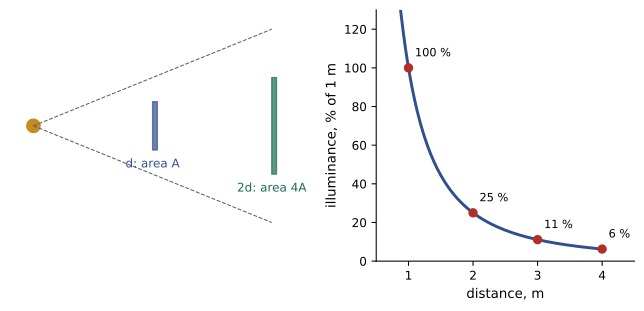
Light from a small (point-like) source spreads over an area that grows with the square of the distance. Doubling the distance spreads the same light over four times the area, so the illuminance falls to one quarter:
Because a quarter is two stops, doubling the distance from a small source costs two stops, and moving it 1.4 times farther (√2) costs one stop. The law applies accurately when the distance is large compared with the source size, roughly five times its largest dimension; very large sources such as a wall of diffusion or an overcast sky fall off much more slowly at close range, and the sun is so far away that its light does not change measurably across a scene.
Worked problem
Moving a light
A small LED fixture gives 1,600 lux on a subject 2 m away. How much light reaches the subject at 4 m, and at what distance would it give 800 lux?
Show solution
- At 4 m: E = 1,600 × (2 ÷ 4)² = 1,600 × 0.25 = 400 lux, two stops less.
- For 800 lux (one stop less), distance d = 2 × √(1,600 ÷ 800) = 2 × 1.414 ≈ 2.83 m.
Answer: 400 lux at 4 m; about 2.8 m for 800 lux. To change light by one stop with distance, multiply or divide the distance by about 1.4.
The inverse square law has a creative consequence called falloff. When a light is close to a subject, the light falls off rapidly behind the subject, so a person 1 m from a lamp is lit far more brightly than the wall 2 m behind them, giving a dark background. Moving the light farther away (and increasing its output) makes illumination more even from front to back. Portrait and product photographers use this to control background brightness without moving the background.
Stops and exposure value
A stop is a doubling or halving of light. Photographers use stops because exposure controls work in powers of two: each full step in shutter speed (1/125 to 1/60 s), aperture (f/5.6 to f/4) or ISO (200 to 400) doubles or halves the exposure. Stops also describe contrast (a scene with ten stops of range has a brightness ratio of 2¹⁰, about 1,000 to 1) and the capability of sensors (dynamic range).
Aperture f-numbers follow a sequence in which each step changes the area of the opening by a factor of two: f/1.4, 2, 2.8, 4, 5.6, 8, 11, 16, 22. Each f-number is about 1.4 times the previous one, because the area depends on the square of the diameter.
Exposure value (EV) combines aperture N and shutter time t into one number:
Combinations with the same EV give the same exposure: f/8 at 1/250 s, f/5.6 at 1/500 s and f/11 at 1/125 s are all about EV 14. EV is also used to describe how bright a scene is, usually stated for ISO 100 (EV100): bright sunlight is about EV 15 (the "sunny 16" rule: f/16 at a shutter speed of 1/ISO), overcast daylight about EV 12 to 13, bright interiors about EV 8 to 9, and city streets at night about EV 5 to 7. For incident light, illuminance in lux is related to EV100 approximately by lux ≈ 2.5 × 2^EV.
Worked problem
Using exposure values
A meter reads 640 lux on a subject. Estimate EV100, and find a shutter speed at f/2.8 and ISO 800.
Show solution
- EV100 ≈ log₂(640 ÷ 2.5) = log₂(256) = 8.
- At ISO 800 (three stops more sensitive), the working EV is 8 + 3 = 11.
- From EV = log₂(N²/t): t = N² ÷ 2^EV = 2.8² ÷ 2,048 = 7.84 ÷ 2,048 ≈ 1/260 s.
- Use 1/250 s.
Answer: About EV 8 at ISO 100; f/2.8 at 1/250 s at ISO 800. Cinematographers often fix the shutter (for example 1/48 s at 24 frames per second) and adjust aperture, ISO, ND filters and lighting instead.
Lighting specifications in practice
When choosing lights, image makers compare output at working distances rather than electrical power. A fixture's photometric data shows lux or foot-candles at several distances for each beam setting; a narrower beam concentrates light for more intensity on a smaller area. Lumens tell the total output but not where it goes. For practical planning, decide the exposure you need (for example f/2.8 at ISO 800 and 1/48 s), convert to required illuminance on the subject, then check which fixtures can deliver it at the distance and beam spread the scene requires, allowing for diffusion, which can cost one to three stops.
In Canada, lighting equipment for film and photography must carry certification marks such as CSA or cUL for electrical safety, and many productions also follow provincial film industry safety guidelines for set lighting.
Measuring with everyday tools
Dedicated light meters are not the only way to measure light. Many smartphone apps estimate illuminance using the phone's camera or ambient light sensor, accurate enough to compare locations and check the inverse square law, though not for precise work. Camera meters report exposure values that can be converted to approximate illuminance. LED fixture manufacturers publish photometric calculators. For colour-critical work, colour meters and spectrometers measure colour temperature, tint, colour rendering and the full spectrum of sources, which is especially useful when mixing fixtures from different manufacturers.
Whatever the tool, consistency matters more than absolute precision: measuring the key light the same way for every shot keeps a sequence consistent, and comparing readings in stops rather than raw numbers makes them easier to use.
Ratios in the real world
Thinking in ratios and stops makes many practical questions easier. A window that measures four stops brighter than an interior face will blow out unless the face is lit up or the window is darkened with neutral density gel. A practical lamp in the frame should usually be no more than about two to three stops brighter than the faces near it if it is to keep detail. A background that measures one stop below the subject will look slightly darker and help the subject stand out; three stops below, it will look quite dark. Learning these relationships turns meter readings into confident decisions.
Many image makers keep a small notebook or app with typical readings from their own work: a sunny exterior, a bright office, a candlelit dinner, a night street. Over time, these reference numbers make it possible to estimate how much light a scene will need just by looking at it, and to plan equipment before arriving on location.
Measurement is also essential for communication. A director of photography can tell a gaffer to put 200 foot-candles on an actor's face and keep the background two stops under, and the gaffer knows exactly what to do. A photographer can tell an assistant to move a light until it reads f/8 at the subject. Numbers make lighting reproducible from day to day and transferable from one location to another, which is why measurement remains central even with modern cameras that show exposure on screen.
For students, the most useful habit is to carry a meter, or a meter app, and take readings everywhere: in classrooms, streets, shops and at home at different times. Comparing the numbers with what your eyes report teaches how strongly vision adapts, and builds the intuition needed to plan shoots realistically.
Measurement also protects against a common trap: assuming that a scene will look on camera the way it looks to the eye. A dim restaurant that feels comfortably lit may measure only 50 lux, several stops below what a camera needs for clean images at moderate ISO settings, while a sunlit window behind the diners may be ten stops brighter. Measuring first allows the image maker to plan lights, filters or settings before the shoot rather than discovering problems in the footage.
Common mistakes
MistakeComparing lights by wattage.
InsteadCompare photometric output at working distance.
MistakeApplying the inverse square law to very large sources up close.
InsteadUse it when distance is several times the source size.
MistakeDoubling distance and expecting to lose one stop.
InsteadDoubling distance loses two stops; multiply by 1.4 for one stop.
MistakeConfusing illuminance with luminance.
InsteadIlluminance falls on a surface; luminance leaves it.
MistakeTrusting eyes to judge light levels.
InsteadMeasure, since vision adapts across huge ranges.
Summary and key terms
- Photometry weights light by the eye's sensitivity, peaking near 555 nm.
- Flux (lumens), intensity (candelas), illuminance (lux) and luminance (nits) describe light.
- Typical scenes range from about 100,000 lux in sun to below 1 lux by moonlight.
- The inverse square law: doubling distance from a small source quarters the light (two stops).
- Light falloff controls background brightness.
- A stop doubles or halves light; f-numbers step by about 1.4.
- EV combines aperture and shutter; EV100 describes scene brightness (sunny 16 ≈ EV 15).
- Photometry
- Measurement of light as perceived by the eye.
- Luminous efficacy
- Light output per watt.
- Candela
- The unit of luminous intensity.
- Foot-candle
- Lumens per square foot, about 10.76 lux.
- Inverse square law
- Illuminance from a point source falls with distance squared.
- Falloff
- The decrease of light with distance across a scene.
- Stop
- A doubling or halving of light.
- f-number
- Focal length divided by aperture diameter.
- Exposure value
- A number combining aperture and shutter time.
- Sunny 16 rule
- f/16 at 1/ISO in bright sun.
Practice problems
Work each problem on paper first, then reveal the answer to check.
Why do image makers use photometric rather than radiometric units?
Show answer
They describe light as the eye perceives it.
Convert 50 foot-candles to lux.
Show answer
About 538 lux.
What illuminance is direct summer sun?
Show answer
About 80,000 to 110,000 lux.
A light gives 1,000 lux at 1 m. What at 3 m?
Show answer
About 111 lux.
By how much must distance change for one stop?
Show answer
A factor of about 1.4.
Why does a close light darken the background?
Show answer
Light falls off rapidly with distance behind the subject.
List the full f-stops from f/2 to f/16.
Show answer
f/2, 2.8, 4, 5.6, 8, 11, 16.
What EV is f/8 at 1/125 s?
Show answer
log₂(64 × 125) ≈ 13.
What is the sunny 16 setting at ISO 200?
Show answer
f/16 at 1/200 s.
Estimate EV100 for 160 lux.
Show answer
log₂(64) = 6.
Lesson quiz · 5 questions
Score 60% or more to complete this lesson.
Create a free account to save your progress, take quizzes and earn a certificate.