
VIS-110 · Lesson 4 of 12 · 24 min
Quality of light: hard and soft
Two photographs of the same face, taken with the same exposure from the same position, can feel completely different: one dramatic, gritty and sharp-edged, the other gentle, flattering and calm. Much of that difference comes from the quality of light, whether it is hard or soft. Quality describes the character of the shadows and highlights a light produces, and it is controlled mainly by one factor: the apparent size of the light source as seen from the subject. This lesson explains hard and soft light and the physics of shadows, how source size and distance determine softness, how diffusion and bounce change quality, how quality affects texture, skin, shape and mood, and the tools image makers use to shape quality in studios and on location.
Hard and soft light
Hard light comes from a source that is small relative to the subject, such as the direct sun on a clear day, a bare bulb, a small LED or a focused spotlight. It produces crisp, well-defined shadows with sharp edges, bright specular highlights, strong texture and high contrast. Soft light comes from a source that is large relative to the subject, such as an overcast sky, a large window with no direct sun, a big softbox or light bounced off a white wall. It produces gradual shadow edges, broad, gentle highlights, reduced texture and lower apparent contrast.
Neither is better. Hard light suits drama, heat and harsh environments, graphic shapes, textured surfaces such as stone or weathered faces, and styles referencing film noir or bright summer days. Soft light suits beauty, children, food, products that need even rendering, and calm or intimate moods. Many images combine both: a soft key light on a face with a hard backlight or a hard light on the background.
Why source size matters: umbra and penumbra
A shadow forms where an object blocks light. With a point source, every part of the shadow region is either fully lit or fully blocked, so the shadow edge is sharp. With a larger source, points near the edge of the shadow can see part of the source but not all of it. That partially lit transition zone is the penumbra; the fully shadowed core is the umbra. The larger the source appears from the subject, the wider the penumbra and the softer the shadow edge.
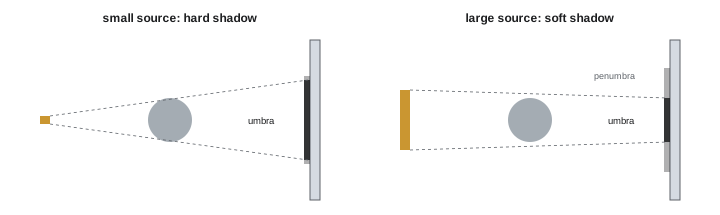
What matters is apparent size, the angle the source subtends at the subject, not its physical size. The sun is about 1.4 million kilometres across, yet it subtends only about half a degree, so it is a hard source. A 1 m softbox 1 m from a face subtends about 53°, a very soft source; the same softbox 5 m away subtends about 11° and gives much harder light.
Distance and softness
Moving a light closer to the subject makes it larger in apparent size and therefore softer; moving it farther makes it harder. This is counter-intuitive to many beginners, who move a light away to make it "softer" and get the opposite. Distance also changes intensity and falloff (Lesson 3): a close soft source gives soft shadows and rapid falloff toward the background, while a distant source gives harder shadows and more even illumination across the scene.
Worked problem
Apparent size of a softbox
A 90 cm softbox is placed 1.2 m and then 3.6 m from a subject. What angle does it subtend at each distance, and how does the light change?
Show solution
- Angle = 2 × arctan(half-width ÷ distance).
- At 1.2 m: 2 × arctan(0.45 ÷ 1.2) = 2 × 20.6° ≈ 41°.
- At 3.6 m: 2 × arctan(0.45 ÷ 3.6) = 2 × 7.1° ≈ 14°.
- At three times the distance, the source looks about a third as large, so shadows become noticeably harder, and illuminance falls by about nine times (just over three stops).
Answer: About 41° at 1.2 m and 14° at 3.6 m. To keep soft light, keep the source close or use a larger source.
Diffusion
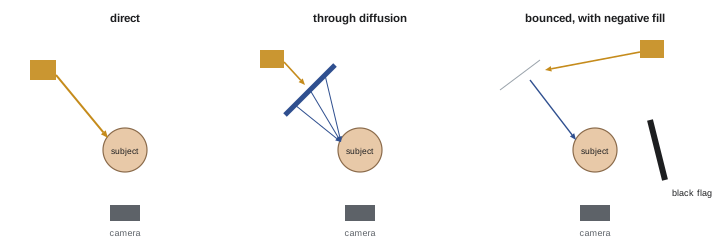
Diffusion converts a small hard source into a larger soft one by passing its light through a translucent material that scatters it (Lesson 2). The diffuser becomes the new apparent source. Tools include softboxes, which enclose a light and diffuse it through a front panel; diffusion frames and butterflies, fabric or plastic stretched over frames from about 60 cm to 6 m or more across; shower-curtain or tracing paper on location; and the diffusion built into some LED panels. Diffusion materials come in grades from light (which slightly softens and spreads the beam) to heavy (which creates a very even, large source but loses more light, often one to two stops or more). Placing the diffuser farther from the light fills it more evenly; placing it closer to the subject makes the effective source larger relative to the subject.
Outdoors, a large overhead silk or scrim between the sun and a subject turns hard sunlight into soft light over the subject, a standard technique for exterior close-ups.
Bounce
Bouncing light off a surface also creates a large soft source. Light directed at a white wall, a ceiling, a bounce board (foam core, poly board or a reflector) or a fabric bounce reflects diffusely, and the illuminated patch becomes the source. Bounce tends to be softer and more natural-looking than diffusion because the bounced patch is often larger, but it is less efficient and takes on the colour of the bounce surface: light bounced off a green wall or a wooden ceiling turns green or warm. Silver reflectors give a brighter, harder, more specular bounce; gold adds warmth; white is softest; black surfaces absorb light and create negative fill (below).
Texture, shape and skin
Quality strongly affects texture. Hard light, especially from the side, exaggerates surface texture by casting tiny shadows from every bump: excellent for showing the grain of wood, the weave of fabric or the craters of the moon, but unflattering for skin, emphasizing pores, wrinkles and blemishes. Soft light fills in those tiny shadows, smoothing skin and revealing form through gentle gradations of tone, which is why beauty and portrait lighting usually relies on large sources close to the subject.
Shape, the three-dimensional form of a subject, is revealed by the transition from light to shadow across it. Soft light produces long, gradual transitions that describe rounded forms beautifully; very flat soft light from the front can lose shape altogether. Hard light produces abrupt transitions that emphasize planes and edges. Specular highlights also describe shape: their size and position tell the viewer whether a surface is curved or flat and glossy or matte.
| Characteristic | Hard light | Soft light |
|---|---|---|
| Source size (apparent) | Small | Large |
| Shadow edges | Sharp, defined | Gradual, feathered |
| Texture | Emphasized | Smoothed |
| Highlights on glossy surfaces | Small, bright points | Broad, gentle |
| Typical mood | Dramatic, harsh, energetic, noir | Gentle, flattering, calm, intimate |
| Common sources | Direct sun, bare bulbs, spotlights, fresnels | Overcast sky, windows, softboxes, bounce |
Controlling spill and adding contrast
Soft light spreads widely and can spill onto backgrounds and into the lens, reducing contrast and mood. Image makers control it with flags (opaque black panels that block light), grids or egg crates on softboxes (which narrow the spread of soft light while keeping it soft), skirts and barn doors. Negative fill, placing black surfaces on the shadow side of a subject, absorbs bounced light from the surroundings and deepens shadows, restoring shape and contrast in soft-light situations such as white-walled rooms or overcast exteriors. Combining a large soft source with careful flagging gives soft but directional, sculpted light, a hallmark of much contemporary cinematography.
Reading quality in existing light
Developing an eye for quality means noticing it everywhere: look at the shadow of your hand on a table under different lights, at faces under a clear sky versus overcast, at how light from a window changes with distance from it. A useful habit is to look at the edges of shadows: a sharp edge means a small source, a feathered edge a larger one. Another is to look at the eyes, whose reflections (catchlights) reveal the size, shape and position of the light sources. These observations help when matching light between shots, recreating natural looks with film lights, and choosing the right time and place to shoot outdoors (Lesson 6).
Quality and the camera
Camera and lens choices interact with light quality. Wide apertures and shallow depth of field turn background points of light into soft circles (bokeh), whose shape depends on the aperture blades, while small apertures render them as sharp points or stars (Lesson 2). Higher-resolution sensors and sharp lenses show texture more clearly, so skin may need softer light than it would with older, softer cameras. Diffusion filters on the lens soften highlights and contrast, an alternative or complement to softening the light itself. Understanding these interactions helps decide whether to soften the light, the lens or the image in post-production.
Practising with quality
A simple exercise teaches more about quality than any description. Place a small object such as an egg, an orange or a sculpture on a table and light it with a bare bulb from the side. Note the hard shadow and the bright specular point. Then hold a sheet of tracing paper between the bulb and the object, first close to the bulb and then close to the object, and observe how the shadow edge and highlight change. Finally, bounce the bulb off a white card and compare. Photograph each version from the same position and compare them side by side.
Repeating the exercise with a face, with permission, shows how strongly quality affects skin, and why portrait photographers invest in large modifiers. Repeating it outdoors, comparing a subject in direct sun, open shade and under an overhead diffusion sheet, connects the studio lessons to natural light (Lesson 6).
Finally, quality of light is not only a technical setting but a storytelling choice. Hard light can suggest heat, honesty, danger or isolation; soft light can suggest comfort, nostalgia, romance or calm. Many films change quality over a story, beginning in soft, gentle light and moving to harder, more contrasty light as tension rises, or the reverse. Thinking about quality in terms of meaning, not only flattery, opens up creative possibilities.
Quality also changes how a viewer perceives the size and material of objects. Hard light makes small objects look crisp and sculptural but can make large surfaces look harsh; soft light makes products look premium and smooth but can flatten detail if overused. Product photographers therefore often mix a large soft key with small hard accents that pick out edges, logos and textures.
Whichever quality you choose, make it a decision rather than an accident: decide what the subject and story need, then choose source size and distance to match.
Common mistakes
MistakeMoving a light farther away to soften it.
InsteadMove it closer or enlarge it; distance makes light harder.
MistakeUsing hard frontal light on textured skin for beauty work.
InsteadUse large, close soft sources.
MistakeBouncing off coloured surfaces without noticing the cast.
InsteadBounce off neutral surfaces or correct the colour.
MistakeLetting soft light spill everywhere.
InsteadControl it with grids, flags and negative fill.
MistakeAssuming a physically big source is always soft.
InsteadJudge apparent size from the subject's position.
Summary and key terms
- Quality of light ranges from hard (small apparent source) to soft (large apparent source).
- Penumbra width, and therefore shadow softness, grows with apparent source size.
- Closer sources are softer and fall off faster; distant sources are harder and more even.
- Diffusion and bounce create large soft sources, at a cost in light and possibly colour.
- Hard light emphasizes texture; soft light smooths skin and reveals rounded form.
- Grids, flags and negative fill control spill and add contrast to soft light.
- Shadow edges and catchlights reveal the quality of existing light.
- Hard light
- Light from a small apparent source with sharp shadows.
- Soft light
- Light from a large apparent source with gradual shadows.
- Umbra
- The fully shadowed core of a shadow.
- Penumbra
- The partially lit edge of a shadow.
- Apparent size
- The angle a source subtends at the subject.
- Diffusion
- Material that scatters light to enlarge a source.
- Bounce
- Light reflected from a surface to create a soft source.
- Grid
- A honeycomb that narrows the spread of light.
- Negative fill
- Black surfaces that deepen shadows by absorbing light.
- Catchlight
- The reflection of a light source in the eyes.
Practice problems
Work each problem on paper first, then reveal the answer to check.
What single factor mainly determines softness?
Show answer
The apparent size of the source as seen from the subject.
Why is the sun a hard source despite its size?
Show answer
It subtends only about half a degree.
What is a penumbra?
Show answer
The partially lit transition at a shadow edge.
A 1 m source at 2 m subtends about what angle?
Show answer
2 × arctan(0.25) ≈ 28°.
What happens to softness when a light moves closer?
Show answer
It becomes softer.
Name two drawbacks of bounce.
Show answer
Loss of light and colour from the bounce surface.
Why is hard side light unflattering for skin?
Show answer
It emphasizes pores and wrinkles.
What does a grid on a softbox do?
Show answer
Narrows the spread while keeping the light soft.
What is negative fill?
Show answer
Black surfaces that absorb light to deepen shadows.
What do catchlights reveal?
Show answer
The size, shape and position of light sources.
Lesson quiz · 5 questions
Score 60% or more to complete this lesson.
Create a free account to save your progress, take quizzes and earn a certificate.