
SLS-254 · Lesson 8 of 12 · 21 min
Live shopping
▶ Video coming soon A video version of this lesson is on the way.
On the evening of Wednesday, October 21, 2026, after the store closed, Tessa propped her phone on a small tripod at the end of the dining gallery, clipped a microphone to Noura Saleh's collar and asked Aiden to stand behind the phone with a tablet showing the comments. For thirty minutes Noura set a fall dinner table on camera, live: a walnut dining set, linen napkins, stoneware plates, two lanterns and a runner. She explained why the runner was shorter than the table, how to mix two plate colours, and how far apart to place the chairs. Viewers asked questions in the comments, and Aiden read the best ones aloud. When the stream ended, Tessa said, "That was our pilot. Now we find out whether a live stream sells, or whether it is just a nice show."
Live shopping, also called live commerce or livestream shopping, combines a live video broadcast with the chance to buy the products shown, either by tapping a product link during the stream or by following a link afterward. It is the online descendant of television shopping channels, with two big differences: viewers can ask questions and get answers in real time, and anyone with a phone can host a stream. This lesson covers how live shopping works, how to plan and host a stream, what to measure, and the rules that apply, using Juniper & Pine's pilot and its plan for a holiday stream on December 3.
Why live shopping works, and where it has struggled
Live shopping grew first and fastest in China, where platforms such as Taobao Live made it a major part of online retail in the late 2010s, with popular hosts selling large volumes in a single evening. Its appeal combines several things the earlier lessons described: a demonstration that shows how a product works, the social proof of seeing other viewers ask and buy, the urgency of an offer that lasts only for the stream, and the personal connection of a host who answers questions by name.
In North America, live shopping has grown more slowly and unevenly. Facebook shut down its live shopping feature in October 2022, and Instagram ended product tagging in live videos in March 2023, as lesson 7 explained. Live shopping continues on some platforms, including TikTok Shop in the United States and specialized live marketplaces for categories such as collectibles, and on retailers' own websites using live video tools. Forecasts of its growth vary widely, and many come from vendors selling live shopping software, so they are best treated as optimistic.
For a furniture and home store, live shopping is less about impulse purchases and more about demonstration and advice. A live stream can show a sofa bed opening, a recliner's mechanism, how a dining table extends or how to style a shelf, and answer questions a product page cannot anticipate. It works best for products with something to show, an engaged audience and a host who knows the products well.
What the pilot showed
Tessa streamed the pilot on the store's Instagram account, which has about 9,800 followers, and posted the recording afterward. Because Instagram no longer supports product tags in live video, she pinned a comment with a link to a page on the website listing every product in the stream, tagged so the analytics could count visits from it. She also offered a code, valid for 48 hours, for 10 in 100 off table linens and dinnerware.
| Measure | Result |
|---|---|
| Unique viewers during the live stream | 260 |
| Peak viewers at one time | 74 |
| Average watch time | about 6 minutes of 30 |
| Comments and questions | 96 |
| Visits to the stream products page within 48 hours | 312 |
| Online orders using the code | 5, averaging 150 dollars |
| Store purchases using the code | 3, including part of a dining set |
| Replay views in the following week | 1,450 |
Worked problem
Converting viewers into buyers
Of the 260 unique live viewers and 1,450 replay viewers, 312 visited the stream products page, and 5 ordered online. What share of the 312 visitors ordered online, and how does it compare with the website's overall conversion of about 0.55 in 100 sessions?
Show solution
- Online conversion from the products page:
- \[5 \div 312 \approx 0.016\]
- Comparison with the site's overall rate:
- \[0.016 \div 0.0055 \approx 2.9\]
Answer: About 1.6 in 100 of the stream's visitors ordered online, nearly three times the site's overall rate. The numbers are small, so the result could partly be chance, but it fits the idea that a live demonstration sends better-prepared shoppers to the website.
The pilot also showed problems. Average watch time was only about six minutes; most viewers dropped in and out. Several questions about prices and delivery went unanswered because Aiden could not find the information quickly. The sound dropped twice when Noura turned away from the phone. And the store purchases included part of a dining set, which suggested that the stream's real value was in sending people to the store, not only in online orders.
Planning a stream: the run of show
A good live stream looks relaxed but is carefully planned. The core document is the run of show, a minute-by-minute plan of what happens when, who does it and which products appear. For the December 3 holiday stream, Tessa and Noura planned a 40-minute stream in four segments, with the products page and code ready before it started.
| Minutes | Segment | Products | Who |
|---|---|---|---|
| 0 to 3 | Welcome; what we will make tonight; how to ask questions | None | Noura, host |
| 3 to 15 | Setting a holiday table for eight | Extending dining table, chairs, linens, dinnerware | Noura; Aiden on questions |
| 15 to 25 | Making room for guests | Sofa bed opened and made up, extra bedding, extra chairs | Carl joins for the sofa bed |
| 25 to 35 | Gifts under 100 dollars | Throws, candles, lanterns, serving boards | Noura |
| 35 to 40 | Answers to saved questions; how to order or visit; code reminder | All | Noura and Carl |
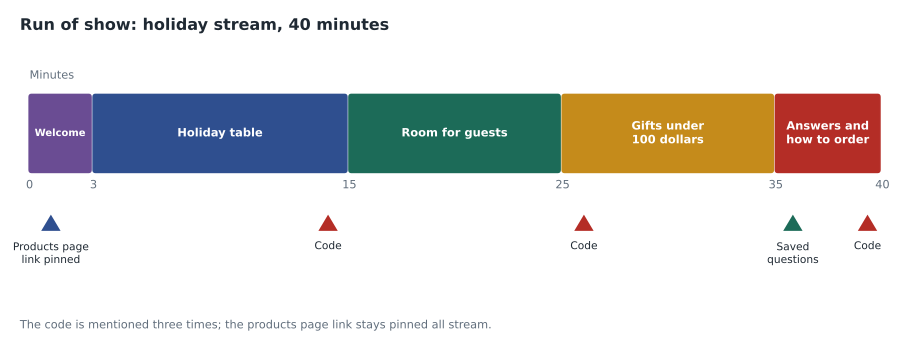
The plan also covers the practical details the pilot exposed. A second person monitors comments, answers simple questions in writing and passes the best ones to the host. A sheet beside the camera lists every product's price, sizes, colours, stock and delivery time, so nobody has to guess. A separate microphone for each speaker and a test stream the day before prevent sound problems. Stock is checked that afternoon so the stream does not promise products that have sold out, the same promise gap lesson 1 warned about.
Worked problem
How many hours does a stream really take?
For the December 3 stream, Tessa estimates: planning and run of show, 4 hours; setting the scene, 3 hours with two people; rehearsal and test stream, 1 hour with three people; the stream itself, 40 minutes with three people; and follow-up (answering comments, posting the replay, reporting), 3 hours. How many staff hours is that in total? At an average of 30 dollars an hour, what is the labour cost?
Show solution
- Staff hours by task:
- The stream itself is 40 minutes for three people, or 120 minutes, which is 2 staff hours.
- Total:
- \[4 + 6 + 3 + 2 + 3 = 18\]
- Labour cost:
- \[18 \times 30 = 540\]
Answer: About 18 staff hours, or about 540 dollars of labour, for a 40-minute stream. At a 55 in 100 gross margin, the stream needs about 982 dollars of traced sales just to cover the labour, before counting the code discount. Planning makes the cost visible before the stream, not after.
Hosting well
A good host combines the floor skills of SLS-250 with a little broadcasting. Noura's rules for hosts, refined after the pilot, are these. Speak to one person, not "everyone out there". Show, don't describe: open the drawer, sit in the chair, pour water on the performance fabric. Say the product name and price clearly every time a product appears, because viewers join at different moments. Greet viewers by their screen names when they ask questions, and answer honestly, including "I don't know, but I will find out and post the answer". Repeat how to buy every few minutes without pressure. And never invent urgency: if the code lasts 48 hours, say 48 hours, not "only a few left" unless that is true.
Comment moderation matters as much as hosting. Live comments can attract spam, offensive remarks and complaints about unrelated orders. Juniper & Pine's moderator hides spam and abuse, answers simple questions, and replies to service complaints with "I'm sorry about that. Please message us your order number and our service team will help", moving the conversation to a private channel. The store's community guidelines are pinned at the start of every stream.
The rules for live selling
A live stream is advertising, and everything said on it is subject to the same rules as a product page or a printed flyer. Prices and savings claims must be accurate, performance claims must be backed by tests, and urgency claims such as "only three left" must be true. Live streams add two risks: things are said on the spot, without the review that printed advertising gets, and the recording stays online afterward. Hosts should stick to the claims on the product sheet.
Giveaways during streams raise extra rules. In Canada, a contest that awards prizes by chance can be an illegal lottery under the Criminal Code unless no purchase is required and, by long practice, winners must answer a skill-testing question. The Competition Act also requires fair disclosure of the number and approximate value of prizes, any regional allocation, the odds and any facts that affect them, and the Act and the platform's own promotion rules apply to how a giveaway is run.
Juniper & Pine decided to avoid giveaways in its first streams and to use a simple, honest offer instead: a code valid for 48 hours on the products shown.
Measuring a stream
Live streams produce attention numbers, such as viewers, peak viewers, watch time and comments, and sales numbers, such as visits to the products page, orders and code redemptions. As with social posts, the sales numbers always undercount, because some viewers buy later without the code or come into the store weeks afterward. Tessa measures four things for every stream: unique viewers including replays, products page visits, traced sales and the gross margin on them, and labour hours. She compares each stream with the last one, not with the wildly varying benchmarks published by vendors.
After the stream
The stream does not end when the camera stops. Much of the value of live shopping comes in the next few days. Juniper & Pine's checklist for the morning after a stream has four parts. First, answer every unanswered question from the comments, either publicly under the replay or by direct message, and record any answer that should go on a product page. Second, edit the replay: trim the start and end, add product names and prices on screen, and post it where viewers who missed the live event can find it. Third, cut short clips of the strongest moments, such as Noura showing how far apart to place dining chairs, for use as social posts over the following weeks. Fourth, record the results against the stream's targets while the details are fresh, including what went wrong, such as the sound dropping, and what to change next time.
Tessa found that the replay and clips of the October pilot together reached more people over the following two weeks than the live stream itself. That changed how she judged the cost of a stream. A 40-minute stream that produces a replay and five useful clips is a month of content as well as an evening's selling. It also meant that the stream had to be planned with clips in mind: clear segments, each showing one idea, with the product name said aloud at the start of each.
Common mistakes
MistakeA live stream is just a casual video; no plan is needed.
InsteadPlan a run of show, a product sheet, a comment moderator and a test stream.
MistakeCount success by the number of viewers.
InsteadMeasure products page visits, traced sales, gross margin and labour hours as well.
MistakeCreate excitement with "almost sold out!"
InsteadUrgency claims must be true; false urgency is misleading advertising.
MistakeRun a giveaway to boost viewers without checking the rules.
InsteadContests and sweepstakes have legal requirements in both countries, and platforms have their own rules.
MistakeAnswer service complaints in the live comments.
InsteadMove them to a private channel with the order number.
Summary and key terms
- Live shopping combines live video with the chance to buy, adding real-time questions and demonstration to online selling.
- It grew first in China and has grown unevenly in North America, where several platform features were withdrawn.
- For a home store, its value lies in demonstration, advice and sending prepared shoppers to the website and store.
- A run of show, a product sheet, a moderator and a test stream turn a casual video into a reliable selling event.
- Everything said in a stream is advertising; prices, claims and urgency must be true, and giveaways have their own rules.
- Measure viewers, products page visits, traced sales and margin, and labour hours, and compare streams with each other.
- Live shopping
- Selling through a live video broadcast in which viewers can ask questions and buy the products shown.
- Run of show
- A minute-by-minute plan of a live stream.
- Peak viewers
- The largest number of people watching a live stream at the same moment.
- Moderator
- The person who monitors, answers and manages comments during a live stream.
- Replay
- The recording of a live stream posted for later viewing.
- Skill-testing question
- A question, usually arithmetic, that Canadian contest winners answer so the contest is not a game of pure chance.
Practice problems
Work each problem on paper first, then reveal the answer to check.
A stream sends 400 visitors to the products page, and 8 of them order. What is the conversion rate?
Show answer
8 divided by 400 is 0.02, or 2 in 100.
Why should the host say the price every time a product appears?
Show answer
Viewers join at different moments and need the price to decide.
What should a moderator do with a complaint about a late delivery?
Show answer
Apologize and ask the customer to message the order number so the service team can help privately.
Why did Juniper & Pine avoid giveaways in its first streams?
Show answer
Contests and sweepstakes have legal requirements in both countries; a simple, honest code was easier to run correctly.
Lesson quiz · 5 questions
Score 60% or more to complete this lesson.
Create a free account to save your progress, take quizzes and earn a certificate.