
SLS-254 · Lesson 5 of 12 · 24 min
Buy online, pick up in store
▶ Video coming soon A video version of this lesson is on the way.
On Wednesday, October 28, 2026, the session started not at the e-commerce desk but at the pick-up counter beside the furniture entrance. Marcus Dube, the store's operations and loss prevention lead, was there with a clipboard. Three customers were waiting: a man collecting a lamp he had ordered that morning, a woman picking up two dining chairs, and a couple who had come for a mattress protector but could not find their confirmation email. "This counter is where the website keeps its promise or breaks it," Marcus said. "If the order is ready, the bag is labelled and the person is out in two minutes, they will order again. If they wait fifteen minutes while somebody searches the back room, they will not." Tessa had asked Marcus to join that afternoon because buy online, pick up in store depends on the store's operations as much as on the website.
Buy online, pick up in store, usually shortened to BOPIS, lets a customer order and pay on the website, then collect the order at the store. Related services include reserve online, pay in store, where the item is held for the customer to see and pay for, and curbside pick-up, where staff bring the order to the customer's car. This lesson explains why customers and stores like these services, how the process works, how to measure it, and how to use the pick-up visit as a selling opportunity without spoiling the convenience the customer came for.
Why customers choose pick-up
Customers choose pick-up for four main reasons. It is usually free, while delivery costs money. It is fast; a small item ordered in the morning can be ready the same afternoon. It is certain; the customer knows the item is in stock and set aside, instead of hoping it will be on the shelf. And it avoids missed deliveries and parcels left on doorsteps in winter. For Juniper & Pine, pick-up is also the natural choice for customers who live in town and own a vehicle large enough for a chair, a small table or a boxed bookshelf.
In October 2026, 118 of Juniper & Pine's 225 web orders were pick-up orders, about 52 in 100. Home delivery by the store's own crew accounted for 82 orders and parcel shipping of small décor for 25. Pick-up orders were smaller on average, around 310 dollars, because large furniture is almost always delivered.
Why stores like pick-up
Pick-up saves the store the cost of shipping and delivery. A parcel shipped across the province might cost the store 14 to 25 dollars; a pick-up order costs only the labour to pick, pack and hand it over. Pick-up also brings online customers into the store, where some buy something else. Retailers and consultants regularly report that a large share of pick-up customers buy additional items during the visit, though the figures vary a great deal by store type and come mostly from retailers' own reports.
Worked problem
The cost of pick-up versus shipping
A web order for two cushions and a vase totals 120 dollars. Shipping it by parcel would cost Juniper & Pine about 18 dollars, plus 4 dollars of packing materials and 6 minutes of packing labour. A pick-up order needs 5 minutes to pick and bag and 3 minutes at the counter. Labour costs the store about 24 dollars an hour including benefits. Compare the fulfilment cost of each option.
Show solution
- Labour cost per minute:
- \[24 \div 60 = 0.40\]
- Shipping cost:
- \[18 + 4 + 6 \times 0.40 = 18 + 4 + 2.40 = 24.40\]
- Pick-up cost:
- \[(5 + 3) \times 0.40 = 3.20\]
Answer: Shipping costs about 24.40 dollars and pick-up about 3.20 dollars, a saving of about 21 dollars on a 120-dollar order. That saving is why the store makes pick-up free and sets a minimum order value for free shipping.
The pick-up process
A reliable pick-up service follows the same steps every time. Marcus and Tessa mapped Juniper & Pine's process on the whiteboard behind the counter.
| Step | Who | Standard |
|---|---|---|
| 1. Order received | Website and order system | Payment authorized; order appears on the pick list |
| 2. Pick | Décor or stockroom associate | Started within 30 minutes during store hours |
| 3. Check and stage | Same associate | Item inspected, bagged or tagged with the order number, placed on the labelled pick-up shelf |
| 4. Notify | Order system, automatically | Text or email: "Your order is ready", with hours and parking information |
| 5. Hand over | Counter associate | Check the name and order number, show the item, offer help to the vehicle |
| 6. Close | Counter associate | Mark as collected; note any issues |
| 7. Follow up uncollected orders | Order desk | Reminder after 3 days; call after 7; cancel and refund after 14 if not collected |
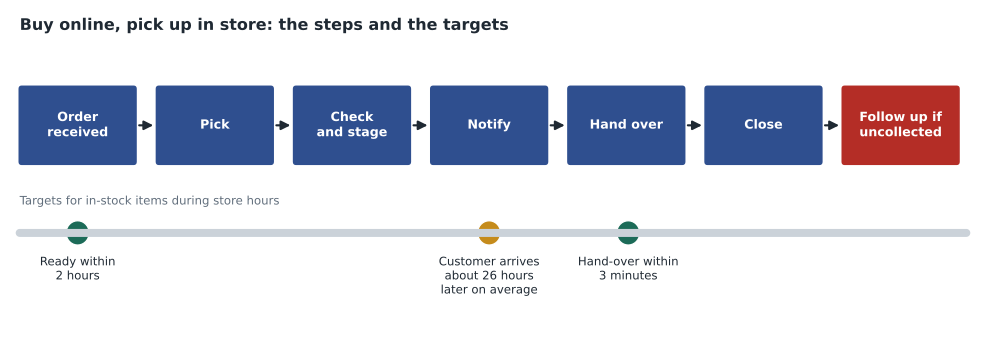
The most important number is ready time, the time from the order being placed to the "ready" notification. Juniper & Pine promises that in-stock décor ordered during store hours will be ready within two hours, and larger boxed items by the next day. The promise depends on the promise gap from lesson 1 being closed; an item that is out of stock cannot be ready in two hours, however fast the pickers are. The second key number is hand-over time, how long the customer waits at the counter.
Worked problem
Measuring ready time
In the week of October 19, Juniper & Pine logged 31 pick-up orders for in-stock décor placed during store hours. Of these, 24 were ready within two hours, 5 were ready within four hours and 2 took until the next day. What share met the two-hour promise?
Show solution
- Share ready within two hours:
- \[24 \div 31 \approx 0.774\]
Answer: About 77 in 100 orders met the promise. Marcus traced the 7 late orders: 4 arrived while the only décor associate was helping customers on a busy Saturday, and 3 involved stock that was not where the system said. The first problem is staffing; the second is inventory accuracy, which SLS-252 covers.
Getting the hand-over right
The hand-over is the only time an online customer meets the store in person, so it shapes how they feel about the whole purchase. A good hand-over is quick, friendly and accurate. The counter associate greets the customer within a minute, confirms the name and order number, shows the item before handing it over so the customer can check it, and offers help carrying it to the vehicle. For furniture and heavier items, Juniper & Pine's rule is that staff load the vehicle, using a cart or a second person; customers should not be left wrestling a boxed table into a hatchback in the parking lot.
Identity checks protect both the customer and the store. Marcus explained that most pick-up fraud involves someone using a stolen card to order online and then collecting the goods before the card holder notices. Juniper & Pine asks for the order number and photo identification matching the name on the order, or a named alternate person the customer added at checkout. For orders over 1,000 dollars, or where the order system flags the payment as risky, the counter associate also checks the last four digits of the card. These steps take seconds and stop most of the problem.
Checking identification at pick-up is collecting personal information. Under PIPEDA, the store should look at the ID to confirm the name rather than photocopy it or record the number, unless it has a clear reason to keep it and has told customers. Juniper & Pine records only that ID was checked.
Selling at the pick-up counter
A pick-up customer is already in the store and already a buyer, which makes the visit a selling opportunity. It is also a visit the customer expects to be short. The skill is to add value without adding delay. SLS-250's link-recommend-release pattern works well here: link a suggestion to what the customer bought, recommend one specific item, and release the customer if they are not interested.
Juniper & Pine uses three light-touch methods. First, the pick-up shelf is placed so customers walk past a small display of add-ons, such as cushion inserts, fabric protector spray and felt pads for chair legs. Second, the order system flags common companion items, so a counter associate handing over dining chairs can mention the matching cushions or the protector spray that suits the fabric. Third, pick-up customers who mention a bigger project, such as furnishing a new room, are offered a time with a floor associate, now or later. Nobody is kept at the counter with a long pitch.
Worked problem
What is the pick-up counter worth in add-on sales?
In October, 118 pick-up orders were collected. In 31 of those visits the customer bought at least one extra item, spending an average of 46 dollars. What was the add-on rate and the extra revenue? If the gross margin on add-ons averages 52 in 100, what was the extra gross margin?
Show solution
- Add-on rate:
- \[31 \div 118 \approx 0.263\]
- Extra revenue:
- \[31 \times 46 = 1{,}426\]
- Extra gross margin:
- \[1{,}426 \times 0.52 \approx 741.52\]
Answer: About 26 in 100 pick-up visits produced an add-on sale, adding about 1,426 dollars of revenue and about 742 dollars of gross margin in the month. That is a modest but real gain from a service the customer chose for convenience.
Reserve online, try in store
For furniture, many shoppers are not ready to pay online but want to be sure a product will be there when they arrive. Reserve online, try in store lets them hold a floor model or a specific item for a set time, often 24 or 48 hours, without paying. Juniper & Pine already offers 48-hour holds on the floor, as SLS-250 described; extending the same hold to the website, with a "Reserve to see it in store" button, was one of the changes Tessa planned for early 2027.
Reservations carry a cost: an item on hold cannot be sold to someone else, and many reservations are never collected. Stores that offer them usually limit the number of active holds per customer and release holds automatically when they expire. The pay-off is that a reserving customer has set a time to visit, which a good associate can turn into a sale. Tessa planned to track the share of reservations that end in a purchase as the main measure of the service.
Uncollected orders
Some pick-up orders are never collected. Customers forget, change their minds or find the product elsewhere. Uncollected orders take up shelf space and tie up stock that could be sold. Juniper & Pine's process sends a reminder after three days, calls after seven and, after fourteen days, cancels the order, refunds the payment and returns the item to stock. In October, 4 of the 118 pick-up orders, about 3 in 100, reached the seven-day call, and one was cancelled.
Curbside, lockers and other pick-up options
Pick-up does not have to mean the counter. Curbside pick-up lets customers wait in a marked parking space while an associate brings the order out, which suits parents with children in the car, customers with limited mobility and anyone collecting a heavy box. Pick-up lockers let customers open a compartment with a code at any time the building is open, without waiting for an associate; they suit small orders but cannot handle furniture, and they remove the chance to sell or help. Some stores also offer pick-up from a loading door for bulky items, with staff to help load the vehicle.
Juniper & Pine uses the counter for décor and small items, and the loading door for boxed furniture. Tessa considered lockers and decided against them for now: most of the store's pick-up orders are too large, and the counter conversation, done well, is part of what makes pick-up worth offering. She did mark two parking spaces near the loading door for curbside pick-up, with a sign asking customers to reply to their "ready" text when they arrive. The reply tells the counter associate who is waiting and where, so the order comes out within a few minutes instead of the customer having to come in and queue.
Common mistakes
MistakePick-up is just a cheaper form of shipping.
InsteadIt is a store visit; the hand-over shapes how the customer feels about the whole purchase and can lead to more sales.
MistakeSend the "ready" message as soon as the order is received.
InsteadSend it only when the item is picked, checked and on the pick-up shelf.
MistakeUse the pick-up visit for a full sales pitch.
InsteadCustomers chose pick-up for speed. Suggest one linked item and offer a later appointment for bigger needs.
MistakeAnyone with the order number can collect.
InsteadCheck photo identification or a named alternate to stop fraud, without recording more personal information than needed.
MistakeLeave uncollected orders on the shelf until the customer comes.
InsteadRemind, call and, after a set period, cancel, refund and return the stock to sale.
Summary and key terms
- Buy online, pick up in store lets customers order and pay online and collect at the store; related services include reserve online and curbside pick-up.
- Customers like pick-up because it is free, fast and certain; stores like it because it saves shipping costs and brings buyers into the store.
- A reliable process covers order, pick, check and stage, notify, hand over, close and follow-up of uncollected orders.
- Ready time and hand-over time are the key measures, and both depend on accurate inventory.
- Identity checks at hand-over stop most pick-up fraud and should collect as little personal information as possible.
- The pick-up visit is a light-touch selling opportunity: one linked suggestion, then release.
- BOPIS
- Buy online, pick up in store: ordering and paying online, then collecting at the store.
- Curbside pick-up
- A pick-up service in which staff bring the order to the customer's vehicle.
- Reserve online, try in store
- Holding an item online, without paying, to see it in the store.
- Ready time
- The time from an online order to the notification that it is ready to collect.
- Hand-over time
- How long a customer waits at the counter to collect an order.
- Add-on rate
- The share of visits or orders in which the customer buys at least one extra item.
Practice problems
Work each problem on paper first, then reveal the answer to check.
Of 50 pick-up orders, 42 were ready within the promised time. What share met the promise?
Show answer
42 divided by 50 is 0.84, or 84 in 100.
Why should the "ready" notification wait until the item is on the pick-up shelf?
Show answer
Otherwise the customer may arrive before the item is picked and checked, and wait or find a problem.
Give one way to sell at the pick-up counter without slowing the customer down.
Show answer
Mention one companion item linked to the order, such as protector spray for a new fabric chair.
How does Juniper & Pine reduce pick-up fraud?
Show answer
It asks for the order number and photo ID matching the order name or a named alternate, and checks card digits on large or flagged orders.
Lesson quiz · 5 questions
Score 60% or more to complete this lesson.
Create a free account to save your progress, take quizzes and earn a certificate.