
SLS-254 · Lesson 10 of 12 · 23 min
Reviews and ratings
▶ Video coming soon A video version of this lesson is on the way.
On Wednesday, November 11, 2026, the last of the fall sessions, Tessa started with a short story from the week before. A customer named Denise Morin had posted a five-star review of Juniper & Pine. Her refrigerator delivery in early November had gone wrong: the crew had gouged her wall bringing the fridge in. The store had apologized the same day and paid a painter 380 dollars to fix it, as SLS-130 described. "She wrote that the way we handled the problem is why she will buy from us again," Tessa said. "That review has done more for us than any ad this year. And the important thing is what we did not do. We did not ask her for a good review in exchange for the painter. We fixed the problem, and then we asked her, like every customer, to tell people what she thought."
Online reviews and star ratings are now one of the most important influences on what people buy and where they buy it. This lesson explains why reviews matter, what the research shows about how shoppers read them, how to collect more honest reviews, how to respond to good and bad ones, and the laws in both countries that make fake or manipulated reviews a serious legal risk.
Why reviews matter
Reviews are social proof in its most direct form: other buyers telling a shopper what it was like to own the product or deal with the store. For a shopper who cannot see or touch a product, reviews answer the questions a salesperson would answer, and many shoppers trust them more than a salesperson because the reviewers have nothing to gain.
Research by Northwestern University's Spiegel Research Center, based on millions of product page views on retail websites, found that a product with five reviews was 270 in 100 more likely to be bought than a product with none, that the effect was larger for higher-priced products (about 380 in 100 more likely) than for lower-priced ones (about 190 in 100), and that the first handful of reviews made the biggest difference. The researchers also found that purchase likelihood usually peaked for products rated between 4.0 and 4.7 stars and fell as ratings approached a perfect 5.0, apparently because shoppers distrust ratings that look too good to be true. These findings come from the researchers' analysis of its partners' data rather than controlled experiments, but they match what retailers commonly see.
Reading a rating
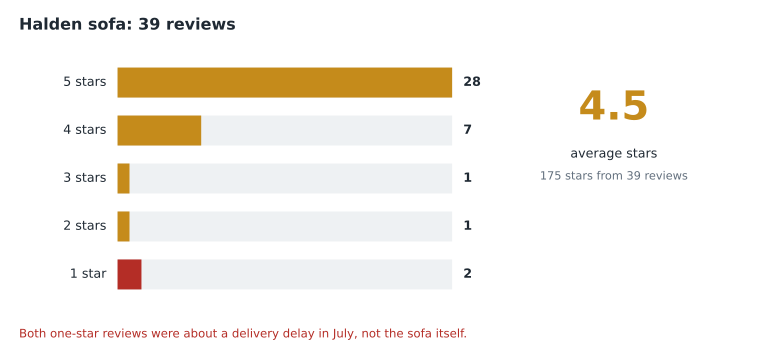
A star rating is an average, and averages can hide a lot. A sofa rated 4.3 stars from 46 reviews may have mostly fours and fives with a cluster of ones from people whose deliveries went wrong; another sofa with the same average may have reviews spread evenly across the scale. Shoppers increasingly look at the distribution and read the negative reviews to see whether the problem would matter to them. A complaint that "the cushions are firm" helps a shopper who wants firm cushions.
| Stars | Reviews |
|---|---|
| 5 | 28 |
| 4 | 7 |
| 3 | 1 |
| 2 | 1 |
| 1 | 2 |
Worked problem
Calculating the average rating
The Halden sofa has 28 five-star, 7 four-star, 1 three-star, 1 two-star and 2 one-star reviews. What is its average rating, to one decimal place?
Show solution
- Total stars:
- \[28 \times 5 + 7 \times 4 + 1 \times 3 + 1 \times 2 + 2 \times 1 = 140 + 28 + 3 + 2 + 2 = 175\]
- Number of reviews:
- \[28 + 7 + 1 + 1 + 2 = 39\]
- Average:
- \[175 \div 39 \approx 4.49\]
Answer: The average is about 4.5 stars from 39 reviews. Lesson 3's product page showed 4.6 from the 38 reviews available in mid-October (174 stars, an average of about 4.58); one of the one-star reviews was posted later and pulled the average down slightly.
Ratings also respond slowly to new reviews once there are many, and quickly when there are few. A new product with three five-star reviews and one two-star review averages 4.25; one more two-star review brings it to 3.8. That is one reason the first reviews matter so much, and why stores work to collect reviews soon after launch.
Worked problem
How many reviews would change the rating?
The Halden has 39 reviews totalling 175 stars. If the next 10 reviews are all five stars, what will the new average be?
Show solution
- New total stars:
- \[175 + 10 \times 5 = 225\]
- New number of reviews:
- \[39 + 10 = 49\]
- New average:
- \[225 \div 49 \approx 4.59\]
Answer: Ten more five-star reviews would lift the average only from about 4.49 to about 4.59. Ratings move slowly once a product has dozens of reviews, so the store's energy is better spent getting more customers to review than worrying about any single rating.
Collecting more honest reviews
Most satisfied customers never write a review unless asked, while unhappy customers are more motivated to post on their own. Asking every customer, at the right time, in a simple way, produces more reviews and a fairer picture. Juniper & Pine sends a review request by email or text, with the customer's consent, after delivery or pick-up: 7 days after for décor and small furniture, 30 days after for sofas and mattresses, so customers have lived with the product, and 14 days after for appliances. The request goes to every buyer, not only to those the store expects to be happy, and links straight to the review form.
Worked problem
Review collection rate
In October 2026 Juniper & Pine sent review requests to 1,640 customers who had received their purchases. It received 197 reviews. What was the collection rate? If the store could raise it to 15 in 100 with a shorter form, how many reviews a month would that bring?
Show solution
- Current collection rate:
- \[197 \div 1{,}640 \approx 0.120\]
- Reviews at 15 in 100:
- \[1{,}640 \times 0.15 = 246\]
Answer: The store collected reviews from about 12 in 100 of customers asked. A rate of 15 in 100 would bring about 246 reviews a month, nearly 50 more. Tessa planned to cut the form from six questions to three.
Some ways of collecting reviews are illegal or unethical, and the next section explains the rules. The short version is that a store may ask everyone, may make it easy, and may even offer a small thank-you for writing a review, but may not ask only happy customers, may not reward positive reviews, may not write or buy reviews, and may not hide negative ones.
The law on fake and manipulated reviews
In Canada, reviews are covered by the Competition Act's rules on false or misleading representations. A fake review, a review written by an employee or someone paid by the store without disclosure, or a selection of reviews that gives a misleading general impression can all be misleading representations. The Competition Bureau has enforced these rules against fake reviews before; in 2015 Bell Canada paid 1.25 million dollars after employees were encouraged to post positive reviews of its apps without disclosing who they were. Since the 2024 amendments, civil penalties for corporations can reach 10 million dollars for a first order, or three times the benefit gained, or 3 in 100 of annual worldwide revenue, and since June 2025 private parties can also bring deceptive marketing cases to the Competition Tribunal with leave.
| Generally allowed | Not allowed |
|---|---|
| Asking every buyer for a review | Asking only customers you expect to be happy |
| A small thank-you for any review, positive or negative, clearly disclosed | A reward for positive reviews only, or a discount in exchange for raising a rating |
| Staff reviews clearly labelled as from staff | Staff, owners or relatives posting as ordinary customers |
| Showing all reviews, with a fair filter for abuse and personal information | Hiding or delaying negative reviews to make the rating look better |
| Responding publicly and politely to complaints | Threatening customers or asking them to remove a negative review in exchange for a refund |
| Reviews from verified buyers marked as such | Buying reviews, followers or views |
Juniper & Pine's review policy follows these rules. Every buyer is asked. Reviews are published unless they contain abuse, personal information or content unrelated to the product, and the policy saying so is linked on every product page. Staff may review products only with a "Juniper & Pine staff" label. No incentive is ever tied to the rating. And the store never offers a refund or repair on condition that a review is changed; it fixes the problem first, then may ask the customer whether they would like to update their review, which is their choice.
Responding to reviews
Responding to reviews shows shoppers that the store listens, and research by review platforms suggests that shoppers think better of businesses that reply politely to criticism. A good response to a negative review thanks the customer, apologizes for the experience without arguing, states briefly what the store has done or will do, and offers a direct way to continue the conversation privately. It never reveals the customer's personal information or order details in public, and it never accuses the customer of lying.
| Review | Response |
|---|---|
| "Waited three weeks past the promised date for my sofa. Nobody called to tell me. The sofa is fine but I would not order online again." | "Thank you for telling us, and I am sorry. Three weeks late with no call is not the service we promise. Our supplier had a delay in July, and we should have called you as soon as we knew. We now contact every customer the same day if a delivery date will be missed. If you would like to talk, please reach me directly at the store. Tessa, Juniper & Pine" |
Positive reviews deserve a reply too, but a short and specific one, such as thanking the reviewer for mentioning the delivery crew by name and passing the compliment on. Replies that copy the same sentence onto every review look automated and add nothing.
Using reviews to sell and improve
Reviews are also data. Tessa reads every review below four stars each week and tags the reason. Over the summer, the tags showed three patterns: delivery delays from one supplier, a chair whose seat stitching was failing, and confusion about the colour of a rug. The first led to a change in supplier lead times on product pages, the second to a warranty claim with the manufacturer and the removal of that chair, and the third to new daylight photos. On the floor, associates can use reviews honestly in conversation, as SLS-250 suggested: "Customers who bought this mattress mention that it sleeps cool, which is what you asked about."
Questions, answers and customer photos
Reviews are not the only content customers add to a product page. Many store platforms also offer questions and answers, where shoppers ask questions publicly and the store or other customers answer, and customer photos, where buyers upload pictures of the product in their homes. Both can be persuasive because they answer the questions real shoppers have, in their own words, and because a photo of a sofa in an ordinary living room shows its true size and shade better than a studio shot.
Both also need care. Questions should be answered quickly and accurately by someone who knows the product, because an unanswered question looks like an unhelpful store, and a wrong answer can lead to a return. Customer photos need the customer's permission for use beyond the review itself, such as in advertising or social posts, and the store must not edit them to make the product look better than it does. Juniper & Pine added questions and answers to its top 50 product pages in October, with the chat team answering within one business day. The most common question on the Halden sofa page, "Will the fabric show cat hair?", led Tessa to add a close-up photo of the fabric after a lint roller test, along with a line in the care section.
Common mistakes
MistakeAsk happy customers for reviews and leave the others alone.
InsteadAsk every buyer; asking only satisfied customers misleads shoppers and breaks review rules.
MistakeA perfect 5.0 rating is the goal.
InsteadRatings between about 4.0 and 4.7 often convert best; shoppers distrust perfection, and honest negatives build credibility.
MistakeOffer a discount to customers who give five stars.
InsteadIncentives tied to positive reviews are prohibited in both countries.
MistakeRemove negative reviews to protect the rating.
InsteadSuppressing honest reviews gives a misleading impression, which the Competition Act prohibits.
MistakeArgue with an unfair review in public.
InsteadApologize, state what you have done and move the conversation to a private channel.
Summary and key terms
- Reviews are a powerful form of social proof; the first few reviews have the largest effect, especially for expensive products.
- Shoppers read distributions and negative reviews, and ratings between about 4.0 and 4.7 often convert best.
- Averages move slowly once there are many reviews, so collecting reviews from every buyer matters more than any single rating.
- Ask every customer at a sensible time, make it easy, and never reward or select for positive reviews.
- Fake, bought, undisclosed or suppressed reviews can break the Competition Act's rules against misleading representations, with large penalties.
- Respond to reviews politely and specifically, and use review reasons to fix products, pages and processes.
- Star rating
- The average of customers' ratings, usually on a scale of one to five stars.
- Review distribution
- How many reviews a product has at each star level.
- Collection rate
- The share of customers asked for a review who write one.
- Verified buyer
- A reviewer confirmed to have bought the product.
- Review suppression
- Hiding, delaying or discouraging honest negative reviews.
- Incentivized review
- A review given in return for a reward; allowed only if the reward does not depend on the review's content and is disclosed.
Practice problems
Work each problem on paper first, then reveal the answer to check.
A product has 10 five-star, 4 four-star and 2 one-star reviews. What is its average rating?
Show answer
50 plus 16 plus 2 is 68 stars; 68 divided by 16 is 4.25.
Why might a product rated 4.6 sell better than one rated 5.0?
Show answer
Shoppers may distrust a perfect rating; a few honest criticisms make the reviews more believable.
Is it allowed to give every reviewer a 5-dollar coupon, whatever they write?
Show answer
Generally yes, if the reward does not depend on the review's content and is disclosed.
Name three parts of a good response to a negative review.
Show answer
Thanks and an apology, a brief statement of what the store has done, and a private way to continue the conversation.
Lesson quiz · 5 questions
Score 60% or more to complete this lesson.
Create a free account to save your progress, take quizzes and earn a certificate.