
SLS-254 · Lesson 4 of 12 · 23 min
Marketplaces
▶ Video coming soon A video version of this lesson is on the way.
On Wednesday, October 21, 2026, Tessa had a spreadsheet open when Aiden sat down. Across the top were the names of three online marketplaces; down the side were forty décor products, from throw blankets to table lamps. "The owners asked me a simple question last month," she said. "Should we sell on marketplaces? It sounds like free customers: millions of shoppers, and all we do is upload a listing. It is not free, and it is not simple. Today we work out what it would really cost us, what we would gain, and what we would risk."
An online marketplace is a website or app where many independent sellers list products and the marketplace operator handles the shopping experience: search, product pages, checkout and often payment. Examples familiar to Juniper & Pine's customers include Amazon.ca, Walmart.ca and Wayfair.ca, along with eBay and Etsy for some décor. This lesson explains how marketplaces work, what they cost, how they change the relationship with the customer, and the rules that apply to sellers.
How marketplaces work
Marketplaces bring together huge numbers of shoppers and sellers. Shoppers come because the selection is wide, prices are easy to compare and checkout is familiar. Sellers come because that is where the shoppers are. The operator earns money from fees and, increasingly, from advertising sold to sellers who want their listings to appear higher in search results.
There are several marketplace models. In a third-party marketplace, independent sellers own the stock, set prices and pay fees on each sale; the marketplace may also sell its own stock alongside them, as Amazon does. In a fulfilment service, the seller sends stock to the marketplace's warehouses and the marketplace picks, packs, ships and handles returns for an extra fee. In a drop-ship model, common for large furniture on sites such as Wayfair, the marketplace takes the order and the supplier ships directly from its own warehouse. Each model shifts different costs and risks between the seller and the operator.
| Model | Who holds stock | Who ships | Main fees for the seller |
|---|---|---|---|
| Third-party marketplace, seller ships | Seller | Seller | Referral fee on each sale; optional advertising |
| Third-party with marketplace fulfilment | Marketplace warehouse | Marketplace | Referral fee, fulfilment fee per unit, storage fees |
| Drop-ship supplier to a marketplace | Supplier | Supplier | Marketplace sets the price and pays the supplier a wholesale cost |
| Marketplace selling its own stock | Marketplace | Marketplace | Not a seller arrangement; the marketplace competes directly |
What it really costs
The main fee is a referral fee, a share of each sale price, often around 15 in 100 for home and furniture categories, though rates differ by marketplace, category and price band and change from time to time. Sellers who use the marketplace's fulfilment pay per-unit fees for picking, packing and shipping, and monthly storage fees. Many marketplaces also charge a monthly account fee. And because search results on the largest marketplaces are crowded, most sellers buy advertising to be seen, which can add several more dollars per sale.
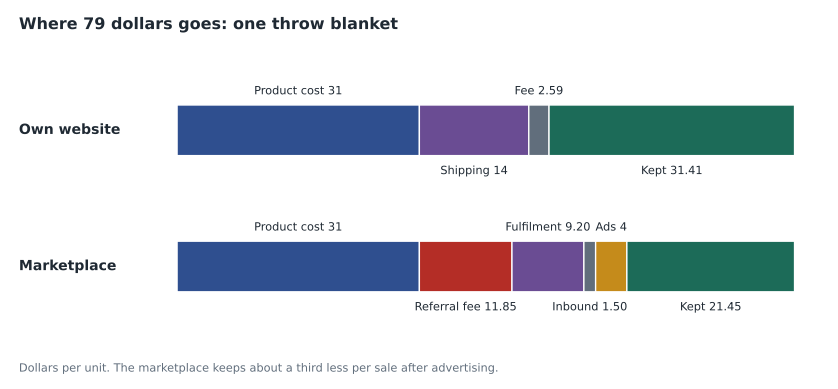
Tessa built her comparison around one of Juniper & Pine's best-selling décor items, a chunky-knit throw blanket priced at 79 dollars that cost the store 31 dollars from the supplier. She compared selling it on the store's own website, with the store shipping it, against selling it on a marketplace using the marketplace's fulfilment service. The fees below are illustrative, chosen to be in the range Tessa found in published fee schedules in October 2026; any real decision would use the current schedule for the exact category.
Worked problem
Margin on the throw blanket, website versus marketplace
The throw sells for 79 dollars and costs 31. On the store's own website, shipping a parcel costs Juniper & Pine about 14 dollars (it offers free shipping on décor over 75 dollars), and the card payment fee is 2.9 in 100 of the sale plus 0.30 dollars. On the marketplace, the referral fee is 15 in 100, the fulfilment fee is 9.20 dollars per unit, and sending stock to the marketplace warehouse costs about 1.50 dollars per unit. Payment processing is included in the referral fee. Compare the contribution per unit before advertising.
Show solution
- Website: payment fee
- \[79 \times 0.029 + 0.30 = 2.29 + 0.30 = 2.59\]
- Website: contribution per unit
- \[79 - 31 - 14 - 2.59 = 31.41\]
- Marketplace: referral fee
- \[79 \times 0.15 = 11.85\]
- Marketplace: contribution per unit
- \[79 - 31 - 11.85 - 9.20 - 1.50 = 25.45\]
Answer: The website keeps about 31.41 dollars per throw (about 40 in 100 of the price); the marketplace keeps about 25.45 dollars (about 32 in 100) before any advertising. If the store spends 4 dollars a unit on marketplace ads to be seen, the marketplace contribution falls to 21.45 dollars. The marketplace sale is still profitable, but each one is worth about a third less than a sale on the store's own site.
What a marketplace offers in return
The case for marketplaces is reach. Many shoppers start their product searches on the largest marketplace rather than on a search engine, and a store whose products are not there is invisible to them. A marketplace can also reach customers far from the store, test demand for a new product without building pages for it, and move overstock that would otherwise be marked down. For Juniper & Pine, whose website traffic comes mostly from people within a two-hour drive, a marketplace could sell décor to shoppers across the country who will never visit Regina.
Worked problem
How many extra units make it worthwhile?
Suppose the marketplace test costs Juniper & Pine 2,400 dollars to set up (photography, listing work and account fees for the first months) and 300 dollars a month in staff time to manage. Each throw sold on the marketplace contributes 21.45 dollars after advertising. How many throws, or equivalent décor units, must the marketplace sell in the first six months just to cover these costs?
Show solution
- Costs for six months:
- \[2{,}400 + 6 \times 300 = 4{,}200\]
- Units needed to cover them:
- \[4{,}200 \div 21.45 \approx 195.8\]
Answer: About 196 units in six months, roughly 33 a month, just to break even, and that assumes every marketplace sale is a new customer. If some of those buyers would otherwise have bought from the store's own site at the higher margin, the true break-even is higher.
The risks: customers, prices and control
The biggest risk is not the fees but the relationship. On a marketplace the customer usually sees the marketplace, not the seller. The marketplace controls the product page layout, the reviews, the communication and, in many cases, the customer's contact details. A shopper who buys a Juniper & Pine throw on a marketplace may never learn the store's name, cannot be invited to the spring sale and may not come back. Bev's concern was exactly this: the store had spent years building a client book, and a marketplace sale does not add to it.
Prices are the second risk. Marketplaces make it easy to compare prices, and sellers of identical products compete hard. A product sold at a lower price on a marketplace than on the store's own website undermines the store's pricing, while a higher marketplace price, needed to cover fees, may make the store look expensive. Juniper & Pine's price-match policy already excludes online marketplaces, as SLS-250 explained, partly because marketplace prices change constantly and may come from sellers who are not authorized dealers.
The third risk is control. Marketplaces change fees, rules and search ranking with little notice, can suspend seller accounts for missed shipping times or high return rates, and may use sales data to decide which products to sell themselves. Some brands also restrict which retailers may sell their products on marketplaces, and Juniper & Pine's supplier agreements had to be checked before anything was listed.
| Good candidates | Poor candidates |
|---|---|
| Small, light items that ship easily, such as throws and cushions | Large furniture that needs delivery and assembly |
| Products where the store has good stock and a reliable supplier | Products with frequent stock shortages |
| Store-label items no one else sells | Brand-name products sold by dozens of sellers at low prices |
| Overstock the store wants to clear without public markdowns | Products that need advice and fitting to sell well |
| Items with low return rates | Items customers often return, such as mattresses |
Rules for marketplace sellers
Selling on a marketplace does not change the seller's legal obligations. Product claims, pricing claims and reviews are still subject to advertising law, and the seller is still responsible for product safety and for honouring warranties. Marketplaces add their own seller agreements, which can be stricter than the law, such as rules on shipping times, cancellations, return windows and how sellers may contact customers.
Canada has no federal law aimed specifically at marketplace sellers, but the general rules apply to every listing, including the Competition Act's rules on misleading representations, drip pricing and reviews. Since July 2021, marketplace operators that facilitate sales by non-resident sellers must collect GST/HST on those sales, and Saskatchewan has required online marketplaces to register for and collect PST since 2020. Juniper & Pine, as a registered Saskatchewan business, would continue to account for its own GST and PST, and its accountant would need to confirm how marketplace-collected tax is reported.
Tessa's recommendation
Tessa's conclusion, which she presented to Bev in October, was a limited test rather than a yes or no. She proposed listing 40 store-label décor items on one marketplace for six months from February 2027, shipped by the store rather than through marketplace fulfilment so the stock stayed visible to the store and website. The test would measure contribution per unit after all fees and advertising, return rates, time spent managing the listings, and whether any marketplace buyers later found the store's own website. Large furniture, mattresses, appliances and brand-name products would stay off marketplaces. Bev approved the test as a plan for the new year, to be reviewed in August 2027.
Worked problem
Setting a test target
Tessa's test lists 40 items. She sets a target of 2 units per item per month. Over six months, how many units would that be, and would it clear the break-even of about 196 units?
Show solution
- Units at target:
- \[40 \times 2 \times 6 = 480\]
- Compared with break-even:
- \[480 > 196\]
Answer: The target is 480 units, about two and a half times the break-even. The target is a guess; the test exists to find out whether the marketplace can reach it.
Choosing which products to list
Not every product suits a marketplace. Tessa and Aiden sorted the store's range against a few simple tests before choosing items for the planned trial.
| Test | Good fit | Poor fit |
|---|---|---|
| Size and shipping | Small, light items that ship in a standard box | Sofas, appliances and anything needing a delivery crew |
| Margin after fees | Enough margin left after the referral fee and shipping | Thin-margin items that would sell at a loss |
| Return risk | Items customers rarely return, such as throws and serving boards | Items where colour or size often disappoints |
| Competition | Items few other sellers list, such as the store's own-brand décor | Branded items listed by dozens of sellers at lower prices |
| Store role | Items that introduce new customers to the store | Items that bring customers into the store for advice and add-ons |
The last test matters most for a store like Juniper & Pine. A mattress or a fridge sold in the store often comes with delivery, removal of the old one, a protection plan and a conversation that leads to the next purchase. Sold on a marketplace, it is a single transaction with a customer the store may never hear from again. The trial list therefore leaned toward own-brand décor that customers could not easily compare elsewhere, with each listing carrying the same photos, dimensions and care information as the store's own product page.
Common mistakes
MistakeA marketplace gives you customers for free.
InsteadReferral, fulfilment, storage and advertising fees often take a third or more of the price.
MistakeMarketplace customers become store customers.
InsteadThe marketplace usually owns the relationship; few marketplace buyers learn the seller's name or return directly.
MistakePut every product on the marketplace to maximize reach.
InsteadLarge, fragile, advice-heavy or often-returned products rarely work; start with small, easy-to-ship items.
MistakeMarketplace rules replace the law.
InsteadAdvertising, consumer protection, product safety and tax laws still apply to every listing.
MistakeMatch any price seen on a marketplace.
InsteadMarketplace prices change constantly and may come from unauthorized sellers; most retailers exclude them from price matching.
Summary and key terms
- Online marketplaces gather many sellers in one shopping experience run by an operator who earns fees and advertising revenue.
- Models include third-party selling, marketplace fulfilment and drop-ship supply, each sharing costs and risks differently.
- Referral, fulfilment, storage and advertising fees can cut contribution per unit sharply compared with the store's own website.
- Marketplaces offer reach, but the operator usually owns the customer relationship, the page and the rules.
- Small, easy-to-ship, low-return, store-label items make the best test candidates.
- Sellers remain responsible under advertising, consumer protection and tax law, and marketplaces collect GST/HST and Saskatchewan PST on many of the sales they facilitate.
- Online marketplace
- A website or app where many sellers list products and the operator runs the shopping experience.
- Referral fee
- The share of each sale price a marketplace charges the seller.
- Fulfilment service
- A marketplace service that stores, picks, packs and ships a seller's stock for a fee.
- Drop-ship
- An arrangement in which the supplier ships orders directly to the customer.
- Contribution per unit
- The price minus the product cost and all variable selling costs for one unit.
- Marketplace facilitator
- An online marketplace that processes sales for other sellers; in Saskatchewan it must register for and collect PST on the sales it facilitates.
Practice problems
Work each problem on paper first, then reveal the answer to check.
A cushion sells for 50 dollars, costs 18, and the marketplace charges a 15 in 100 referral fee and a 7 dollar fulfilment fee. What is the contribution before advertising?
Show answer
50 times 0.15 is 7.50; 50 minus 18 minus 7.50 minus 7 is 17.50 dollars.
Why do many retailers exclude marketplaces from price matching?
Show answer
Marketplace prices change constantly, come from many sellers, and may not be from authorized dealers.
Give two reasons large furniture is a poor marketplace product for a store like Juniper & Pine.
Show answer
It needs delivery and assembly that the store cannot provide far away, and it often needs advice and fitting to sell well.
Since July 2021, who must collect GST/HST on marketplace sales by non-resident sellers?
Show answer
The marketplace operator that facilitates the sales.
Lesson quiz · 5 questions
Score 60% or more to complete this lesson.
Create a free account to save your progress, take quizzes and earn a certificate.