
ROOF-210 · Lesson 9 of 12 · 23 min
Surfacing: gravel, granules and coatings
▶ Video coming soon A video version of this lesson is on the way.
On the afternoon of Friday, November 13, after the Westlane dry-in was finished, Glen Pelham sent Rory back to the Ferncliff Bakery with Dana to finish the report on the rest of the roof. The repair at the north drains was done. The question now was the other 530 m² of 42-year-old gravel BUR. In some areas the gravel was thick and the flood coat beneath it was black and soft when scratched. In others, wind and water had swept the gravel into windrows, leaving bare, grey, crazed asphalt baking in the sun. "This roof didn't wear out," Dana said. "Its surfacing did. The plies under the bare patches are getting a sunburn."
A bituminous membrane cannot be left bare. This lesson covers why surfacing matters, the three main kinds (gravel, factory granules and coatings), how each is installed and maintained, and how surfacing choices affect reflectivity, weight and fire rating.
What surfacing does
- Protects bitumen from ultraviolet light, which breaks down its surface, makes it brittle and shrinks it into cracks.
- Keeps the membrane cooler. Bare black bitumen can reach 80 °C (175 °F) or more on a summer afternoon; a light surface runs much cooler, which slows ageing.
- Improves the roof's fire rating, by keeping flame from reaching the bitumen.
- Takes foot traffic, hail and wear.
- On gravel roofs, adds weight that helps hold the roof down and protects the flood coat from wind and rain.
Roof coverings are fire tested and classed under CAN/ULC-S107 in Canada (and ASTM E108 or UL 790 in the US), from Class A, the best, through B and C. The class depends on the whole tested system, including the deck, insulation, membrane and surfacing. Changing the surfacing, for example coating a gravel roof or using a different cap, can change the class, so a specification that requires Class A must be built exactly as tested.
Gravel
A gravel-surfaced BUR finishes with a heavy flood coat of hot asphalt and a layer of aggregate embedded in it while it is hot. The aggregate protects the flood coat, and the flood coat is the roof's top line of waterproofing.
- Use clean, dry, rounded gravel or slag, about 9 to 20 mm (3/8 to 5/8 in), free of dust and fines, as the specification and the aggregate standard require (ASTM D1863 is the usual reference).
- Pour the flood coat in strips and spread the gravel immediately, while the asphalt is still fluid, so about half of each stone sinks into the asphalt.
- Typical rates for a single pour are about 2.9 kg/m² (60 lb per square) of asphalt and 19.5 kg/m² (400 lb per square) of gravel. A double pour, a second flood coat and a second layer of gravel, gives a thicker, longer-lasting surface.
- Sweep off loose gravel after the asphalt cools, and spread it where coverage is thin.
- Wet or dusty gravel does not embed. Damp stone in hot asphalt also makes it foam.
| Advantage | Limitation |
|---|---|
| very durable; excellent UV protection | heavy, adding load the structure must carry |
| good fire resistance | hard to find leaks: the gravel hides the membrane |
| tolerates traffic | gravel can be scoured off by wind at corners and edges, and blown off in storms |
| flood coat is a thick extra waterproofing layer | repairs need the gravel scraped back and replaced |
Worked problem
The weight of a gravel surface
What does a single-pour gravel surface add per square metre, and over the whole 650 m² Ferncliff roof?
Show solution
- Per m² = 2.9 kg asphalt + 19.5 kg gravel = 22.4 kg/m².
- Load = 22.4 × 9.81 ÷ 1,000 = 0.22 kPa.
- Whole roof = 650 × 22.4 = 14,560 kg, about 14.6 tonnes.
Answer: About 22 kg on every square metre and 14.6 tonnes over the roof. Re-graveling restores it; changing to a lighter surfacing removes it, which matters if the roof relies on the gravel weight for wind resistance.
Granule-surfaced cap sheets
Most modified bitumen roofs, and many BUR hybrids, use a cap sheet with mineral granules bonded to it in the factory. The granules are crushed rock, often coated with a coloured ceramic. They give UV protection, colour and fire resistance at a fraction of gravel's weight.
- Granules come in standard colours, and in white or highly reflective grades for cooler roofs.
- Keep granules on the sheet: do not drag tools or materials across caps, and walk on them with soft-soled boots. Lost granules expose bitumen to the sun.
- At end laps and anywhere a sheet laps onto granules, embed or remove the granules so bitumen bonds to bitumen (lesson 6).
- Touch up scuffed areas and torch marks with loose granules of the same colour, broadcast into hot bitumen or a compatible adhesive, as the maker specifies.
- Some granules wash off in the first rains; this is normal in small amounts. Bare patches are not.
Coatings
A coating is a liquid applied over a membrane to protect it, reflect sunlight or both. Coatings are used on smooth-surfaced BUR and mod-bit, as a reflective top layer on granulated caps, and to restore aged roofs.
| Coating | What it is | Notes |
|---|---|---|
| Asphalt emulsion | asphalt in water, often with clay or fibres | a protective, black coating for smooth roofs; also a base coat under reflective coatings |
| Fibred asphalt (cutback) coating | asphalt in solvent with fibres | thicker, black; solvent rules apply |
| Aluminum coating | asphalt coating with aluminum flakes that float to the surface | reflective silver surface; applied over cured asphalt |
| Acrylic elastomeric | water-based, usually white | highly reflective; needs dry weather above its minimum temperature to cure; not for ponding areas unless rated |
| Silicone | moisture-curing, usually white | tolerates ponding well; picks up dirt; few products adhere to it later |
| Polyurethane | one- or two-part | tough; used for traffic areas and restoration systems |
Coatings must be compatible with what is under them. Many coatings cannot go on fresh asphalt or mod-bit until its surface oils have weathered off, which can take weeks; the coating maker gives the waiting time. Silicone cannot be recoated with most other products. Water-based acrylics cannot be applied when rain, dew or frost is expected before they dry.
Coating thickness
A coating protects only if it is thick enough, so specifications give a dry film thickness, usually in micrometres (µm) or millimetres. The coating goes on wet and shrinks as its water or solvent leaves, so the applicator must put on more wet than the dry target. The product data sheet gives the volume solids, the share of the wet coating that stays.
Worked problem
How much acrylic coating
A reflective acrylic must give 0.50 mm dry. Its volume solids are 52 per cent. What wet thickness is needed, and how many litres per square metre in total? (1 L spread over 1 m² is 1 mm thick.)
Show solution
- Wet thickness = 0.50 ÷ 0.52 = 0.96 mm.
- Rate = 0.96 L/m², because 1 L/m² gives 1 mm.
- Applied in two coats of about 0.48 L/m² each, at right angles to each other.
Answer: 0.96 L/m² of coating, in two coats. The applicator checks with a wet film gauge as he goes: each coat should read about 0.48 mm wet.
A wet film gauge is a small steel comb with teeth of different lengths. Pressed into the fresh coating, it shows which tooth the coating reaches, giving the wet thickness on the spot.
Reflectivity and cool roofs
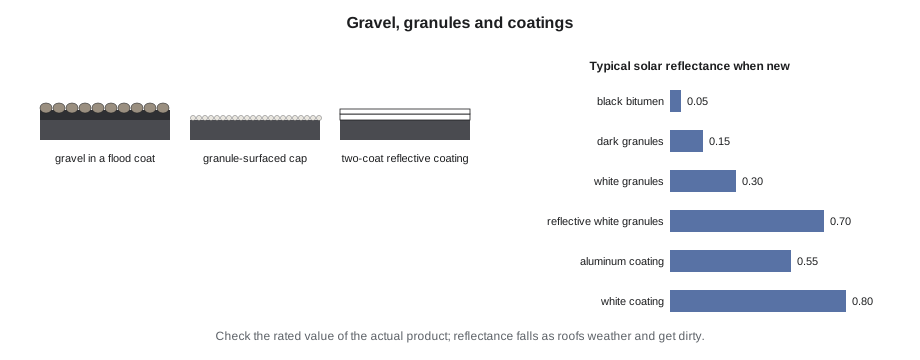
Two numbers describe how hot a roof surface gets in the sun: solar reflectance, the share of sunlight it reflects, from 0 (none) to 1 (all), and thermal emittance, how well it sheds the heat it absorbs. The two are combined in the solar reflectance index (SRI). Rated products are listed by the Cool Roof Rating Council, with values when new and after three years of weathering.
| Surface | Typical solar reflectance when new |
|---|---|
| Black smooth bitumen | about 0.05 |
| Dark gravel or dark granule cap | about 0.10 to 0.20 |
| Standard white granule cap | about 0.25 to 0.35 |
| Highly reflective white granule cap | about 0.70 or more |
| Aluminum coating | about 0.50 to 0.60 |
| White acrylic or silicone coating | about 0.80 or more |
Reflective roofs cut summer cooling loads and keep the membrane cooler, which slows ageing. In a heating climate like southern Ontario's, codes seldom require them on ordinary buildings, and a cooler roof surface in winter slightly increases heat loss and the chance of condensation in some assemblies, which designers weigh (ROOF-310). The owner and designer choose; the roofer keeps the surface clean and installs exactly the specified product, because a substitute may not carry the rating.
Applying coatings
When Ridgecap applies coatings, the routine is:
- Clean the roof: power wash or broom off dirt, loose granules and chalk; let it dry completely.
- Repair first: open laps, blisters, splits and wet insulation must be fixed before coating; a coating does not fix leaks.
- Prime if the maker requires it, especially over aged asphalt that may bleed brown stains into white coatings.
- Reinforce seams, flashings and transitions with fabric set in a first coat, if the system calls for it.
- Check the forecast: no rain, dew or frost before the coating dries, and air and surface above the maker's minimum, often 10 °C (50 °F) for acrylics.
- Apply at the specified rate by roller, brush or spray, in two or more coats, the second at right angles to the first, checking with a wet film gauge.
- Keep traffic off until cured, and keep overspray off cars, windows and neighbours. Spray coatings drift a long way in wind.
Walkways and protection
Every surfacing wears fastest where people walk: from the hatch to the units, around the units and along the paths service workers use. Walkway pads, heavy granulated sheets or rubber pads adhered or torched in place as the maker says, protect those paths and show people where to walk. The specification usually locates them; if it does not, Ridgecap asks.
The Ferncliff recommendation
Rory and Dana mapped the surfacing on a plan of the roof: thick gravel, thin gravel, and bare patches, with the area of each. Dana's report to the owner gave two options. The first was to re-gravel the bare areas in hot asphalt during a planned shutdown, or in a cold-applied flood coat if odour ruled out hot work, which would buy several more years. The second, which she recommended, was a full restoration in spring 2027: remove the loose gravel, repair the membrane, apply a fabric-reinforced asphalt emulsion base and a reflective acrylic top coat, with walkway pads to the units. It would cost more, but the owner's insurer and the roof's fire rating would have to be checked first, and the coating maker would have to inspect the roof and accept it for its restoration warranty. The owner said he would decide in the new year.
Keeping surfacing in good condition
Surfacing wears long before the membrane under it, so a roof's maintenance plan is largely a surfacing plan. On the twice-yearly inspections Ridgecap offers its clients, the crew looks for:
- Gravel scoured from corners and edges, or washed into windrows and drains.
- Bare, crazed or alligatored flood coat, which needs re-graveling or coating before the plies below are damaged.
- Granule loss on caps, especially at walkways, around units and where water drips from equipment.
- Chalking, cracking or peeling coatings, and ponding areas where coatings have worn away.
- Oil, grease and chemicals from kitchen exhausts and rooftop equipment, which soften bitumen and must be cleaned and repaired with resistant materials.
Small problems caught early are cheap: a few bags of gravel in hot or cold flood coat, a broadcast of granules, a coat over a worn spot. Left for a few years, the same spots become wet insulation and a re-roof.
Changing the surfacing on a re-roof
Owners sometimes ask to replace an old gravel roof with a lighter granulated cap or a coated surface. It is usually possible, but three questions come first: whether the roof's wind design depended on the weight of the gravel, whether the new surfacing keeps the fire rating the building needs, and whether the drains, scuppers and edge metal suit a smooth roof that sheds water faster. The designer answers them; the crew makes sure the old gravel is fully removed, the flood coat is cleaned and any gravel stops are replaced with edge metal that suits the new system.
Common mistakes
MistakeLeaving bare asphalt exposed on a gravel roof.
InsteadRe-gravel or coat bare areas; UV damage to unprotected asphalt is fast.
MistakeSpreading gravel after the flood coat has cooled.
InsteadSpread gravel immediately into hot, fluid asphalt so it embeds.
MistakeCoating over leaks and wet insulation.
InsteadRepair the membrane and replace wet insulation first; coatings do not stop leaks.
MistakeApplying a coating by eye.
InsteadUse the specified rate and check with a wet film gauge.
MistakeSubstituting a different coating or cap.
InsteadUse the specified product; another may change the fire rating or reflectivity rating.
Summary and key terms
- Surfacing protects bitumen from UV, heat, fire and traffic; a bituminous roof is never left bare.
- Gravel goes into a hot flood coat at about 2.9 kg/m² (60 lb per square) of asphalt and 19.5 kg/m² (400 lb per square) of gravel.
- Granule cap sheets give factory surfacing at low weight; protect and touch up granules.
- Coatings include asphalt emulsions, aluminum, acrylic, silicone and urethane; each has compatibility and weather limits.
- Wet thickness = dry thickness ÷ volume solids; check with a wet film gauge.
- Reflectivity, weight and fire rating all depend on the surfacing, so build exactly as specified.
- Surfacing
- The protective top layer of a roof: gravel, granules or a coating.
- Aggregate
- Gravel or slag used to surface a built-up roof.
- Granules
- Crushed and often coloured mineral particles bonded to cap sheets in the factory.
- Roof coating
- A liquid applied over a membrane to protect it or reflect sunlight.
- Dry film thickness
- The thickness of a coating after it has cured.
- Volume solids
- The share of a wet coating that remains after it dries.
- Solar reflectance
- The share of sunlight a surface reflects, from 0 to 1.
- Wet film gauge
- A notched gauge pressed into fresh coating to measure its wet thickness.
Practice problems
Work each problem on paper first, then reveal the answer to check.
A coating with 60 per cent volume solids must give 0.6 mm dry. What wet thickness and rate are needed?
Show answer
0.6 ÷ 0.6 = 1.0 mm wet, so 1.0 L/m².
What does a double-pour gravel surface add compared with a single pour?
Show answer
A second flood coat and second layer of gravel, for more protection and weight.
How much gravel does 300 m² take at 19.5 kg/m²?
Show answer
300 × 19.5 = 5,850 kg, about 5.9 tonnes.
Which coating type tolerates ponding well but is hard to recoat with other products?
Show answer
Silicone.
Why can a change in surfacing affect the fire rating?
Show answer
The class applies to the whole tested system, including the surfacing.
Lesson quiz · 5 questions
Score 60% or more to complete this lesson.
Create a free account to save your progress, take quizzes and earn a certificate.