
ROOF-210 · Lesson 2 of 12 · 27 min
Built-up roofing: plies and bitumen
▶ Video coming soon A video version of this lesson is on the way.
Rory's first job back on Crew 2 was a repair survey on the Ferncliff Bakery, a one-storey bakery and warehouse built in 1984 with its original gravel-surfaced built-up roof. The owner wanted to know whether the roof could be repaired and restored or had to come off. Before anyone cut into it, Anjali Mukherjee had sent a sample of the flashing cement and felt to a lab for asbestos testing, as Ridgecap does on every roof older than 1990 unless the owner already has a survey. The result came back clear on Monday afternoon, and on Tuesday, November 3, Dana scraped back the gravel near the north drain, cut a narrow strip across the plies with a hook knife and laid it on a board for Rory to read.
"Count them," she said. One, two, three, four black felts, each separated by a shiny line of asphalt, with a thick crust of asphalt and gravel on top. "That's a four-ply built-up roof. Somebody mopped every one of those plies by hand forty-two years ago, and most of it's still doing its job."
This lesson covers what a built-up roof is made of: the felts, the asphalts and pitches that bind them, how many plies are used and how they are laid out so that every point on the roof is covered by the same number of plies.
What a built-up roof is
A built-up roof (BUR) is a membrane assembled on the roof from layers of reinforcing felt, called plies, each laid into and covered by a layer of hot or cold bitumen. The bitumen is the waterproofing. The felts hold it in place, give it strength and stop it from cracking or flowing. The surfacing on top protects the whole membrane from sunlight and damage.
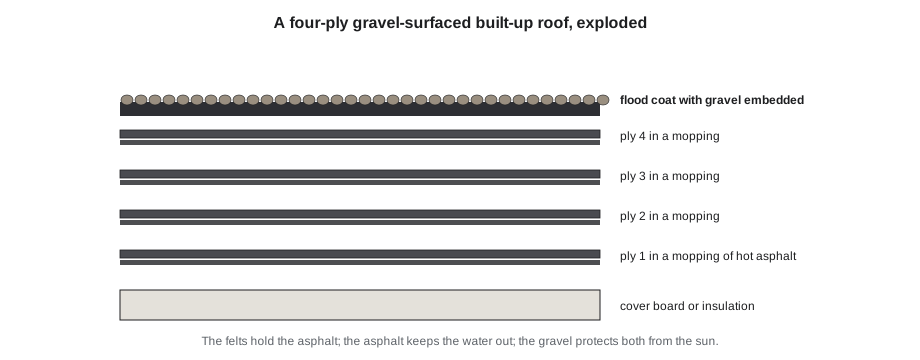
The membrane works because no single felt has to be perfect. A small void or a dry spot in one mopping is backed up by three other plies. That redundancy is why built-up roofs on well-built buildings commonly last 25 years or more, and why a good BUR can be repaired many times.
Felts and base sheets
Roofing felts are thin, flexible mats that are saturated or coated with asphalt in the factory. The kind of felt decides how it is handled on the roof.
| Felt | What it is | Standards | Notes |
|---|---|---|---|
| Glass-fibre ply felt | a mat of glass fibres bonded with resin and coated with asphalt | CSA A123.17; ASTM D2178 in the US | the usual ply felt today; does not rot; must be fully embedded in bitumen |
| Organic felt | a felt of paper and wood fibres saturated with asphalt | CSA A123.3; ASTM D226 in the US | used for decades; absorbs water if exposed and can wrinkle and rot |
| Base sheet | a heavier coated felt used as the first ply | CSA standards and ASTM D4601 | often fastened mechanically to the deck (lesson 8) |
| Venting base sheet | a base sheet with granules or channels on its underside | maker specifications | lets vapour move sideways to vents; over wet or uneven decks |
| Asbestos felt | felt made with asbestos fibre | no longer made | found on old roofs; treat any unknown old felt as suspect until tested |
Glass felts have replaced organic felts on almost all new work. They are dimensionally stable, do not absorb water and do not rot. But they behave differently when laid: an organic felt soaks up some of the hot asphalt and lies flat under a broom, while a glass felt is a porous mat that must be pushed down into the hot mopping so the asphalt comes up through it. A glass felt that is not fully embedded leaves dry, unbonded areas that become blisters.
Felts come in rolls about 1 m (39-3/8 in) wide. The rolls Ridgecap stocks are 50 m (164 ft) long, giving 50 m² of felt per roll before laps. Store them on end, on pallets, under cover. A roll stored on its side flattens, and a flattened roll lays out with wrinkles; a wet roll steams and blisters under hot asphalt.
The bitumens
Asphalt for built-up roofing is graded by its softening point, the temperature at which it starts to flow. A higher softening point means a stiffer asphalt that resists sliding on steeper slopes and softening in summer heat; a lower one means an asphalt that flows and self-heals better on dead-flat roofs. In Canada, roofing asphalt is graded in CSA A123.4; in the US, the same kinds of asphalt are graded as Types I to IV in ASTM D312. Ridgecap's suppliers label kegs and tankers with the ASTM type on both sides of the border.
| ASTM D312 type | Softening point | Traditional upper slope | Typical use |
|---|---|---|---|
| Type I (dead level) | 57 to 66 °C (135 to 151 °F) | about 4 in 100 (1/2 in 12) | very flat roofs, some flood coats |
| Type II (flat) | 70 to 80 °C (158 to 176 °F) | about 1 in 8 (1-1/2 in 12) | flat roofs in moderate climates |
| Type III (steep) | 85 to 96 °C (185 to 205 °F) | about 1 in 4 (3 in 12) | the most common mopping asphalt |
| Type IV (special steep) | 99 to 107 °C (210 to 225 °F) | about 1 in 2 (6 in 12) | steeper slopes, hot climates, flashings |
All four types have a minimum flash point of 260 °C (500 °F), the temperature at which the vapour above the asphalt can ignite. Lesson 3 explains why the kettle must never be run anywhere near that.
Coal tar pitch is the other bitumen used in built-up roofing. It is made from coal, not petroleum, and it is excellent at sealing itself on dead-flat roofs, which is why it was used for many years on roofs that held water. It gives off fumes with a much lower occupational exposure limit than asphalt fumes, irritates skin and eyes in sunlight, and is not compatible with asphalt: never mop asphalt onto a pitch roof or pitch onto an asphalt roof without the manufacturer's approved method. Ridgecap does not install coal tar roofs, but the crews meet them on old buildings. If an old gravel roof looks shiny black and brittle in the cut and smells sharply of tar, Dana stops and asks for it to be identified.
How many plies
A built-up roof is described by its number of plies: two-ply (rare and only with special products), three-ply and four-ply. More plies mean more redundancy, more weight and more labour. A specification might call for a base sheet plus three glass ply felts, a four-ply roof with a gravel flood coat, or a hybrid: two or three glass plies with a modified bitumen cap sheet in place of the gravel.
Plies are laid shingle fashion, each one lapped over the last by most of its width, so that at every point the membrane is the same number of plies thick. This is different from a shingle roof's exposure only in degree: on a four-ply roof, only about a quarter of each felt is exposed before the next one covers it.
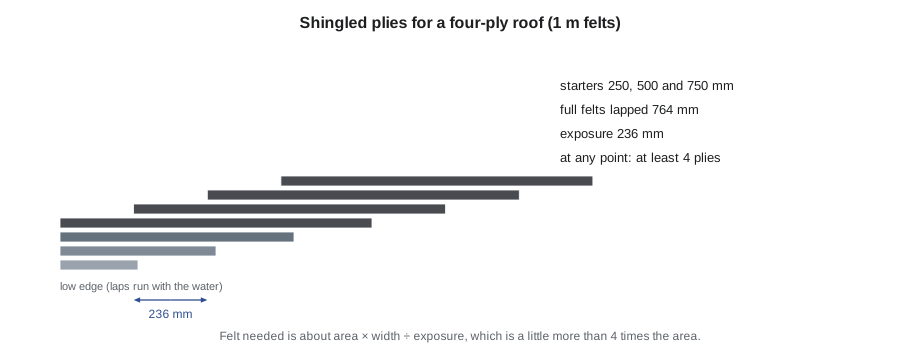
Laying felts this way needs starter strips at the low edge. For four plies, the first three courses are strips one quarter, one half and three quarters of a roll wide, then full rolls follow. For three plies, the starters are one third and two thirds of a roll. IKO's published layout for 1 m felts, for example, uses starters of 250, 500 and 750 mm for four plies, with each full felt lapping the previous one by 764 mm, and 333 and 667 mm for three plies with laps of 684 mm. Always use the manufacturer's numbers for the felt on the job.
Working out the exposure
The exposure is how much of each felt shows before the next covers it. If the felts were perfect and laid exactly, the exposure would be the width divided by the number of plies. In practice the makers set it a little smaller, so that a slight wander in the line still leaves at least the specified number of plies everywhere.
Worked problem
Exposure and lap for four plies
Ridgecap's glass felt is 1,000 mm wide. The maker's four-ply lap is 764 mm. What is the exposure, how many plies does that give in theory, and what margin did the maker allow?
Show solution
- Exposure = width − lap = 1,000 − 764 = 236 mm.
- Plies in theory = width ÷ exposure = 1,000 ÷ 236 = 4.24, so at least four everywhere.
- Margin: 4 × 236 = 944 mm, so the maker allowed 1,000 − 944 = 56 mm.
Answer: The exposure is 236 mm. Four exposures use 944 mm, leaving a 56 mm margin so the line can wander slightly and still give four plies.
Rory chalked lines at the exposure for the first few courses on the shop roof the next morning, so his eye learned what a straight 4-ply layout looked like. On the job, the mopper and the felt layer keep their line by watching the lap mark printed or embossed on many felts, and by checking against chalk lines every few rolls.
How much felt
Because the felts overlap so much, a four-ply roof uses a little more than four times its area in felt. The ratio of felt width to exposure gives the factor directly.
Worked problem
Felt for the Ferncliff repair area
The worst part of the Ferncliff roof, about 120 m² around the north drains, may be removed and rebuilt as a four-ply glass felt roof with the 236 mm exposure. Rolls are 50 m² gross. Allow 5 per cent for end laps and waste. How many rolls?
Show solution
- Felt factor = 1,000 ÷ 236 = 4.24.
- Felt area = 120 × 4.24 = 509 m².
- With 5 per cent extra: 509 × 1.05 = 534 m².
- Rolls = 534 ÷ 50 = 10.7, so 11 rolls.
Answer: Eleven rolls of glass ply felt. The starter strips are cut from full rolls, which is part of the waste allowance.
How much asphalt
Each ply is laid into a mopping of hot asphalt, and the top ply gets a heavy flood coat if the roof is gravel-surfaced. The amounts are set by the manufacturer and are checked by weighing test cuts (lesson 11), because too little asphalt leaves dry spots and too much makes the membrane slide on slopes and wastes material.
| Layer | Typical rate | Notes |
|---|---|---|
| Interply mopping (each ply) | 1.2 kg/m² (25 lb per square), plus or minus about 20 in 100 | thin enough that the next ply bonds; no dry spots |
| Mopping to a substrate | similar to interply, or as the maker states | over insulation, cover board or a base sheet |
| Flood coat | 2.9 kg/m² (60 lb per square) | poured, not mopped, so gravel can be embedded |
| Gravel (single pour) | 19.5 kg/m² (400 lb per square) | clean, dry, rounded stone or slag, about 9 to 20 mm (3/8 to 5/8 in) |
Worked problem
Asphalt and gravel for the repair area
For the 120 m² repair area: four interply moppings at 1.2 kg/m², a flood coat at 2.9 kg/m² and gravel at 19.5 kg/m². How much asphalt and gravel? Asphalt comes in 45 kg kegs.
Show solution
- Interply = 4 × 1.2 = 4.8 kg/m²; flood = 2.9 kg/m²; total asphalt = 7.7 kg/m².
- Asphalt = 120 × 7.7 = 924 kg.
- Kegs = 924 ÷ 45 = 20.5, so 21 kegs; Marco adds two for kettle losses: 23.
- Gravel = 120 × 19.5 = 2,340 kg, about 2.3 tonnes; reuse of clean old gravel can cover part of it.
Answer: About 23 kegs of Type III asphalt and 2.3 tonnes of gravel.
Laying the plies
Rory had done BUR work at Ashgrove in the spring only as a ground hand. At Ferncliff he would carry felt. Dana's rules for laying plies:
- Start at the low point of the roof so that every lap runs with the water, never against it.
- Keep the mopping just ahead of the roll, a short distance and never more than the felt layer can cover while the asphalt is still hot and fluid. Asphalt that skins over before the felt meets it does not bond.
- Lay glass felt into the hot asphalt and squeegee or broom it so the asphalt comes up through the mat across its full width. The surface should look uniformly wet with asphalt, not grey and dry.
- Keep side laps straight at the specified exposure and end laps at least 150 mm (6 in), staggered at least 300 mm (12 in) from the end laps in the plies below.
- Do not step on fresh, hot felts more than needed, and keep wheeled equipment off them until they cool.
- Remove wrinkles, fishmouths (open, raised edges at laps) and buckles before the next ply goes on: cut them, mop them down and patch over them.
- Finish each day's work with a water cut-off: a sealed temporary edge so water cannot get under the new plies overnight. Remove it before work resumes.
Most work today is shingled in one pass, with all the plies laid together in a continuous run. Phased application, laying some plies one day and the rest days later, invites dust, dew and moisture between the layers and is discouraged by most makers. If a roof must be phased, the exposed ply is protected and the surface is cleaned and dried before the next phase.
Reading the old roof
Back at the Ferncliff test cut, Rory listed what Dana pointed out. The four organic felts were intact and well bonded except near the drain, where the top two plies peeled apart easily and the felt was soft and brown. The flood coat had cracked into a pattern of small polygons, a sign that the asphalt surface had aged and shrunk. Gravel had been washed off a patch near the scupper, leaving the flood coat bare to the sun. "Wet felt at the drain, bare asphalt by the scupper, old but bonded everywhere else," Dana said. "That's a roof we can repair around the drains, re-gravel where it's bare, and probably restore with a coating. Lesson for you: you can't decide anything about a BUR until you've cut it."
Common mistakes
MistakeLeaving glass felts sitting on top of the mopping.
InsteadSqueegee or broom glass felt into hot asphalt so it is fully embedded and wet-looking across its width.
MistakeLaying plies from the high side down.
InsteadStart at the low edge so every lap sheds water.
MistakeMopping far ahead of the roll.
InsteadKeep the mop just ahead of the felt so the asphalt is still fluid when the felt meets it.
MistakeMixing coal tar pitch and asphalt.
InsteadThey are incompatible; identify an old roof's bitumen before patching or recovering it.
MistakeStoring felt rolls on their sides in the rain.
InsteadStore rolls on end, on pallets, covered and dry; wet felt blisters under hot asphalt.
Summary and key terms
- A built-up roof is several plies of felt laid in bitumen and protected by surfacing; its strength is redundancy.
- Glass-fibre ply felts are standard today and must be fully embedded in hot asphalt.
- Roofing asphalt is graded by softening point (ASTM D312 Types I to IV); higher types suit steeper slopes.
- Plies are shingled so every point has the specified number; exposure is a little less than width ÷ plies.
- Felt needed is about area × width ÷ exposure; asphalt and gravel are figured from the specified rates.
- Coal tar pitch is a different bitumen, incompatible with asphalt, with stricter fume limits.
- Ply
- One layer of felt in a built-up roof.
- Ply felt
- A thin reinforcing felt of glass fibre or organic fibre used in the plies of a built-up roof.
- Exposure
- The width of each ply left showing before the next ply covers it.
- Starter strips
- Narrow strips laid at the low edge so shingled plies give the full number of layers from the start.
- Softening point
- The temperature at which a bitumen begins to flow, used to grade roofing asphalt.
- Flood coat
- The heavy top pour of asphalt into which gravel is embedded.
- Fishmouth
- An open, raised edge at a lap where a felt has not bonded.
- Water cut-off
- A temporary sealed edge built at the end of a day to keep water out from under new roofing.
- Coal tar pitch
- A bitumen made from coal, used on some older flat roofs; not compatible with asphalt.
Practice problems
Work each problem on paper first, then reveal the answer to check.
A three-ply roof uses 1,000 mm felts lapped 684 mm. What is the exposure and the felt factor?
Show answer
Exposure 316 mm; factor 1,000 ÷ 316 = 3.16.
How much asphalt is needed for three interply moppings at 1.2 kg/m² on 200 m²?
Show answer
3 × 1.2 × 200 = 720 kg.
Which ASTM D312 type is the most common mopping asphalt?
Show answer
Type III.
What are the four-ply starter strip widths for a 1 m felt?
Show answer
250, 500 and 750 mm (one quarter, one half and three quarters).
Why are end laps staggered?
Show answer
So end laps in different plies do not line up and form a weak line through the membrane.
Lesson quiz · 5 questions
Score 60% or more to complete this lesson.
Create a free account to save your progress, take quizzes and earn a certificate.