
RCDD-160 · Lesson 7 of 12 · 23 min
Review: bonding, grounding and power
▶ Video coming soon A video version of this lesson is on the way.
Bonding is the area where Daniel's October diagnostic was weakest, and the reason is typical. Installers bond what the drawings tell them to bond, usually to a busbar someone else has placed, with a conductor someone else has sized. A designer has to decide where every busbar goes, what it connects to, how the backbone is routed and sized, what gets bonded and why, and how it all joins the building's electrical grounding system. Bonding questions also mix two kinds of authority more than any other area: the electrical code, which sets mandatory safety requirements, and the bonding standard, which sets the telecommunications design. Week 4 of the plan gives bonding two full study routines, and this review covers what Daniel needs to have ready.
Why bond: safety and performance
Bonding and grounding serve two purposes. The first is safety. If a power conductor faults to the metal of a rack, a cable shield or a pathway, a low-impedance path back to the source lets the overcurrent device trip quickly and keeps touch voltages low. If lightning or a power-line fault raises the voltage on an incoming telecommunications cable, protectors and bonding divert the surge to ground and keep different systems at nearly the same potential, so that dangerous voltage differences do not appear between, for example, a telephone and a radiator. The second purpose is performance. Equipment and screened cabling work best when their reference potentials are close together and noise currents have a defined, low-impedance path.
Two terms need keeping apart. Grounding, or earthing in international usage, means connecting to the earth or to a conductive body that serves in its place. Bonding means joining metal parts together so that they stay at the same potential. Most telecommunications work is bonding; the connection to earth is made once, at the building's electrical service, by the electrical installation.
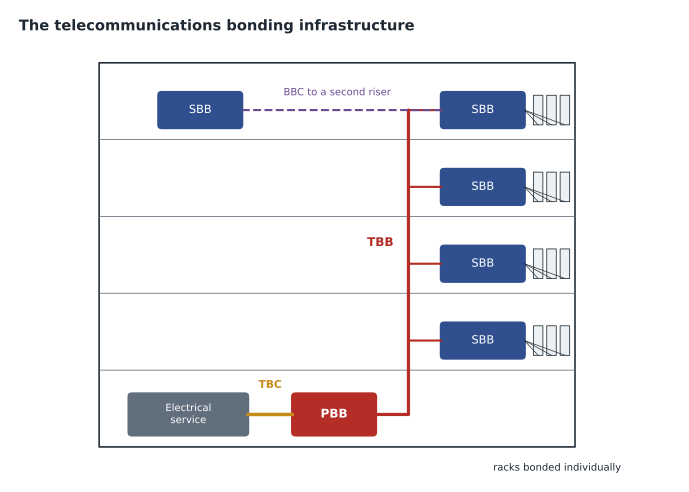
The bonding infrastructure
Current terminology in the bonding standard, which RCDD-113 uses, names a primary bonding busbar, the PBB, usually in the entrance facility or equipment room, close to the electrical service; secondary bonding busbars, SBBs, in each telecommunications room and equipment room; the telecommunications bonding conductor, TBC, that joins the PBB to the electrical service grounding; the telecommunications bonding backbone, TBB, that runs from the PBB to the SBBs; and the backbone bonding conductor, BBC, that joins TBBs where there is more than one riser, typically on the top floor and at least every third floor. Older documents and some practice items use earlier names: telecommunications main grounding busbar, telecommunications grounding busbar, bonding conductor for telecommunications and grounding equalizer. Know both sets, because the exam may use current terms and your practice material may not.
| Current term | Older term | What it is |
|---|---|---|
| PBB, primary bonding busbar | TMGB | The main telecommunications busbar near the electrical service |
| SBB, secondary bonding busbar | TGB | The busbar in each telecommunications room |
| TBC, telecommunications bonding conductor | BCT | Joins the PBB to the electrical service grounding |
| TBB, telecommunications bonding backbone | TBB | Runs from the PBB to each SBB |
| BBC, backbone bonding conductor | GE, grounding equalizer | Joins two or more TBBs |
Design rules worth having ready: the TBB is a continuous insulated copper conductor, routed as straight as possible, without splices where avoidable and with listed connectors where they are needed. It is sized from its length using the standard's table; the rule of thumb of about 2 kcmil per linear foot, with a minimum of 6 AWG and a maximum of 750 kcmil, is a useful check. The TBC is at least as large as the largest TBB. Busbars are solid copper, drilled for two-hole lugs and mounted on insulating standoffs. The TBB is not a water pipe, a cable shield or the metal of a pathway, although those may be bonded to it.
Bonding in rooms and racks
Within a room, every rack, cabinet, cable tray section, ladder rack and metallic pathway entering the room is bonded to the SBB. Racks are bonded individually to the busbar or to a rack bonding conductor that runs along a row and connects to the busbar, never daisy-chained from rack to rack so that removing one breaks the path for the others. Painted surfaces need paint-piercing hardware or prepared contact surfaces. Equipment is bonded to its rack by its own bonding conductor or by listed mounting hardware where the manufacturer allows it. Two-hole compression lugs are preferred because they resist loosening and rotation.
In data centres and large equipment rooms, a mesh bonding network under the floor or overhead lowers impedance across the room, and each row or cabinet is bonded to it. RCDD-115 covers those designs; for the exam, recognize the purpose and the basic arrangement.
Electrical protection
Telecommunications circuits that enter a building from outside, on metallic conductors, are exposed to lightning and to accidental contact with power lines. Codes require a primary protector, typically at the entrance, as close as practical to the point of entry, bonded with a short, straight conductor to the building's grounding electrode system. The protector limits the voltage on the incoming conductors by diverting surges to ground. Secondary protection, closer to the equipment, may be added to limit what reaches sensitive electronics. All-dielectric fibre cables carry no metallic conductors and do not need primary protectors, although any metallic strength members or armour in a fibre cable must be bonded at the entrance.
Surge protective devices on the power system, such as those at the service entrance and on branch circuits feeding telecommunications rooms, work with the telecommunications protectors. Coordinated protection keeps the whole facility at nearly the same potential during a surge. Daniel's RCDD-113 project story includes an existing building with a long, looping protector bond to a water pipe; the lesson is that long bonding conductors have high impedance during fast surges and defeat the protector.
Power for ICT
Telecommunications rooms and equipment rooms need dedicated branch circuits, sized for the equipment load with margin, plus convenience receptacles for tools. Many owners require that ICT circuits be connected to emergency or standby power, and health care facilities often require it for clinical systems. Uninterruptible power supplies bridge the gap until a generator starts and protect equipment from short disturbances; in data rooms a central double-conversion system is common, while telecommunications rooms often use rack-mounted units. Battery chemistry, ventilation and room location are design questions, coordinated with the electrical engineer.
Isolated ground receptacles, once common for ICT equipment, are rarely necessary and can create problems if installed incorrectly. They are permitted by code under specific conditions; items may ask about them to test whether you know that the equipment grounding path must still be complete and code compliant.
Code and standard in bonding items
Bonding items are the clearest case of two authorities working together. The electrical code sets the mandatory requirements: the building's grounding electrode system, the intersystem bonding connection at the service, primary protector bonding for communications circuits entering the building, and equipment grounding conductors for power circuits. In Canada these come from the Canadian Electrical Code, Part I, and especially its sections on grounding and bonding and on communication systems. The bonding standard sets the telecommunications design that builds on those requirements: busbars, backbones, room and rack bonding.
When an item asks what is required, decide which authority is meant. A requirement to bond a primary protector to the building's grounding electrode system is code. A requirement to mount an SBB on insulating standoffs is the standard. If an item asks who enforces a requirement, the code is enforced by the authority having jurisdiction, while the standard is enforced through the contract and the owner's inspection.
Timed practice items with explanations
Original items from Daniel's week 4 bonding set. Work each in about ninety seconds.
Item 1. Where is the PBB normally located? A, on the top floor. B, in the entrance facility or equipment room, close to the electrical service. C, in every telecommunications room. D, in the data centre only. Answer: B. The PBB is the central point of the telecommunications bonding system and should be close to the electrical service to keep the TBC short.
Item 2. A building has two risers at opposite ends. What joins the two backbones? A, a cable shield. B, a backbone bonding conductor at the top floor and at intervals. C, the water piping. D, nothing; each riser is separate. Answer: B. The BBC equalizes potential between backbones.
Item 3. Which item does not belong in the telecommunications bonding infrastructure as a substitute for the TBB? A, an insulated copper conductor sized from its length. B, the metallic water piping. C, a continuous run with listed connectors where needed. D, a conductor bonded to every SBB. Answer: B. Water piping may be bonded, but it is not the TBB.
Item 4. A fibre cable entering the building has a metallic armour. What is required at the entrance? A, a primary protector on each fibre. B, bonding of the armour to the building's grounding system as required. C, nothing. D, removal of the armour inside the building. Answer: B. Protectors are for metallic conductors; metallic members of fibre cables are bonded.
Item 5. A telecommunications room's UPS is sized at 6 kVA with a power factor of 0.9. What is its real power capacity? A, 6.0 kW. B, 5.4 kW. C, 6.7 kW. D, 0.9 kW. Answer: B. Real power is apparent power times power factor: 6 × 0.9 = 5.4 kW.
Item 6. Which practice reduces the impedance of a bonding path? A, adding extra loops for slack. B, keeping the conductor short and straight with large-radius bends. C, using a smaller conductor to save cost. D, routing the conductor inside a steel conduit without bonding the conduit at both ends. Answer: B. Loops and unbonded steel enclosures raise impedance to fast surges.
Item 5 is modelled on one that caught Daniel in November: he answered in kilovolt-amperes because the stem gave the rating that way. Units in power items are a recurring trap. Apparent power in kilovolt-amperes, real power in kilowatts, and heat in British thermal units per hour or tons describe different things, and items often give one and ask for another. He adds a card that asks for each conversion and a worked number, and drills it daily for the rest of the week.
Worked problem
Bonding backbone and conductor
A building has one riser, with the PBB at ground level and the highest SBB 140 ft above it along the TBB route. Using the rule of thumb as a check, what size TBB is expected, and how large must the TBC be?
Show solution
- Area ≈ 2 kcmil × 140 = 280 kcmil.
- 250 kcmil is too small; 300 kcmil or larger, depending on the standard's table, is expected.
- The TBC must be at least as large as the largest TBB, so at least the same size.
- Confirm both against the table in the current standard.
Answer: About 300 kcmil for the TBB as a check, and a TBC no smaller than the TBB.
Worked problem
Finding the fault in a description
A practice item describes a telecommunications room: racks bonded to one another with a single conductor that runs from the last rack to the SBB; a cable tray bonded at one end; the SBB mounted directly on a painted steel plate; and a TBB spliced twice with mechanical connectors. How many problems are there?
Show solution
- Daisy-chained racks: a problem; each rack needs its own path.
- Tray bonded at one end only: usually a problem; sections should be bonded continuously and to the SBB.
- SBB on painted steel without insulating standoffs: a problem; busbars are insulated from their mounting.
- Two mechanical splices in the TBB: avoid splices, and where unavoidable use listed connectors; two mechanical splices is poor practice.
Answer: Four problems, each a common distractor in bonding items.
Common mistakes
MistakeTreating grounding and bonding as the same thing.
InsteadGrounding connects to earth; bonding joins metal parts to the same potential.
MistakeDaisy-chaining racks to the busbar.
InsteadBond each rack directly or by a rack bonding conductor.
MistakeUsing a long, looping protector ground.
InsteadKeep protector bonding conductors short and straight.
MistakeAdding primary protectors to all-dielectric fibre.
InsteadOnly metallic conductors need protectors; bond any metallic members.
MistakeSizing the TBC smaller than the TBB.
InsteadThe TBC is at least as large as the largest TBB.
MistakeRelying on old busbar names only.
InsteadKnow current and older terms.
Summary and key terms
- Bonding protects people and equipment and supports performance; grounding connects to earth once at the service.
- The PBB, SBBs, TBC, TBB and BBC form the telecommunications bonding infrastructure; older names still appear.
- Size the TBB from its length using the standard's table; about 2 kcmil per foot is a check; the TBC is at least as large.
- Bond every rack, tray and metallic pathway in a room individually; never daisy-chain racks.
- Primary protectors go at the entrance on metallic circuits, bonded with short, straight conductors.
- ICT rooms need dedicated circuits, often standby power and UPS, coordinated with the electrical engineer.
- PBB
- Primary bonding busbar, the main telecommunications busbar near the electrical service.
- SBB
- Secondary bonding busbar, in each telecommunications room.
- TBB
- Telecommunications bonding backbone, joining the PBB to the SBBs.
- TBC
- Telecommunications bonding conductor, joining the PBB to the electrical service grounding.
- BBC
- Backbone bonding conductor, joining two or more TBBs.
- Primary protector
- A device at the entrance that limits surge voltages on incoming metallic circuits.
Practice problems
Work each problem on paper first, then reveal the answer to check.
What is the difference between bonding and grounding?
Show answer
Bonding joins metal parts to the same potential; grounding connects to earth.
Where is the PBB usually located?
Show answer
In the entrance facility or equipment room, near the electrical service.
What is the older name for the SBB?
Show answer
Telecommunications grounding busbar, TGB.
Why should racks not be daisy-chained?
Show answer
Removing one breaks the bonding path for the others.
Does an all-dielectric fibre cable need a primary protector?
Show answer
No; only metallic members need bonding.
Estimate the TBB size for a 90 ft run as a check.
Show answer
About 180 kcmil, so 4/0 AWG, confirmed from the table.
Lesson quiz · 5 questions
Score 60% or more to complete this lesson.
Create a free account to save your progress, take quizzes and earn a certificate.