
RCDD-160 · Lesson 10 of 12 · 23 min
Review: testing, administration and project management
▶ Video coming soon A video version of this lesson is on the way.
Week 6 covers the areas that most technically minded candidates neglect: testing, administration and project management. Daniel's October diagnostic scored lowest here, and his error log shows why. He knows how to run a certification tester, because he has done it hundreds of times, but he is unsure what the designer specifies, who witnesses what, and how a question about the contract documents differs from a request for a change. Roz reminds him that the blueprint gives real weight to scoping, bid support and installation support, and that much of that weight falls on this material. This review covers what a candidate should have ready.
Copper testing
Field testing of balanced twisted-pair cabling has three levels. Verification checks continuity and wire map: that each conductor is connected to the right pin at both ends, with no opens, shorts, reversed or crossed pairs, or split pairs. Qualification checks whether a link can support a specific application. Certification measures the link against the performance limits of a category in the standard, using a tester that meets the accuracy level required, and is what designers specify for new installations. A certification test includes wire map, length, propagation delay and delay skew, insertion loss, near-end and far-end crosstalk measures, return loss and, for some installations, resistance unbalance and alien crosstalk.
The designer specifies what is tested and how: permanent link or channel test, the limits to be used, the tester accuracy level, the required adapters, how results are recorded, and who receives them. Permanent link testing is normal for new installations, because the patch cords are often not installed until later and the permanent link is what the contractor builds. Results marked with an asterisk or as marginal, close to the limit within the tester's accuracy, need a clear acceptance rule in the specification.
| Test level | What it shows | When used |
|---|---|---|
| Verification | Continuity and wire map | Troubleshooting and basic checks |
| Qualification | Ability to support a particular application | Existing cabling for a planned use |
| Certification | Compliance with the category limits in the standard | Acceptance of new installations |
Fibre testing
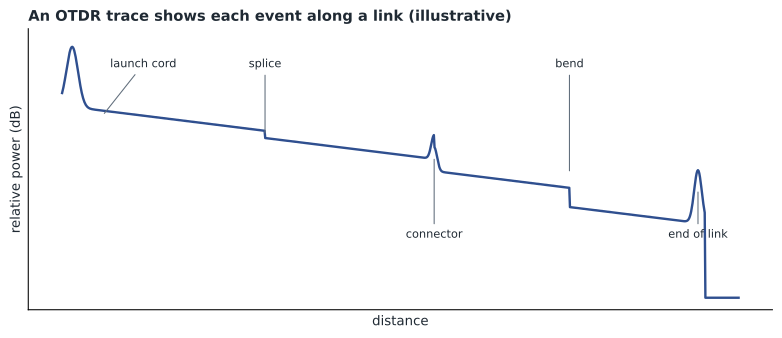
Optical fibre is tested at two tiers. Tier 1 uses an optical loss test set, a light source and power meter, to measure end-to-end loss at the specified wavelengths, plus length and polarity. The result is compared with a loss limit calculated from the cable length, connector pairs and splices, as in lesson 4. The reference method matters: the method described in the standard for most premises links uses one test reference cord when setting the reference, so that the measured loss includes both end connections. Using the wrong reference method can hide or exaggerate connector loss. Tier 2 adds an optical time domain reflectometer trace, which shows the location and loss of individual events along the link, such as connectors, splices and bends, and is useful for long links and troubleshooting.
Multimode testing also depends on how the light is launched into the fibre. Encircled flux launch conditions, set by the testing standards, make results repeatable between testers. The designer's specification should name the test method, wavelengths, reference method, launch conditions and the limit calculation, and it should require test results in the tester's native format as well as a summary.
Timed practice items with explanations
Original items from Daniel's week 6 set.
Item 1. A new Category 6A installation is ready for acceptance; patch cords will be supplied by the owner later. What should the specification require? A, channel testing with the owner's future cords. B, permanent link certification to Category 6A limits with a tester of the required accuracy. C, wire map only. D, qualification testing. Answer: B.
Item 2. A fibre link fails its Tier 1 limit by 0.3 dB. What is the best first step? A, replace the cable. B, inspect and clean the connectors, confirm the reference method, and retest. C, raise the limit. D, accept it. Answer: B. Dirty connectors and wrong references are the commonest causes of small failures.
Item 3. Which phase of the design process produces the drawings and specifications from which contractors bid? A, needs analysis. B, schematic design. C, construction documents. D, closeout. Answer: C.
Item 4. During construction, the contractor proposes a different brand of patch panel. What process applies? A, an RFI only. B, a substitution request or submittal reviewed against the specification. C, an addendum. D, a punch list. Answer: B.
Item 5. Which document is issued to all bidders to change the documents before bids close? A, a change order. B, an addendum. C, a submittal. D, a field report. Answer: B.
Item 6. Under the administration standard, which factor sets the class of administration? A, the colour of the labels. B, the size and complexity of the infrastructure, from a single equipment room to a multi-building campus. C, the number of contractors. D, the budget. Answer: B.
Item 7. What is the main purpose of a punch list? A, to price changes. B, to record deficiencies to be corrected before acceptance. C, to answer bidders. D, to list products. Answer: B.
Why these items matter
Project delivery items are rarely difficult in the way a calculation can be difficult. They are difficult because the options all sound reasonable and the distinction between them is a matter of process: who does what, when, using which document. Daniel's error log from the autumn showed the same pattern seven times: he chose a document from the wrong phase. His fix is a single card listing each document, its phase and its purpose, which he reviews every morning for the rest of the plan.
Roz adds one more point from her own career. In real projects, confusion between an RFI and a change order costs money: a contractor who treats a clarification as a change may claim extra payment, and a designer who answers a scope change as if it were a clarification may commit the owner to work it never approved. The exam tests the distinction because practice depends on it.
Worked problem
Pass or fail at Tier 1
A multimode link is 85 m with two connector pairs and no splices. Using 3.5 dB per km at 850 nm and 0.75 dB per connector pair, what is the limit, and does a measured loss of 1.94 dB pass?
Show solution
- Cable: 0.085 km × 3.5 = 0.30 dB.
- Connectors: 2 × 0.75 = 1.50 dB.
- Limit: 0.30 + 1.50 = 1.80 dB.
- Measured 1.94 dB is above the limit.
Answer: The limit is 1.80 dB; 1.94 dB fails. Check the reference method and clean and inspect the connectors before reterminating.
Administration and labelling
The administration standard sets out how cabling infrastructure is identified and recorded: identifiers for spaces, pathways, cables, termination points, bonding components and firestop locations, labels that are durable and legible, and records that link them. It defines classes of administration by the size and complexity of the system: from a single equipment room serving one building, through single buildings with several rooms, to campuses with outside plant and multiple buildings. Higher classes need more elements identified and more formal records.
The designer chooses the class, sets the identifier format in the specification, and makes sure the drawings, the outlet schedule, the labels and the test reports all use the same identifiers. Daniel's Harbourview drawings use identifiers that include the floor, the room and the panel and port, so that a technician reading a label at an outlet can find the panel position without a drawing. Records include as-built drawings, cable and termination records, test results and change history, and they must be maintained after handover.
| Administered element | Example identifier content |
|---|---|
| Telecommunications space | Building and floor, room designation |
| Cabling termination | Space, panel or block, port number |
| Horizontal link | Room termination and outlet identifiers |
| Backbone cable | The two spaces it joins and a sequence number |
| Bonding busbar | Its type and space |
| Firestop location | Location and system used |
The design process
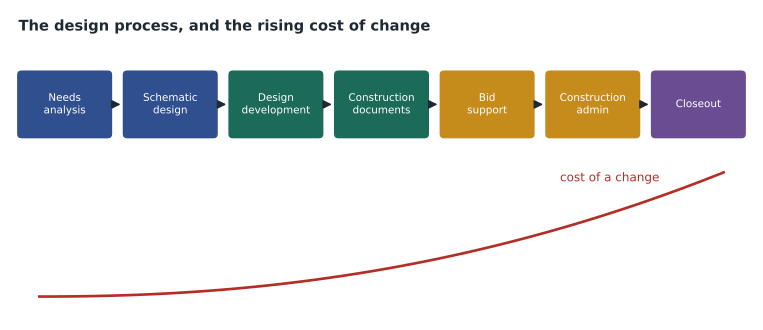
Design projects move through phases, whatever names a firm or contract uses. First comes needs analysis, sometimes called programming, where the designer learns what the owner needs: the users, the applications, the systems, the growth expected, the standards the owner follows and the budget. Next is schematic design, which sets the broad approach: room locations, backbone routes, media choices. Design development fills in the detail: outlet counts and locations, room layouts, pathway sizes, bonding design. Construction documents are the drawings and specifications from which contractors bid and build. Then come bid support, construction administration and closeout.
Each phase ends with a review by the owner and the design team, and each change after that review costs more than the same change before it. Items often ask what the designer should do at a given stage, and the answer usually reflects the stage: requirements early, coordination in the middle, documentation and verification at the end.
Specifications, drawings and bids
Construction documents have two parts. Drawings show what and where: floor plans with outlets and identifiers, enlarged room plans and rack elevations, riser and site diagrams, details and schedules. Specifications describe the quality and the requirements: products, installation methods, testing, documentation and warranty. Communications work is commonly organized under Division 27 of MasterFormat, the classification system used in Canada and the United States, with electronic safety and security in Division 28 and electrical work in Division 26. Where drawings and specifications seem to disagree, the contract's order of precedence decides, which is why the designer must keep them consistent.
During bidding, contractors ask questions, and the designer answers them through addenda, issued to all bidders, so that everyone bids on the same information. Substitution requests for alternative products are evaluated against the specification. The designer may help the owner evaluate bids for compliance, but the award decision belongs to the owner.
Construction administration
During construction, the designer reviews submittals, which are the contractor's product data, shop drawings and samples, to confirm they meet the design intent. Requests for information, or RFIs, are questions about the documents; the designer answers them. A change that affects scope, cost or time is handled through the contract's change process, with a change order or equivalent approved by the owner. Site visits observe progress and quality; a punch list, or deficiency list, records items to be corrected before acceptance. At closeout, the contractor delivers test results, as-built records, warranties and training, and the designer confirms that the documentation is complete. Standard contract forms such as those published by the Canadian Construction Documents Committee define these processes and the roles of owner, consultant and contractor; the specific forms used on a project govern.
Worked problem
Naming the right document
During construction, the cabling foreman asks whether the outlets in the nursing simulation lab should be mounted at desk height or wall height, because the drawing and the specification seem to differ. Then the owner decides to add twelve outlets to a room not on the drawings. Which document handles each?
Show solution
- The mounting height question is about the meaning of the documents: an RFI, answered by the designer.
- Adding twelve outlets changes scope and cost: a change through the contract's change process, approved by the owner.
- Neither is handled by an addendum, which is issued during bidding.
Answer: An RFI response for the first, and a change order for the second.
Common mistakes
MistakeSpecifying channel testing for new permanent cabling.
InsteadSpecify permanent link testing for new installations, unless the owner needs channel results.
MistakeUsing the wrong fibre reference method.
InsteadUse the method the standard and specification require, usually with one reference cord.
MistakeTreating an RFI as a change order.
InsteadAn RFI clarifies the documents; a change order changes scope, cost or time.
MistakeIssuing an answer to one bidder only.
InsteadAnswers during bidding go to all bidders by addendum.
MistakeLabelling outlets with identifiers not on the drawings.
InsteadUse one identifier scheme across drawings, labels, schedules and test reports.
MistakeLeaving test acceptance rules to the field.
InsteadSpecify the test method, limits and how marginal results are treated.
Summary and key terms
- Copper testing has verification, qualification and certification levels; new work is certified, usually as permanent links.
- Fibre Tier 1 measures loss, length and polarity against a calculated limit; Tier 2 adds an OTDR trace.
- The reference method and launch conditions must be specified for repeatable fibre results.
- The administration standard sets identifiers, labels and records by class of system.
- Design moves from needs analysis to schematic design, design development, construction documents, bid, construction and closeout.
- Addenda answer bid questions; RFIs clarify documents; change orders change scope, cost or time.
- Certification
- Testing a link against the limits of a cabling category in the standard.
- OLTS
- Optical loss test set: a light source and power meter.
- OTDR
- Optical time domain reflectometer, which shows events along a fibre.
- Addendum
- A change or clarification to bid documents issued to all bidders.
- RFI
- Request for information: a question about the contract documents.
- Submittal
- Product data, shop drawings or samples for review against the design.
- Punch list
- A list of deficiencies to be corrected before acceptance.
Practice problems
Work each problem on paper first, then reveal the answer to check.
Which copper test level is used to accept new installations?
Show answer
Certification.
What does Tier 2 fibre testing add?
Show answer
An OTDR trace showing individual events.
A multimode link of 60 m has two connector pairs. What is the Tier 1 limit at 850 nm with the practice values?
Show answer
0.21 + 1.50 = 1.71 dB.
Which document answers a bidder's question?
Show answer
An addendum issued to all bidders.
Which phase sets outlet counts and room layouts in detail?
Show answer
Design development.
What does the contractor deliver at closeout?
Show answer
Test results, as-built records, warranties and training.
Lesson quiz · 5 questions
Score 60% or more to complete this lesson.
Create a free account to save your progress, take quizzes and earn a certificate.