
RCDD-160 · Lesson 12 of 12 · 23 min
A full practice exam and what to do next
▶ Video coming soon A video version of this lesson is on the way.
The plan schedules Daniel's full practice set for Saturday, April 3, 2027, twelve days before the exam. It is a complete rehearsal: 100 original items in 150 minutes, at the kitchen table with his phone in another room, a timer running and no notes. The following Sunday is for review, and the remaining days are for repairing what the set reveals. This lesson explains how to build and use a full practice set, gives a sample of original items across the domains with explanations, and sets out what to do after the real exam, whatever the result.
Building a full practice set
A useful practice set matches the real exam in length, timing and mix. Use 100 items in 150 minutes, with no breaks. Weight the items roughly as the current blueprint does: most items on design decisions, a smaller share on scope and requirements, and the rest on bid support and installation support. Mix recall, application, analysis and calculation items, and include multiple response and matching formats. Draw items from sources you have found reliable, and do not include items you have seen recently, because recognition inflates the score.
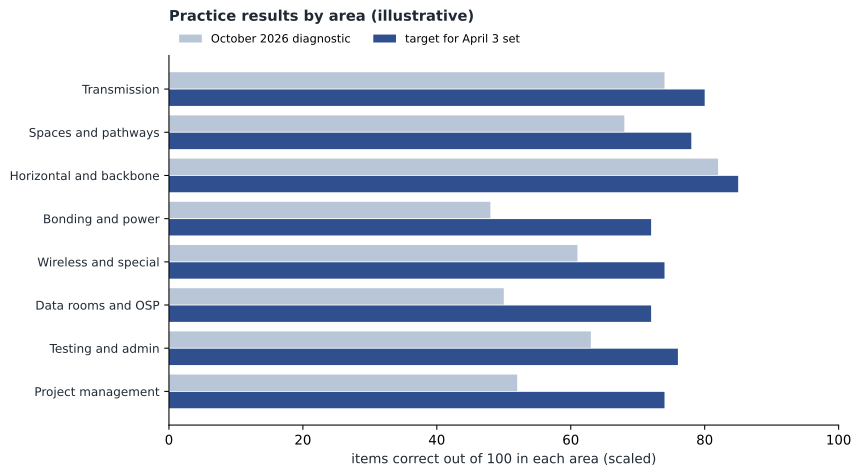
Score the set by domain as well as in total. The total tells you roughly where you stand; the domain scores tell you where the remaining hours should go. Because BICSI does not publish a passing score, do not read a practice total as a pass or fail. Treat it as a measure of readiness and of change: the useful comparison is between this set and your earlier ones.
Reviewing the set
Review takes longer than the set. Daniel's plan gives the Sunday after to it. Every item goes into one of four groups: right and sure, right but guessed, wrong but close, and wrong and unknown. Right-and-sure items need nothing. Guessed and close items go into the error log with the reason, because they are the cheapest marks to gain. Unknown items show content gaps; if several cluster in one area, that area gets a ninety-minute routine in the final week. Pacing is reviewed too: where did the time go, and were the checkpoints met?
| Group | What it means | Action |
|---|---|---|
| Right and sure | Secure knowledge | None |
| Right but guessed | Fragile knowledge | Error log; card |
| Wrong but close | Partial knowledge or a reading slip | Error log with reason; targeted drill |
| Wrong and unknown | Content gap | Group by area; routine in final week if clustered |
Sample items with explanations
The following original items are a sample of the kind in Daniel's full set, across all areas. They are written for practice and are not exam items. Try each before reading the answer.
Item 1, scope. A client asks for a design for a renovated floor and supplies a furniture plan. What should the designer obtain next? A, the cabling manufacturer's price list. B, the owner's requirements for applications, systems, growth and standards. C, the contractor's labour rates. D, the paint colours. Answer: B. Requirements come before design choices.
Item 2, transmission. Which result shows the least crosstalk? A, NEXT of 38 dB. B, NEXT of 44 dB. C, NEXT of 31 dB. D, NEXT of 26 dB. Answer: B. NEXT is expressed as a loss; the largest value shows the least coupling.
Item 3, spaces. Which location is most appropriate for a floor's telecommunications room? A, beside the washrooms, sharing their plumbing wall. B, near the centre of the area served, stacked above and below the rooms on other floors. C, at the far end of the floor near the loading dock. D, inside the electrical room. Answer: B.
Item 4, pathways. A conduit is 52.9 mm in internal diameter. Cables are 6.1 mm. With a fill factor of 0.40, how many cables fit? A, 30. B, 29. C, 75. D, 19. Answer: A. The usable area is 0.40 × 2198 = 879 mm², each cable occupies π × 3.05² = 29.2 mm², and 879 / 29.2 = 30.1, which rounds down to 30. Option D is the count for 7.5 mm cables from lesson 4, and option C forgets the fill factor.
Item 5, horizontal. A permanent link is 89 m and the cords total 9 m. Is the channel compliant? A, yes. B, no, the channel exceeds 100 m. C, no, the permanent link exceeds 90 m. D, no, the cords exceed 10 m. Answer: A. 89 plus 9 is 98 m; each limit is met.
Item 6, backbone. Which describes a truly redundant backbone? A, two cables in one sleeve. B, two cables on physically separate routes. C, one cable with spare strands. D, one cable with armour. Answer: B.
Item 7, bonding. Which conductor joins the PBB to the building's electrical service grounding? A, the TBB. B, the TBC. C, the BBC. D, a cable shield. Answer: B.
Item 8, bonding calculation. Using about 2 kcmil per linear foot as a check, what is the smallest standard size for a 64 ft TBB? A, 1/0 AWG. B, 2/0 AWG. C, 3/0 AWG. D, 6 AWG. Answer: B. 2 × 64 = 128 kcmil; 1/0 is 105.6 and 2/0 is 133.1. The design uses the standard's table.
Item 9, power. A room has 3.5 kW of heat load. What cooling is needed in tons? A, about 1.0. B, about 0.3. C, about 3.5. D, about 12. Answer: A. 3,500 × 3.412 = 11,942 BTU/h, about 1.0 ton.
Item 10, wireless. An access point transmits 20 dBm through 3 dB of cable loss into a 6 dBi antenna. What is the EIRP? A, 23 dBm. B, 29 dBm. C, 17 dBm. D, 26 dBm. Answer: A. 20 − 3 + 6 = 23 dBm.
Item 11, special systems. Who approves an emergency responder radio coverage system? A, the cellular carrier. B, the authority having jurisdiction. C, the owner alone. D, the cabling manufacturer. Answer: B.
Item 12, data centres. A load needs 4 UPS modules. How many are installed for N plus 1? A, 4. B, 5. C, 8. D, 6. Answer: B.
Item 13, outside plant. What must happen before excavation for a new duct bank? A, the cable is ordered. B, existing buried facilities are located as required by law. C, the maintenance holes are installed. D, the trench is backfilled. Answer: B.
Item 14, testing. A multimode link of 70 m has two connector pairs. What is the Tier 1 limit at 850 nm with 3.5 dB per km and 0.75 dB per pair? A, 1.75 dB. B, 1.50 dB. C, 2.25 dB. D, 0.25 dB. Answer: A. 0.245 + 1.50 = 1.745, about 1.75 dB.
Item 15, administration. Which practice best supports administration? A, labels with identifiers that differ from the drawings. B, one identifier scheme used on drawings, labels, schedules and test reports. C, labelling only the patch panels. D, handwritten labels on tape. Answer: B.
Item 16, bid. During bidding, the designer finds an error in the outlet schedule. What should happen? A, tell the lowest bidder. B, issue an addendum to all bidders. C, wait for a change order. D, ignore it. Answer: B.
Item 17, construction. The contractor asks whether a detail applies to every floor. What document answers this? A, a change order. B, an RFI response. C, a submittal. D, a punch list. Answer: B.
Item 18, closeout. Which items does the contractor typically deliver at closeout? Select all that apply: test results; as-built records; warranties; the original bid documents marked up by the owner. Answer: test results, as-built records and warranties.
Item 4 shows why review matters. When Daniel worked a similar item in his October diagnostic, he rounded the cable area up before dividing and chose the count one lower than the key. The habit is common and costly: carry full precision through intermediate steps and round only the final count. His error log entry for the item reads: round once, at the end.
After the exam: if you pass
Under the current handbook, a candidate who passes is notified at the test site and receives an electronic certificate within a few days. The credential's first term runs for the rest of the calendar year in which you pass plus three full years, ending on December 31. For Daniel, a pass on April 15, 2027 would mean a first term ending December 31, 2030. To renew, you need 45 approved continuing education credits in each cycle, including the required conference credit, and you pay a recertification fee. Start a CEC log the week you pass; RCDD-101 lesson 12 explains the rules.
Passing is also a professional responsibility. The RCDD Code of Ethics sets out obligations that every credential holder must follow, and the designation goes on drawings and documents that owners and authorities rely on. Many new RCDDs pursue further credentials, such as BICSI's data centre or outside plant designations, or project management credentials, and many begin mentoring candidates in their turn, as Roz did with Daniel.
After the exam: if you do not pass
A candidate who does not pass receives a score report. Read it as diagnostic information, not as a verdict. It may show performance by domain; compare it with your practice results and your error log. Under the current handbook, you must wait at least 30 days before the next attempt, rising to 90 days after a third unsuccessful attempt, and each retake has a fee paid to the testing provider. Every attempt must fall inside your eligibility year.
The best retake plans are short and targeted. Take a few days off. Then rebuild the triage grid from the score report and your error log, and spend four to six weeks on the weakest areas with the same routines: free recall, checking, cards, timed practice and full review. Book the retake date early, because a booked date turns the plan into a schedule. Daniel's plan, written in November 2026, already includes this branch: if April does not go his way, he will rebook for late May and spend the weeks between on his three weakest areas.
Using the last eleven days
The full set on April 3 leaves eleven days before the exam. The plan's rule is that nothing new enters those days. Daniel will take the two areas where the set shows the most guessed and close items and give each one ninety-minute routine. He will redo every item from his error log that is marked calculation error, without looking at the working. He will take one short timed set on April 10 to keep his pace sharp, write his summary sheet from memory a second time on April 12, and then ease off. Everything about April 14 and 15 is already in lesson 11's countdown.
Roz also asks him to write down, before the exam, what he will do the day after, whatever the result. If he passes, he will start his CEC log and update his professional profile. If he does not, he will read the score report, take two days off and then book a retake. Writing both plans in advance makes either outcome a next step rather than a shock.
Worked problem
Planning a retake
Suppose a candidate's first attempt is on April 15 and the score report shows the weakest domains as installation support and design of bonding and power. Eligibility ends in late December. Plan the retake.
Show solution
- Earliest retake: 30 days later, about May 15.
- Rebuild the triage grid from the score report and the error log.
- Four to six weeks of targeted routines on the weak areas, with timed mixed sets each week.
- Book a date in late May or June, inside the eligibility year.
- If a second retake is needed, at least 30 more days, still well inside the window.
Answer: A targeted plan with a retake in late May or June, leaving room for one more attempt if needed.
Worked problem
Working out a first term
A candidate passes on February 10, 2027. When does the first term end, and how long is it?
Show solution
- The term covers the rest of 2027 plus three full years.
- It ends December 31, 2030.
- Length: from February 10, 2027 to December 31, 2030, nearly four years.
Answer: December 31, 2030, nearly four years. A pass late in a year gives a first term just over three years.
Common mistakes
MistakeTaking a full practice set with notes nearby.
InsteadRehearse closed book, timed and in one sitting.
MistakeReading a practice total as pass or fail.
InsteadNo passing score is published; use practice results to measure readiness and change.
MistakeRounding intermediate values in calculations.
InsteadCarry full precision and round only the final answer.
MistakeStudying new material in the last ten days.
InsteadRepair weak areas found by the practice set; protect what is secure.
MistakeTreating a failed attempt as a verdict.
InsteadUse the score report to build a short, targeted retake plan.
MistakeForgetting continuing education after passing.
InsteadStart a CEC log the week you pass.
Summary and key terms
- A full practice set should match the exam: 100 items in 150 minutes, no breaks, weighted like the blueprint.
- Score by domain and review every item into four groups to target the final days.
- No passing score is published; practice totals measure readiness and progress, not pass or fail.
- After passing: an e-certificate, a first term to December 31 three years after the year of passing, and 45 CECs to renew.
- After not passing: a score report, a 30-day wait (90 after a third attempt), and a short targeted retake plan inside the eligibility year.
- Full practice set
- A complete timed rehearsal of the exam.
- Domain score
- The share of practice items correct in one area of the blueprint.
- Score report
- The report a candidate who does not pass receives, used to plan a retake.
- CEC
- Continuing education credit, required to renew the credential.
- Recertification
- Renewing the credential at the end of each cycle.
Practice problems
Work each problem on paper first, then reveal the answer to check.
How long should a full practice set be?
Show answer
100 items in 150 minutes, with no breaks.
Which review groups give the cheapest marks to gain?
Show answer
Right but guessed, and wrong but close.
When does a credential earned on April 15, 2027 first expire?
Show answer
December 31, 2030.
How many CECs are needed in each cycle?
Show answer
45, including the required conference credit.
What is the minimum wait before a first retake?
Show answer
30 days.
What should a retake plan start from?
Show answer
The score report and the error log.
Lesson quiz · 5 questions
Score 60% or more to complete this lesson.
Create a free account to save your progress, take quizzes and earn a certificate.