
RCDD-112 · Lesson 4 of 12 · 23 min
Open office cabling: consolidation points and multi-user outlets
▶ Video coming soon A video version of this lesson is on the way.
The second floor of Harbourview is planned as an open office for the college's administration, with rows of benching desks, a few glass meeting rooms and furniture that the facilities manager says will be rearranged at least twice in the first five years. She asks Roz a fair question: if the desks move, do the cables have to be pulled again? In a traditional design the answer is often yes, because each cable runs from the telecommunications room to a fixed outlet that may end up under a filing cabinet. Open office cabling is the set of design tools that let horizontal cabling adapt to moving furniture without being replaced.
The problem with fixed outlets in open offices
Horizontal cabling is meant to be permanent, but open office furniture is not. When workstations move, fixed outlets end up in the wrong places, and the usual fixes are bad ones: long work area cords snaking across the floor, cords run through furniture never designed for them, or new cables pulled into a crowded ceiling while old ones are abandoned. Abandoned cable is a real problem. It adds fire load, blocks pathways and, under the Canadian Electrical Code and many fire codes, may have to be removed. Designers therefore want a way to separate the permanent part of the cabling from the part that follows the furniture.
The standards give two tools for this, both permitted by ANSI/TIA-568.1 and described in ISO/IEC 11801 in similar terms: the consolidation point and the multi-user telecommunications outlet assembly, usually shortened to MUTOA. Both place an intermediate point in the open office so that the long, permanent part of each run can stay where it is while the short part near the furniture changes.
The consolidation point
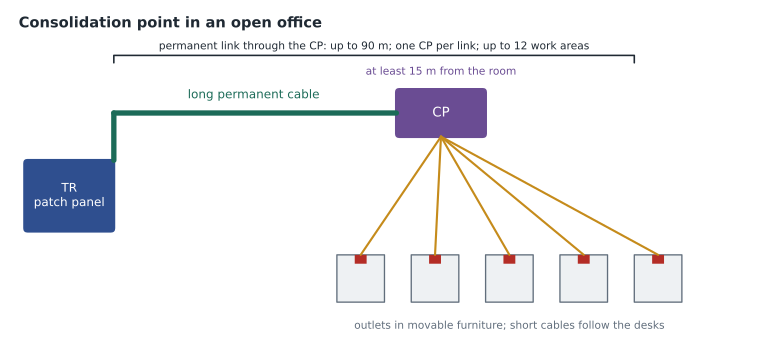
A consolidation point is an interconnection point within the horizontal cabling, between the horizontal cross-connect and the equipment outlet. The permanent cable runs from the telecommunications room to the consolidation point, usually in a zone enclosure in the ceiling, under a raised floor or on a building column. A shorter cable then runs from the consolidation point to the outlet at the furniture. When the furniture moves, only the short cable is moved or replaced; the long run back to the room stays in place.
The standards set several rules for consolidation points. There may be only one consolidation point in any horizontal link. It must be an interconnection, with cable from each side terminated on connecting hardware, never a cross-connect with patch cords. It should be at least 15 metres from the telecommunications room, because closely spaced connections near the room can add crosstalk and return loss problems at high frequencies. It should serve no more than 12 work areas, so that one enclosure does not concentrate too many links. And it must be in a permanent, accessible location, not inside movable furniture and not hidden above a fixed ceiling with no access.
The cable from the consolidation point to the outlet is part of the permanent link, not a cord. That means the total length from the room to the outlet, through the consolidation point, is still limited to 90 metres, and it is tested as one permanent link. Consolidation point hardware must also be at least the same category as the rest of the link.
The multi-user telecommunications outlet assembly
A MUTOA takes a different approach. Instead of extending the permanent cabling to outlets at each desk, it ends the horizontal cabling at a group of outlets in a single fixed location, such as a column or a wall near a cluster of desks. Users then connect to the MUTOA with longer work area cords, routed through the furniture, that can be changed whenever the desks move. The horizontal cabling never changes at all.
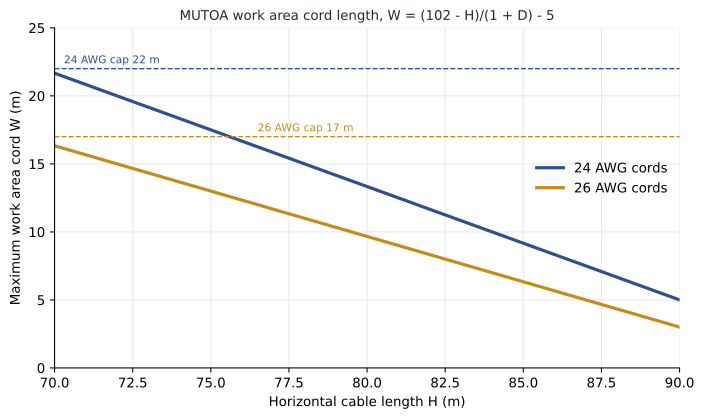
Because the work area cords are longer than usual, the channel needs a different length budget. Cords use stranded conductors, which have higher insertion loss than the solid conductors in horizontal cable, so each metre of cord counts for more than a metre of cable. ANSI/TIA-568.1 therefore gives a formula for the maximum combined cord length when the horizontal cable is shorter than 90 metres:
Here C is the maximum combined length of the work area cord, the equipment cord and any patch cords, H is the length of the horizontal cable, and D is a de-rating factor for the cord type: 0.2 for 24 AWG cords and 0.5 for 26 AWG cords. The work area cord alone may then be W = C − T, where T is the length of the cords in the telecommunications room, usually taken as 5 metres. For 24 AWG cords, the work area cord may be no longer than 22 metres; for 26 AWG cords, no longer than 17 metres.
| Horizontal cable H | Combined cords C (24 AWG) | Work area cord W = C − 5 |
|---|---|---|
| 90 m | 10 m | 5 m |
| 85 m | 14 m | 9 m |
| 80 m | 18 m | 13 m |
| 75 m | 22 m | 17 m |
| 70 m | 27 m | 22 m |
A MUTOA also follows the 12-work-area limit, must be in a permanent location such as a column or wall rather than in the ceiling or in furniture, and must be labelled so that each cord can be traced to its work area. Each cord should be labelled at both ends with the work area it serves, and the MUTOA should show the maximum allowed cord length.
Choosing between them
Both tools serve the same goal, but they suit different situations. A consolidation point is better when desks have outlets in the furniture and the users expect a normal short cord at each desk. It puts the flexible part of the system in the cabling contractor's hands: moving a desk means a planned move of a short cable. A MUTOA is better when furniture moves very often or when the owner wants users or facilities staff to make changes without a cabling contractor, because a cord can be unplugged and rerouted by anyone. Its drawback is long cords in furniture, which must be managed carefully to avoid damage and clutter.
Zone cabling is the broader approach of which consolidation points are one part. In a zone design, the floor is divided into zones of a few hundred square metres, each with an enclosure that serves every outlet type in the zone: desks, wireless, cameras and building systems. The zone enclosure can be a consolidation point, a MUTOA, or for building systems a place where service outlets are clustered. The same idea appears in ceiling-mounted enclosures for wireless and in floor boxes in raised-floor offices.
| Feature | Consolidation point | MUTOA |
|---|---|---|
| Where horizontal cabling ends | At the outlet in the furniture | At the MUTOA on a column or wall |
| What changes when furniture moves | The short cable from CP to outlet | The work area cord only |
| Who usually makes changes | Cabling contractor | Users or facilities staff |
| Length limit | 90 m permanent link, through the CP | Cord formula; work area cord up to 22 m for 24 AWG |
| Work areas served | Up to 12 | Up to 12 |
| Location | Permanent and accessible; 15 m or more from the room | Permanent, such as a column or wall; not in the ceiling |
Furniture coordination
Open office cabling succeeds or fails on coordination with the furniture supplier. Systems furniture often has raceways in the base, the beam or the spine where cables can run between desks, with knockouts for outlets. The cabling designer needs the furniture drawings early to know where those raceways are, how much cable they can hold and whether they separate power from communications cables, because many furniture raceways have separate channels for each. Running communications cable in the same compartment as power cable is a code problem and an interference problem.
The point where cables enter the furniture is often the weakest part of the design. A cable that drops from a ceiling consolidation point to a desk usually needs a service pole or a power and data pole, which must be placed where it does not block movement or sightlines. Cables that enter from a floor box need grommets and strain relief. In each case, the designer should specify the entry method and show it on the drawings, and the furniture installer and cabling installer should agree on who supplies and installs each part.
Finally, the moves themselves need a process. The facilities team should have a simple procedure for a desk move: record the old and new locations, move or replace the short cable or cord, update the records and test the link. Without that procedure, the open office tools that were meant to keep the cabling tidy can produce a new kind of mess, with undocumented cords and abandoned short cables in the ceiling.
Worked problem
Sizing a MUTOA work area cord
A cluster of eight desks is served from a MUTOA on a column. The horizontal cable from the room to the MUTOA is 76 metres. Cords are 24 AWG, and the room cords total 5 metres. What is the longest work area cord allowed?
Show solution
- Use the formula with H = 76 and D = 0.2: C = (102 − 76) / 1.2.
- 102 − 76 = 26, and 26 / 1.2 = 21.7 metres.
- Subtract the room cords: W = 21.7 − 5 = 16.7 metres.
- This is below the 22 metre cap for 24 AWG, so 16.7 metres applies.
Answer: The work area cords may be up to about 16.7 metres; specify 16 metre cords or shorter and label the MUTOA with the limit.
Worked problem
Checking a consolidation point layout
A design puts a consolidation point in a ceiling enclosure 11 metres from the telecommunications room, serving 16 benching desks with one outlet each. What problems does it have?
Show solution
- The consolidation point should be at least 15 metres from the room; 11 metres is too close.
- It serves 16 work areas; the limit is 12.
- The fix is to move the enclosure farther from the room and split the desks between two consolidation points.
Answer: Two problems: distance from the room and the number of work areas. Moving the enclosure and adding a second one solves both.
On Harbourview, Daniel and Roz choose consolidation points for the administration floor, with six zone enclosures in the ceiling, each serving up to ten desks and the wireless and camera outlets nearby. The facilities manager is pleased that a desk move will mean replacing a few short cables, not pulling new runs from the room. For the college's flexible project room, where tables move every week, they specify a MUTOA on each of two columns.
Common mistakes
MistakeUsing two consolidation points in one link.
InsteadOnly one consolidation point is allowed in any horizontal link.
MistakePlacing a consolidation point inside movable furniture.
InsteadIt must be in a permanent, accessible location.
MistakePatching at a consolidation point.
InsteadA consolidation point is an interconnection only; no patch cords or cross-connects.
MistakeUsing the normal 10 m cord rule at a MUTOA.
InsteadApply the cord length formula, with the 22 m cap for 24 AWG cords.
MistakeTreating the CP-to-outlet cable as a cord.
InsteadIt is part of the permanent link and counts toward 90 m.
Summary and key terms
- Open office tools separate the permanent cabling from the part that follows the furniture.
- A consolidation point is an interconnection within the horizontal link; only one is allowed per link.
- A consolidation point should be at least 15 m from the room, serve up to 12 work areas and be permanent and accessible.
- A MUTOA ends the horizontal cabling at a group of outlets on a column or wall, with longer work area cords.
- MUTOA cord lengths follow C = (102 − H) / (1 + D) and W = C − T, capped at 22 m for 24 AWG cords.
- Consolidation points suit contractor-managed moves; MUTOAs suit frequent moves made by users.
- Zone cabling uses enclosures to serve all outlet types in an area of the floor.
- Consolidation point
- An interconnection point within the horizontal cabling, between room and outlet.
- MUTOA
- A multi-user telecommunications outlet assembly: a group of outlets serving several work areas through longer cords.
- Zone enclosure
- An enclosure in the ceiling, floor or column that serves outlets in one zone.
- De-rating factor
- A factor that accounts for the higher loss of stranded cords.
- Abandoned cable
- Installed cable that is no longer terminated or used.
- Interconnection
- A connection made directly between two cables without patch cords.
Practice problems
Work each problem on paper first, then reveal the answer to check.
How many consolidation points may a horizontal link have?
Show answer
One.
What is the minimum recommended distance from the room to a consolidation point?
Show answer
15 m.
How many work areas may a MUTOA serve?
Show answer
Twelve at most.
With H = 80 m and 24 AWG cords, what is C?
Show answer
(102 − 80) / 1.2 = 18.3 m.
With that C and 5 m of room cords, what is W?
Show answer
13.3 m.
Where may a MUTOA not be mounted?
Show answer
In the ceiling or in movable furniture.
Why are stranded cords de-rated?
Show answer
Stranded conductors have higher insertion loss than solid cable.
Lesson quiz · 5 questions
Score 60% or more to complete this lesson.
Create a free account to save your progress, take quizzes and earn a certificate.