
RCDD-112 · Lesson 11 of 12 · 23 min
Designing for growth and future applications
▶ Video coming soon A video version of this lesson is on the way.
Halfway through design development, the Harbourview budget comes in high, and a value engineering workshop is called. On the list of proposed cuts are the spare outlets in the clinic rooms, the second backbone cable to each floor, the spare sleeves in the riser, and half of the wireless grid. Each cut saves money this year. Roz asks the group to imagine the building in year twelve, when the clinic is renovated, the college adds a simulation lab and the network has been upgraded twice. Her argument is simple: the cheapest time to install cabling capacity is while the ceilings are open. This lesson is about making that argument with numbers.
The life of a cabling plant
Cabling outlives almost everything connected to it. A horizontal cabling plant is usually planned for 15 to 20 years, and many last longer. Over that time, the network switches will be replaced three or four times, the wireless system several times, and the users' devices many more. Applications that did not exist when the cabling was designed will run over it. The cabling designer's job is to make choices today that the building will not regret in twenty years, without knowing exactly what those twenty years will bring.
Some of that is a matter of media, covered in lesson 6: Category 6A horizontal cabling and singlemode in the backbone keep many options open. Much of it is a matter of capacity: spare outlets, spare strands, spare pathway space, spare room space and spare power. And some of it is a matter of architecture: a topology and pathway system that can absorb new kinds of devices without being rebuilt.
What changes, and how fast
The pressures on cabling come from a few directions. Wireless access points need more bandwidth with each generation, and current access points have multi-gigabit Ethernet ports that run at 2.5 or 5 gigabits per second over twisted pair, with 10 gigabits expected; that is one reason TIA recommends two Category 6A cables to each access point location. Devices that once had their own wiring, such as lights, sensors, locks and displays, are moving onto the network and often onto PoE. Power levels are rising. And new physical layers are appearing that use the cabling in new ways.
One of these is single pair Ethernet, which carries Ethernet over one twisted pair instead of four. Variants such as 10BASE-T1L carry 10 megabits per second up to about 1000 metres on a single pair, and can carry power at the same time, which makes them attractive for building sensors and industrial devices. TIA has published a standard for single balanced twisted-pair cabling, ANSI/TIA-568.5, with an addendum in 2024, and ISO/IEC has similar work. Another is fault-managed power, a new class of power distribution that delivers higher power over communications-style cable with continuous monitoring that shuts the circuit down within milliseconds of a fault. Codes in Canada and elsewhere are beginning to address it, and designers should watch for changes in the adopted edition. Neither replaces structured cabling, but both may need pathways and spaces in the same rooms and trays.
Spare capacity where it is cheap
The rule Roz teaches is to install capacity where it is cheap to install now and expensive to add later, and to reserve space where installing now would be wasteful. Horizontal cable to a spare outlet costs a modest amount during construction, because the labour of pulling one more cable along an existing route is small. The same cable added after the ceilings are closed may cost several times as much, with ceiling access, disruption to occupants, after-hours work and patching of finishes. Backbone fibre follows the same logic: the cost of extra strands in a cable being pulled anyway is small; the cost of pulling a second cable up a full riser later is not.
Other capacity is better reserved than filled. Empty rack space, spare sleeves and conduit with pull strings, empty cable tray width and spare electrical circuits in the telecommunications room cost little to leave in place, and they let future cabling be added cheaply. TIA-569 provides guidance on pathway fill that leaves room for growth: designers commonly plan conduit for no more than about two fifths of its cross-section when filled, and leave tray space for additions. A riser built with spare sleeves at every floor is far cheaper than one that must be core-drilled again through a finished building.
| Item | Install now or reserve | Reason |
|---|---|---|
| Spare horizontal outlets in renovation-prone rooms | Install now | Labour to add later is high once ceilings close. |
| Spare backbone fibre strands | Install now | Extra strands in a cable being pulled anyway cost little. |
| Second, diverse backbone path | Install now for critical floors | Adding a riser later means new penetrations. |
| Riser sleeves and conduit | Install empty with pull strings | Cheap now; core drilling later is disruptive. |
| Rack space and room floor space | Reserve | Equipment will be chosen later. |
| Electrical circuits and cooling capacity | Reserve capacity, install some | PoE and new equipment raise room loads. |
Coverage areas and service outlets
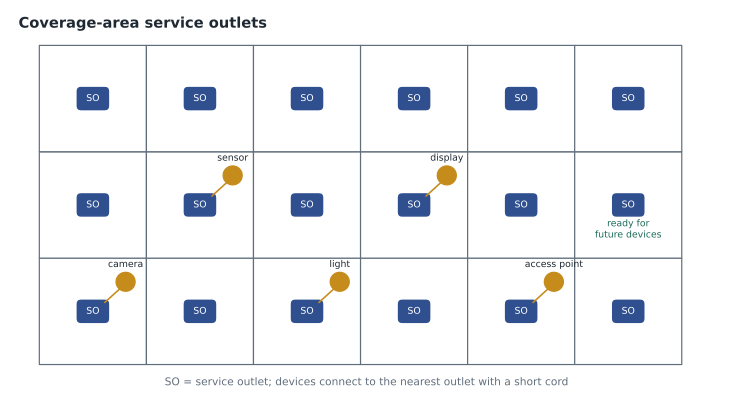
The most effective way to prepare for devices nobody has specified yet is to give the ceiling a regular grid of service outlets, the coverage-area approach of ANSI/TIA-862 and ISO/IEC 11801 for distributed building services. Each coverage area, often the same cell used for the wireless grid or a smaller one, is served by a few cables to a service outlet or a zone enclosure. When a new sensor, display, camera or controller is needed, it is connected to the nearest outlet with a short cord rather than a new home run. The cost is a few extra cables per cell during construction; the benefit is that new building systems can be added for years without opening the ceiling.
Total cost of ownership
Value engineering looks at first cost. A designer should present the total cost of ownership: first cost plus the expected cost of the changes the building will need over the life of the cabling. That means estimating, from the owner's own history or from similar buildings, how often spaces are renovated, how often devices are added, and what each change costs with and without the spare capacity. The numbers are uncertain, but even a rough comparison usually shows that capacity installed during construction pays for itself if it is used even a few times.
Removing capacity can also have hidden costs. Abandoned cable must be dealt with when new cable is added, as lesson 4 noted. Undersized pathways force new cables into poor routes or out of the standards' rules. A full telecommunications room forces new equipment into ceilings or corridors. And a backbone with no spare strands can delay a network upgrade for months while a riser is reopened.
The design narrative
The best defence of growth capacity is a design narrative written before the value engineering meeting. It lists each piece of spare capacity with its reason, its cost and the consequence of removing it, so that the owner can make an informed decision rather than a reflexive cut. It also records the assumptions behind the design: the expected life, the applications planned for, the growth expected in each area. When someone asks in year twelve why the building has spare sleeves in the riser, the narrative answers.
Planning for media changes
Even with good choices today, a future designer may need to replace some cabling, and today's design can make that easier. Pathways sized with spare capacity let a new cable be pulled beside an old one before the old one is removed, so that services move over without downtime. Labels and records that identify every cable make it possible to find and remove abandoned cable. Telecommunications rooms with spare wall and rack space let new panels be installed beside old ones during a migration. And pull strings left in every conduit, sleeve and empty pathway save hours of work when the time comes.
Some owners also plan staged upgrades from the start. A college might install Category 6A to every outlet now but only connect a fraction of them, adding switches as spaces are fitted out. A hospital might install singlemode backbone everywhere but run multimode-based network equipment for the first years, swapping optics later without touching the cabling. Each plan works only if the cabling was designed to support it, which is why the design narrative should state the expected upgrade path as well as today's design.
Growth planning also applies to the telecommunications rooms themselves. ANSI/TIA-569 gives minimum room sizes, but many designers size rooms for the cabling and equipment expected at the end of the cabling's life rather than at opening day, because enlarging a room later usually means moving walls, ducts and electrical panels. A few extra square metres in each room during design is almost always cheaper than a renovation in year ten, and it is one of the items most often removed in value engineering without anyone noticing the cost.
Worked problem
Spare outlets now or later
The clinic floor has 60 exam rooms. The design adds two spare outlets per room, at about 180 dollars per outlet during construction. The owner's history shows clinic rooms are renovated about every eight years, and adding an outlet after construction costs about 750 dollars. If half the spare outlets are eventually used, which is cheaper over the life of the cabling?
Show solution
- Spare outlets now: 60 × 2 = 120 outlets; 120 × 180 = 21,600 dollars.
- Outlets used later: half of 120 is 60.
- Cost to add those 60 later without spares: 60 × 750 = 45,000 dollars.
- Even if only half are used, installing now saves 45,000 − 21,600 = 23,400 dollars.
Answer: Installing the spares now is cheaper, by about 23,400 dollars, and avoids disruption to clinics.
Worked problem
Checking riser sleeve capacity
A riser has four 100 millimetre sleeves per floor. Each sleeve's usable fill area, at the planned fill, is about 3,140 square millimetres. Today's backbone uses two cables of 15 millimetre diameter and one of 20 millimetre diameter per floor. How much of the sleeve capacity is used?
Show solution
- Cable areas: two at π × 7.5² ≈ 176.7 each, 353.4; one at π × 10² ≈ 314.2; total ≈ 667.6 square millimetres.
- Total usable sleeve area: 4 × 3,140 = 12,560 square millimetres.
- Share used: 667.6 / 12,560 ≈ 0.053, about one twentieth.
- The riser has ample room for growth, as long as cables are spread across sleeves and pull strings are left.
Answer: About one twentieth of the usable capacity is used. The spare sleeves are what make future backbone cables cheap to add.
At the workshop, Roz presents a one-page table of the proposed cuts, each with its first cost saving and its estimated later cost. The group keeps the spare outlets in the clinics and the second backbone to the clinic floors, keeps the riser sleeves and the wireless grid, and cuts some spare outlets in storage rooms and corridors, where the narrative shows little growth is expected. The project manager calls it the first value engineering meeting where he understood what he was buying.
Common mistakes
MistakeCutting spare capacity without knowing its later cost.
InsteadCompare first cost with the cost of adding capacity after construction.
MistakeFilling every pathway to its maximum.
InsteadPlan fill that leaves room for growth, and leave pull strings in spare sleeves.
MistakeDesigning only for today's devices.
InsteadUse coverage-area outlets so new building devices can be added cheaply.
MistakeIgnoring new physical layers.
InsteadSingle pair Ethernet and fault-managed power may need space in the same rooms and trays.
MistakeLeaving growth decisions undocumented.
InsteadRecord each piece of spare capacity and its reason in the design narrative.
Summary and key terms
- Cabling is planned for 15 to 20 years and outlives several generations of equipment.
- Rising wireless speeds, more networked devices and higher PoE levels drive growth.
- Single pair Ethernet and fault-managed power are new ways of using communications cabling.
- Install capacity that is cheap now and costly later; reserve space where installing now is wasteful.
- Coverage-area service outlets prepare ceilings for devices not yet specified.
- Compare total cost of ownership, not just first cost.
- A design narrative records spare capacity, reasons and assumptions.
- Spare capacity
- Outlets, strands, pathway or room space provided beyond current needs.
- Multi-gigabit Ethernet
- Ethernet at 2.5 or 5 gigabits per second over twisted pair.
- Single pair Ethernet
- Ethernet carried over one twisted pair, for long reach or small devices.
- Fault-managed power
- A power system that monitors continuously and shuts down quickly on a fault.
- Total cost of ownership
- First cost plus the cost of changes and operation over the asset's life.
- Design narrative
- A written record of design decisions, reasons and assumptions.
Practice problems
Work each problem on paper first, then reveal the answer to check.
What is a typical planned life for a horizontal cabling plant?
Show answer
15 to 20 years.
Why does TIA recommend two Category 6A cables per access point?
Show answer
To support multi-gigabit and future radios and higher power.
About how far does 10BASE-T1L reach?
Show answer
About 1000 m.
Name two things better reserved than installed.
Show answer
Rack space, room floor space, empty tray width or spare circuits.
What does a coverage-area grid provide?
Show answer
Service outlets so new devices can connect without new home runs.
Why compare total cost of ownership?
Show answer
Because spare capacity installed now is often much cheaper than adding it later.
What document records growth decisions?
Show answer
The design narrative.
Lesson quiz · 5 questions
Score 60% or more to complete this lesson.
Create a free account to save your progress, take quizzes and earn a certificate.