
PYTH-250 · Lesson 8 of 12 · 22 min
Async web requests
▶ Video coming soon A video version of this lesson is on the way.
Theo's Monday quotes are the real test of everything in the last two lessons. The shipping company offers a web API: send an HTTP request with the parcel's weight and destination, receive a JSON reply with prices. The company's documentation sets two rules: no more than ten requests in flight at once per account, and clients must back off and retry when the server replies 429 Too Many Requests or fails temporarily. A good async quote client must therefore run requests concurrently, respect the limit, retry sensibly, survive individual failures, and still finish 200 quotes in under 15 seconds.
This lesson builds that client step by step. It introduces async HTTP libraries such as httpx and aiohttp and why ordinary requests cannot be used inside a coroutine, sharing one client session for many requests, limiting concurrency with asyncio.Semaphore, collecting results and errors with gather and return_exceptions, retrying with exponential backoff and jitter, and processing results as they arrive. The browser cannot make real network requests from these exercises, so the network is replaced by small fake coroutines, and the code you write is the same logic a real client needs.
Async HTTP clients
The popular requests library is blocking: requests.get() stops the thread until the reply arrives. Inside a coroutine that would freeze the event loop, so async programs use HTTP libraries built for asyncio. httpx offers an AsyncClient whose methods are coroutines, with an interface close to requests. aiohttp is an older, widely used async client and server library. Both are third-party packages installed with pip. Both encourage you to create one client or session and reuse it for every request, because the client keeps connections to the server open between requests, saving the cost of opening a new connection and negotiating encryption each time.
import asyncio
import httpx

API = "https://api.example-shipping.test/v2/quotes"

async def get_quote(client, order):
    reply = await client.post(API, json={"weight_kg": order["kg"], "postal": order["postal"]})
    reply.raise_for_status()                    # turns 4xx and 5xx replies into exceptions
    return order["id"], reply.json()["price"]

async def main(orders):
    async with httpx.AsyncClient(timeout=10.0) as client:     # one client, reused
        results = await asyncio.gather(*(get_quote(client, o) for o in orders))
    return dict(results)

orders = [{"id": "A-1001", "kg": 0.68, "postal": "V1Y 2B3"}, {"id": "A-1002", "kg": 1.36, "postal": "T5J 0N3"}]
print(asyncio.run(main(orders)))
This version has the right shape but follows none of the shipping company's rules. With 200 orders, gather starts all 200 requests at once, the server answers most of them with 429 Too Many Requests, and raise_for_status turns those into exceptions. Worse, gather raises the first exception it sees and the results of the successful requests are lost. Each of these problems has a standard fix.
Limiting concurrency with a semaphore
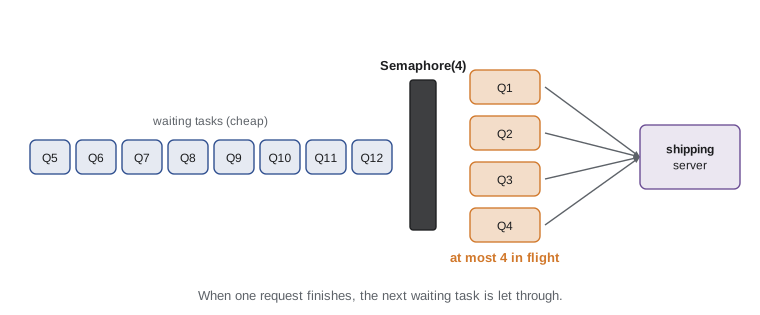
A semaphore is a counter that controls how many tasks may enter a section of code at the same time. asyncio.Semaphore(10) starts at ten. Each task that enters with async with semaphore: decreases the counter, and if the counter is zero the task waits until another task leaves and increases it again. Wrapping the request in a semaphore caps the number in flight, while gather still schedules every coroutine at once. The tasks beyond the limit simply wait their turn, costing almost nothing while they wait.
import asyncio, time

in_flight = 0
peak = 0

async def get_quote(order_id, limit):
    global in_flight, peak
    async with limit:                         # at most N inside at once
        in_flight += 1
        peak = max(peak, in_flight)
        await asyncio.sleep(0.5)              # the request
        in_flight -= 1
        return order_id, 12.40

async def main():
    limit = asyncio.Semaphore(10)
    orders = [f"A-{1000 + n}" for n in range(200)]
    start = time.perf_counter()
    quotes = await asyncio.gather(*(get_quote(o, limit) for o in orders))
    print(f"{len(quotes)} quotes in {time.perf_counter() - start:.1f} s; peak in flight: {peak}")

asyncio.run(main())200 quotes in 10.0 s; peak in flight: 10
The arithmetic is the same as for the thread pool in lesson 6: 200 requests, ten at a time, half a second each, gives twenty rounds and about ten seconds, inside the goal. The semaphore belongs to the event loop, so it should be created inside a coroutine, as main does here, and shared by passing it to the tasks.
Collecting results and errors
By default, asyncio.gather raises the first exception from any of its coroutines, and you lose access to the other results. Passing return_exceptions=True changes that: gather waits for everything and returns a list in which each entry is either a result or the exception that coroutine raised. The program can then separate successes from failures, report the failures and retry them later. For long jobs, processing results as they arrive with asyncio.as_completed gives early feedback, much like the futures version in lesson 6.
def drive(coro):
    """Run a coroutine to completion by stepping it (enough for await asyncio.sleep(0))."""
    try:
        while True:
            coro.send(None)
    except StopIteration as done:
        return done.value

import asyncio

async def get_quote(order_id):
    await asyncio.sleep(0)
    if order_id.endswith("3"):
        raise ConnectionError(f"timeout for {order_id}")
    return 12.40

async def main(orders):
    results = await asyncio.gather(*(get_quote(o) for o in orders), return_exceptions=True)
    ok = {o: r for o, r in zip(orders, results) if not isinstance(r, Exception)}
    bad = {o: str(r) for o, r in zip(orders, results) if isinstance(r, Exception)}
    return ok, bad

orders = ["A-1001", "A-1002", "A-1003", "A-1004"]
coros = [get_quote(o) for o in orders]
ok, bad = {}, {}
for o, c in zip(orders, coros):                  # stepped one by one here, for the browser
    try:
        ok[o] = drive(c)
    except ConnectionError as e:
        bad[o] = str(e)
print("ok:", ok)
print("failed:", bad)ok: {'A-1001': 12.4, 'A-1002': 12.4, 'A-1004': 12.4}
failed: {'A-1003': 'timeout for A-1003'}Try it yourself
Sort out the results
After results = await asyncio.gather(..., return_exceptions=True), each entry is either a price or an exception object. Write split_results(order_ids, results) returning a tuple (quotes, failures): quotes maps order id to price for the successes, and failures maps order id to the exception's class name, such as "ConnectionError".
The two lists are in the same order.
def split_results(order_ids, results):
    return dict(zip(order_ids, results)), {}

print(split_results(['A-1', 'A-2'], [12.4, ConnectionError('timeout')]))
Retrying with exponential backoff
Some failures are permanent, such as a postal code that does not exist, which returns 400 Bad Request; retrying will never help. Others are temporary: a 429 when the server is busy, a 503 Service Unavailable, a dropped connection. For temporary failures the right response is to wait and try again, but not immediately and not all at the same moment, or every client hammers the struggling server in lockstep. The standard approach is exponential backoff: wait a base delay after the first failure, then double the wait after each further failure, up to a cap. Adding jitter, a small random variation in each delay, stops many clients from retrying in sync.
import random

def backoff_delays(attempts, base=0.5, cap=8.0):
    """Delays before each retry: base, 2*base, 4*base, ... capped."""
    return [min(cap, base * 2 ** i) for i in range(attempts)]

def with_jitter(delays, seed=1):
    rnd = random.Random(seed)
    return [round(d * rnd.uniform(0.5, 1.0), 2) for d in delays]   # "equal jitter" style

print("backoff:    ", backoff_delays(6))
print("with jitter:", with_jitter(backoff_delays(6)))
print("total worst-case wait:", sum(backoff_delays(6)), "s")backoff: [0.5, 1.0, 2.0, 4.0, 8.0, 8.0] with jitter: [0.28, 0.92, 1.76, 2.51, 5.98, 5.8] total worst-case wait: 23.5 s
When a server sends a Retry-After header with a 429 or 503 reply, a polite client waits at least that long instead of its own calculated delay. A client should also give up after a fixed number of attempts and report the failure, rather than retrying forever. In async code the retry loop wraps the awaited request, and await asyncio.sleep(delay) waits without blocking other tasks.
Try it yourself
An async retry helper
Write a coroutine retry(make_request, attempts) that calls await make_request() and returns its result. If it raises ConnectionError, try again, up to attempts calls in total; if every attempt fails, raise the last error. Other exceptions must not be retried.
Between attempts, await asyncio.sleep(0) (a real client would sleep for a backoff delay). A drive(coro) helper and a fake flaky(n) factory are provided: flaky(n) returns a request coroutine function that fails n times before succeeding.
import asyncio

async def retry(make_request, attempts):
    return await make_request()

print(drive(retry(flaky(0), 3)))
Putting the client together
The finished client combines the pieces: one shared AsyncClient, a semaphore of ten, a retry loop with exponential backoff and jitter for temporary errors, and gather with return_exceptions so a few failures do not lose the rest. Each piece is small, and together they make a client that is fast, polite to the server and robust. Theo's Monday run now finishes in about eleven seconds, including a handful of retries, and prints a short list of orders that need attention.
import asyncio, random
import httpx

API = "https://api.example-shipping.test/v2/quotes"
TEMPORARY = {429, 500, 502, 503, 504}

async def get_quote(client, limit, order, attempts=5):
    for attempt in range(attempts):
        async with limit:
            reply = await client.post(API, json={"weight_kg": order["kg"], "postal": order["postal"]})
        if reply.status_code not in TEMPORARY:
            reply.raise_for_status()                      # permanent errors are raised at once
            return reply.json()["price"]
        wait = float(reply.headers.get("Retry-After", min(8.0, 0.5 * 2 ** attempt)))
        await asyncio.sleep(wait * random.uniform(0.5, 1.0))
    raise ConnectionError(f"{order['id']}: gave up after {attempts} tries")

async def quote_all(orders):
    limit = asyncio.Semaphore(10)
    async with httpx.AsyncClient(timeout=10.0) as client:
        results = await asyncio.gather(*(get_quote(client, limit, o) for o in orders),
                                       return_exceptions=True)
    quotes = {o["id"]: r for o, r in zip(orders, results) if not isinstance(r, Exception)}
    failed = {o["id"]: repr(r) for o, r in zip(orders, results) if isinstance(r, Exception)}
    return quotes, failed
The semaphore is released while the client sleeps between retries, because the sleep sits outside the async with block. A retrying request should not hold one of the ten slots while it waits, or a burst of failures could stall the whole job.
Rate limits over time
A concurrency limit caps how many requests are in flight. Many APIs instead limit how many requests may start per second or per minute, a rate limit. The two are different: ten fast requests in flight could still exceed a limit of five requests per second. A simple way to respect a rate limit is to space out request starts so that at most n begin in any one-second window; libraries such as aiolimiter implement the token bucket algorithm for this. The planning arithmetic is straightforward, and worth doing before the job runs.
import math

def job_time(n_requests, per_second=None, concurrent=None, request_s=0.5):
    """Lower bound on time from a rate limit and a concurrency limit."""
    by_rate = n_requests / per_second if per_second else 0
    by_concurrency = math.ceil(n_requests / concurrent) * request_s if concurrent else n_requests * request_s
    return max(by_rate, by_concurrency)

print("200 quotes, 10 in flight:", job_time(200, concurrent=10), "s")
print("200 quotes, 10 in flight, 15 per second:", round(job_time(200, per_second=15, concurrent=10), 1), "s")
print("200 quotes, 50 in flight, 15 per second:", round(job_time(200, per_second=15, concurrent=50), 1), "s")200 quotes, 10 in flight: 10.0 s 200 quotes, 10 in flight, 15 per second: 13.3 s 200 quotes, 50 in flight, 15 per second: 13.3 s
Try it yourself
Backoff delays
Write backoff(attempts, base, cap) returning the list of delays before each retry: base, 2 * base, 4 * base and so on, each limited to at most cap, with attempts delays in total.
Then write total_wait(attempts, base, cap) returning the sum of those delays.
def backoff(attempts, base, cap):
    return [base] * attempts

def total_wait(attempts, base, cap):
    return 0

print(backoff(5, 0.5, 4))
Common mistakes
MistakeCalling requests.get inside a coroutine.
InsteadUse an async client such as httpx.AsyncClient or aiohttp, or wrap blocking calls with asyncio.to_thread.
MistakeCreating a new client for every request.
InsteadCreate one client or session and reuse it, so connections are kept open.
MistakeStarting thousands of requests at once with gather.
InsteadWrap each request in an asyncio.Semaphore to cap the number in flight.
MistakeLetting one failed request lose all the results.
InsteadUse gather(..., return_exceptions=True) and separate successes from failures.
MistakeRetrying immediately and forever.
InsteadUse exponential backoff with jitter, respect Retry-After, and stop after a few attempts.
MistakeRetrying permanent errors such as 400 Bad Request.
InsteadRetry only temporary failures such as 429, 503 and connection errors.
Summary and key terms
- Async programs use async HTTP clients such as httpx and aiohttp; blocking requests would freeze the loop.
- One shared client session reuses connections across many requests.
- asyncio.Semaphore(n) caps how many tasks are in flight; the rest wait cheaply.
- gather(..., return_exceptions=True) returns results and exceptions together so failures can be handled individually.
- Temporary failures are retried with exponential backoff, a cap, jitter and a maximum number of attempts.
- Permanent errors are reported, not retried; Retry-After headers are respected.
- Rate limits restrict request starts per unit of time; the tighter of the rate and concurrency limits sets the minimum job time.
- async HTTP client
- A library whose request methods are coroutines, such as httpx.AsyncClient.
- session
- A reusable client object that keeps connections to servers open between requests.
- semaphore
- A counter that limits how many tasks may enter a section of code at once.
- return_exceptions
- A gather option that returns exceptions as results instead of raising the first one.
- exponential backoff
- Waiting longer after each failure, usually doubling the delay.
- jitter
- Random variation added to retry delays so clients do not retry in sync.
- 429 Too Many Requests
- An HTTP status meaning the client has exceeded the server's limits.
- rate limit
- A cap on how many requests may be made per unit of time.
- Retry-After
- An HTTP header telling the client how long to wait before retrying.
Practice problems
Work each problem on paper first, then reveal the answer to check.
Why should one AsyncClient be shared by all requests?
Show answer
It keeps connections open and reuses them, avoiding repeated connection set-up.
500 requests of 0.4 s each, at most 20 in flight. Estimate the time.
Show answer
25 rounds of 0.4 s = 10 seconds.
List the first five backoff delays with base 1 s and cap 10 s.
Show answer
1, 2, 4, 8, 10.
Which status codes are worth retrying?
Show answer
Temporary ones such as 429, 500, 502, 503 and 504, plus connection errors.
Why add jitter to backoff delays?
Show answer
So many clients do not all retry at the same moments.
A limit of 5 requests per second applies to 200 requests. What is the minimum time?
Show answer
40 seconds.
Lesson quiz · 5 questions
Score 60% or more to complete this lesson.
Create a free account to save your progress, take quizzes and earn a certificate.