
PYTH-250 · Lesson 3 of 12 · 24 min
Efficient use of built-in data structures
▶ Video coming soon A video version of this lesson is on the way.
The profile from lesson 2 left no doubt: Anita's month-end report spends almost all its time in find_product, which scans a list of 600 products for every one of 20,000 sales. The cure is not a faster loop. It is a different data structure. Python's built-in types, lists, dictionaries, sets and tuples, plus a handful of specialized containers in the standard library, each have operations that are fast and operations that are slow. Choosing the right container for the job is the single most effective performance skill in everyday Python.
This lesson goes through the cost of the common operations on each built-in type, shows how to build an index with a dictionary, uses sets for fast membership and duplicate removal, replaces slow queue code with collections.deque, counts with Counter and defaultdict, finds the top items with heapq, searches sorted data with bisect, and covers the small idioms, such as str.join and preferring built-in functions, that keep Python code fast without making it obscure.
The cost of list operations
A Python list is a dynamic array: the items sit in one block of memory in order, and the list keeps extra room at the end. That layout makes some operations very cheap and others expensive. Reading or replacing an item by index, appending to the end and popping from the end are O(1), constant time, whatever the list's length. Inserting or deleting at the front or in the middle is O(n), because every later item must move along by one place. Searching for a value with in, index() or count() is O(n), because Python has to look at the items one by one.
from collections import deque

def front_insert_moves(n):
    """How many item moves inserting n items at the front of a list costs."""
    moves = 0
    for size in range(n):
        moves += size            # every existing item shifts one place
    return moves

for n in [10, 1_000, 100_000]:
    print(f"{n:>7,} front inserts: {front_insert_moves(n):>13,} item moves; appends: 0 moves")

orders = []
for o in ["A-1", "A-2", "A-3"]:
    orders.append(o)             # O(1) at the end
print(orders, orders[-1], orders.pop())10 front inserts: 45 item moves; appends: 0 moves 1,000 front inserts: 499,500 item moves; appends: 0 moves 100,000 front inserts: 4,999,950,000 item moves; appends: 0 moves ['A-1', 'A-2'] A-3 A-3
The count of item moves grows with the square of the number of inserts: five billion moves to build a list of 100,000 items by inserting each at the front, against none for appending. If you need to add at the front, either build the list by appending and reverse it once at the end, or use a deque, described below.
Dictionaries and sets: hashing
Dictionaries and sets are hash tables. When you store a key, Python computes its hash, a number derived from the value, and uses it to choose a slot in an internal table. To look a key up, Python computes the hash again and goes straight to the slot. Looking up, adding and deleting a key are therefore O(1) on average, no matter how many keys are stored. The price is memory, since hash tables keep spare slots, and the rule that keys must be hashable: immutable values such as strings, numbers and tuples of them, but not lists or dictionaries.
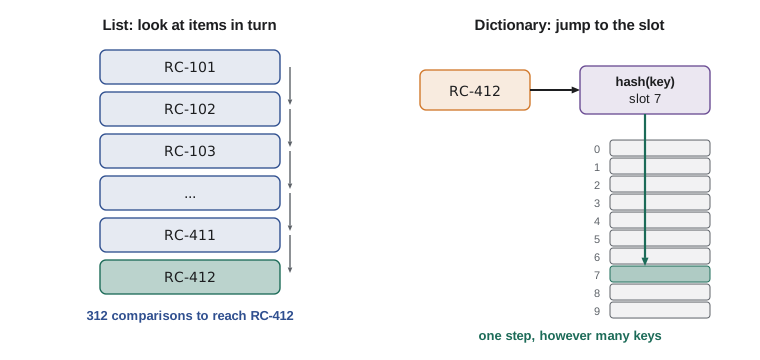
Jordan's fix for the report follows directly. Instead of scanning the product list for every sale, he builds a dictionary from sku to product once, which costs one pass over the 600 products, and then each sale is a single lookup. Counting the comparisons shows the difference, and the timing confirms it.
import random, time

rnd = random.Random(7)
PRODUCTS = [{"sku": f"RC-{n}", "price": 18 + n % 5} for n in range(101, 701)]
SALES = [(f"RC-{rnd.randint(101, 700)}", rnd.randint(1, 3)) for _ in range(20_000)]

def report_scan(sales):
    totals = {}
    for sku, qty in sales:
        product = next(p for p in PRODUCTS if p["sku"] == sku)   # O(n) scan
        totals[sku] = totals.get(sku, 0) + product["price"] * qty
    return totals

def report_index(sales):
    by_sku = {p["sku"]: p for p in PRODUCTS}                     # built once
    totals = {}
    for sku, qty in sales:
        totals[sku] = totals.get(sku, 0) + by_sku[sku]["price"] * qty
    return totals

for f in (report_scan, report_index):
    start = time.perf_counter()
    result = f(SALES)
    print(f"{f.__name__:13} {time.perf_counter() - start:.4f} s, grand total {sum(result.values()):,}")
print("same answer:", report_scan(SALES) == report_index(SALES))report_scan 0.2014 s, grand total 798,819 report_index 0.0031 s, grand total 798,819 same answer: True
On a typical laptop the indexed version is dozens of times faster, and the gap widens as the product list grows. The result is identical, which the last line checks. This one change took the real report from minutes to a couple of seconds, comfortably inside the 10-second goal from lesson 1.
Try it yourself
Build an index
PRODUCTS is a list of dictionaries with keys sku, name and price. Write build_index(products) returning a dictionary from sku to the product dictionary.
Then write order_total(lines, index) where lines is a list of (sku, qty) pairs; return the total price, using the index for every lookup. Unknown skus should raise KeyError.
def build_index(products):
    return products

def order_total(lines, index):
    total = 0
    for sku, qty in lines:
        for p in index:
            if p['sku'] == sku:
                total += p['price'] * qty
    return total

idx = build_index(PRODUCTS)
print(order_total([('RC-101', 2), ('RC-104', 1)], idx))
Sets for membership and duplicates
When you only need to know whether something is present, use a set. Checking x in some_set is O(1) on average, while x in some_list is O(n). Sets also remove duplicates for free and support the operations of set algebra: union, intersection and difference, each of which runs in time proportional to the sizes involved rather than their product. A common slow pattern is filtering one list against another with a nested membership test; converting the second list to a set first turns an O(n × m) job into O(n + m).
loyalty_members = [f"555-{n:04d}" for n in range(0, 20_000, 3)]       # phone numbers
todays_phones = [f"555-{n:04d}" for n in range(0, 20_000, 7)]

def checks_list(phones, members):
    steps = 0
    found = 0
    for ph in phones:
        for m in members:                # what "ph in members" does for a list
            steps += 1
            if m == ph:
                found += 1
                break
    return found, steps

member_set = set(loyalty_members)
found_set = sum(1 for ph in todays_phones if ph in member_set)
found_list, steps = checks_list(todays_phones, loyalty_members)
print("members among today's customers:", found_set, found_list)
print(f"list version: {steps:,} comparisons; set version: {len(todays_phones):,} lookups")
print("first four unique roasts:", sorted(set(["B-0412", "B-0413", "B-0412", "B-0414"])))members among today's customers: 953 953 list version: 15,876,984 comparisons; set version: 2,858 lookups first four unique roasts: ['B-0412', 'B-0413', 'B-0414']
The order of items in a set is not defined, so print sorted(the_set) when you need repeatable output. If you need to remove duplicates but keep the original order, dict.fromkeys(items) does it in one pass, because dictionaries remember insertion order and their keys are unique.
collections.deque for queues
A queue takes items from the front and adds them at the back. With a list, list.pop(0) is O(n), because every remaining item moves forward. collections.deque, a double-ended queue, supports O(1) appends and pops at both ends. Theo's order-processing loop takes orders first in, first out; with thousands of orders a day, the deque version stays fast while the list version slows down as the backlog grows. A deque with maxlen also makes a convenient sliding window that discards the oldest item automatically.
from collections import deque

queue = deque(["A-1001", "A-1002", "A-1003"])
queue.append("A-1004")            # arrives at the back
first = queue.popleft()           # served from the front, O(1)
print("served:", first, "waiting:", list(queue))

# last five temperatures from the roaster, oldest dropped automatically
recent = deque(maxlen=5)
for t in [182, 186, 190, 195, 199, 204, 208]:
    recent.append(t)
print("window:", list(recent), "average:", sum(recent) / len(recent))served: A-1001 waiting: ['A-1002', 'A-1003', 'A-1004'] window: [190, 195, 199, 204, 208] average: 199.2
Try it yourself
A rolling average with deque
Kai wants the average of the last k temperature readings at every step. Write rolling_average(readings, k) returning a list with one value per reading: the average of the most recent k readings so far (fewer at the start), rounded to 1 decimal place.
Use collections.deque(maxlen=k) and keep a running sum so each step is O(1); do not call sum() on the window every time.
from collections import deque

def rolling_average(readings, k):
    return readings

print(rolling_average([180, 190, 200, 210], 2))
Counting and grouping
Counting things is so common that the standard library has two containers for it. collections.Counter counts hashable items in one pass and has most_common() for the top entries. collections.defaultdict creates a missing key's value automatically, which removes the if key not in d checks that clutter grouping code. Both are dictionaries underneath, so they keep the O(1) lookups.
from collections import Counter, defaultdict

sales = [("RC-101", 2), ("RC-106", 1), ("RC-101", 1), ("RC-103", 2), ("RC-106", 3), ("RC-101", 1)]

bags = Counter()
for sku, qty in sales:
    bags[sku] += qty
print("bags sold:", dict(sorted(bags.items())))
print("top two:", bags.most_common(2))

by_qty = defaultdict(list)
for sku, qty in sales:
    by_qty[qty].append(sku)          # no need to create the list first
print("orders by quantity:", dict(sorted(by_qty.items())))bags sold: {'RC-101': 4, 'RC-103': 2, 'RC-106': 4}
top two: [('RC-101', 4), ('RC-106', 4)]
orders by quantity: {1: ['RC-106', 'RC-101', 'RC-101'], 2: ['RC-101', 'RC-103'], 3: ['RC-106']}heapq for the top items
Finding the ten best-selling coffees by sorting the whole list is O(n log n). When you only need the top or bottom k items, heapq.nlargest and heapq.nsmallest do it in O(n log k), which for k much smaller than n is close to a single pass. A heap is also the right structure for a priority queue, where you repeatedly need the smallest remaining item: heappush and heappop are O(log n).
import heapq

batches = [("B-0412", 14.2), ("B-0413", 12.8), ("B-0414", 15.6), ("B-0415", 13.1), ("B-0416", 16.0)]
print("two longest roasts:", heapq.nlargest(2, batches, key=lambda b: b[1]))
print("shortest roast:", heapq.nsmallest(1, batches, key=lambda b: b[1]))

jobs = []                                    # (priority, job): smaller number first
for job in [(3, "print labels"), (1, "ship express order"), (2, "update stock")]:
    heapq.heappush(jobs, job)
while jobs:
print("next:", heapq.heappop(jobs)[1])two longest roasts: [('B-0416', 16.0), ('B-0414', 15.6)]
shortest roast: [('B-0413', 12.8)]
next: ship express order
next: update stock
next: print labelsbisect for sorted data
If data is kept sorted, a binary search finds a position in O(log n). The bisect module provides it: bisect_left returns where a value would be inserted to keep the list sorted, and insort inserts it there. Mei's loyalty tiers are a classic use: a sorted list of thresholds and bisect turn a points total into a tier in a couple of comparisons, without a chain of if statements.
from bisect import bisect_right

THRESHOLDS = [100, 300]                     # points needed for Roast, Reserve
TIERS = ["Bean", "Roast", "Reserve"]

def tier(points):
    return TIERS[bisect_right(THRESHOLDS, points)]

for p in [0, 99, 100, 299, 300, 1200]:
print(p, tier(p))0 Bean 99 Bean 100 Roast 299 Roast 300 Reserve 1200 Reserve
Small idioms that add up
A few habits keep everyday Python fast. Build strings with str.join on a list of pieces rather than += in a loop, which can copy the growing string each time. Prefer built-in functions such as sum, min, max, any, all and sorted with a key over equivalent Python loops: they run in C and avoid the interpreter's per-iteration overhead. Look up attributes and global names once outside a hot loop if the loop runs millions of times. And use comprehensions, which are a little faster than the same loop with append, as well as clearer.
import timeit

words = ["roast"] * 5000

def with_plus():
    s = ""
    for w in words:
        s += w + ","
    return s

def with_join():
    return ",".join(words) + ","

def manual_sum():
    total = 0
    for n in range(10_000):
        total += n
    return total

print("same string:", with_plus() == with_join())
for f in (with_plus, with_join, manual_sum, lambda: sum(range(10_000))):
    t = min(timeit.repeat(f, number=50, repeat=3))
print(f"{getattr(f, '__name__', 'builtin sum'):12} {t * 1000:.2f} ms for 50 runs")same string: True with_plus 13.45 ms for 50 runs with_join 1.29 ms for 50 runs manual_sum 12.74 ms for 50 runs <lambda> 4.62 ms for 50 runs
Try it yourself
Keep the first of each
Roast batch ids arrive with duplicates. Write unique_in_order(ids) that returns a list of the ids with duplicates removed, keeping the first occurrence of each in its original position.
It must run in O(n): use a set or dict.fromkeys, not ids.count() or in on a list.
def unique_in_order(ids):
    out = []
    for i in ids:
        if ids.count(i) >= 1 and i not in out:
            out.append(i)
    return out

print(unique_in_order(['B-12', 'B-13', 'B-12', 'B-14', 'B-13']))
Common mistakes
MistakeSearching a list inside a loop with in or a for loop.
InsteadBuild a dictionary or set once, then look items up in O(1).
MistakeUsing list.pop(0) or list.insert(0, x) for a queue.
InsteadUse collections.deque with popleft() and appendleft().
MistakeSorting a whole list just to get the top few items.
InsteadUse heapq.nlargest or heapq.nsmallest.
MistakeBuilding a long string with += in a loop.
InsteadCollect the pieces in a list and join them once.
MistakeUsing a list as a dictionary key.
InsteadUse an immutable tuple, because keys must be hashable.
MistakePrinting a set and expecting the same order every run.
InsteadPrint sorted(the_set) when order matters.
Summary and key terms
- Lists are dynamic arrays: index, append and pop from the end are O(1); front inserts and searches are O(n).
- Dictionaries and sets are hash tables with O(1) average lookup, insertion and deletion.
- Building an index dictionary once replaces repeated list scans and is often the biggest single speedup.
- Sets give fast membership tests, duplicate removal and set algebra.
- collections.deque gives O(1) appends and pops at both ends, and maxlen makes a sliding window.
- Counter and defaultdict simplify counting and grouping; heapq finds top items; bisect searches sorted data.
- str.join, built-in functions and comprehensions keep everyday code fast.
- dynamic array
- A block of memory holding items in order with spare room at the end; how lists are stored.
- hash table
- A structure that uses a hash of each key to find its slot directly.
- hashable
- Having a hash value that never changes, which is required for dictionary keys and set members.
- index (dictionary)
- A dictionary built to look records up by a key in constant time.
- deque
- A double-ended queue with fast operations at both ends.
- heap
- A tree stored in a list where the smallest item is always first.
- priority queue
- A queue that always serves the item with the smallest priority value next.
- binary search
- Searching sorted data by halving the range at each step.
- Counter
- A dictionary subclass for counting hashable items.
Practice problems
Work each problem on paper first, then reveal the answer to check.
What is the cost of x in a list of n items, and in a set?
Show answer
O(n) for the list, O(1) on average for the set.
Why is building an index dictionary worth its cost?
Show answer
It costs one pass over the data, then every lookup is O(1) instead of O(n).
Which container should a first-in, first-out order queue use?
Show answer
collections.deque, with append and popleft.
How do you get the three longest roasts from a list of (batch, minutes)?
Show answer
heapq.nlargest(3, batches, key=lambda b: b[1])
Remove duplicates from a list while keeping order in one line.
Show answer
list(dict.fromkeys(items))
Why might s += piece in a loop be slow for long strings?
Show answer
Strings are immutable, so each += can copy the whole growing string.
Lesson quiz · 5 questions
Score 60% or more to complete this lesson.
Create a free account to save your progress, take quizzes and earn a certificate.