
PWR-420 · Lesson 5 of 12 · 24 min
Environmental permits and reporting
▶ Video coming soon A video version of this lesson is on the way.
On November 1, Lorne had written Cantwell's October environmental summary, which recorded a contained diesel weep at the generator fuel filter and nothing else of note (PWR-240). Pilar had read dozens of those summaries without asking where their headings came from. Grazyna handed her the plant's permit binder. "Every line in that summary answers a condition in one of these documents," she said. "A Second Class engineer has to know which ones, and what happens if a line is wrong."
This lesson describes the environmental approvals a combustion plant needs, the emissions it must estimate, monitor and report, and the inventories and greenhouse gas programs that collect the data in each country. It works through annual emission estimates for Cantwell, a potential-to-emit calculation, and a threshold check for each reporting program, and it closes with spills, records and the plant's role when an environmental officer visits.
What needs a permit
Environmental approvals control what a plant may release to air, water and land, and how. For a combustion plant the main concern is air: the boilers, turbines, engines and emergency generators that burn fuel, and minor sources such as tanks and cooling towers. Noise is often regulated with air. Water discharges were covered in lesson 4. Waste rules govern the storage, transport and disposal of used oil, chemical containers, spent resin, ash and other wastes, and some wastes need registration and manifests.
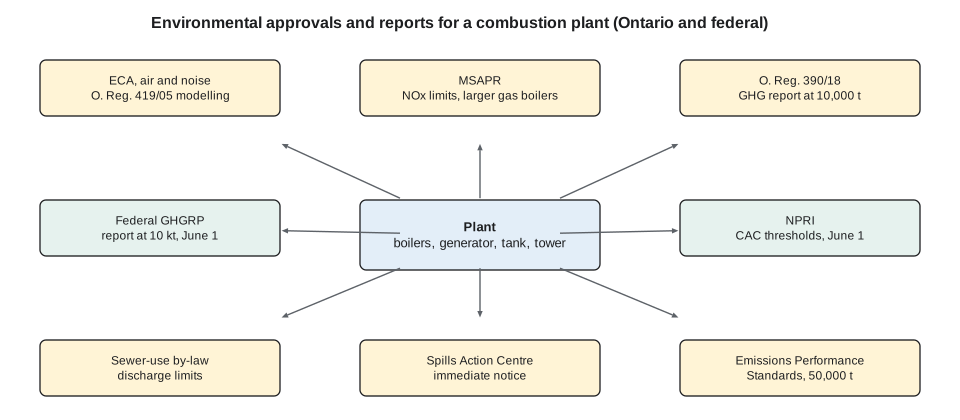
In Ontario, section 9 of the Environmental Protection Act requires an approval for any equipment that may discharge a contaminant to air, and most plants hold an Environmental Compliance Approval (ECA) for air and noise from the Ministry of the Environment, Conservation and Parks. Smaller, standard activities, including some heating boilers and standby generators, may instead be registered on the Environmental Activity and Sector Registry (EASR) under a regulation that sets standard rules. An ECA typically describes the equipment, sets limits or performance requirements, requires an emission summary and dispersion modelling report showing compliance with Ontario's air standards at the property line under O. Reg. 419/05, and sets conditions for operation, maintenance, monitoring, complaint handling, record keeping and reporting.
Emission standards for boilers
Two kinds of limits apply to boilers. Equipment standards set emission rates for the units themselves: the federal Multi-Sector Air Pollutants Regulations set NOx limits in grams per gigajoule for gas-fired boilers and heaters of 10.5 GJ/h or more in listed industries (PWR-330), with stricter limits for new and modernized units, and Ontario applies its own guideline limits for new boilers through the ECA. Ambient standards set concentration limits at the point of impingement or the property line: O. Reg. 419/05 requires the plant to show by modelling that its combined emissions meet the standards for NO₂ and other contaminants, and to update its emission summary when equipment changes.
Cantwell's three steam boilers each have a heat input of about 35 GJ/h (33.6 million Btu/h) at full fire. Its two hot water boilers are smaller. Its standby diesel generator is an emergency engine with limits on non-emergency running hours, and its fuel oil tank is a minor source of volatile organic compounds.
Estimating annual emissions
Most small and medium plants do not measure emissions continuously. They estimate them from fuel use and emission factors, which are average emission rates per unit of fuel or heat input, taken from a recent stack test on the plant's own units where one exists, from the manufacturer's data, or from published factors such as the US EPA's AP-42 compilation. Larger units, and units with emission limits that require it, use continuous emission monitoring systems (CEMS) for NOx, CO, O₂ and sometimes flow, with daily calibration checks and periodic audits (PWR-330).
Worked problem
Cantwell's NOx and CO₂ for 2025
In 2025 Cantwell burned about 9.8 million m³ of natural gas with a higher heating value of 37.3 MJ/m³. Its 2024 stack tests gave an average of about 40 g of NOx per GJ of heat input. The CO₂ factor for this gas is about 1.89 kg/m³. Estimate the year's NOx and CO₂.
Show solution
- \[Q = 9.8 \times 10^6 \times 37.3 = 365.5 \times 10^6 \text{ MJ} = 365{,}540 \text{ GJ}\]
- \[\text{NO}_x = 365{,}540 \times 40 \text{ g} = 14.6 \text{ t}\]
- \[\text{CO}_2 = 9.8 \times 10^6 \times 1.89 \text{ kg} \approx 18{,}500 \text{ t}\]
Answer: Cantwell emitted about 14.6 t of NOx and 18,500 t of CO₂ in 2025, matching the figure in Lorne's annual summary (PWR-240). The NOx estimate is only as good as the factor: a boiler whose burner drifts out of tune, as boiler 2's rising stack temperature suggested this autumn (PWR-330), may be emitting at a different rate from the one tested.
Potential to emit
Approvals are written around what the equipment could emit, not only what it did last year. The potential to emit assumes every unit runs at full capacity all year unless an enforceable limit in the approval restricts it. It is used to decide which requirements apply and to model the worst case at the property line.
Worked problem
Cantwell's potential to emit NOx
Estimate the potential NOx from Cantwell's three steam boilers, each burning 940 m³/h of gas at full fire, for 8,760 hours a year at 40 g/GJ.
Show solution
- \[Q_{max} = 3 \times 940 \times 37.3 \times 8{,}760 \text{ MJ} \approx 921{,}000 \text{ GJ}\]
- \[\text{NO}_x = 921{,}000 \times 40 \text{ g} \approx 36.9 \text{ t per year}\]
Answer: The potential is about 36.9 t a year, two and a half times the actual. It is the potential, with the hot water boilers and the generator added, that the ECA's emission summary and modelling were based on. If the plant ever adds a boiler, the summary must be updated and the modelling rerun before the approval is amended.
Pollutant inventories
The federal National Pollutant Release Inventory (NPRI) collects data on releases, disposals and transfers of listed substances. Most substances are reportable only by facilities whose employees and contractors work 20,000 hours a year or more, but facilities with stationary combustion equipment must report the criteria air contaminants whenever their releases reach the thresholds, regardless of hours. The air release thresholds are 20 tonnes each for NOx, CO, SO₂ and total particulate matter, 10 tonnes for VOCs, 0.5 tonnes for PM₁₀ and 0.3 tonnes for PM₂.₅. Reports are due by June 1 for the previous year, and the data are published.
Cantwell's 2025 NOx of 14.6 t is below the 20 t threshold, but the plant checks every criteria contaminant each year, because the particulate thresholds are far lower. Its consultant runs the check from the same fuel data and factors, and the result is filed with the year's records whether or not a report is required.
Greenhouse gas reporting
Two greenhouse gas programs apply in Ontario. The provincial Greenhouse Gas Emissions: Quantification, Reporting and Verification regulation (O. Reg. 390/18) requires facilities emitting 10,000 tonnes CO₂e or more a year to report by June 1 for the previous year, with third-party verification for facilities covered by the provincial Emissions Performance Standards program (registration is mandatory at 50,000 tonnes, PWR-330). The federal Greenhouse Gas Reporting Program (GHGRP) requires facilities emitting 10 kilotonnes CO₂e or more to report, also by June 1. Both reports are filed through the federal Single Window system, which shares the data with Ontario.
Worked problem
Which programs apply?
Using the 2025 figures, which greenhouse gas programs require Cantwell to report?
Show solution
- Cantwell emitted about 18,500 t CO₂ (plus small amounts of methane and nitrous oxide).
- Ontario threshold 10,000 t: 18,500 ≥ 10,000, so it reports under O. Reg. 390/18.
- Federal threshold 10 kt = 10,000 t: it also reports to the federal GHGRP.
Answer: Cantwell reports to both programs through the Single Window. It is below the 50,000 t mandatory threshold of the Emissions Performance Standards program, so its report does not need verification unless it opts in. Keswold, with emissions several times higher, reports to both and is a registered EPS facility with a verified report.
Spills and unplanned releases
Ontario's Environmental Protection Act requires anyone who spills a pollutant that causes or is likely to cause an adverse effect to notify the ministry's Spills Action Centre immediately, as well as the municipality and the owner of the pollutant, and to do everything practicable to prevent, eliminate and ameliorate the adverse effect. Spills to a sewer must also be reported to the municipality under its by-law. Federal rules add duties for some substances, such as releases above specified quantities of substances covered by the Environmental Emergency Regulations (PWR-340). A contained weep inside a bund, like the generator filter on November 1, is not a spill to the natural environment, but the plant records it and fixes the cause.
Records, reports and inspections
Every approval requires records, and most environmental enforcement begins with records that are missing or inconsistent. A plant should be able to produce, quickly: the current approval and its amendments; fuel use by unit and month; operating hours of limited units such as the emergency generator; stack test and CEMS reports; maintenance and tune-up records required by the approval or the federal rules; complaint logs; spill records; and copies of every report submitted, with its date and signature. Many plants keep a compliance calendar listing each obligation, its due date and its owner, so that nothing depends on one person's memory.
When an environmental officer visits, the shift engineer is often the first person they meet. The plant should have a short procedure: greet the officer, check identification, call the chief engineer or the person responsible for environmental compliance, accompany the officer, answer factual questions accurately, provide requested documents and keep a list of what was given, take duplicate samples or photographs if the officer takes them, and never guess. Officers in both countries have broad powers of entry and inspection, and obstructing them, or giving them false information, is an offence in its own right.
"The environmental side is where small plants get caught out," Grazyna said. "Not because they pollute, but because nobody updated the emission summary when we replaced the FD fan motor, or nobody logged the generator's test hours. Your monthly summary is our proof that we did what the approval says."
Stack testing
Emission factors from a plant's own units come from stack tests, in which a qualified testing company measures the concentration of each pollutant and the gas flow in the stack while the unit runs at specified loads, using reference methods published by the environmental agency. The approval or permit may require a test at startup and periodically after, and the plant usually wants its own tests after major burner work so that its emission estimates stay honest. Before a test, the plant agrees a test plan with the agency, notifies it of the date so that an observer can attend, and makes sure the unit is in its normal condition: a boiler tuned specially for the test produces a number that does not represent the year.
A stack test measures concentration, usually in parts per million by volume corrected to a reference oxygen level such as 3 in 100 for gas-fired boilers, and the testing company converts it to a mass rate using the measured flow. The correction to a reference oxygen level matters, because diluting the flue gas with extra air lowers the measured concentration without lowering the mass emitted. A concentration limit is therefore always stated with its reference oxygen level.
Emergency generators and minor sources
Standby diesel generators are usually limited by the approval or registration to emergency use and a set number of hours a year for testing and maintenance. The plant must log every run with its date, duration and reason, because those hours are the basis of compliance. Cantwell's monthly generator test, about 140 kW for an hour (PWR-230), uses only a small part of the allowance, but an extended outage like September 20 is also recorded, and the year's total is checked against the limit in the annual summary.
Minor sources still need attention. The fuel oil tank's vents, the cooling tower's drift, the chemical storage area and the ash or waste skip are all sources the approval may name, and odour and noise complaints from neighbours are a common reason for an environmental officer's visit. A plant's complaint log, with the date, the nature of the complaint, what was found and what was done, is often the first thing an officer asks for.
Records of complaints, stack tests and generator hours are kept for the period the approval or permit requires, commonly several years, and they must be retrievable: a record that exists only on a retired employee's computer does not exist as far as an inspector is concerned.
Common mistakes
MistakeUsing last year's actual emissions to decide which rules apply.
InsteadUse the potential to emit, limited only by enforceable conditions.
MistakeRelying on an old emission factor after a burner change.
InsteadRetest or update the factor when equipment or tuning changes.
MistakeAssuming an emissions program's rules are the same as last year.
InsteadCheck thresholds, deadlines and proposals every year.
MistakeTreating a small contained leak as not worth recording.
InsteadRecord every release, contained or not, and fix the cause.
MistakeLeaving reporting deadlines to one person's memory.
InsteadKeep a compliance calendar with owners and due dates.
MistakeGuessing in answer to an environmental officer's question.
InsteadAnswer factually, get the responsible person, and record what was provided.
Summary and key terms
- Ontario plants need an ECA for air and noise (or EASR registration) with O. Reg. 419/05 modelling; boilers may be covered by the MSAPR.
- Annual emissions are estimated from fuel use and emission factors or measured by CEMS; potential to emit assumes full capacity unless enforceably limited.
- NPRI requires criteria air contaminant reports from combustion facilities above thresholds such as 20 t NOx, by June 1.
- GHG reporting applies at 10,000 t CO₂e provincially (O. Reg. 390/18) and 10 kt federally, through the Single Window.
- Spills are reported immediately to the Spills Action Centre.
- Records and a compliance calendar are the plant's proof of compliance; inspections need a prepared, factual response.
- Environmental Compliance Approval
- An Ontario approval for equipment that discharges to air, water or land, with conditions.
- O. Reg. 419/05
- Ontario's air pollution regulation setting local air quality standards and modelling requirements.
- Emission factor
- An average emission rate per unit of fuel or heat input.
- Potential to emit
- The maximum emissions a source could produce at full capacity, limited only by enforceable conditions.
- Continuous emission monitoring system
- Analyzers that measure stack emissions continuously.
- NPRI
- The National Pollutant Release Inventory, the federal inventory of pollutant releases.
- Spills Action Centre
- The Ontario ministry's 24-hour line for reporting spills.
- Compliance calendar
- A schedule of every environmental obligation, its due date and its owner.
Practice problems
Work each problem on paper first, then reveal the answer to check.
A plant burns 200,000 GJ a year at 35 g NOx per GJ. Annual NOx?
Show answer
7.0 t.
Does a facility emitting 12,000 t CO₂e report to the federal GHGRP?
Show answer
Yes; the threshold is 10 kt.
A boiler of 20 GJ/h runs 8,760 h at 40 g/GJ. Potential NOx?
Show answer
About 7.0 t per year.
To whom is a spill with an adverse effect reported in Ontario?
Show answer
The Spills Action Centre (and the municipality and pollutant owner).
Lesson quiz · 5 questions
Score 60% or more to complete this lesson.
Create a free account to save your progress, take quizzes and earn a certificate.