
PWR-420 · Lesson 7 of 12 · 22 min
Budgets, contracts and plant economics
▶ Video coming soon A video version of this lesson is on the way.
In early autumn Grazyna begins Cantwell's budget for the following year, and in 2026 she asked Pilar to help. Pilar had expected a spreadsheet of costs. What she found was a set of arguments: why the fuel line should assume a colder winter than the last, why the maintenance line had to carry the boiler 3 tube replacement and the CBD line section, why a water treatment contract should be retendered, and why the CHP study (PWR-330) deserved a line at all. "A budget is a plan written in money," Grazyna said. "The engineer who can't argue it ends up running the plant somebody else planned."
This lesson explains the operating and capital budgets of a power plant, the cost of producing steam and how it is built up, and variance analysis that separates the effects of weather, efficiency and price. It then covers the main types of contracts a plant uses, from purchase orders and service agreements to lump sum, unit price and time and materials work, and the long-term service agreements of large machines, with the basics of tendering, evaluating bids and managing contractors. Investment appraisal of projects is treated in PWR-410; here the focus is on running the plant within a budget.
Operating and capital budgets
An operating budget covers the recurring costs of running the plant for a year: fuel, purchased electricity, water and sewer charges, chemicals, wages and benefits, maintenance materials and contractors, insurance, permits and fees, training, and overheads. A capital budget covers spending on assets that will last several years, such as a new boiler, an economizer, a control system upgrade or a major overhaul that extends equipment life. The distinction matters because capital spending is usually approved separately, often by the owner's board, and is depreciated over the asset's life rather than charged to one year.
In a district energy plant like Cantwell, the budget also drives the rates charged to customers. Many systems set a fixed capacity charge that recovers the plant's fixed costs, such as debt, staffing and maintenance, and a variable energy charge per unit of steam or hot water that recovers fuel and other variable costs, often with a fuel adjustment that passes changes in gas price through to customers. A badly estimated budget becomes either a rate increase nobody expected or a loss.
The largest single line in almost any thermal plant's budget is fuel. At Cantwell it is more than half of the operating budget, which is why the fuel estimate gets the most attention and why efficiency improvements pay so well.
The cost of steam
The cost of steam per tonne or per thousand pounds is the plant's most useful single economic number. The fuel part follows directly from the heat added to the water, the boiler efficiency and the fuel price:
Worked problem
The fuel cost of Cantwell steam
Cantwell's boilers add 2,342 kJ/kg to the feedwater (PWR-210), and the steam boilers average an efficiency of about 0.82. At a sample gas price of 5.50 dollars per GJ, what is the fuel cost of one tonne of steam?
Show solution
- \[\text{Fuel energy} = \frac{2{,}342 \text{ MJ/t}}{0.82} = 2{,}856 \text{ MJ/t} = 2.856 \text{ GJ/t}\]
- \[\text{Fuel cost} = 2.856 \times 5.50 \approx 15.71 \text{ dollars per tonne}\]
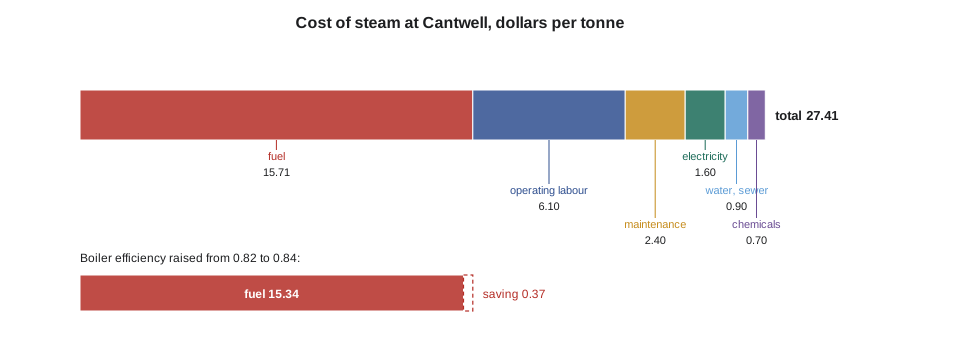
Answer: The fuel cost is about 15.70 dollars per tonne of steam. Each point of boiler efficiency changes it by about 1.2 in 100, roughly 0.19 dollars per tonne, which over a year's steam production is a large sum. That is why the boiler 2 stack temperature trend this autumn mattered as money as well as engineering.
The full cost of steam adds the other costs, divided by the year's steam production: electricity for fans and pumps, water and sewer, chemicals, labour, maintenance, and a share of fixed costs. Grazyna's 2026 cost build-up, using sample prices, looked like this:
| Cost element | Dollars per tonne | Share of total |
|---|---|---|
| Fuel | 15.71 | 57 in 100 |
| Electricity | 1.60 | 6 in 100 |
| Water and sewer | 0.90 | 3 in 100 |
| Chemicals | 0.70 | 3 in 100 |
| Operating labour | 6.10 | 22 in 100 |
| Maintenance | 2.40 | 9 in 100 |
| Total | 27.41 | 100 in 100 |
Variance analysis
Each month the plant compares actual costs with the budget. A variance is the difference; it is favourable if actual cost is lower than budget and unfavourable if higher. A raw variance says little on its own. For fuel, the useful step is to split it into a volume variance, caused by burning more or less fuel than budgeted, and a price variance, caused by paying a different price, and then to split the volume variance again into the part explained by weather (heating degree days) and the part left over, which reflects the plant's efficiency.
Worked problem
October's fuel variance
Cantwell budgeted 30,000 GJ of gas for October at 5.50 dollars per GJ, based on 300 heating degree days. It actually burned 33,600 GJ at an average of 5.20 dollars per GJ, and October had 345 degree days. Find the total, volume and price variances, then split the volume variance into weather and efficiency parts, assuming fuel use is proportional to degree days.
Show solution
- \[\text{Budget} = 30{,}000 \times 5.50 = 165{,}000, \quad \text{Actual} = 33{,}600 \times 5.20 = 174{,}720\]
- \[\text{Volume} = 3{,}600 \times 5.50 = 19{,}800 \text{ U}, \quad \text{Price} = -0.30 \times 33{,}600 = -10{,}080 \text{ F}\]
- \[\text{Weather-adjusted budget} = 30{,}000 \times \frac{345}{300} = 34{,}500 \text{ GJ}\]
- \[\text{Weather} = 4{,}500 \times 5.50 = 24{,}750 \text{ U}, \quad \text{Efficiency} = (33{,}600 - 34{,}500) \times 5.50 = -4{,}950 \text{ F}\]
Answer: October cost 9,720 dollars more than budget. Colder weather alone would have added about 24,750 dollars, but the plant burned 900 GJ less than the weather would predict, worth about 4,950 dollars, and the lower gas price saved about 10,080 dollars. The story for the operations meeting is not "we overspent" but "it was a cold October, we ran efficiently, and the gas contract helped."
The weather model is an approximation: some load, such as domestic hot water and process steam for customers, does not depend on weather, and a better model has a fixed base load plus a weather-dependent part. But even the simple split turns a number into an explanation, and explanation is what an owner wants from a plant manager.
Fuel and energy purchasing
Most Ontario plants of Cantwell's size buy gas from a marketer or directly at market prices and pay the local distributor for delivery, under a contract that may fix part of the price for a year or more, index it to a market hub, or combine both. Electricity is bought from the grid with a commodity charge and a global adjustment component that depends on the plant's share of system peak demand; larger customers can reduce it by cutting load during the few peak hours of the year. A Second Class engineer may not negotiate the contracts, but must understand them well enough to know what operating decisions cost.
Contracts
Plants buy goods and services under several kinds of contract, each sharing risk differently between the owner and the contractor:
- Purchase orders for materials and equipment, with specifications, delivery dates, warranty and acceptance terms.
- Lump sum (fixed price) contracts for well-defined work: the contractor carries the risk of cost overruns, so the scope must be clear and complete, and changes are priced as extras.
- Unit price contracts pay a fixed rate per unit of work, such as per steam trap replaced, per metre of insulation or per tube plugged, which suits work whose quantity is uncertain.
- Time and materials (T&M) contracts pay for hours and materials at agreed rates: flexible for emergencies and work whose scope cannot be defined, but the owner carries the cost risk and must supervise closely.
- Service agreements cover recurring work such as water treatment, burner service, DCS support, elevator and fire system inspection, often with fixed fees and response time commitments.
- Long-term service agreements (LTSA) for large gas turbines and other major machines, under which the manufacturer provides parts, inspections and overhauls for many years, often priced per operating hour or per equivalent start, with guarantees of availability or performance.
Keswold's gas turbine is covered by an LTSA with its manufacturer, which is why the October borescope and offline wash (PWR-320) were done by the manufacturer's field engineer. The agreement shapes how the plant is operated: each start, trip and hour at high load uses up part of the interval to the next inspection, and the plant's dispatch decisions take that cost into account.
Cantwell's contracts include burner service with Calderwood Combustion Services, water treatment with Beaumont Water Services, DCS support with Sallow Creek Controls, and insurance and inspection with Ottoline Brackwater's company. The boiler 2 CBD line replacement planned for 2027 will be a lump sum contract with a qualified welding contractor (PWR-340), because the scope can be defined exactly.
Tendering and contractor management
For significant work, the plant prepares a request for quotation or tender that states the scope, specifications, schedule, site conditions, safety requirements, insurance and qualification requirements, and the form of the bid. Bids are evaluated on more than price: the contractor's safety record, qualifications (such as a registered welding procedure or an R certificate), experience, schedule, exclusions and the terms they propose. The cheapest bid with a long list of exclusions is often the most expensive job.
Once a contract is let, the plant remains responsible for safety on its site. Contractors must be oriented to the plant's hazards and procedures, work under the plant's permit and lockout systems, and be supervised. Their work is inspected and accepted against the specification before it is paid for, and changes in scope are agreed in writing before the work is done. A contractor's poor performance is recorded and considered at the next tender.
Controlling costs without cutting safety
When budgets are tight, the easiest cuts are often the most dangerous: deferring maintenance, skipping training, reducing staffing, stretching inspection intervals. These savings appear in this year's budget, while their costs arrive later, as breakdowns, incidents and premature replacement. A Second Class engineer should be able to show an owner the cost of a deferral: what failure mode it allows, how likely, and what it would cost. That is the language of the risk matrix and the reliability measures in lesson 6, translated into money.
Good cost control looks instead for waste: steam leaks and failed traps, unreturned condensate, poor combustion, excessive blowdown, compressed air leaks, idle equipment left running, and contracts that no longer match the work. The September air leak survey found about 41,000 kWh a year of leaks (PWR-230), and the October trap survey found three traps blowing through (PWR-230); each finding is a small budget line recovered.
"You don't have to love accounting," Grazyna said. "But if you can show the owner that a 20,000 dollar inspection prevents a 200,000 dollar failure, you will get the inspection. If you can't, you won't."
Reading the monthly cost report
Most owners receive a monthly report comparing actual costs with budget for each line, for the month and for the year to date. A plant engineer reading it should look first at the large lines, fuel and labour, then at any line with a large variance in either direction, and should always ask whether a favourable variance is real: a maintenance line under budget may mean jobs deferred, not money saved. The report is most useful when each significant variance carries one sentence of explanation, written by the person who understands it, as in the October fuel example above.
Year-to-date figures can mislead early in the year and in seasonal plants. A district heating plant spends most of its fuel budget between November and March, so a fuel line that is under budget in September says little about December. Budgets for seasonal plants are therefore phased by month, using the same degree-day profile as the weather model, rather than divided into twelve equal parts.
Insurance and risk
Insurance is a significant operating cost and a source of technical advice. A plant usually carries property insurance against fire and other damage, boiler and machinery cover against breakdown and explosion, business interruption cover for the revenue lost while equipment is repaired, and liability insurance. Premiums depend on the insurer's view of the plant's risk, which its engineers form from inspections, loss history and the quality of the plant's maintenance and emergency programs. A plant that can show a good inspection record, tested protective devices and closed audit findings negotiates better terms, which is one more way in which the work of lessons 2, 6 and 11 shows up in the budget.
Common mistakes
MistakeTreating a total fuel variance as a measure of plant performance.
InsteadSeparate weather, efficiency and price before judging performance.
MistakeChoosing the lowest bid without examining exclusions and qualifications.
InsteadEvaluate safety, qualifications, scope, exclusions and terms as well as price.
MistakeUsing time and materials for well-defined work.
InsteadUse lump sum for defined scopes; reserve T&M for uncertain or emergency work.
MistakeLetting contractors work outside the plant's permit and lockout systems.
InsteadOrient, permit and supervise every contractor.
MistakeCutting maintenance and training to meet a budget.
InsteadShow the cost of each deferral in failure risk and future cost.
MistakeIgnoring the fixed part of load in a weather model.
InsteadModel a base load plus a weather-dependent part.
Summary and key terms
- Operating budgets cover recurring costs, dominated by fuel; capital budgets cover long-lived assets and are approved and depreciated separately.
- District energy rates usually combine a capacity charge for fixed costs and an energy charge for variable costs.
- The fuel cost of steam is the heat added divided by boiler efficiency, times the fuel price; the full cost adds power, water, chemicals, labour and maintenance.
- Variance analysis splits fuel variances into price and volume, and volume into weather and efficiency.
- Contracts include purchase orders, lump sum, unit price, time and materials, service agreements and LTSAs, each allocating risk differently.
- Tenders are evaluated on safety, qualifications and scope as well as price; contractors work under the plant's safety systems.
- Operating budget
- The plan for a year's recurring costs of running the plant.
- Capital budget
- The plan for spending on long-lived assets.
- Cost of steam
- The total cost of producing a unit mass of steam.
- Variance
- The difference between actual and budgeted cost.
- Heating degree day
- A measure of how cold a day is, used to weather-adjust fuel use.
- Lump sum contract
- A contract for a defined scope at a fixed price.
- Time and materials contract
- A contract paying for hours and materials at agreed rates.
- Long-term service agreement
- A multi-year agreement with a manufacturer for parts, inspections and overhauls of a major machine.
Practice problems
Work each problem on paper first, then reveal the answer to check.
Heat added 2,500 kJ/kg, efficiency 0.80, gas 6.00 dollars/GJ. Fuel cost per tonne?
Show answer
18.75 dollars.
Budget 20,000 GJ at 5.00, actual 21,000 GJ at 5.20. Volume and price variances?
Show answer
5,000 U volume; 4,200 U price.
Which contract type suits replacing an unknown number of failed traps?
Show answer
Unit price.
If degree days are 10 in 100 above budget, what fuel use is expected for a 20,000 GJ budget?
Show answer
22,000 GJ.
Lesson quiz · 5 questions
Score 60% or more to complete this lesson.
Create a free account to save your progress, take quizzes and earn a certificate.