
PWR-420 · Lesson 4 of 12 · 25 min
Plant water and wastewater systems
▶ Video coming soon A video version of this lesson is on the way.
Water treatment for boilers had filled much of Pilar's Third Class study (PWR-220, PWR-330). At Second Class level, Grazyna said, the question widens: where does all the plant's water come from, where does it go, what does it cost, and what is the plant allowed to put down the drain or into the river? "A boiler plant is a water plant that happens to make steam," she said. "Most of the water we buy, we throw away again, and both ends of that are regulated."
This lesson surveys a plant's water systems as a whole: raw water supply and pretreatment, cooling water systems and their control, the mass balance of an evaporative cooling tower, closed loops, and the plant's wastewater streams and how they are treated and discharged. It ends with the permits and limits that govern discharge to a municipal sewer or a watercourse in each country, and with the Legionella control programs that cooling towers now require.
Water in and water out
A plant's water balance accounts for every flow in and out: city or well water bought, surface water drawn, condensate returned from customers, and the outflows of steam to customers that do not return, cooling tower evaporation and drift, blowdown from boilers and towers, regeneration and reject streams from treatment, and losses to leaks, sampling and washdown. A water balance built from meter readings and calculation, and updated each year, finds leaks and waste, supports permit applications and tells the operators what normal looks like.
At Cantwell, city water feeds the softeners and makeup system, the cooling tower and the domestic supply. Condensate returns from most customer buildings, but some steam is lost in buildings that use it directly, in humidifiers and in clean steam generators (PWR-330), and leaks in customer systems are a constant concern. Outflows go to the city sewer: boiler blowdown through the tempering tank, cooling tower blowdown, softener regeneration brine, floor drains and sample drains.
Raw water and pretreatment
Raw water from a river or lake usually needs clarification: coagulation with a metal salt or polymer, flocculation, settling and filtration, to remove suspended solids and colour before softening or demineralization. Well water may be clear but high in hardness, iron, manganese or silica. City water, as at Cantwell and Keswold, has already been treated for drinking, and the plant's concerns are hardness, alkalinity, silica, chlorine or chloramine (which damage reverse osmosis membranes and ion exchange resins and are removed by activated carbon or bisulphite), and seasonal changes in quality. Keswold's chain of carbon filters, antiscalant, cartridge filters, RO and mixed beds (PWR-330) is typical of a high-pressure plant on city water.
Cooling water systems
Cooling water removes heat from condensers, lube oil coolers, air compressors, chillers and process equipment. The three basic arrangements are:
- Once-through systems draw water from a river, lake or sea, pass it through the heat exchangers and return it warmer. They need very large flows, about a hundred times the flow of an evaporative system for the same duty, and are now restricted by rules on fish impingement and entrainment and on thermal discharge.
- Open recirculating systems pass the water through a cooling tower, where a small part evaporates and cools the rest, and recirculate it. They use far less water but concentrate the dissolved solids, which must be controlled by blowdown and chemical treatment.
- Closed loops circulate treated water or glycol through the equipment and reject heat to a cooling tower, a dry cooler or another loop through a heat exchanger. They have almost no losses, so the water can be heavily inhibited against corrosion.
Keswold's condenser and auxiliary coolers use an open recirculating system with a large mechanical draft tower; Cantwell's small tower on the pump gallery roof serves the chiller condenser and a few coolers (PWR-230), and its district hot water and glycol systems are closed loops.
The cooling tower mass balance
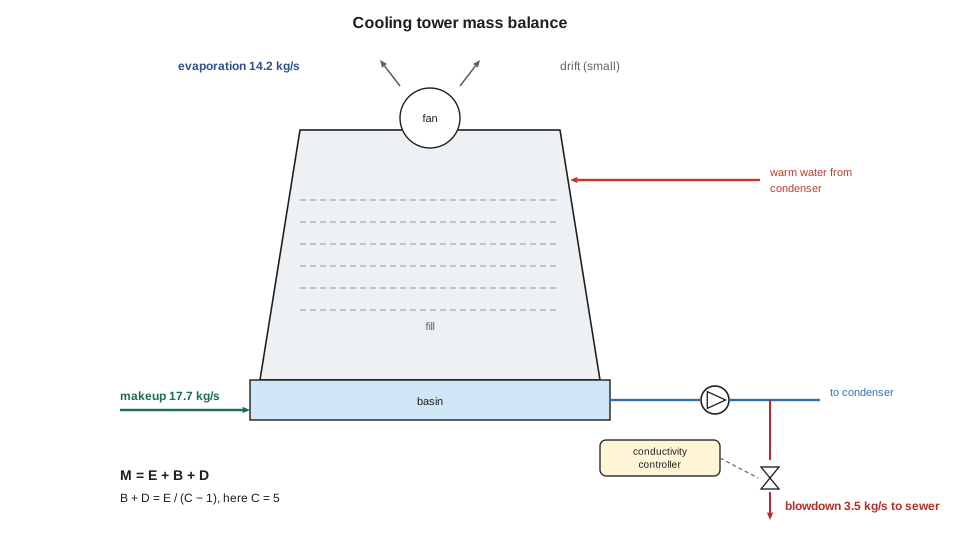
In a cooling tower, water lost by evaporation (E) leaves its dissolved solids behind. Drift (D), fine droplets carried out by the air, carries solids with it but is small in modern towers with drift eliminators. Blowdown (B) is the water deliberately drained to limit the concentration of solids. Makeup (M) replaces all three. The ratio of the concentration in the circulating water to that in the makeup is the cycles of concentration (C).
Evaporation is set by the heat load: almost all the heat leaves as latent heat of the evaporated water, roughly 2,420 kJ/kg (1,050 Btu/lb) at tower temperatures. A common rule of thumb is that about 1 in 100 of the circulating flow evaporates for every 5.6 K (10 °F) of range.
Worked problem
Keswold's tower
Keswold's condenser circulating water flow is about 821 kg/s, heated from 30 °C to 40 °C. The tower runs at 5 cycles of concentration, and drift is negligible. Estimate the evaporation, blowdown and makeup.
Show solution
- \[Q = 821 \times 4.18 \times 10 \approx 34{,}300 \text{ kW}\]
- \[E = \frac{34{,}300}{2{,}420} \approx 14.2 \text{ kg/s}\]
- \[B = \frac{14.2}{5 - 1} \approx 3.5 \text{ kg/s}, \qquad M = 14.2 + 3.5 \approx 17.7 \text{ kg/s}\]
Answer: The tower evaporates about 14 kg/s and needs about 17.7 kg/s of makeup, roughly 1,530 m³ a day at full load, which is the biggest single water purchase at Keswold. The 500 in the US formula is the usual shortcut for water: 8.34 lb/gal × 60 min/h × 1 Btu/lb·°F.
Raising the cycles saves water, with diminishing returns: going from 3 to 5 cycles cuts blowdown by half, but going from 5 to 10 saves much less. The limit is set by the scale and corrosion tendency of the concentrated water, mainly calcium carbonate, calcium sulphate and silica, and by the chemistry of the treatment program. Most towers run between about 3 and 8 cycles on city water, with blowdown controlled automatically by a conductivity controller.
Worked problem
Cantwell's small tower
Cantwell's tower rejects about 352 kW at full load and runs at 4 cycles. Estimate the evaporation, blowdown and makeup in litres per hour and the makeup per day at full load.
Show solution
- \[E = \frac{352}{2{,}420} = 0.1455 \text{ kg/s} \approx 524 \text{ L/h}\]
- \[B = \frac{524}{3} \approx 175 \text{ L/h}, \qquad M \approx 698 \text{ L/h} \approx 16.8 \text{ m}^3/\text{day}\]
Answer: These are full-load figures. The tower runs well below full load most of the year, so the annual makeup is a fraction of the full-load rate multiplied by the hours. Pilar checks the tower's makeup and blowdown meters on her weekly round, and the ratio of makeup to blowdown is a quick independent check on the conductivity controller: it should equal the cycles.
Cooling water treatment
Open recirculating cooling water is treated against four problems. Scale is controlled by limiting the cycles, sometimes by feeding acid to lower alkalinity, and by scale inhibitors such as phosphonates and polymers that keep calcium salts in solution beyond their normal solubility. Corrosion is controlled by inhibitors suited to the metals in the system: phosphate and zinc blends, azoles for copper alloys, and molybdate in some programs. Fouling by silt and debris is controlled by dispersants and side-stream filtration. Biological growth, slime, algae and bacteria including Legionella, is controlled by oxidizing biocides such as chlorine or bromine, often supplemented by a non-oxidizing biocide fed periodically.
Monitoring includes conductivity, pH, inhibitor residuals, oxidant residual, corrosion coupons or corrosion rate probes, and microbiological counts. Keziah Ostby of Beaumont Water Services reviews Cantwell's tower data monthly; on Pilar's October 24 check the tower was at 1,580 µS/cm, pH 8.4 and 0.7 mg/L free chlorine, all within the program limits (PWR-230).
Legionella control
Cooling towers are a known source of Legionnaires' disease outbreaks, because they can grow Legionella bacteria and spread them in drift over a wide area. Control rests on good design (efficient drift eliminators, no stagnant legs), continuous biocide treatment, regular cleaning and disinfection, monitoring, and a written water management program that assigns responsibility and sets out what to do when results go out of limits.
Ontario has no province-wide cooling tower registry, but several municipalities do; Cantwell's tower is registered with Hamilton Public Health Services under the city's program, and the plant keeps a risk management plan with sampling results available to inspectors (PWR-230). Keswold's large tower is registered under the same program. Nationally, the Public Health Agency of Canada and provincial guidance documents describe Legionella control in cooling towers, and ASHRAE Standard 188 is often used as the framework for the program.
Wastewater streams
A power or process plant produces several kinds of wastewater, each with its own characteristics:
- Boiler blowdown is hot, alkaline and contains treatment chemicals. It is cooled before discharge, often by mixing with cold water, because sewer rules limit discharge temperature.
- Cooling tower blowdown contains concentrated dissolved solids and the treatment chemicals and biocide residuals, which may need dechlorination before discharge to a watercourse.
- Regeneration wastes from softeners (brine) and demineralizers (acid and caustic) are neutralized before discharge; RO reject is concentrated raw water.
- Oily water from floor drains, transformer and tank areas and equipment washing passes through an oil-water separator before discharge.
- Stormwater from yards, roofs and fuel unloading areas may carry oil and solids and is often regulated separately.
- Sanitary wastewater from washrooms goes to the sanitary sewer or a septic system.
Worked problem
Tempering the blowdown
Cantwell's boiler blowdown tank discharges at about 100 °C, and the city's sewer-use rules limit the discharge temperature; the plant's own limit is 60 °C (PWR-240). City water is available at about 10 °C. How much cold water is needed per kilogram of blowdown, and how much for a boiler blowing down 3 in 100 of 11,300 kg/h?
Show solution
- A heat balance on the mixture, with equal specific heats:
- \[\frac{m_{cold}}{m_{bd}} = \frac{100 - 60}{60 - 10} = 0.8\]
- \[m_{bd} = 0.03 \times 11{,}300 = 339 \text{ kg/h}, \qquad m_{cold} = 0.8 \times 339 \approx 271 \text{ kg/h}\]
Answer: Each boiler's continuous blowdown needs about 270 kg/h of tempering water, unless its heat has already been recovered. At Cantwell most continuous blowdown passes through the flash tank and the makeup heat exchanger first (PWR-220), so the water reaching the tempering tank is already much cooler and needs far less dilution, which is one more benefit of heat recovery.
Discharge permits and limits
In Ontario, a plant that discharges to a municipal sanitary or combined sewer must meet the municipality's sewer-use by-law, which sets limits for temperature, pH, oil and grease, suspended solids, metals and other parameters, prohibits some substances outright, and may require a monitoring program or an agreement for overstrength discharges. A plant that discharges industrial wastewater to a watercourse, or operates its own treatment works, needs an Environmental Compliance Approval (ECA) for industrial sewage works from the Ministry of the Environment, Conservation and Parks, with effluent limits, monitoring and reporting conditions. Federal rules also apply in some cases, for example the Fisheries Act prohibition on depositing deleterious substances in water frequented by fish.
Cantwell discharges only to the city sewer, under the by-law. Keswold discharges its tower blowdown and treated plant wastewater to the sewer as well, under an agreement with the city that sets limits for temperature, total dissolved solids and phosphorus, while its stormwater from the transformer and fuel areas passes through an oil-water separator under its ECA. Grazyna's rule for both plants is the same: know every point where water leaves the site, and know what limit applies there.
Water as a cost
Water is bought twice: once as supply and again as sewer charges, which are often based on the metered supply unless the plant meters its discharge or claims credit for evaporation. Treating, heating and pumping it adds to the cost, and every litre of condensate that is not returned must be replaced with treated makeup heated from cold. Simple measures, such as higher cycles on the tower, recovering blowdown heat, fixing customer condensate leaks and claiming sewer credit for tower evaporation, often pay back faster than any other improvement in the plant.
Closed loops
Closed loops lose almost no water, so their makeup meter is their best leak detector. Cantwell's district hot water loop and its glycol systems each have a makeup meter read on the daily round, and a rise in makeup is treated as a leak until proved otherwise, because a leak in a customer building or a buried pipe can run for weeks before anyone sees water. After plate exchanger 2 was cleaned of scale in October, Keziah was asked to review the district loop's makeup (PWR-230): scale in a closed loop means hard makeup water has been getting in, which means the loop is losing water somewhere.
Closed loop water is treated with corrosion inhibitors, often nitrite or molybdate based programs with an azole for copper, and tested monthly for inhibitor level, pH, conductivity and iron or copper. Glycol loops are also tested for glycol concentration, usually with a refractometer, to confirm the freeze protection, and for the inhibitor that the glycol supplier packages with it, which is consumed over time. When a glycol system is topped up, as Cantwell's was in November (PWR-120), the top-up should be pre-mixed glycol of the same type and concentration, not water, or the freeze point rises with every top-up.
Common mistakes
MistakeAssuming makeup equals blowdown.
InsteadMakeup equals evaporation plus blowdown plus drift; most of it evaporates.
MistakeRaising cycles indefinitely to save water.
InsteadScale and corrosion limits set a maximum; returns diminish beyond about 5 to 8 cycles.
MistakeDischarging hot blowdown straight to the sewer.
InsteadRecover heat and temper it below the permitted temperature.
MistakeTreating Legionella control as a chemical feed problem only.
InsteadUse a written water management program with design, cleaning, monitoring and corrective actions.
MistakePaying sewer charges on water that evaporated.
InsteadMeter tower evaporation or discharge and claim the credit where the utility allows it.
MistakeNot knowing every discharge point.
InsteadList every point where water leaves the site and its applicable limits.
Summary and key terms
- A plant water balance accounts for supply, condensate return, evaporation, drift, blowdown, treatment wastes and losses.
- Cooling systems are once-through, open recirculating with a tower, or closed loops.
- Tower mass balance: M = E + B + D and B + D = E / (C − 1); evaporation is set by the heat load.
- Cooling water treatment controls scale, corrosion, fouling and biological growth; towers need a Legionella water management program.
- Wastewater streams include boiler and tower blowdown, regeneration wastes, oily water, stormwater and sanitary waste, each treated to suit.
- Discharges to sewer follow the municipal sewer-use by-law; discharges to water need an ECA and must respect the Fisheries Act.
- Cycles of concentration
- The ratio of dissolved solids in circulating water to those in the makeup.
- Blowdown
- Water drained deliberately to limit the concentration of dissolved solids.
- Drift
- Water droplets carried out of a cooling tower by the air.
- Makeup
- Water added to replace evaporation, drift and blowdown.
- Water management program
- A written program for controlling Legionella and other hazards in building and plant water systems.
- Oil-water separator
- A tank that separates floating oil from wastewater before discharge.
- Sewer-use by-law
- Municipal rules that limit what may be discharged to the sewer.
- Environmental Compliance Approval
- An Ontario approval for industrial sewage works, with effluent conditions.
Practice problems
Work each problem on paper first, then reveal the answer to check.
A tower evaporates 2.0 kg/s at 4 cycles. Blowdown and makeup?
Show answer
About 0.67 kg/s blowdown, 2.67 kg/s makeup.
Makeup is 600 L/h and blowdown 150 L/h. Cycles?
Show answer
4.
Blowdown at 90 °C is tempered to 50 °C with water at 10 °C. Cold water per kg?
Show answer
1.0 kg.
Name two ways a tower controls scale.
Show answer
Limiting cycles by blowdown, and scale inhibitors (or acid feed).
Lesson quiz · 5 questions
Score 60% or more to complete this lesson.
Create a free account to save your progress, take quizzes and earn a certificate.