
PWR-310 · Lesson 5 of 12 · 22 min
The Rankine cycle
▶ Video coming soon A video version of this lesson is on the way.
On Wednesday, September 2, 2026, the last week of his summer day relief, Okonkwo Demarest found a sheet of paper clipped to his study binder in the control room. Grazyna Wolanski had written out a problem from the pulp mill where she had worked before coming to Cantwell: a condensing turbine taking steam at 4,000 kPa and 400 °C and exhausting to a condenser at 10 kPa absolute. "Find the cycle efficiency, ideal and real," the note said. "Then tell me why Cantwell has never generated a kilowatt of its own power, and why that might change." Cantwell's 2027 capital list already carried a feasibility study of combined heat and power, and Grazyna wanted her relief operators to understand what it would weigh.
This lesson works the problem. It describes the Rankine cycle, the ideal cycle of every steam power plant, calculates its work, heat and efficiency from steam properties, shows how real turbines and pumps fall short of the ideal, and explains what raises the efficiency: higher pressure and temperature, lower condenser pressure, reheat and feedwater heating. It closes with the cycles that use the rejected heat instead of wasting it.
Why not the Carnot cycle?
Lesson 4 showed that the Carnot cycle, with all heat added at the highest temperature and all rejected at the lowest, sets the limit for any engine. A steam Carnot cycle is possible on paper: add heat to water at its saturation temperature until it is dry steam, expand it isentropically, condense it partly, then compress the wet mixture back to the boiler pressure. In practice the last step defeats it. Compressing a wet mixture of water and steam needs a large, awkward compressor, absorbs a lot of work and wears the machine with water droplets.
The Rankine cycle fixes the problem by condensing the steam completely. A small pump then raises the pressure of liquid water, which takes very little work because water's specific volume is so small. The cost is that the water entering the boiler is well below its saturation temperature, so part of the heat is added at lower temperatures, and the cycle's efficiency is lower than the Carnot efficiency between the same extremes. That trade has been worth it in every steam plant for well over a century.
The four processes
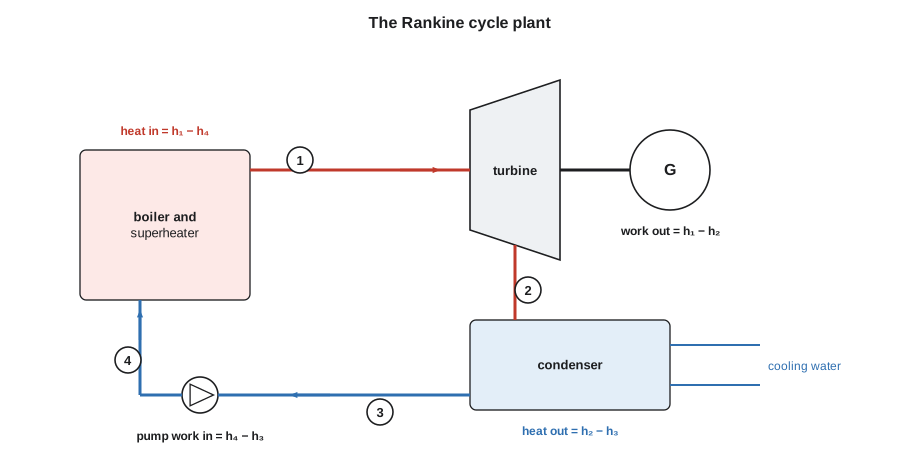
The ideal Rankine cycle has four components and four processes, numbered here as most textbooks do:
- 1 to 2, turbine: steam from the boiler expands isentropically to the condenser pressure, producing work w_t = h₁ − h₂.
- 2 to 3, condenser: the exhaust steam condenses completely at constant pressure, rejecting heat q_out = h₂ − h₃ to the cooling water. State 3 is saturated liquid.
- 3 to 4, pump: the condensate is pumped isentropically to boiler pressure, absorbing work w_p = h₄ − h₃.
- 4 to 1, boiler: the water is heated at constant pressure to saturation, evaporated and, usually, superheated, absorbing heat q_in = h₁ − h₄.
Each line comes straight from the steady flow energy equation of lesson 4. The net work is w_net = w_t − w_p, and the thermal efficiency is the net work divided by the heat supplied:
Because the pump handles liquid, its work is small and is found from the liquid's specific volume and the pressure rise, without the steam tables:
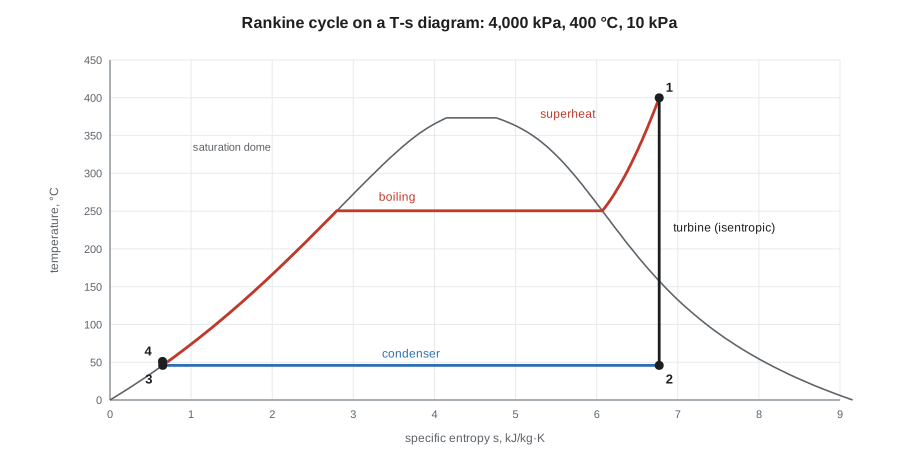
On a temperature-entropy diagram the cycle has a characteristic shape. The pump and turbine are vertical lines, because they are isentropic. Heating in the boiler follows the liquid line up to saturation, runs horizontally across the dome as the water evaporates at constant temperature, then climbs into the superheat region. Condensing is a horizontal line at the bottom. The area enclosed is the net work, and the area under the top line is the heat supplied.
Working the cycle
The steam tables, or the IAPWS-IF97 equations that modern tables and software are built from, give the properties needed. Lesson 6 covers how to read them; for now the values are given in the example.
Worked problem
Grazyna's condensing plant, ideal
Steam enters a turbine at 4,000 kPa and 400 °C and expands isentropically to 10 kPa absolute. Properties: at 4,000 kPa and 400 °C, h₁ = 3,214.4 kJ/kg and s₁ = 6.7712 kJ/kg·K. At 10 kPa, h_f = 191.8, h_fg = 2,392.1 kJ/kg, s_f = 0.6492, s_fg = 7.4997 kJ/kg·K and v_f = 0.001010 m³/kg. Find the turbine work, pump work, heat supplied, net work and thermal efficiency.
Show solution
- Exhaust dryness from s₂ = s₁:
- \[x_2 = \frac{6.7712 - 0.6492}{7.4997} = 0.8163\]
- Exhaust enthalpy:
- \[h_2 = 191.8 + 0.8163 \times 2{,}392.1 = 2{,}144.5 \text{ kJ/kg}\]
- Turbine work:
- \[w_t = 3{,}214.4 - 2{,}144.5 = 1{,}069.9 \text{ kJ/kg}\]
- Pump work, with pressures in kPa:
- \[w_p = 0.001010 \times (4{,}000 - 10) = 4.0 \text{ kJ/kg}\]
- Feedwater enthalpy and heat supplied:
- \[h_4 = 191.8 + 4.0 = 195.8, \quad q_{in} = 3{,}214.4 - 195.8 = 3{,}018.6 \text{ kJ/kg}\]
- Net work and efficiency:
- \[w_{net} = 1{,}069.9 - 4.0 = 1{,}065.9 \text{ kJ/kg}, \quad \eta = \frac{1{,}065.9}{3{,}018.6} = 0.353\]
Answer: The ideal cycle converts 35.3 in 100 of the heat into work. The pump takes less than half of one in 100 of the turbine's work, which is why it is often ignored in rough estimates. The exhaust is 82 in 100 dry, which matters below.
For comparison, a Carnot engine between the same top temperature, 400 °C, and the condensing temperature at 10 kPa, 45.8 °C, would reach 1 − 319.0 ÷ 673.2 = 0.526. The gap between 0.526 and 0.353 is mostly the cost of heating the feedwater from 46 °C, and of the large share of heat added at the evaporating temperature, 250 °C, rather than at the 400 °C peak.
Real turbines and pumps
A real turbine does not expand steam isentropically. Friction in the nozzles and blades, leakage past seals and tips, and losses from wet steam turn part of the available energy back into heat in the steam itself, so the exhaust leaves with a higher enthalpy and entropy than the ideal. The isentropic efficiency of the turbine compares the actual enthalpy drop with the ideal one:
Large multistage turbines reach 0.85 to 0.90; small single-stage drives like Cantwell's backup feed pump turbine, with its efficiency of 0.45 from PWR-230, much less. A pump's isentropic efficiency is defined the other way round, ideal work over actual, because the real pump needs more work than the ideal.
Worked problem
Grazyna's plant with a real turbine
Repeat the cycle with a turbine isentropic efficiency of 0.85. Find the actual exhaust enthalpy and dryness, the net work, the efficiency, and the steam rate and heat rate.
Show solution
- Actual turbine work:
- \[w_t = 0.85 \times 1{,}069.9 = 909.4 \text{ kJ/kg}\]
- Actual exhaust enthalpy and dryness:
- \[h_2 = 3{,}214.4 - 909.4 = 2{,}305.0, \quad x_2 = \frac{2{,}305.0 - 191.8}{2{,}392.1} = 0.883\]
- Net work and efficiency:
- \[w_{net} = 909.4 - 4.0 = 905.4 \text{ kJ/kg}, \quad \eta = \frac{905.4}{3{,}018.6} = 0.300\]
- Steam rate (1 kWh = 3,600 kJ):
- \[\text{SR} = \frac{3{,}600}{905.4} = 3.98 \text{ kg/kWh}\]
- Heat rate:
- \[\text{HR} = \frac{3{,}600}{0.300} = 12{,}000 \text{ kJ/kWh}\]
Answer: The real cycle converts 30 in 100. Each kilowatt-hour at the generator terminals, before generator and mechanical losses, needs about 4 kg of steam and 12,000 kJ of heat in the steam. The exhaust is drier, 0.883, because the losses reheated it.
Steam rate and heat rate are the plant's working measures. Steam rate shows how much steam a turbine needs for each unit of output and is used to size boilers and check turbine performance; a rising steam rate at the same conditions points to worn blades, leaking glands, deposits or a poor vacuum. Heat rate is the efficiency turned upside down, and a whole station's heat rate, measured from fuel to output, is how utilities compare plants. Lower is better for both.
What raises the efficiency
The Carnot reasoning of lesson 4 explains every improvement: add heat at a higher average temperature, or reject it at a lower one. The table shows the ideal efficiency of the cycle in the example as one condition at a time is changed.
| Change from the example | Ideal efficiency | Exhaust dryness |
|---|---|---|
| Base case: 4,000 kPa, 400 °C, 10 kPa | 0.353 | 0.816 |
| Superheat raised to 500 °C | 0.368 | 0.859 |
| Condenser lowered to 5 kPa | 0.373 | 0.795 |
| Condenser raised to 20 kPa | 0.331 | 0.839 |
| Boiler raised to 8,000 kPa and 500 °C | 0.394 | 0.810 |
| Cantwell's header, 1,136 kPa saturated, to 10 kPa | 0.274 | 0.786 |
- Higher superheat raises the average temperature of heat addition and dries the exhaust. It is limited by the creep strength of superheater tubes and turbine inlet parts.
- Lower condenser pressure lowers the temperature of heat rejection. It is limited by the temperature of the cooling water: the steam cannot condense below the cooling water's temperature. A loss of vacuum is therefore a direct loss of output and efficiency, and condenser air leakage and fouling are watched closely.
- Higher boiler pressure raises the evaporating temperature, but on its own makes the exhaust wetter, which erodes the last rows of blades. Below about 0.88 to 0.90 dryness, last-stage erosion becomes a design concern, which is why high pressure is usually paired with high superheat or reheat.
- Reheat returns partly expanded steam to the boiler to be superheated again before the rest of the expansion. It keeps the exhaust drier and adds a little efficiency.
- Regenerative feedwater heating bleeds steam from the turbine at intermediate pressures to heat the feedwater, so that less heat is added at low temperature. Large stations have six to eight heaters and gain several points of efficiency. A deaerator heated by turbine exhaust or extraction steam is the simplest feedwater heater, and Cantwell's is one.
Advanced cycles, analysis of reheat and regeneration, and supercritical plants are covered in PWR-410.
Using the rejected heat
The table's last line answers half of Grazyna's question. Cantwell's boilers make saturated steam at a modest pressure, ideal for heating buildings but poor for generating power: even an ideal condensing cycle on that steam would convert only about 27 in 100 of the heat, and a real one, with a small turbine, far less. A utility station sells power more cheaply than Cantwell could make it that way.
The other half is that the Rankine cycle's biggest loss, the heat rejected in the condenser, is exactly what a district heating plant needs. A back-pressure turbine expands steam only down to the pressure the heating load needs and sends its whole exhaust to the load instead of a condenser. Only a small fraction of the heat becomes power, but almost none is wasted: the heat that would have gone to cooling water heats buildings. Cantwell's backup feed pump turbine already works that way, exhausting to the deaerator. A combined heat and power plant, or cogeneration plant, generates power and supplies useful heat from the same fuel, and its measure of merit is the fuel utilization, the power plus useful heat divided by the fuel energy, which can exceed 0.75 where a condensing plant alone reaches about 0.35 to 0.40.
Whether CHP pays at Cantwell depends on the price of power and gas, the steam pressure the customers need, how steady the heating load is through the year, and the cost and complexity of the machinery. That is what the 2027 feasibility study is to weigh, comparing a gas engine generator with heat recovery against a back-pressure steam turbine generator in parallel with the existing pressure reducing stations. PWR-320 covers the turbines, generators and cogeneration schemes themselves.
Okonkwo's answer
Okonkwo left his working clipped to the note: 0.353 ideal, 0.300 with a real turbine, 3.98 kg/kWh, and the Cantwell row of the table worked out to show why condensing power on 1,035 kPa saturated steam made no sense. For the second question he wrote three lines: that the plant's steam was too low in pressure and temperature to make power efficiently, that utility power was cheaper than Cantwell could make it in a condensing cycle, and that a back-pressure machine changed the sum because the exhaust heat was not wasted. Grazyna's reply, pencilled underneath the next morning, was "Good. Now tell me what happens to the back-pressure turbine's output in July."
Common mistakes
MistakeForgetting the pump work, or taking it from the steam tables as a vapour enthalpy change.
InsteadPump work is v_f(p₄ − p₃) for the liquid; small but included in net work and in h₄.
MistakeUsing the isentropic exhaust enthalpy for a real turbine.
InsteadFind h₂s first, then apply the isentropic efficiency: h₂ = h₁ − η_t(h₁ − h₂s).
MistakeDividing turbine work, not net work, by the heat supplied.
InsteadThermal efficiency is (w_t − w_p) ÷ q_in, with q_in measured from the pump discharge enthalpy h₄.
MistakeThinking a higher boiler pressure always helps the turbine.
InsteadIt raises efficiency but wets the exhaust unless superheat or reheat rises with it.
MistakeMixing kJ/kWh and kWh conversions.
Instead1 kWh = 3,600 kJ; steam rate = 3,600 ÷ w_net in kJ/kg.
Summary and key terms
- The Rankine cycle condenses the exhaust completely so that a small pump can return liquid to the boiler.
- Turbine work h₁ − h₂, pump work v_f Δp, heat in h₁ − h₄; efficiency is net work over heat in.
- Isentropic exhaust conditions come from s₂ = s₁; real turbines are rated by isentropic efficiency.
- Steam rate and heat rate measure plant performance; lower is better.
- Superheat, high pressure, low condenser pressure, reheat and regenerative heating all raise efficiency.
- Back-pressure turbines and CHP use the rejected heat, giving high fuel utilization where heat is needed.
- Rankine cycle
- The ideal steam power cycle of isentropic expansion, complete condensation, isentropic pumping and constant-pressure heating.
- Thermal efficiency
- Net work output divided by the heat supplied in a cycle.
- Isentropic efficiency
- For a turbine, actual enthalpy drop divided by the isentropic enthalpy drop.
- Steam rate
- Mass of steam used per unit of work output, in kg/kWh or lb/kWh.
- Heat rate
- Heat supplied per unit of work output; the reciprocal of efficiency expressed in heat units per kWh.
- Reheat
- Returning partly expanded steam to the boiler to be superheated again before further expansion.
- Back-pressure turbine
- A turbine that exhausts at a pressure above atmospheric, sending its exhaust steam to a heating or process load.
- Fuel utilization
- In a combined heat and power plant, the sum of power and useful heat divided by the fuel energy.
Practice problems
Work each problem on paper first, then reveal the answer to check.
A turbine has h₁ = 3,300 kJ/kg and an isentropic exhaust enthalpy of 2,250 kJ/kg. Its isentropic efficiency is 0.80. Find the actual work.
Show answer
0.80 × 1,050 = 840 kJ/kg.
Find the pump work to raise water with v_f = 0.00101 m³/kg from 7 kPa to 6,000 kPa.
Show answer
0.00101 × 5,993 = 6.05 kJ/kg.
A cycle produces 950 kJ/kg net work from 2,900 kJ/kg of heat. Find the efficiency, steam rate and heat rate.
Show answer
η = 0.328; SR = 3,600 ÷ 950 = 3.79 kg/kWh; HR = 3,600 ÷ 0.328 = 10,990 kJ/kWh.
A turbine has a steam rate of 5.2 kg/kWh. How much steam does it need for 3,000 kW?
Show answer
5.2 × 3,000 = 15,600 kg/h.
Lesson quiz · 5 questions
Score 60% or more to complete this lesson.
Create a free account to save your progress, take quizzes and earn a certificate.