
PWR-310 · Lesson 2 of 12 · 34 min
Statics and dynamics problems
▶ Video coming soon A video version of this lesson is on the way.
On Wednesday, August 12, 2026, Fenella Thorncroft's maintenance crew lifted the old forced draft fan motor off boiler 2 so that the new premium efficiency motor could go in. The old motor, a 45 kW unit with a mass of about 340 kg, hung from a chain hoist on a trolley running along a monorail beam above the fan, slung with a two-leg sling. Okonkwo Demarest, still on summer day relief, had isolated the fan and signed onto the lockout with the crew. While the millwrights rigged, Fenella handed him the lift plan and asked him to check the sling and beam numbers himself. "You'll be doing these on the third class paper," she said, "and one day you'll be the one signing them."
This lesson works through the mechanics behind that lift and behind the fan the motor drives. Statics deals with bodies at rest or moving at constant velocity, where the forces balance: resolving forces, resultants, the conditions of equilibrium, moments, beam reactions and friction. Dynamics deals with bodies that accelerate: motion in a straight line, Newton's second law, rotation, centripetal force, and the work and energy of moving and spinning machinery.
Forces as vectors
A force has both a size and a direction, so it is a vector. It can be drawn as an arrow whose length represents its magnitude, and two or more forces acting at a point can be combined into a single resultant by drawing them nose to tail. More often a force is resolved into two components at right angles, usually horizontal and vertical, using the trigonometry of lesson 1:
where θ is measured from the horizontal. The components of several forces are added separately, and the resultant is rebuilt from the totals by Pythagoras, with its direction from the tangent: R = √(ΣFₓ² + ΣF_y²) and tan θ = ΣF_y ÷ ΣFₓ. Signs matter. Take right and up as positive, and a component pointing left or down goes in as a negative number.
Units must be consistent. In SI, mass is in kilograms and force in newtons; the weight of a mass is W = mg, with g = 9.81 m/s². A 340 kg motor weighs 340 × 9.81 = 3,335 N, or 3.34 kN. A common slip is to treat a mass in kilograms as a force.
Equilibrium
A body is in equilibrium when it does not accelerate. For forces acting at a single point, two conditions must hold: the horizontal components add to zero and the vertical components add to zero. When the forces act at different points on a body, a third condition is needed, that the moments about any point add to zero, so that the body does not rotate. These three equations solve any problem with up to three unknown forces in a plane.
A free-body diagram is the first step in every statics problem. Draw the body alone, cut free from everything that touches it, and replace each contact with the force it applies: weights acting down from the centre of gravity, tensions along ropes and slings, reactions at supports, and friction along contact surfaces. Mark the known forces with their values and the unknowns with symbols. Most errors in statics come from a missing or misdirected force on that diagram, not from the arithmetic that follows.
When three forces keep a body in equilibrium, their arrows drawn nose to tail form a closed triangle of forces. That triangle can be solved with the sine rule from lesson 1, which is often quicker than resolving components.
Sling angles
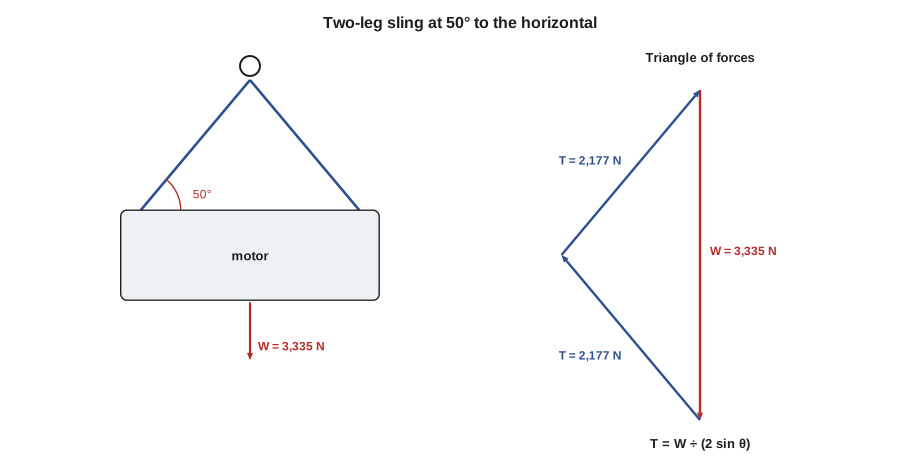
A two-leg sling hanging from a single hook shares the load between its legs, but not equally with the weight. Each leg pulls along its own line, at an angle θ to the horizontal, and only its vertical component holds the load up. For a symmetrical lift with legs at equal angles, the vertical components of the two leg tensions add to the weight:
As the legs flatten, sin θ falls and the tension in each leg climbs steeply. At 60° from the horizontal each leg carries 58 in 100 of the load; at 45°, 71 in 100; at 30°, the full weight of the load in each leg, so that the two legs together carry twice the weight. Below 30° the tensions rise very fast, and rigging practice and manufacturers' rating charts treat that as the practical limit. The horizontal components of the leg tensions also squeeze the load, which can crush a light casing or pull lifting eyes sideways if they were designed for a vertical pull.
Worked problem
Checking the sling
The 340 kg motor hangs from a two-leg sling with each leg at 50° to the horizontal. Find the tension in each leg.
Show solution
- Weight of the motor:
- \[W = 340 \times 9.81 = 3{,}335 \text{ N}\]
- Tension in each leg:
- \[T = \frac{3{,}335}{2 \sin 50^\circ} = \frac{3{,}335}{1.532} = 2{,}177 \text{ N}\]
Answer: About 2.18 kN in each leg, or 65 in 100 of the weight. The sling's tag gave its rated capacity at that angle, well above the load. Had the crew shortened the hook height so that the legs dropped to 30°, each leg would have carried the full 3.34 kN.
Moments and beam reactions
A force that does not pass through a pivot tends to turn the body about it. The turning effect, the moment, is the force multiplied by its perpendicular distance from the pivot:
For a body in equilibrium, the clockwise moments about any point equal the anticlockwise moments. Taking moments about one support of a beam removes that support's unknown reaction from the equation, because its distance from itself is zero, and leaves the other reaction as the only unknown. The vertical force balance then gives the first.
A simply supported beam rests on two supports and is free to rotate at both. A monorail beam carrying a hoist trolley is a typical example. The reactions at the supports change as the trolley moves: with the load at midspan each support carries half; with the load near one end, that end carries nearly all of it. The beam's own weight acts at its centre and adds half its value to each reaction.
Worked problem
Reactions on the monorail beam
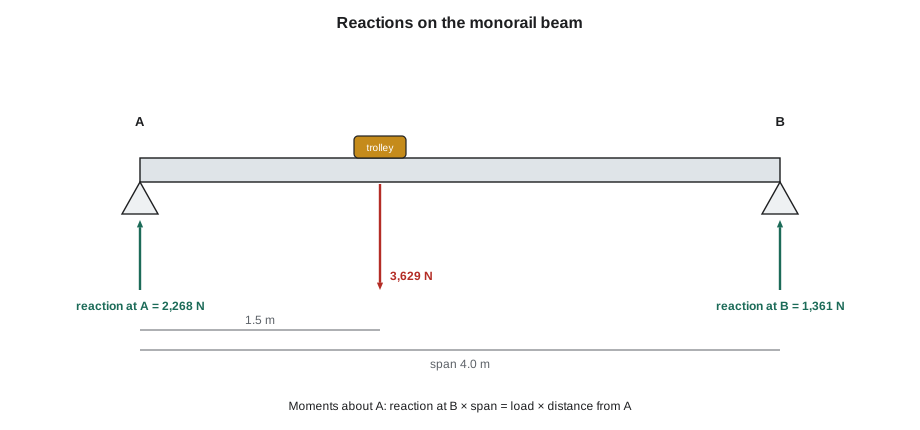
The monorail beam spans 4.0 m between supports A and B. With the hoist trolley 1.5 m from A, it carries the motor (3,335 N) plus the hoist and trolley (30 kg, or 294 N). Ignoring the beam's own weight, find the reactions at A and B.
Show solution
- Total load:
- \[F = 3{,}335 + 294 = 3{,}629 \text{ N}\]
- Moments about A:
- \[R_B \times 4.0 = 3{,}629 \times 1.5 \;\Rightarrow\; R_B = 1{,}361 \text{ N}\]
- Vertical balance:
- \[R_A = 3{,}629 - 1{,}361 = 2{,}268 \text{ N}\]
Answer: Support A carries about 2.27 kN and B about 1.36 kN. The heavier reaction is always at the support nearer the load.
A beam that is built in at one end and free at the other, a cantilever, has a single support that must provide both a vertical reaction and a resisting moment. Pipe support brackets bolted to a wall are cantilevers, and the moment at the wall, the load times its distance from the wall, is what the anchor bolts must resist.
Friction
Friction opposes sliding between two surfaces. The force needed to start a body sliding is the normal force pressing the surfaces together multiplied by the coefficient of friction, μ:
The coefficient depends on the two materials and their condition, not on the contact area. The static coefficient, for starting motion, is a little higher than the kinetic coefficient for keeping it going, which is why a heavy part needs a hard shove to start and less to keep moving. Typical values are around 0.4 to 0.6 for steel sliding on dry steel or concrete, and far lower, around 0.05 or less, for loads rolled on machinery skates.
On an incline the weight resolves into two components: W cos θ pressing into the slope, which sets the normal force, and W sin θ pulling down the slope. To push a load up an incline at a steady speed, the push along the slope must overcome both the downslope component and the friction:
Worked problem
Moving the new motor up the ramp
The new motor, also about 340 kg, is rolled on machinery skates (μ = 0.05) up a 5° ramp into the boiler room. What steady push is needed along the ramp?
Show solution
- Push along the slope:
- \[P = 3{,}335(\sin 5^\circ + 0.05\cos 5^\circ) = 3{,}335(0.0872 + 0.0498) = 457 \text{ N}\]
Answer: About 460 N, the push of one or two people. The same load going down the ramp would need restraint, because the downslope component, 291 N, is larger than the rolling friction, 166 N.
Motion in a straight line
For a body moving with constant acceleration a, starting at velocity u and reaching velocity v after time t and distance s, four equations link the quantities. Any three known values give the other two:
Newton's second law connects acceleration to force: the net force on a body equals its mass times its acceleration, F = ma. When a hoist lifts a load and accelerates it upward, the tension in the hoist chain must hold the weight and also provide the accelerating force, so the chain tension is larger than the weight during the start of the lift. When the load is lowered and the hoist brakes, the same thing happens in reverse. A load that is snatched, lifted with slack in the sling, can produce a tension several times its weight for a moment, which is why riggers take up slack slowly.
Worked problem
Chain tension at the start of the lift
The hoist accelerates the 340 kg motor upward at 0.3 m/s² for the first moment of the lift. Find the chain tension during the acceleration.
Show solution
- Newton's second law, with up positive:
- \[T - mg = ma \;\Rightarrow\; T = m(g + a) = 340(9.81 + 0.3) = 3{,}437 \text{ N}\]
Answer: About 3.44 kN, 3 in 100 above the static weight. A snatch that stopped a falling load in a few centimetres could multiply that many times over.
Rotation and centripetal force
Rotating machinery is described by its angular velocity ω in radians per second, related to the speed N in revolutions per minute by ω = 2πN ÷ 60. A point at radius r moves at a peripheral or tip speed of v = ωr = πDN ÷ 60. Tip speed limits fan and pump impellers, because the stress in a rotating part rises with the square of its tip speed.
A mass moving in a circle is continually accelerated toward the centre, even at constant speed, because its direction keeps changing. The force needed to hold it in its circle, the centripetal force, is:
The shaft and bearings supply that force for every part of a rotor. When the rotor is perfectly balanced the forces cancel around the circle. A small out-of-balance mass, a lump of fly ash on one fan blade or a missing balance weight, produces an unbalanced force that rotates with the shaft and shakes the bearings once per revolution. Because it rises with the square of the speed, a small imbalance that is harmless at low speed can be serious at full speed.
Worked problem
Imbalance on the FD fan wheel
The boiler 2 FD fan wheel is 1.1 m in diameter and turns at 1,775 r/min. A deposit of 25 g builds up on one blade at a radius of 0.5 m. Find the tip speed and the rotating force the deposit applies to the bearings.
Show solution
- Angular velocity:
- \[\omega = \frac{2\pi \times 1{,}775}{60} = 185.9 \text{ rad/s}\]
- Tip speed:
- \[v = \frac{\pi \times 1.1 \times 1{,}775}{60} = 102 \text{ m/s}\]
- Centripetal force on the deposit:
- \[F = 0.025 \times 185.9^2 \times 0.5 = 432 \text{ N}\]
Answer: A 25 g deposit, the mass of a few coins, pulls on the bearings with 432 N, about 44 kg of force, swinging around 30 times a second. That is why fan vibration is trended and why a fan that suddenly shakes after a soot blow or a wet start needs looking at.
Work, energy and momentum in machines
Work is force times the distance moved in the direction of the force; for rotation it is torque times the angle turned in radians. Power is the rate of doing work: P = Fv for a force moving at speed v, and P = Tω for a torque at angular velocity ω. A motor's torque can be found from its power and speed by rearranging the second form.
A moving body stores kinetic energy: ½mv² for straight-line motion and ½Iω² for rotation, where I is the moment of inertia. For a rotor, I = mk², where k is the radius of gyration, the radius at which the whole mass could be concentrated to give the same inertia. Potential energy, mgh, is the energy stored by height. The principle of conservation of energy says that, without losses, kinetic and potential energy convert into each other without changing their total; with friction, the difference turns into heat.
Worked problem
Energy stored in the spinning fan
The FD fan wheel has a mass of 180 kg and a radius of gyration of 0.38 m. How much kinetic energy does it store at 1,775 r/min?
Show solution
- Moment of inertia:
- \[I = mk^2 = 180 \times 0.38^2 = 26.0 \text{ kg·m}^2\]
- Kinetic energy:
- \[E = \tfrac{1}{2} I\omega^2 = 0.5 \times 26.0 \times 185.9^2 = 449{,}000 \text{ J}\]
Answer: About 449 kJ. That stored energy is why a large fan takes minutes to coast to a stop after its motor is switched off, and why the lockout procedure requires the fan to be confirmed stopped, and the wheel blocked against windmilling in the draft, before anyone opens the housing.
Momentum is mass times velocity. The change of momentum of a body equals the impulse applied to it, the force times the time it acts. A water hammer in a pipe is a momentum problem: a column of water stopped in a fraction of a second by a closing valve or a slug of condensate meeting a fitting must be stopped by a very large force, and the pipe and its supports take it. The same reasoning explains why a jet of water or steam pushes back on the nozzle that produces it, the principle of the impulse turbine blades covered in PWR-320.
After the lift
The old motor came off without trouble. Okonkwo's figures matched the lift plan: 2.18 kN in each sling leg against a much higher rated capacity, and a beam reaction comfortably inside the monorail's posted rating. The one thing he added to the plan was the sling angle, which the plan had assumed but not stated; Fenella agreed and wrote "legs not less than 45° to horizontal" on the master copy. Before the new motor was coupled, the millwrights checked that the fan wheel turned freely by hand and had no deposits on its blades. Okonkwo wrote the fan's balance and vibration as an item to check on the first run, and the readings on start-up a week later were well inside the plant's limits.
Common mistakes
MistakeTreating a mass in kilograms, or a weight in pounds, as the wrong kind of quantity.
InsteadIn SI, weight is mg newtons; in US units, mass is weight ÷ 32.2 slugs. Use force in statics and mass in F = ma.
MistakeAssuming each leg of a two-leg sling carries half the load.
InsteadEach leg carries W ÷ (2 sin θ); at 30° to the horizontal each leg carries the full weight.
MistakeTaking moments with the distance measured along a sloping member.
InsteadA moment uses the perpendicular distance from the pivot to the line of the force.
MistakeUsing r/min directly in ω²r.
InsteadConvert to radians per second first: ω = 2πN ÷ 60.
MistakeForgetting that friction acts against the motion and changes direction when the motion does.
InsteadDraw friction opposing the intended movement; going down a slope it acts up the slope.
Summary and key terms
- Forces are vectors: resolve them into components, add the components and rebuild the resultant.
- Equilibrium needs zero net force in each direction and zero net moment; a free-body diagram comes first.
- Each leg of a symmetrical two-leg sling carries W ÷ (2 sin θ), rising steeply as the legs flatten.
- Beam reactions come from taking moments about one support and then balancing the vertical forces.
- Friction is μN; on an incline, the push to move a load up is W(sin θ + μ cos θ).
- F = ma, the constant-acceleration equations and the rotation formulas ω = 2πN ÷ 60, F = mω²r and E = ½Iω² cover most dynamics problems.
- Resultant
- The single force that has the same effect as two or more forces acting together.
- Equilibrium
- The state of a body with no net force and no net moment acting on it, so that it does not accelerate.
- Moment
- The turning effect of a force, equal to the force times its perpendicular distance from the pivot.
- Coefficient of friction
- The ratio of the friction force to the normal force between two surfaces.
- Centripetal force
- The inward force needed to keep a mass moving in a circle, equal to mω²r.
- Moment of inertia
- The rotational equivalent of mass, equal to mk² for a rotor with radius of gyration k.
- Radius of gyration
- The radius at which the whole mass of a rotating body could be concentrated to give the same moment of inertia.
Practice problems
Work each problem on paper first, then reveal the answer to check.
A 500 kg load hangs from a two-leg sling with legs at 60° to the horizontal. Find the tension in each leg.
Show answer
W = 4,905 N; T = 4,905 ÷ (2 × 0.866) = 2,832 N.
A 6 m simply supported beam carries 12 kN at 2 m from support A. Find both reactions.
Show answer
R_B = 12 × 2 ÷ 6 = 4 kN; R_A = 8 kN.
A pump impeller 300 mm in diameter turns at 3,550 r/min. What is its tip speed?
Show answer
π × 0.3 × 3,550 ÷ 60 = 55.8 m/s.
A 2,000 kg load accelerates upward at 0.5 m/s². What is the rope tension?
Show answer
2,000 × (9.81 + 0.5) = 20,620 N.
A motor delivers 30 kW at 1,780 r/min. What torque does it produce?
Show answer
ω = 186.4 rad/s; T = 30,000 ÷ 186.4 = 161 N·m.
Lesson quiz · 5 questions
Score 60% or more to complete this lesson.
Create a free account to save your progress, take quizzes and earn a certificate.