
PWR-310 · Lesson 3 of 12 · 34 min
Strength of materials
▶ Video coming soon A video version of this lesson is on the way.
On Monday, August 17, 2026, Fenella Thorncroft's crew opened the steam drum manway on boiler 3, which was standing in wet layup for the summer, so that they could look at the internal feed pipe and the steam separators. On Tuesday, August 18, they closed it again with a new gasket, and Okonkwo Demarest stood by with the torque wrench chart while a millwright drew the yoke nuts up. The cover is the usual internal type: an elliptical plate that sits inside the drum and is pulled against its seat by two bolts through yokes across the outside of the opening. "Those two bolts look small for a drum at 1,380 kPa," Okonkwo said. The millwright grinned. "They don't hold the pressure. The pressure holds the cover. Work it out."
This lesson works it out, and covers the rest of the strength of materials that third class candidates need: direct stress and strain, Hooke's law and the modulus of elasticity, the stress-strain curve, factors of safety, shear, thermal expansion and thermal stress, stresses in thin cylinders such as drums and pipes, and the loads in bolted joints.
Stress and strain
When a bar is pulled by a force F, every cross-section carries the force spread over its area. The force per unit area is the stress:
Stress is tensile when the force pulls the material apart and compressive when it pushes it together. A pressure is also a force per unit area, and the units are the same; one megapascal is one newton per square millimetre, which makes MPa a convenient unit when areas are in mm².
The bar also stretches. The change in length divided by the original length is the strain, ε = ΔL ÷ L, a pure number with no units. Strain in steel parts at working stress is small, usually a few parts in ten thousand, and it is often quoted in microstrain, millionths.
For most metals, up to a limit, stress is proportional to strain. That is Hooke's law, and the constant of proportionality is the modulus of elasticity, or Young's modulus, E:
A high modulus means a stiff material. Steel's modulus is about three times aluminium's, so an aluminium part stretches about three times as much under the same stress. The modulus barely changes from one carbon steel to another, which is why hardening or alloying a steel makes it stronger but not stiffer. When a bar stretches it also gets slightly thinner; the ratio of the sideways strain to the lengthwise strain is Poisson's ratio, about 0.3 for steel.
| Material | Modulus of elasticity | Coefficient of linear expansion | Typical use |
|---|---|---|---|
| Carbon steel | 200 GPa (29 × 10⁶ psi) | 12 × 10⁻⁶ per K (6.5 × 10⁻⁶ per °F) | Drums, shells, pipe, structural members |
| Stainless steel (austenitic) | 193 GPa (28 × 10⁶ psi) | 17 × 10⁻⁶ per K (9.6 × 10⁻⁶ per °F) | Sample coolers, chemical lines, separators |
| Copper | 117 GPa (17 × 10⁶ psi) | 17 × 10⁻⁶ per K (9.4 × 10⁻⁶ per °F) | Heat exchanger tubes, instrument tubing |
| Aluminium | 69 GPa (10 × 10⁶ psi) | 23 × 10⁻⁶ per K (13 × 10⁻⁶ per °F) | Jacketing, fins, light structures |
| Cast iron (grey) | 100 GPa (15 × 10⁶ psi) | 11 × 10⁻⁶ per K (6 × 10⁻⁶ per °F) | Pump casings, valve bodies at low pressure |
The stress-strain curve
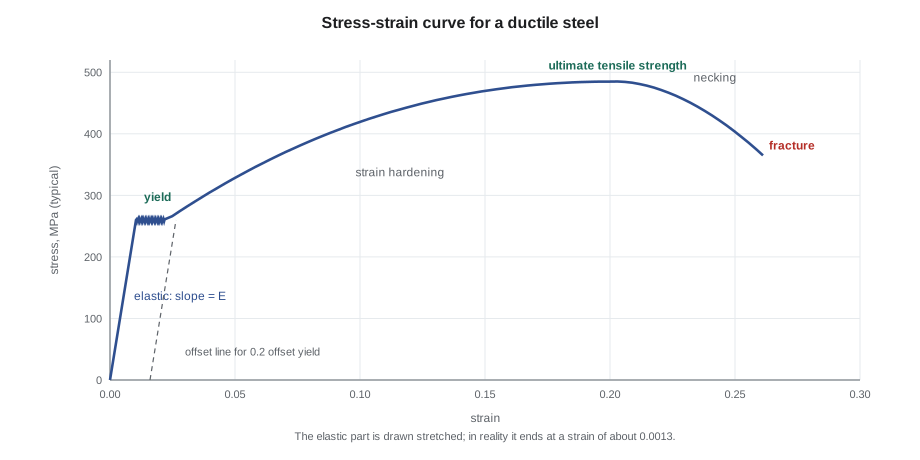
A tensile test pulls a standard specimen to destruction while recording the load and the extension. Plotted as stress against strain, the result for a ductile steel shows the material's whole life story:
- A straight elastic region, where the specimen returns to its original length when unloaded. Its slope is the modulus E.
- The yield point, where the steel starts to stretch permanently with little or no increase in load. Beyond it the deformation is plastic. For materials without a sharp yield point, a 0.2 in 100 offset yield strength is used instead.
- Strain hardening, where the stress needed to keep stretching the steel rises again, up to the ultimate tensile strength, the highest stress on the curve.
- Necking, where the specimen thins at one spot and the load falls until it fractures.
Ductility, measured as the elongation at fracture or the reduction of area, is what lets a steel part bend, bulge or leak before it fails, rather than shatter. Pressure equipment steels are chosen for ductility as much as strength. Brittle materials such as grey cast iron have little or no plastic region and break suddenly near their elastic limit, which is why codes restrict cast iron to lower pressures and temperatures.
Allowable stress and the factor of safety
No component is designed to work near its ultimate strength. The factor of safety is the ratio of the stress that would cause failure to the stress allowed in service. It covers uncertainties in the loads, the material, the workmanship and the analysis, and the effects of corrosion and fatigue over the years. Pressure equipment codes build the safety factor into the allowable or maximum allowable stress they publish for each material at each temperature, and the designer uses that stress directly.
For a common drum and shell plate such as SA-516 Grade 70, the specified minimum tensile strength is 485 MPa (70,000 psi) and the minimum yield strength about 260 MPa (38,000 psi). The allowable stress used in boiler design at moderate temperatures is about 138 MPa (20,000 psi), roughly a factor of 3.5 below the tensile strength. At high temperature the allowable stress falls, first because the strength drops and then, above about 400 °C, because the steel begins to creep, stretching slowly under steady load over months and years. Those limits belong to the code tables, which this course does not reproduce; the figures here are typical values for teaching.
Shear stress
A force that tries to slide one part of a material past another produces shear stress, the force divided by the area resisting the slide: τ = F ÷ A. A pin through a clevis, a bolt in a lap joint, a key in a shaft keyway, and a punch cutting a hole all work in shear. A pin through a clevis with two side plates is in double shear: it must be cut through at two cross-sections to fail, so the area resisting the load is twice the pin's cross-section.
Ductile steels fail in shear at roughly 0.6 to 0.75 times their tensile strength, so a design that is safe in tension is not automatically safe in shear. Shear in a rotating shaft is caused by torsion: the shear stress at the surface of a solid round shaft carrying torque T is τ = 16T ÷ πd³, which is why doubling a shaft's diameter makes it eight times stronger in torsion.
Worked problem
A spring hanger pin
A spring hanger on a steam main carries 18 kN through a 16 mm steel pin in double shear. Find the shear stress in the pin, and the factor of safety if the steel's ultimate shear strength is 300 MPa.
Show solution
- Area resisting shear (two sections):
- \[A = 2 \times \frac{\pi \times 16^2}{4} = 402 \text{ mm}^2\]
- Shear stress:
- \[\tau = \frac{18{,}000}{402} = 44.8 \text{ MPa}\]
- Factor of safety:
- \[\text{FS} = \frac{300}{44.8} = 6.7\]
Answer: A comfortable margin. If the same pin were in single shear, the stress would double and the factor of safety would halve.
Thermal expansion and thermal stress
Materials expand when heated. A bar of length L heated through ΔT grows by:
where α is the coefficient of linear expansion. If the bar is free to grow, there is no stress. If it is held rigidly between fixed anchors, it cannot grow, and the anchors must push it back by exactly the amount it would have grown. The strain it is denied, αΔT, becomes a compressive stress through Hooke's law:
The length cancels out: a short restrained pipe is stressed exactly as much as a long one. Steam lines are therefore never anchored rigidly at both ends of a straight run. Expansion loops, offsets, bellows expansion joints and slip joints let the pipe grow, and anchors are placed so that each section's growth is taken up where the piping can flex.
Worked problem
A restrained steam line
A carbon steel steam line is installed at 20 °C and runs at 185 °C. Find (a) the free expansion of a 30 m straight run, and (b) the stress if a run were somehow fully restrained. Use E = 200 GPa and α = 12 × 10⁻⁶ per K.
Show solution
- Temperature rise:
- \[\Delta T = 185 - 20 = 165 \text{ K}\]
- (a) Free expansion:
- \[\Delta L = 12 \times 10^{-6} \times 30{,}000 \times 165 = 59.4 \text{ mm}\]
- (b) Restrained stress:
- \[\sigma = 200{,}000 \times 12 \times 10^{-6} \times 165 = 396 \text{ MPa}\]
Answer: The run grows about 60 mm. Fully restrained, it would be stressed to 396 MPa, well past the yield strength of ordinary pipe steel; it would bow, buckle or tear its anchors out. That is the reason for the expansion loops in Cantwell's tunnels.
Thermal stress also arises without external restraint when one part of a component is hotter than another. A thick drum or header heated quickly on the inside expands there first while the cooler outside holds it back, and the steeper the temperature difference across the wall, the larger the stress. That is the physics behind the limits on warm-up and cool-down rates in every boiler's operating procedure, and behind the cracking found at ligaments and nozzles of boilers that are cycled hard.
Stresses in thin cylinders
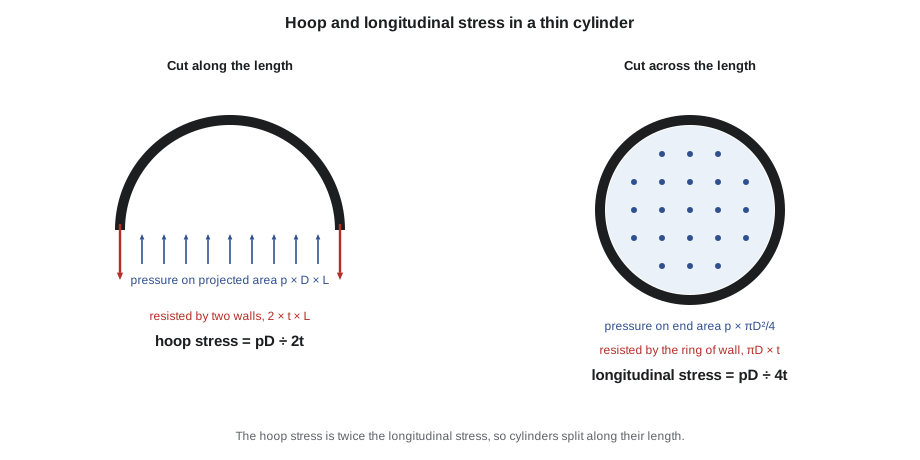
A drum, shell or pipe under internal pressure is a thin cylinder when its wall is thin compared with its diameter, usually less than about a tenth. The pressure tries to split it in two ways, and each sets a stress in the wall.
- The circumferential or hoop stress acts around the circumference and resists splitting along the length. Cut the cylinder lengthwise: the pressure on the projected area, p × D × L, is resisted by the two walls, each of area t × L. So σ_h = pD ÷ 2t.
- The longitudinal stress acts along the length and resists the ends blowing off. The pressure on the end area, πD²/4, is resisted by the ring of wall, πDt. So σ_L = pD ÷ 4t.
The hoop stress is twice the longitudinal stress. That is why a cylinder over-pressured to failure splits along its length, and why longitudinal welds and longitudinal rows of tube holes are the weak lines that codes treat most carefully. Holes drilled for tubes reduce the metal carrying the load; the ligament efficiency is the ratio of the metal left between holes to the full pitch, and it divides into the stress at the ligament.
Worked problem
Boiler 3 drum stresses
Boiler 3's steam drum has an inside diameter of 1,070 mm and a plate thickness of 14 mm. Its tube-hole ligament efficiency is 0.45. Find the hoop and longitudinal stresses at the normal operating pressure of 1,035 kPa gauge, and the hoop stress at the ligaments.
Show solution
- Hoop stress in the solid plate:
- \[\sigma_h = \frac{pD}{2t} = \frac{1.035 \times 1{,}070}{2 \times 14} = 39.6 \text{ MPa}\]
- Longitudinal stress:
- \[\sigma_L = \frac{pD}{4t} = 19.8 \text{ MPa}\]
- Hoop stress at the ligaments:
- \[\sigma = \frac{39.6}{0.45} = 88 \text{ MPa}\]
Answer: The solid plate is lightly stressed, but the ligaments carry 88 MPa at operating pressure, which is why the drum's plate thickness is set by the ligaments and not by the plain shell. The full code formulas add corrosion allowance and other terms, taken up in PWR-340.
A sphere under pressure carries the stress pD ÷ 4t in every direction, half the hoop stress of a cylinder of the same diameter and thickness. That is why hemispherical heads can be about half the thickness of the shell they close, and why spheres are used for large gas storage.
Pressure forces and bolted joints
The force of pressure on a closure is the pressure times the area it acts on. Large closures at modest pressures carry enormous forces, and the way a closure is arranged decides what holds them.
Worked problem
The force on the manway cover
The boiler 3 manway opening is an ellipse 305 mm by 406 mm. Find the force the steam pressure exerts on the cover at the drum's MAWP of 1,380 kPa.
Show solution
- Area of the ellipse:
- \[A = \frac{\pi \times 0.305 \times 0.406}{4} = 0.0973 \text{ m}^2\]
- Force:
- \[F = pA = 1{,}380 \times 0.0973 = 134 \text{ kN}\]
Answer: About 134 kN, the weight of some 13.7 tonnes. On an internal cover that force pushes the plate outward against its seat, so the pressure itself makes the joint tighter. The yoke bolts only seat the gasket before pressure is raised, and they are retightened lightly once the boiler is warm. A cover arranged the other way, bolted on the outside, would need its bolts to carry the whole 134 kN.
A flanged joint in a pipe is the other kind. The bolts must hold the flanges together against the pressure's end force on the area inside the gasket, and also keep enough squeeze on the gasket to seal. Bolts are therefore preloaded, tightened to a stress far above what the pressure alone would cause, typically 40 to 70 in 100 of the bolt's yield strength. As long as the preload is greater than the pressure force, the joint stays closed and the bolts barely notice changes in pressure. Uneven or inadequate preload, not overloaded bolts, is the usual cause of flange leaks.
Worked problem
Bolt stress from pressure alone
An NPS 6 flange on the steam header has an effective gasket diameter of 175 mm and eight 3/4 in bolts, each with a tensile stress area of 215 mm². Find the stress in each bolt from the pressure end force at 1,035 kPa, and compare it with a preload stress of 250 MPa.
Show solution
- End force:
- \[F = 1{,}035 \times \frac{\pi \times 0.175^2}{4} = 24.9 \text{ kN}\]
- Per bolt, and stress:
- \[\frac{24.9}{8} = 3.11 \text{ kN}, \qquad \sigma = \frac{3{,}110}{215} = 14.5 \text{ MPa}\]
Answer: The pressure adds only about 14.5 MPa per bolt; the 250 MPa preload is what keeps the joint tight. Each bolt carries about 54 kN of preload, more than twice the whole pressure end force on all eight.
Torque is only an indirect measure of preload, because most of the torque goes into overcoming friction under the nut and in the threads; lubricated and dry threads at the same torque can give preloads that differ by a factor of two. Critical joints are tightened in a star pattern in several passes, sometimes with hydraulic tensioners, and sometimes checked by measuring the bolt's elastic stretch with a micrometer or an ultrasonic gauge, using ΔL = σL ÷ E.
Worked problem
How much does a bolt stretch?
A stud with an effective length of 200 mm is preloaded to 200 MPa. How much does it stretch? Use E = 200 GPa.
Show solution
- Strain and stretch:
- \[\varepsilon = \frac{200}{200{,}000} = 0.001, \qquad \Delta L = 0.001 \times 200 = 0.20 \text{ mm}\]
Answer: Two-tenths of a millimetre, easily measured with a stud micrometer and a useful check that torque has produced the intended preload.
The manway, closed
Okonkwo worked the manway force on the back of the torque chart while the millwright finished: about 134 kN at full pressure, all of it pressing the cover onto its seat. The yoke bolts were drawn up to the chart value, and the boiler's layup water was topped up and its chemical residual restored. The work order noted that the gasket seating should be checked and the yoke nuts retightened lightly when boiler 3 was next warmed up. Okonkwo added one more note to his formula sheet: "Hoop stress is twice longitudinal; restrained thermal stress does not depend on length."
Common mistakes
MistakeUsing the outside diameter and the gauge pressure inconsistently in the hoop stress formula.
InsteadUse the diameter and pressure the formula specifies; the thin-cylinder formula uses gauge pressure and, for an estimate, the inside or mean diameter.
MistakeThinking a longer restrained pipe has more thermal stress.
InsteadRestrained thermal stress is EαΔT; the length cancels. Length sets the free expansion, not the stress.
MistakeCounting a pin in double shear as single shear.
InsteadA pin through a clevis with two side plates resists the load at two sections; use twice its area.
MistakeAssuming flange bolts carry only the pressure end force.
InsteadBolts carry their preload, which is much larger; the joint leaks if preload is lost, not usually because bolts are overloaded.
MistakeTreating the modulus of elasticity as a measure of strength.
InsteadThe modulus measures stiffness; strength is the yield or ultimate stress. A stronger steel is not stiffer.
Summary and key terms
- Stress is force over area; strain is extension over length; within the elastic range E = σ ÷ ε.
- The stress-strain curve shows the elastic region, yield, strain hardening, ultimate strength and fracture; ductility gives warning before failure.
- Codes give allowable stresses that build in a factor of safety; creep lowers them at high temperature.
- Shear stress is force over the sheared area; a pin in double shear has twice the area.
- Free thermal expansion is αLΔT; fully restrained, the stress is EαΔT, independent of length.
- In a thin cylinder the hoop stress pD ÷ 2t is twice the longitudinal stress pD ÷ 4t; ligaments raise it further.
- Pressure forces on closures are large; internal manway covers are pressure-seated, and flange bolts rely on preload.
- Stress
- Force per unit area within a material.
- Strain
- Change in length divided by original length, a dimensionless ratio.
- Young's modulus
- The ratio of stress to strain in the elastic range; a measure of stiffness.
- Yield strength
- The stress at which a material begins to deform permanently.
- Hoop stress
- The circumferential stress in the wall of a cylinder under internal pressure, equal to pD ÷ 2t.
- Ligament efficiency
- The ratio of the metal between adjacent tube holes to the hole pitch in a drum or header.
- Preload
- The tension deliberately put into a bolt by tightening, which holds a joint closed.
- Creep
- Slow, continuing deformation of a metal under steady stress at high temperature.
Practice problems
Work each problem on paper first, then reveal the answer to check.
A 20 mm diameter rod carries a tensile load of 40 kN. Find the stress.
Show answer
A = 314 mm²; σ = 40,000 ÷ 314 = 127 MPa.
A steel rod 2 m long is stressed to 150 MPa. How much does it stretch? (E = 200 GPa)
Show answer
ΔL = 150 × 2,000 ÷ 200,000 = 1.5 mm.
A pipe of 600 mm inside diameter and 10 mm wall carries 2,000 kPa. Find the hoop stress.
Show answer
σ_h = 2 × 600 ÷ 20 = 60 MPa.
A copper tube 4 m long is heated from 15 °C to 95 °C. How much does it grow? (α = 17 × 10⁻⁶ per K)
Show answer
17 × 10⁻⁶ × 4,000 × 80 = 5.4 mm.
What force acts on a 150 mm diameter blind flange at 1,500 kPa?
Show answer
1,500 × π × 0.15² ÷ 4 = 26.5 kN.
Lesson quiz · 5 questions
Score 60% or more to complete this lesson.
Create a free account to save your progress, take quizzes and earn a certificate.