
PWR-220 · Lesson 10 of 12 · 21 min
CSA B51 and the ASME Boiler and Pressure Vessel Code
▶ Video coming soon A video version of this lesson is on the way.
On a shelf behind Grazyna Wolanski's desk at Cantwell sit a row of binders and a laptop with the plant's code subscriptions: the current edition of CSA B51, the sections of the ASME Boiler and Pressure Vessel Code that apply to the plant, the Ontario regulations, and TSSA's code adoption documents. When Tamar Ellingsen asked how the chief engineer decided what rules applied to a repair or a new piece of equipment, Grazyna pulled down the binders one at a time. "Nobody memorizes these," she said. "What you need is to know which document answers which question, and in what order they apply. The exam asks the same thing."
This lesson explains how boiler law and codes fit together in Ontario: the Act and regulations, CSA B51 and how it brings in the ASME codes, design registration and the CRN, and the main sections of the ASME Boiler and Pressure Vessel Code with their certification marks. Lesson 11 covers inspections, repairs and records under these rules.
Laws, regulations, standards and codes
Boiler safety rests on a hierarchy of documents, each with a different kind of authority:
- An act or statute, passed by the legislature, sets out the broad duty to keep equipment safe and creates the authority that enforces it.
- Regulations or rules, made under the act, set out specific requirements: what must be registered, inspected and certified, who may operate it, and which codes apply.
- Codes and standards, written by standards organizations such as CSA Group, ASME and the National Board, give the detailed technical rules. A code has legal force only when the act or regulation adopts it, often with changes or additions.
- Code adoption documents, interpretations and code cases keep the rules current between editions and clarify how they apply.
When documents disagree, the law prevails over the code, and a jurisdiction's amendments prevail over the code text it adopts. The owner of the equipment is responsible for meeting all of them.
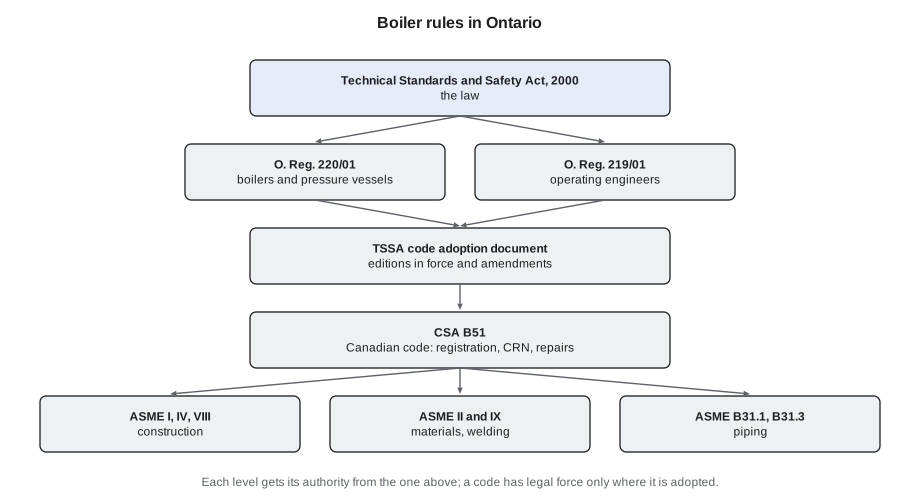
The Ontario framework
In Ontario, boilers and pressure vessels come under the Technical Standards and Safety Act, 2000, enforced by the Technical Standards and Safety Authority (TSSA). Two regulations under it matter most to a power engineer:
- Ontario Regulation 220/01, Boilers and Pressure Vessels, which requires design registration, construction to the adopted code, inspection before first use and periodically after, certificates of inspection, and reporting of accidents, and which adopts CSA B51 as the governing code.
- Ontario Regulation 219/01, Operating Engineers, which sets the classes of power engineer certificate, the plant ratings that each class may supervise, and the duties of the chief and shift engineers (PWR-110).
- TSSA's code adoption documents, which name the edition of each code in force and list Ontario's amendments. In 2025 TSSA brought the 2024 edition of CSA B51 into force through such a document.
CSA B51
CSA B51, Boiler, pressure vessel and pressure piping code, is the Canadian national code. It is adopted, with local amendments, by every province and territory. CSA B51 does not repeat the design rules for boilers. Instead it sets out Canadian requirements and references other codes for the technical detail:
- Power boilers are built to ASME Section I, heating boilers to ASME Section IV, and pressure vessels to ASME Section VIII, with welding to ASME Section IX.
- Power piping is built to ASME B31.1 and process piping to ASME B31.3, and refrigeration systems to CSA B52.
- B51 itself covers design registration, the CRN, material and fitting requirements, quality control programs, welding procedure registration, inspection before use, and repairs and alterations, together with Canadian additions such as requirements for boiler room and installation details.
Because B51 adopts ASME by reference, a boiler built to ASME Section I and registered under B51 meets both. The operator's job is not to know every clause but to recognize when a change, a repair or a new item of equipment brings these rules into play, and to bring in the chief engineer, the inspector or the regulator at that point.
Design registration and the CRN
Before a boiler, pressure vessel or fitting can be built or used in a Canadian province, its design must be registered with that province's regulator. The regulator's design engineers review the drawings and calculations against the code and, if they are satisfactory, issue a Canadian Registration Number (CRN). A CRN has a number followed by a decimal and digits or letters that show the provinces where the design is registered; in Ontario's case, for example, the digit 5. Fittings such as valves, gauges and flanges are also registered, often by category, with a CRN of their own.
A boiler at Cantwell therefore carries both its ASME stamping and its CRN. If the plant buys a replacement safety valve, a new gauge glass or a vessel such as a blowdown tank, Grazyna checks that it has a CRN registered in Ontario before it is installed. Equipment without one cannot legally be put in service, even if it carries the ASME mark.
The ASME Boiler and Pressure Vessel Code
The ASME Boiler and Pressure Vessel Code began after a series of deadly boiler explosions in the late 1800s and early 1900s led to calls for uniform rules (lesson 12). The first edition, covering power boilers, appeared in 1914 and 1915. It is now published every two years in many sections. The ones a power engineer meets most often are:
| Section | Covers |
|---|---|
| I | Power boilers: steam boilers above 15 psi (about 103 kPa) and high-temperature water boilers, with their external piping |
| II | Materials: specifications (Parts A, B and C) and allowable stresses and properties (Part D) |
| IV | Heating boilers: low-pressure steam and hot water heating boilers |
| V | Nondestructive examination methods |
| VI | Recommended guidelines for the care and operation of heating boilers |
| VII | Recommended guidelines for the care of power boilers |
| VIII | Pressure vessels, in three divisions of increasing rigour |
| IX | Welding, brazing and fusing qualifications |
| XIII | Rules for overpressure protection, including safety and relief valves |
Section VII is especially useful to operators: it describes, in plain guidance rather than mandatory rules, how to start up, operate, shut down, lay up and inspect power boilers and their auxiliaries. Many plant procedures, including Cantwell's, are built on it.
Between editions ASME issues code cases, which allow alternatives or new materials before they are written into the code, and interpretations, which answer formal questions about what the code means. Neither changes the law in a jurisdiction until that jurisdiction accepts it.
Certification marks and designators
A manufacturer that builds to the ASME code must hold an ASME certificate of authorization, which requires a written quality control system reviewed by ASME and an agreement with an Authorized Inspection Agency. The manufacturer then applies the ASME certification mark (a cloverleaf-shaped symbol) to the nameplate, with a designator showing the section it was built to:
- S for power boilers built to Section I; A for assembly of power boilers; M for miniature boilers; E for electric boilers; PP for power piping.
- H for heating boilers built to Section IV.
- U for pressure vessels built to Section VIII Division 1, and U2 and U3 for Divisions 2 and 3.
- V for safety valves for power boilers, HV for heating boiler valves, and UV for pressure vessel relief valves.
The nameplate also shows the manufacturer, the serial number, the year built, the MAWP, the heating surface or capacity, and the National Board number where the boiler is registered. Operators should read the nameplate of every pressure item in their plant at least once. It answers most questions about what the item is and what it may be used for.
Hydrostatic tests
Every code boiler and vessel is hydrostatically tested before it leaves the shop: it is filled with water, all air is vented, and the pressure is raised to a test pressure above the MAWP and held while the inspector examines it. Water is used because it stores very little energy when compressed, so a failure during the test releases little energy. For a Section I power boiler the test pressure is typically 1.5 times the MAWP; for a Section VIII Division 1 vessel it is typically 1.3 times, with corrections for temperature.
Worked problem
Shop hydrostatic test pressure
Boiler 3's MAWP is 1,380 kPa. What was its Section I hydrostatic test pressure? What would a Section VIII Division 1 blowdown tank with an MAWP of 1,035 kPa typically be tested to?
Show solution
- \[1{,}380 \times 1.5 = 2{,}070 \text{ kPa}\]
- \[1{,}035 \times 1.3 \approx 1{,}346 \text{ kPa}\]
Answer: The boiler was tested at 2,070 kPa, as its data report shows. The blowdown tank would typically see about 1,346 kPa before any temperature correction. Tests after repairs, and tests at inspections, have their own rules set by the inspection code and the inspector, and are never simply chosen by the plant.
Note that water at the test pressure would be dangerous if it were hot. At the saturation temperature for 2,171 kPa absolute (314.7 psia), about 217 °C (422 °F), a test failure would flash the water explosively. That is why hydrostatic tests are done with water only warm enough to avoid condensation and brittle fracture, typically somewhere between about 20 and 50 °C (70 and 120 °F), never with a hot boiler.
The National Board
The National Board of Boiler and Pressure Vessel Inspectors is an organization of the chief boiler inspectors of the US states, Canadian provinces and other jurisdictions. It promotes uniform enforcement of boiler rules. Its main activities are:
- Registration: manufacturers file the data reports of registered boilers and vessels with the National Board, which keeps them on record, and the item receives an NB number.
- Commissioning inspectors: inspectors who pass the National Board's examination and meet its experience requirements hold a commission, recognized by member jurisdictions.
- The National Board Inspection Code (NBIC), published as NB-23, which covers what happens after a boiler is built: Part 1, installation; Part 2, inspection; and Part 3, repairs and alterations.
- Certificates of authorization for repair organizations: the R certificate for repairs and alterations to pressure-retaining items, the VR certificate for repair of pressure relief valves, and the NR certificate for nuclear repairs. An R certificate holder must have a quality system and work under the acceptance of an inspector, and marks completed work with an R stamp on a nameplate.
In Canada, CSA B51 and the provincial regulations cover the same ground as the NBIC for repairs and alterations, and some provinces accept NBIC methods. In Ontario, repairs and alterations to pressure-retaining parts must follow B51 and TSSA's requirements, using registered welding procedures and qualified welders, with an inspector's acceptance (lesson 11). Ontario contractors may also hold National Board R certificates, which some owners prefer.
Applying the rules: a worked case
Grazyna used the September study of an economizer for boiler 2 (lesson 3) as an example of how the documents fit together. If the economizer were added, it would be a pressure part of the boiler: it would need a design registered with TSSA and its own CRN, construction to ASME Section I by a certified manufacturer, connection to the boiler under B51's rules for alterations, and acceptance and inspection before use. The boiler's records would be updated, and the operating procedures and training revised under the plant's management of change. "None of that is in the economizer's price," she said, "but all of it is in the project."
Finding the answer in the documents
Grazyna's advice for the exam and for the job was the same: start with the question, then pick the document. A few examples show how:
- Is this replacement relief valve allowed on our deaerator? Check its nameplate for the ASME mark and designator, and its CRN registration for Ontario, then confirm its set pressure and capacity against the vessel.
- What thickness was the mud drum when new? The manufacturer's data report.
- How should a power boiler be laid up for the summer? ASME Section VII's guidance, the manufacturer's manual and the treatment supplier's program, written into the plant's procedure.
- Who may supervise this plant, and what must the chief engineer do? O. Reg. 219/01 and the plant's rating.
- What must happen before we weld on a boiler? CSA B51's repair requirements, TSSA's welding procedure registration rules and the inspector's acceptance.
Codes are revised regularly, so the edition matters. A question answered from an old edition may have a different answer today, and the edition in force is the one the jurisdiction has adopted, not necessarily the newest one published. Grazyna keeps a note in each binder of the edition and the date it took effect, and checks the regulator's notices each year for changes.
Common mistakes
MistakeThinking a code has legal force by itself.
InsteadIt applies only where the law adopts it, with the jurisdiction's amendments.
MistakeInstalling an ASME-stamped fitting that has no Ontario CRN.
InsteadOntario requires registered designs and fittings; check the CRN first.
MistakeTreating Section VII as a set of mandatory rules.
InsteadIt is recommended guidance on care and operation, used as the basis for procedures.
MistakeHydrostatic testing with hot water.
InsteadUse water only warm enough to avoid condensation and brittle fracture.
MistakeAssuming any welding shop can repair a boiler.
InsteadRepairs need registered procedures, qualified welders and an inspector's acceptance.
Summary and key terms
- In Ontario, the Technical Standards and Safety Act and O. Reg. 220/01 govern boilers, adopting CSA B51; O. Reg. 219/01 governs operating engineers.
- CSA B51 sets Canadian requirements and references ASME Sections I, IV, VIII and IX and the B31 piping codes.
- Designs and fittings must be registered with the province and carry a CRN before use.
- The ASME code's main sections include I (power boilers), II (materials), IV (heating boilers), VII (care of power boilers), VIII (pressure vessels) and IX (welding).
- The ASME certification mark carries a designator such as S, H, U or V showing the section the item was built to.
- The National Board registers boilers, commissions inspectors, publishes the NBIC (Parts 1 to 3) and issues R and VR certificates; Section I boilers are hydrostatically tested at typically 1.5 times MAWP.
- Code adoption
- The legal act by which a jurisdiction gives a code the force of law, often with amendments.
- Canadian Registration Number
- The number issued by a provincial regulator when a design or fitting is registered.
- ASME certification mark
- The symbol applied by an authorized manufacturer to show construction to an ASME code section.
- Designator
- The letter or letters with the ASME mark that show which code section applies, such as S or U.
- National Board Inspection Code
- The National Board code covering installation, inspection, and repairs and alterations (NB-23).
- R certificate
- A National Board authorization to repair and alter pressure-retaining items.
- Code case
- An ASME ruling that allows an alternative or new material before it is included in the code.
- Hydrostatic test
- A pressure test with water at a pressure above the MAWP to prove strength and tightness.
Practice problems
Work each problem on paper first, then reveal the answer to check.
Which ASME section covers power boilers?
Show answer
Section I.
Which designator would appear on a Section VIII Division 1 vessel?
Show answer
U.
What is the Section I hydrostatic test pressure for a boiler with an MAWP of 1,035 kPa?
Show answer
About 1,553 kPa.
What does a CRN show?
Show answer
That the design or fitting is registered with the provincial regulator.
Which part of the NBIC covers repairs and alterations?
Show answer
Part 3.
Lesson quiz · 5 questions
Score 60% or more to complete this lesson.
Create a free account to save your progress, take quizzes and earn a certificate.