
PWR-220 · Lesson 1 of 12 · 27 min
High-pressure boiler construction
▶ Video coming soon A video version of this lesson is on the way.
On Friday, September 18, 2026, boiler 3 stood cold and open on the east side of the Cantwell boiler room. Its drum entry had been done on Tuesday and it was due back in service the next morning, so the access doors on the furnace and the manways on both drums were still off. Grazyna Wolanski, the chief engineer, handed Tamar Ellingsen a flashlight. "You have operated these boilers for ten weeks," she said. "Today you look at one from the inside. Everything the Fourth Class syllabus asks about construction is in front of you: the drums, the tubes, the furnace walls, the baffles and the casing. Learn what each part does and you will understand why we start them slowly and why low water ruins them."
This lesson describes how high-pressure boilers are built: what makes a boiler high pressure, how firetube and watertube boilers compare at higher pressures and outputs, the parts of a packaged D-type watertube boiler like Cantwell's, natural circulation, membrane walls, refractory and casing, and the other common packaged shapes. PWR-120 introduced firetube and watertube boilers for low-pressure work; BLR-220 covers how boilermakers build and erect them. This lesson is the operating engineer's view.
What makes a boiler high pressure
Canadian and US rules both divide boilers by pressure and temperature. A low pressure or heating boiler makes steam at no more than about 103 kPa (15 psi) or hot water at no more than about 1,100 kPa (160 psi) and 121 °C (250 °F). Anything above those limits is a power boiler, also called a high-pressure boiler, built to ASME Section I rather than Section IV. Cantwell's steam boilers, operating at 1,035 kPa (150 psi) with safety valves set at 1,380 kPa (200 psi), are power boilers. Its two hot water boilers, which heat the district loop, are heating boilers.
The higher pressure changes almost everything about a boiler. The shell or drum must be thicker, the welds must be fully examined, the safety valves must be larger and more carefully set, and the operating staff must be certified at a higher level. Higher pressure also means higher saturation temperature: at Cantwell's drum pressure water boils at about 185 °C (366 °F), compared with about 121 °C (250 °F) at heating-boiler limits. Every part touching the water and steam runs hotter, and a failure releases far more stored energy.
A useful way to see the danger is to compare the energy stored in hot water. Each kilogram of water at 185 °C holds about 787 kJ (lesson 7 of PWR-210). If the drum suddenly opened to the atmosphere, where water boils at 100 °C, the extra heat would flash about 16 in 100 of that water into steam almost instantly, expanding it about 1,600 times. That flash, not the steam already in the drum, is what makes a boiler failure so violent.
Firetube and watertube at higher pressure
In a firetube boiler the hot gases pass through tubes surrounded by water, and the water is held in a large cylindrical shell. In a watertube boiler the water and steam are inside the tubes and the hot gases pass around them. Both designs are built for power-boiler pressures, but they suit different jobs.
The key limit for a firetube boiler is the shell. Hoop stress rises with diameter (lesson 2), so a large-diameter shell at high pressure needs a very thick plate, which is expensive and slow to heat evenly. Packaged firetube boilers are common up to about 1,700 kPa (250 psi) and outputs of a few tonnes of steam an hour; above that, watertube designs take over. A watertube boiler keeps its large-diameter parts, the drums, relatively small and puts most of its heating surface in small-diameter tubes, which can carry high pressure with thin walls.
| Feature | Firetube | Watertube |
|---|---|---|
| Where the water is | In the shell around the tubes | Inside the tubes and drums |
| Water volume | Large, so it rides out load swings | Small, so it responds quickly |
| Pressure range (packaged, typical) | Up to about 1,700 kPa (250 psi) | From low to very high pressures |
| Time to steam from cold | Slow; the big shell must warm evenly | Faster, within the manufacturer's warm-up limits |
| Effect of a tube failure | Water leaks into the furnace | Water and steam leak into the furnace |
| Typical use | Small plants, heating, steady loads | Large outputs, swinging loads, superheat |
The smaller water volume of a watertube boiler is both its strength and its weakness. It lets the boiler follow a swinging district load quickly, which is why Cantwell uses watertube steam boilers. But it also means there is less water between normal level and an empty drum, so feedwater control and low water protection matter even more. The example below puts a number on it.
The packaged D-type boiler
Cantwell's three steam boilers are packaged D-type watertube boilers: shop-built, shipped in one piece on a skid, and set on a foundation with the burner, fan and controls already mounted. Seen from the front, the tubes form the shape of a capital D, which gives the type its name.
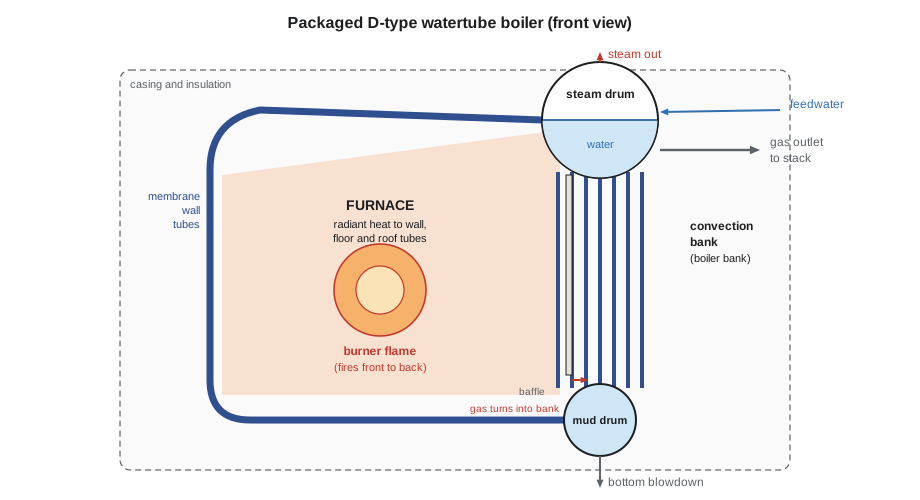
The main parts are:
- The steam drum at the top, a horizontal cylinder about half full of water. Steam separates from the water here, and internal fittings, the steam separators and dry pipe or scrubbers, remove water droplets before the steam leaves. The feedwater enters the steam drum through a perforated internal feed pipe, and the continuous blowdown takes water from just below the surface.
- The mud drum, or lower drum, a smaller cylinder at the bottom, full of water. It collects sludge that settles out of the circulating water, and the bottom blowdown valves are attached to it.
- The furnace, on one side, where the burner fires. Its floor, roof and side walls are lined with tubes that run from the mud drum to the steam drum, so the walls themselves absorb radiant heat from the flame.
- The convection bank or boiler bank, on the other side: rows of tubes joining the two drums. The hot gases leave the furnace through a screen of tubes at the back or side, turn, and pass across the convection bank before leaving through the outlet to the breeching and stack.
- Baffles of refractory or steel that guide the gases so they pass evenly over every tube rather than taking the shortest route.
- The casing, an outer steel skin that holds the insulation and makes the boiler gastight, and the refractory that protects the parts the tubes do not cover, such as the burner throat and door frames.
In a D-type boiler the furnace is beside the bank and the gases make a turn of about 180 degrees; in an A-type the furnace is in the middle with two mud drums below and convection banks on both sides; in an O-type the furnace sits between two symmetrical banks joining one steam drum and one mud drum. All three are common packaged shapes. Larger field-erected boilers for industry and utilities have the same basic parts but are built on site, often with headers instead of a mud drum and with superheaters, economizers and air heaters added (lesson 3).
Heating surface and output
The heating surface of a boiler is the area of metal exposed to hot gas on one side and water on the other. It is measured on the fire side and stated on the nameplate. Furnace tubes receive mostly radiant heat from the flame and do the most work for their area; convection tubes see cooler gas and take up less heat per square metre or foot.
Worked problem
Heat taken up per unit of heating surface
A Cantwell steam boiler delivers 8,000 kW at full rating and has 4,100 ft², about 381 m², of heating surface. What is the average heat taken up per square metre?
Show solution
- Convert the area:
- \[4{,}100 \times 0.0929 \approx 380.9 \text{ m}^2\]
- Divide the output by the area:
- \[8{,}000 \div 380.9 \approx 21.0 \text{ kW/m}^2\]
Answer: About 21 kW for each square metre on average. Furnace tubes take up several times the average and the last rows of the convection bank much less. That uneven loading is why scale or a loss of circulation hurts furnace tubes first.
Natural circulation
Water moves through a drum-type watertube boiler without a pump. Tubes that receive the most heat, the furnace walls and the front rows of the bank, make steam bubbles. The steam and water mixture in those tubes, the risers, is lighter than the solid water in the cooler tubes, the downcomers, which carry water down from the steam drum to the mud drum. The difference in density drives a steady flow: down the downcomers, up the risers, and back into the steam drum, where the steam separates.
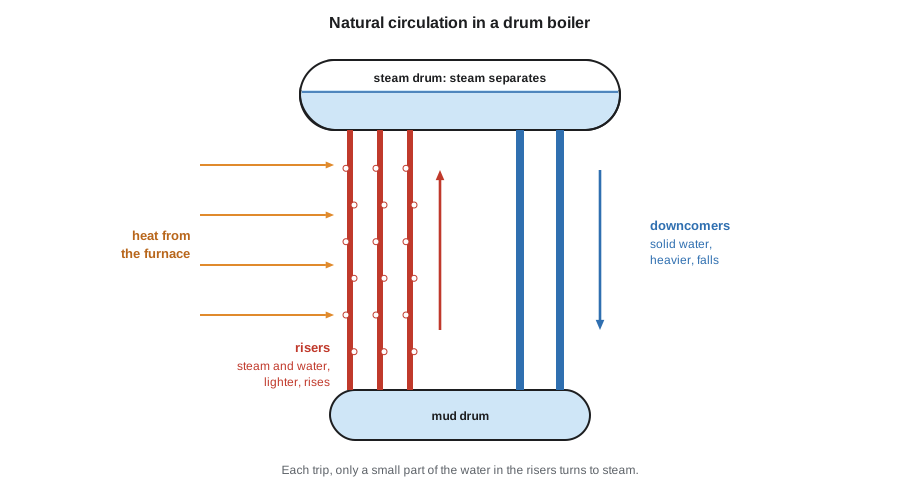
Only a fraction of the water in a riser turns to steam on each trip. The ratio of water circulated to steam produced, the circulation ratio, is typically somewhere around 10 to 25 in a low-pressure industrial boiler. A high ratio keeps the inside of every tube thoroughly wetted, which is what keeps the steel close to the water temperature. If circulation slows or a tube steams too freely, a film of steam can form against the tube wall. Steam carries heat away far worse than water, so the tube metal overheats, softens and bulges. This is called departure from nucleate boiling, and it is one of the causes of tube failure in lesson 12.
Worked problem
Water circulated through the tubes
Boiler 1 is making 11,300 kg/h of steam with a circulation ratio of 15. How much water flows round the circuit each hour?
Show solution
- \[11{,}300 \times 15 = 169{,}500 \text{ kg/h}\]
Answer: About 170,000 kg of water an hour, roughly 47 kg every second, flowing without any pump. Anything that disturbs it, such as low water uncovering the top of the downcomers, sludge blocking the bottom of a riser, or firing far above the rating, starves the hottest tubes first.
Circulation also explains some practical rules. Firing rate must be raised gradually from cold so circulation can become established before the furnace tubes take heavy heat. Downcomers must stay full of solid water, so the drum level must never fall below the top of them. And a boiler should never be fired without a visible water level in the gauge glass.
Membrane walls, refractory and casing
Older watertube boilers had tubes spaced apart with brick or refractory behind them. Most modern boilers use membrane walls (also called water walls or tangent or fin walls): the tubes are joined side by side by welded steel strips, the membranes, forming a continuous gastight panel. The membrane is cooled by the tubes on each side, so the furnace needs little refractory, and the casing can be a light outer skin over insulation.
Refractory is still used where tubes cannot reach: around the burner throat, at the furnace floor in some designs, on door frames and around observation ports. It is brittle and can crack when it heats or cools too quickly, which is another reason for the manufacturer's warm-up rates. Cracked refractory lets flame reach steel that was never meant to see it, and a red-hot patch on the casing is an early warning that refractory or a baffle has failed.
Grazyna had Tamar shine the light along the furnace floor tubes of boiler 3. "Look for three things," she said. "Bulges, which mean a tube got too hot. Blisters or pits in the fire-side surface. And anything that looks like the tubes are bending away from straight, which means expansion is being blocked or a tube overheated." They found none, only a light, even coat of soot on the convection bank, which the maintenance crew noted for brushing at the next outage.
Water reserve: why watertube boilers forgive little
The small water volume of a watertube boiler means that if the feedwater stops, the level falls quickly. Operators must understand how quickly, because it sets how long they have to react to a feed pump trip.
Worked problem
How long until low water
Boiler 1's steam drum holds about 1.2 m³ of water between normal operating level and the low water cutoff point. Water at 185 °C has a density of about 882 kg/m³. If the feed stops completely while the boiler keeps making 11,300 kg/h of steam, how long until the low water cutoff should trip?
Show solution
- Mass of water available:
- \[1.2 \times 882 \approx 1{,}058 \text{ kg}\]
- Time:
- \[1{,}058 \div 11{,}300 \approx 0.094 \text{ h} \approx 5.6 \text{ min}\]
Answer: About five and a half minutes, and less in practice, because the level indication also drops when steam bubbles collapse as pressure rises (shrink, lesson 5). A large firetube boiler of the same output might hold several times that reserve. On a watertube boiler, a feed pump failure is an emergency to act on at once, and the low water cutoff is the last line of defence, not the plan.
This is why Cantwell has a steam turbine-driven backup feed pump that can run with no electric power, why its feed pumps are tested on a schedule, and why the boiler log records the time of every low water alarm.
Expansion and supports
A boiler grows as it heats. A steel drum several metres or feet long gets measurably longer between cold and 185 °C (366 °F), and so does every tube. Packaged boilers are usually supported at one end and left free to slide at the other, on rollers or slide plates, with the piping arranged to flex. Field-erected boilers are often top-supported, hung from steelwork so that they grow downward. Operators should know which end of each boiler is fixed and check that slide plates and hangers are free; a seized support turns expansion into stress, cracking welds or bowing tubes.
Common mistakes
MistakeThinking a watertube boiler is safer because its drums are small.
InsteadIts small water reserve gives less time to react to a loss of feed.
MistakeTreating the mud drum as a place where steam forms.
InsteadIt is full of water and collects sludge; steam separates in the steam drum.
MistakeFiring hard from cold to save time.
InsteadCirculation and refractory need the manufacturer's gradual warm-up.
MistakeIgnoring a hot spot on the casing.
InsteadIt usually means failed refractory, a broken baffle or a gas leak.
MistakeAssuming every square metre of heating surface works equally.
InsteadFurnace tubes take far more heat than the last convection rows.
Summary and key terms
- A power boiler makes steam above about 103 kPa (15 psi) or hot water above about 1,100 kPa (160 psi) or 121 °C (250 °F), and is built to ASME Section I.
- Firetube boilers have large water volume but are limited by shell thickness; watertube boilers put most heating surface in small tubes and suit high outputs and swinging loads.
- A D-type boiler has a steam drum, a mud drum, a tube-lined furnace and a convection bank, with baffles, refractory and casing.
- Natural circulation is driven by the density difference between downcomers and risers; a high circulation ratio keeps tubes wetted and cool.
- Membrane walls make a gastight, water-cooled furnace with little refractory.
- A watertube boiler's small water reserve gives only minutes before low water if the feed stops.
- Power boiler
- A boiler operating above heating-boiler limits of pressure or temperature, built to ASME Section I.
- Steam drum
- The upper drum where steam separates from water and leaves the boiler.
- Mud drum
- The lower drum, full of water, that collects sludge and carries the bottom blowdown.
- Convection bank
- The bank of tubes between the drums that takes up heat from the gases by convection.
- Downcomer
- A tube carrying solid water down from the steam drum.
- Riser
- A heated tube carrying a steam and water mixture up to the steam drum.
- Circulation ratio
- The mass of water circulated divided by the mass of steam produced.
- Membrane wall
- A gastight furnace wall of tubes joined by welded steel strips.
Practice problems
Work each problem on paper first, then reveal the answer to check.
What drives the water round a natural-circulation boiler?
Show answer
The density difference between solid water in the downcomers and the lighter steam and water mixture in the risers.
Which tubes in a D-type boiler take the most heat per square metre?
Show answer
The furnace tubes, which absorb radiant heat from the flame.
A boiler makes 6,000 kg/h of steam at a circulation ratio of 20. How much water circulates?
Show answer
120,000 kg/h.
A drum has 0.8 m³ of water between normal level and the cutoff, at 882 kg/m³. At 9,000 kg/h with no feed, how long until low water?
Show answer
About 4.7 minutes (706 kg ÷ 9,000 kg/h).
Why is a red patch on a boiler casing serious?
Show answer
It shows that refractory, a baffle or a seal has failed and the casing is being overheated.
Lesson quiz · 5 questions
Score 60% or more to complete this lesson.
Create a free account to save your progress, take quizzes and earn a certificate.