
PWR-220 · Lesson 9 of 12 · 24 min
Blowdown and sampling
▶ Video coming soon A video version of this lesson is on the way.
Sunday, November 15, 2026, was a quiet day shift: a mild morning, steady load and all three steam boilers on line. Pilar Quenneville had Tamar Ellingsen with her for the weekly bottom blowdown and the Sunday sample round. "Blowdown is one of the few jobs where an operator deliberately lets hot water at boiler pressure out of a boiler," Pilar said, pulling on her gloves and face shield. "Done right, it keeps the boilers clean. Done carelessly, it can drop a level out of sight, scald someone or wreck a valve. So we do it the same way every time."
This lesson covers why boilers are blown down, the two kinds of blowdown, how blowdown rate follows from the cycles of concentration, how its heat can be recovered, how bottom blowdown is done safely, and how water samples are taken and tested. PWR-120 lesson 3 introduced the blowdown valves and PWR-120 lesson 9 the idea of cycles; this lesson builds on both.
Why blow down
When a boiler makes steam, the water evaporates but the dissolved and suspended solids stay behind. Without blowdown, the solids would concentrate until they caused foaming, carryover, sludge build-up and scale. Blowdown removes some of the concentrated boiler water and replaces it with feedwater, holding the solids at the level the treatment program sets.
There are two kinds:
- Continuous or surface blowdown takes water steadily from just below the water surface in the steam drum, where the dissolved solids are most concentrated, through a fine control valve. It controls dissolved solids, measured as conductivity.
- Bottom or intermittent blowdown opens valves on the mud drum or the lowest point of the boiler for a few seconds at a time. It removes sludge that has settled where circulation is slowest.
Cycles of concentration and blowdown rate
The cycles of concentration are the ratio of a dissolved solid's concentration in the boiler water to its concentration in the feedwater. A mass balance on the boiler gives three useful relationships, where S is steam flow, B is blowdown and F is feedwater flow, all in the same units, and C is the cycles:
The last form is the handiest for operators, because steam flow is measured and the cycles come from the conductivity readings.
Worked problem
Blowdown rate from cycles
Boiler 1 is making 11,300 kg/h of steam. Its feedwater conductivity is 150 µS/cm and the program limit for its boiler water is 3,000 µS/cm. What blowdown rate holds it at the limit, and what fraction of the feedwater is that?
Show solution
- Cycles:
- \[C = 3{,}000 \div 150 = 20\]
- Blowdown:
- \[B = 11{,}300 \div (20 - 1) \approx 595 \text{ kg/h}\]
- Feedwater:
- \[F = 11{,}300 + 595 = 11{,}895 \text{ kg/h}\]
- Fraction:
- \[595 \div 11{,}895 = 0.05\]
Answer: About 595 kg/h, which is 1 part in 20, or 5 in 100, of the feedwater. The fraction depends only on the cycles. Blowing down more than this wastes treated water, chemicals and heat; blowing down less lets solids rise above the limit.
Cantwell's continuous blowdown valves are controlled by conductivity controllers: a probe in each blowdown line measures conductivity, and the controller opens or closes a motorized valve to hold the set point. Operators check the probe against the bench conductivity test each day, because a fouled probe reads low and lets the boiler water drift high. Where the blowdown valve is set by hand, its setting is marked and the setting is adjusted only from test results.
Recovering blowdown heat
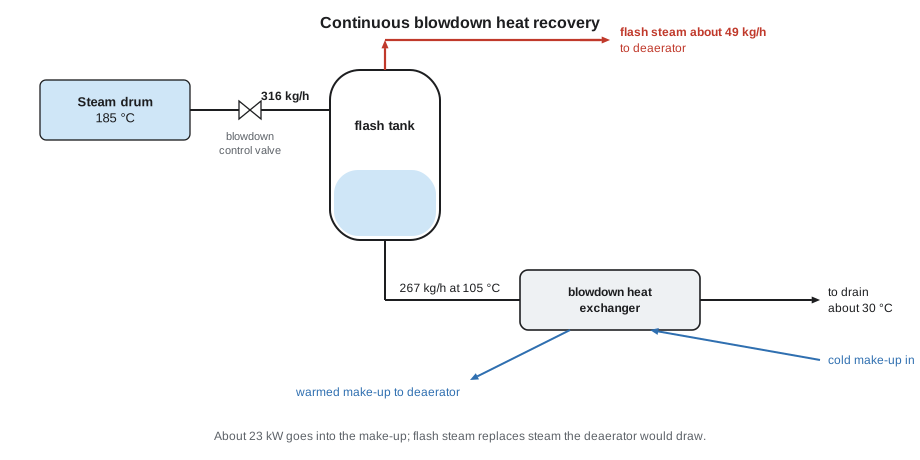
Continuous blowdown water leaves the drum at its saturation temperature, 185 °C (366 °F) at Cantwell. Dumping it would waste a lot of heat, so many plants pass it through a flash tank and a blowdown heat exchanger. In the flash tank, at deaerator pressure, part of the water flashes to steam, which is piped to the deaerator. The remaining hot water passes through a heat exchanger that warms the cold make-up before it goes to drain.
Worked problem
Flash steam and heat recovered from boiler 2's blowdown
Boiler 2 blows down 316 kg/h at 185 °C (h_f = 787 kJ/kg) to a flash tank at deaerator pressure, where h_f = 440 kJ/kg and h_fg = 2,244 kJ/kg. How much flash steam goes to the deaerator? The remaining water is then cooled to 30 °C (h_f about 126 kJ/kg) in the make-up heat exchanger. How much heat does that give the make-up?
Show solution
- Fraction that flashes:
- \[x = \frac{787 - 440}{2{,}244} = \frac{347}{2{,}244} \approx 0.155\]
- Flash steam:
- \[316 \times 0.155 \approx 49 \text{ kg/h}\]
- Water left:
- \[316 - 49 = 267 \text{ kg/h}\]
- Heat to the make-up:
- \[267 \times (440 - 126) \approx 83{,}800 \text{ kJ/h} \approx 23 \text{ kW}\]
Answer: About 49 kg/h of flash steam replaces steam the deaerator would otherwise take from the header, and about 23 kW goes into the make-up. The drain water leaves at about 30 °C, well below the sewer limit. Without recovery, all of that heat would go to drain and the water would need cooling before the sewer.
Bottom blowdown
Bottom blowdown removes sludge from the mud drum and the lowest headers. Each bottom blowdown connection has two valves in series: a quick-opening valve next to the boiler and a slow-opening (screw-down) valve after it. The frequency and duration are set by the treatment program and the manufacturer, typically a few seconds per valve, once a shift to once a week depending on the sludge load. Cantwell, with softened make-up and a polymer program, blows down weekly.
Pilar's procedure for the weekly blowdown followed the plant's written instructions:
- Check the boiler first. It should be at low to moderate firing rate, with the water level at or slightly above normal and the feedwater control in automatic and working. Some manufacturers prefer blowdown at low load, when sludge has settled; none allow it with the level low.
- Check the blowdown tank or separator. Its vent must be clear and the cooling water to the aftercooler on, so the discharge to the sewer stays below the typical limit of about 60 °C (140 °F).
- Tell the control room and make sure no other boiler is blowing down into the same tank.
- Open the quick-opening valve fully, then open the slow-opening valve steadily. The slow valve does the blowing and takes the wear.
- Watch the gauge glass or have someone watch it, and keep the blow short: a few seconds is usually enough. The level drops quickly in a watertube boiler.
- Close the slow-opening valve, then the quick-opening valve. Then check that the level has recovered and that the valves are tight, by feeling the discharge line downstream after a few minutes or using a temperature indicator.
- Never leave an open blowdown valve, even for a moment, and never blow down two connections of the same boiler at once unless the procedure says to.
Tamar watched boiler 1's gauge glass while Pilar blew each connection. The level dipped about 25 mm (1 in) on each blow and recovered within half a minute as the feedwater valve opened. The blowdown tank vented a short plume of flash steam, and the drain thermometer peaked at about 48 °C (118 °F) before falling back. They repeated the sequence on boilers 2 and 3 and logged the time, the duration of each blow and the level change.
Bottom blowdown valves that leak are dangerous and wasteful. A leaking valve wastes hot water, erodes the seat further and can keep the discharge line hot enough to mislead an operator. If the downstream line stays hot after blowdown, the valves are reported for repair at the next outage.
Other blowdowns
- Water column and gauge glass blowdown clears the connections of the level indications (lesson 5). It is done each shift on most boilers.
- Low water cutoff blowdown proves a float-type cutoff operates by draining its chamber and checking that the burner shuts off and the alarm sounds.
- Superheater and header drains are opened during start-up to clear condensate, not to control solids.
Each of these also discharges water at boiler pressure and needs the same care: face shield, gloves, a clear discharge, and attention to the water level.
Sampling
Water tests are only as good as the samples they are made on. A good sample is representative (it is the water you want to know about), fresh (the line has been flushed), cool (so it does not flash and lose gases or concentrate), and uncontaminated (taken in a clean container without touching the inside).
Typical sample points in a plant like Cantwell are:
- Raw water and softener outlet, for hardness.
- Deaerator outlet or feedwater, for dissolved oxygen, pH, hardness and conductivity.
- Boiler water, usually from the continuous blowdown line, for conductivity, pH or alkalinity, polymer or phosphate, and sulphite residual.
- Condensate return, for pH, conductivity, hardness and iron, which reveal corrosion or contamination.
Sample coolers
Boiler water and feedwater are well above the boiling point at atmospheric pressure. A sample cooler, usually a coil inside a shell through which cooling water flows, brings the sample down to a safe temperature, typically below about 35 °C (95 °F), before it reaches the sample valve. Without cooling, the sample would flash, scald the operator and give false results, because flashing releases dissolved gases and concentrates the solids.
The rules for using a sample cooler are simple and absolute:
- Cooling water on first. Open the cooling water before the sample valve, and confirm it is flowing.
- Open the sample valve slowly, with the outlet pointing safely into the sink, and adjust it to a small, steady stream.
- Check the sample temperature before filling the bottle. If it is hot, the cooling water flow is too low or the cooler is fouled.
- Flush the line for long enough to clear standing water, typically a few minutes, before filling the bottle.
- Sample valve off first, cooling water off last. Shutting the cooling water first with the sample still flowing would boil the water in the coil and blow steam from the outlet.
On Pilar's round, boiler 2's sample came out at about 45 °C (113 °F), warmer than usual. The cooling water flow was low. They shut the sample valve, then found the cooling water strainer half full of scale from the city main. Once it was cleaned, the sample ran at 22 °C (72 °F). Pilar wrote a work order to add the strainer to the monthly preventive maintenance list.
Testing and records
Operators run the routine tests on each shift or each day, as the program requires: conductivity, pH or alkalinity, sulphite residual and the treatment chemical on the boiler water; hardness on the softener outlet and feedwater; pH and conductivity on the condensate. The water treatment representative runs a fuller set of tests on each visit and checks the operators' results against their own.
Results go into a water treatment log, with the time, the sample point, the results and any adjustment made. The log is as important as the tests. A single result shows where the water is; a trend shows where it is going. A conductivity creeping up over several days, a sulphite residual falling, or condensate hardness appearing for the first time each point to a specific problem: blowdown not keeping up, oxygen getting in, or a leak in a customer's heat exchanger. Many plants also record continuous analyser readings on the control system, but the bench tests remain the check on the analysers.
Pilar and Tamar's Sunday results were all within range. Tamar entered them, noted the sample cooler repair, and added the blowdown times to the boiler logs.
Blowdown in numbers
Blowdown is not free. Each kilogram or pound of continuous blowdown carries away water that was softened, deaerated, treated and heated to boiler temperature. Typical figures for a plant like Cantwell show why operators keep blowdown close to the program's limit rather than well above it:
- Heat: water leaving at saturation carries roughly a third of the heat needed to make the same mass of steam from deaerated feed. Without heat recovery, all of it goes to drain.
- Water and sewer charges: every unit of blowdown must be replaced with make-up, which is paid for twice, once to buy and once to discharge.
- Chemicals and salt: the blowdown carries away treatment chemicals at the boiler water concentration, and the make-up that replaces it uses softener capacity.
Too little blowdown costs more in the end. Solids that rise above the limit cause foaming, carryover into customers' steam, sludge in the mud drum and, eventually, deposits and tube failures. A boiler that carries over may also contaminate condensate and upset the conductivity of the whole return system, making the water balance harder to read. The aim is a steady boiler water concentration just inside the limit, which is what the conductivity controller holds and what the shift tests confirm.
Pilar logged each boiler's conductivity alongside its blowdown valve position every round, so that a valve slowly opening wider for the same conductivity, a sign of a fouled probe or rising feedwater solids, would show up in the trend before it showed up in the boiler.
Common mistakes
MistakeBlowing down with the water level low or the feedwater control in manual.
InsteadStart with the level at or slightly above normal and the feed control working.
MistakeOpening the slow-opening valve before the quick-opening valve.
InsteadOpen quick-opening first, then slow; close slow first, then quick.
MistakeTurning off a sample cooler's cooling water first.
InsteadSample valve off first, cooling water off last.
MistakeTesting an unflushed or hot sample.
InsteadFlush the line and cool the sample, or the result is false.
MistakeTreating more blowdown as always safer.
InsteadIt wastes water, chemicals and heat; blow down to the program's limit.
Summary and key terms
- Continuous blowdown controls dissolved solids; bottom blowdown removes sludge.
- Blowdown rate follows from steam flow and cycles: B = S ÷ (C − 1); the fraction of feed is 1 ÷ C.
- A flash tank and heat exchanger recover much of the heat in continuous blowdown.
- Bottom blowdown uses a quick-opening and a slow-opening valve, with a short blow, the level watched, and the tank cooled below the sewer limit.
- Good samples are representative, flushed, cooled and clean; sample coolers are operated cooling water on first and off last.
- Test results are logged and trended; trends reveal problems before limits are exceeded.
- Continuous blowdown
- Steady removal of water from just below the drum surface to control dissolved solids.
- Bottom blowdown
- Brief, intermittent removal of water from the lowest point of the boiler to remove sludge.
- Cycles of concentration
- The ratio of dissolved solids in the boiler water to those in the feedwater.
- Flash tank
- A vessel at lower pressure in which hot blowdown water partly flashes to steam.
- Blowdown tank
- A vented vessel that receives blowdown, lets it flash and cool, and discharges it to drain.
- Sample cooler
- A heat exchanger that cools boiler or feedwater samples to a safe temperature.
- Representative sample
- A sample that truly reflects the water at the point being tested.
- Water treatment log
- The record of water test results, times, sample points and adjustments.
Practice problems
Work each problem on paper first, then reveal the answer to check.
A boiler makes 8,000 kg/h of steam at 25 cycles. What is the blowdown?
Show answer
About 333 kg/h.
Feedwater conductivity is 120 µS/cm and boiler water is 3,000 µS/cm. What are the cycles?
Show answer
25.
Blowdown at h_f = 787 kJ/kg flashes at a pressure where h_f = 440 and h_fg = 2,244 kJ/kg. What fraction flashes?
Show answer
About 0.155.
Which valve is opened first in bottom blowdown?
Show answer
The quick-opening valve nearest the boiler.
Why should a sample cooler's cooling water be turned on before the sample valve?
Show answer
So the sample is cooled from the start and cannot flash or scald.
Lesson quiz · 5 questions
Score 60% or more to complete this lesson.
Create a free account to save your progress, take quizzes and earn a certificate.