
PWR-220 · Lesson 3 of 12 · 26 min
Superheaters, economizers and air heaters
▶ Video coming soon A video version of this lesson is on the way.
On Wednesday, September 30, 2026, Grazyna Wolanski was working on the plant's 2027 capital plan. One line on it read "economizer study, boiler 2". Of the three steam boilers, boiler 2 ran the hottest stack, about 196 °C (385 °F) at high fire, and every degree of it was heat leaving the building. Grazyna asked Tamar Ellingsen to help her put a number on the heat an economizer could recover. "Cantwell makes saturated steam," she said, "so we will never need a superheater. But you have to know all three of these heat exchangers for the exam, and an economizer might be on this boiler in two years."
This lesson covers the three heat exchangers that a boiler can add to the gas path beyond the furnace and convection bank: the superheater, which raises steam above its saturation temperature; the economizer, which heats feedwater with flue gas; and the air heater, which heats combustion air with flue gas. All three either recover heat that would otherwise go up the stack or provide steam that a saturated boiler cannot.
Where they sit in the gas path
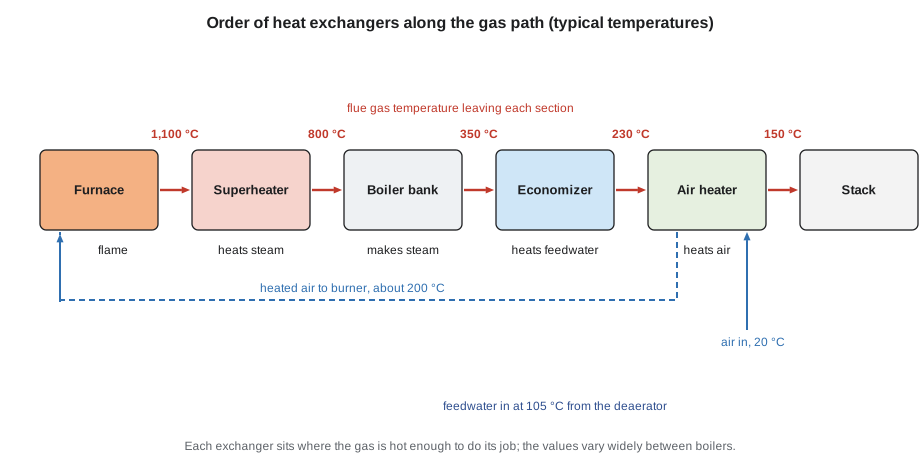
Flue gas leaves the furnace at well over 1,000 °C (1,800 °F) and cools as it passes each bank of tubes. A heat exchanger is placed where the gas is hot enough to do its job:
- Superheaters need the hottest gas, because steam is already at saturation temperature and must be heated further. They sit in or just beyond the furnace.
- The boiler bank or convection bank takes the next share.
- Economizers follow the boiler bank, where the gas is cooler but still well above the feedwater temperature.
- Air heaters come last, because combustion air starts at room temperature and can take heat from the coolest gas.
Superheaters
Steam leaving a drum is saturated: at the boiling temperature for its pressure, and usually carrying a little moisture. Heating it further in tubes with no water present makes superheated steam, which is hotter than the saturation temperature for its pressure. The amount by which it is hotter is the degree of superheat.
Superheated steam is used where wet steam would cause damage or waste energy:
- Turbines. Water droplets erode turbine blades, and superheat keeps the steam dry through most of the turbine. Superheat also increases the work each kilogram or pound of steam can do.
- Long steam lines. Superheat lets steam travel some distance before it starts condensing.
- Process steam at a set temperature, though most heating and process users prefer saturated steam because it gives up its heat at a steady temperature.
Worked problem
Heat added in a superheater
A plant with a drum pressure of 1.136 MPa absolute (Cantwell's drum pressure) superheats steam to 250 °C. Saturated steam at this pressure has h_g = 2,782 kJ/kg at 185 °C, and the steam tables give h = 2,937 kJ/kg at 1.136 MPa and 250 °C. How much heat does the superheater add for each kilogram, and what is its duty at 12,000 kg/h?
Show solution
- Degree of superheat:
- \[250 - 185 = 65 \text{ K}\]
- Heat added per kilogram:
- \[2{,}937 - 2{,}782 = 155 \text{ kJ/kg}\]
- Duty:
- \[12{,}000 \times 155 = 1{,}860{,}000 \text{ kJ/h}\]
- \[1{,}860{,}000 \div 3{,}600 \approx 517 \text{ kW}\]
Answer: About 517 kW. That is only about 6 in 100 of the heat in the steam, because most of the energy goes into making the steam in the first place; superheat is a small addition that makes the steam much more useful to a turbine.
Types of superheater
Superheaters are classified by how they receive heat and how they hang:
- A radiant superheater sits in or facing the furnace and receives radiant heat from the flame. Its steam temperature tends to fall as load rises, because furnace radiation does not increase as fast as steam flow.
- A convection superheater sits in the gas stream beyond the furnace. Its steam temperature tends to rise with load, because more gas flows over it at higher firing rates.
- Combining the two gives a flatter temperature curve. Large boilers add platen superheaters (flat panels hanging in the upper furnace) and pendant superheaters (U-shaped loops hanging from headers above), while horizontal superheaters lie across the gas path and drain more easily.
- A reheater reheats steam that has already passed through part of a turbine, then sends it back to the turbine's lower-pressure stages.
Steam is a poor coolant compared with boiling water. A superheater tube with no steam flowing through it can overheat even at modest firing rates, so superheaters need protection:
- During start-up, before the boiler is delivering steam, the superheater drains and the superheater outlet vent or start-up valve are opened so that steam flows through every tube and any condensate is cleared. Pendant superheaters cannot drain and must be boiled out gently until they are clear.
- The firing rate during start-up is limited so the furnace exit gas temperature stays below the tube metal limit until steam flow is established.
- The superheater safety valve is set to lift before the drum safety valves. If pressure rises, the superheater valve opens first and keeps steam flowing through the superheater. If the drum valves lifted first, steam would bypass the superheater and its tubes could overheat.
Controlling steam temperature
Turbines need steam within a narrow temperature band, so superheat temperature is controlled:
- A spray attemperator or desuperheater injects fine water spray, usually high-purity feedwater, into the steam between superheater stages or at the outlet. The water evaporates and cools the steam. The spray water must be very pure, because any dissolved solids are carried straight to the turbine.
- A surface attemperator passes part of the steam through a coil submerged in the drum or a separate cooler, giving up some of its superheat.
- Gas bypass dampers, tilting burners and gas recirculation change how much heat reaches the superheater.
A temperature that climbs above its limit is dangerous to both the superheater, which nears its creep range, and the turbine. One that falls means wet steam, which erodes blades. Either way the operator investigates rather than adjusting set points to hide it.
Economizers
An economizer is a bank of tubes in the flue gas path, after the boiler bank, through which the feedwater passes on its way to the drum. It lowers the stack temperature and raises the feedwater temperature, so less fuel is needed for the same steam. Most economizers are made of steel tubes, often with fins welded on the outside to increase the gas-side surface. Some have cast iron sleeves for corrosion resistance.
Economizers are classed by whether the water may boil in them:
- A non-steaming economizer heats the water to below its saturation temperature. This is normal for packaged and industrial boilers.
- A steaming economizer lets some water boil and sends a steam and water mixture to the drum. This is used in some large boilers.
An economizer is a pressure part, built to Section I, and sits between the feed pump and the boiler. It has its own drains and vents, usually a relief valve if it can be isolated from the boiler, and often a bypass on the water side so the boiler can run while it is out of service. If the water side is bypassed, the gas side must also be protected, either by a gas bypass damper or by limiting the firing rate, because a dry economizer can be damaged by hot gas.
Grazyna had boiler 2's data from its combustion tests and log. Tamar set up the estimate.
Worked problem
Heat an economizer would recover on boiler 2
Boiler 2 burns about 565 m³/h of natural gas (about 407 kg/h) at a typical high firing rate, with about 8,205 kg/h of combustion air, so the flue gas flow is about 8,612 kg/h. Its stack temperature is about 196 °C. An economizer would cool the gas to about 140 °C. Take the flue gas specific heat as 1.1 kJ/kg·K and the gas heating value as 37.3 MJ/m³. How much heat would be recovered, what fraction of the fuel input is that, and how much would it raise 7,600 kg/h of feedwater from 105 °C?
Show solution
- Temperature drop of the gas:
- \[196 - 140 = 56 \text{ K}\]
- Heat recovered:
- \[8{,}612 \times 1.1 \times 56 \approx 530{,}500 \text{ kJ/h} \approx 147 \text{ kW}\]
- Fuel input:
- \[565 \times 37.3 \approx 21{,}075 \text{ MJ/h}\]
- Fraction:
- \[530.5 \div 21{,}075 \approx 0.025\]
- Feedwater temperature rise, with water at about 4.2 kJ/kg·K:
- \[530{,}500 \div (7{,}600 \times 4.2) \approx 16.6 \text{ K}\]
Answer: About 147 kW, or about 2.5 in 100 of the fuel input, raising the feedwater from 105 °C to about 122 °C. As a rule of thumb, each 20 K drop in stack temperature saves roughly 1 in 100 of the fuel, and this estimate fits that rule.
Worked problem
Annual savings
If boiler 2 runs at that rate for about 6,000 hours a year with an efficiency of 0.817, how much gas would the economizer save, and what is it worth at a sample price of 0.30 dollars per cubic metre?
Show solution
- Heat recovered in a year:
- \[147.4 \times 6{,}000 \approx 884{,}000 \text{ kWh} = 884 \text{ MWh}\]
- Fuel energy saved, dividing by the efficiency (1 MWh = 3.6 GJ):
- \[884 \div 0.817 \approx 1{,}082 \text{ MWh} \approx 3{,}895 \text{ GJ}\]
- Gas saved:
- \[3{,}895{,}000 \div 37.3 \approx 104{,}400 \text{ m}^3\]
- Value:
- \[104{,}400 \times 0.30 \approx 31{,}300 \text{ dollars}\]
Answer: About 31,000 dollars a year at the sample price. Grazyna wrote it into the plan as the starting point for a proper study, which would also price the economizer, the extra fan power to push gas through it, and its maintenance.
Corrosion at the cold end
Every heat recovery device on the gas side has a lower limit. Flue gas contains water vapour, and if it touches metal colder than its dew point, water condenses on the metal. Natural gas flue gas has a water dew point of roughly 55 to 60 °C (130 to 140 °F), so plain condensation is a concern only for very cold surfaces. Fuels containing sulphur are worse: some sulphur forms sulphur trioxide, which combines with water to make sulphuric acid at a much higher acid dew point, roughly 120 to 150 °C (250 to 300 °F) for high-sulphur oil and lower for low-sulphur fuels. Acid condensing on economizer or air heater tubes corrodes them quickly and binds soot into hard deposits.
Because the water inside an economizer is close to the feedwater temperature, the tube metal is close to that temperature too, whatever the gas temperature. This is why feedwater to an economizer is usually kept at or above 105 °C (221 °F) by the deaerator, and why boilers that burn sulphur-bearing oil limit how cool the gas may be made.
Tamar asked about Cantwell's backup fuel. "The oil we store is ultra-low-sulphur diesel," Grazyna said, "so its acid dew point is low, and we only burn it in an emergency or a test. Even so, the study will have to show the economizer is safe on oil as well as gas." She added it to the list of questions for the study.
A special case is the condensing economizer, built of stainless steel or other corrosion-resistant material, which deliberately cools natural gas flue gas below its water dew point to recover the latent heat of the water vapour. It is used to heat cold water, such as make-up or a low-temperature heating loop, not boiler feedwater. Condensing economizers can recover much more heat but need acid-resistant construction and a drain for the slightly acidic condensate.
Air heaters
An air heater or air preheater transfers heat from the flue gas to the combustion air. Hotter air improves combustion and lowers stack loss. Air heaters are common on large boilers, especially those burning coal, where hot air also dries the fuel. The main types are:
- Tubular air heaters, in which gas passes through tubes and air across them, or the reverse.
- Plate air heaters, in which gas and air flow in alternate channels between steel plates.
- Regenerative air heaters, in which a slowly rotating wheel of metal elements turns through the gas stream, picking up heat, and then through the air stream, giving it up. They are compact, but some air leaks into the gas side through the seals, which shows as extra oxygen at the outlet.
- Heat pipe air heaters, which use sealed tubes containing a working fluid that boils in the gas end and condenses in the air end.
The cold end of an air heater, where the coolest gas meets the coldest air, is the most likely place for acid corrosion and fouling. Operators watch the cold end average temperature, the average of the gas outlet and air inlet temperatures, and keep it above a minimum set by the fuel. At low loads or in cold weather, a steam coil air heater ahead of the main air heater, or recirculation of some hot air, keeps the cold end warm enough.
Air heaters also raise furnace temperatures, which increases nitrogen oxide formation; burners on air-heated boilers are designed with that in mind.
Operating checks
- Record superheater outlet temperature and any attemperator spray flow every round; a rising spray demand means more heat is reaching the superheater than expected, perhaps from fouling elsewhere or a burner problem.
- Compare gas temperatures in and out of each heat exchanger with the clean values. A rising stack temperature at steady load usually means fouling on the gas side or scale on the water side.
- Check economizer water inlet and outlet temperatures; an outlet approaching saturation in a non-steaming economizer means it is near steaming, which can cause water hammer and flow problems.
- Watch the pressure drop across each bank on the gas side; a rising pressure drop means deposits are building up and soot blowing or washing is due.
- Before starting a boiler with an economizer, confirm the water side is full and vented and the recirculation or bypass line is set as the procedure requires.
Common mistakes
MistakeFiring a boiler with the superheater drains and vents shut during start-up.
InsteadOpen them until steam flow through every tube is established.
MistakeSetting the drum safety valves to lift before the superheater safety valve.
InsteadThe superheater valve must lift first so steam keeps flowing through the superheater.
MistakeCooling flue gas as far as possible in an ordinary economizer.
InsteadTube metal must stay above the dew point and acid dew point for the fuel.
MistakeRunning gas over an economizer whose water side is bypassed and empty.
InsteadUse the gas bypass or limit firing; a dry economizer overheats.
MistakeUsing any available water for attemperator spray.
InsteadSpray water goes straight into the steam and must be high-purity feedwater.
Summary and key terms
- Superheaters raise steam above saturation temperature; radiant types fall in temperature as load rises and convection types rise.
- Superheaters are protected by open drains and vents at start-up, limited firing, and a safety valve set to lift before the drum valves.
- Steam temperature is controlled by spray or surface attemperators, gas dampers, burner tilt or gas recirculation.
- Economizers heat feedwater with flue gas after the boiler bank; about 1 in 100 of fuel is saved for each 20 K (40 °F) drop in stack temperature (typical).
- Economizer and air heater cold ends must stay above the water and acid dew points of the flue gas.
- Air heaters heat combustion air; tubular, plate, regenerative and heat pipe types are common.
- Superheater
- A bank of tubes that heats saturated steam above its saturation temperature.
- Degree of superheat
- The amount by which steam temperature exceeds the saturation temperature at its pressure.
- Attemperator
- A device that controls superheated steam temperature, by water spray or by cooling part of the steam.
- Economizer
- A heat exchanger that heats feedwater with flue gas after the boiler bank.
- Air heater
- A heat exchanger that heats combustion air with flue gas.
- Acid dew point
- The temperature below which sulphuric acid condenses from flue gas containing sulphur.
- Cold end average temperature
- The average of the air heater gas outlet and air inlet temperatures, kept above a minimum to prevent corrosion.
- Reheater
- A bank of tubes that reheats steam returned from a turbine before it goes back to the turbine.
Practice problems
Work each problem on paper first, then reveal the answer to check.
Steam at a pressure whose saturation temperature is 200 °C leaves a superheater at 300 °C. What is the degree of superheat?
Show answer
100 K.
Why must the superheater safety valve lift first?
Show answer
To keep steam flowing through the superheater so its tubes do not overheat.
An economizer cools 10,000 kg/h of flue gas by 50 K with c_p = 1.1 kJ/kg·K. How much heat does it recover?
Show answer
550,000 kJ/h, about 153 kW.
What is the cold end average temperature if the gas leaves an air heater at 140 °C and air enters at 20 °C?
Show answer
80 °C.
Why does a convection superheater's temperature rise with load?
Show answer
More hot gas flows over it at higher firing rates.
Lesson quiz · 5 questions
Score 60% or more to complete this lesson.
Create a free account to save your progress, take quizzes and earn a certificate.