
PSYC-105 · Lesson 9 of 12 · 20 min
Social influence and group behaviour
▶ Video coming soon A video version of this lesson is on the way.
Navarro begins the class with a small experiment. She shows three lines on a slide and asks which one matches a fourth line in length. The answer is obvious, and everyone gets it right. Then she reveals that she had quietly arranged with five students to give the same wrong answer aloud before anyone else spoke, on the next slide. When the class tries it, two of the remaining students hesitate and then go along with the group. 'You've just reproduced one of the most famous studies in psychology,' she says. 'Today we look at conformity, obedience and what happens to people in groups, and at which classic findings have held up.'
Conformity
Conformity is adjusting one's behaviour or thinking to match a group standard. In the 1930s, Muzafer Sherif used the autokinetic effect, an illusion in which a stationary point of light in a dark room seems to move. Alone, people's estimates of how far the light moved varied widely. In groups, their estimates converged on a shared norm, which persisted when they were later tested alone. When a situation is ambiguous, people use others as a source of information.
In the 1950s, Solomon Asch asked whether people would conform when the right answer was clear. Participants sat with seven to nine others, all confederates working for the experimenter, and judged which of three comparison lines matched a standard line. On some trials, the confederates unanimously gave an obviously wrong answer. Across these critical trials, participants conformed about one third of the time. About three quarters of participants conformed at least once, while about a quarter never conformed at all. Without group pressure, errors were under 1 in 100.
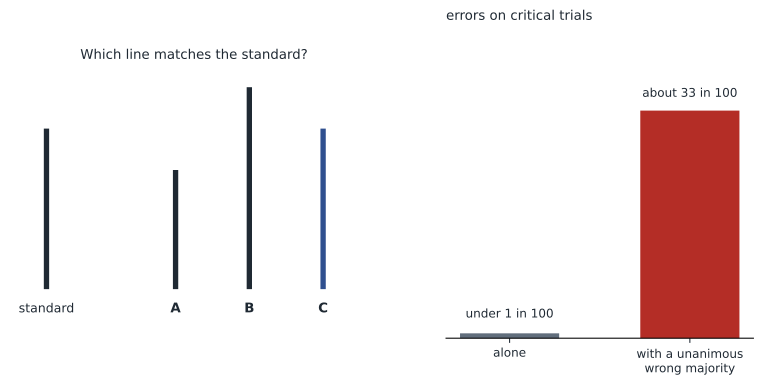
Asch varied the conditions. Conformity rose as the group grew to about three or four people and then levelled off. It dropped sharply when just one other person dissented, even if that person gave a different wrong answer: breaking unanimity freed people to trust their own eyes. Conformity was lower when participants could write their answers privately. Asch's own interpretation emphasized that most responses were independent; it is often forgotten that participants resisted the group on about two thirds of the trials.
Psychologists distinguish two motives for conformity. Normative social influence is conforming to be accepted and avoid rejection; it is strongest when behaviour is public. Informational social influence is conforming because we believe others are right; it is strongest when situations are ambiguous, as in Sherif's studies. Conformity is also affected by culture: a 1996 meta-analysis by Rod Bond and Peter Smith of studies using Asch's task in 17 countries found higher conformity in more collectivist cultures and a decline in conformity in the United States since the 1950s.
Obedience
Obedience is following direct orders from an authority. In the early 1960s, Stanley Milgram at Yale University, motivated in part by the trial of Nazi official Adolf Eichmann, set out to measure how far ordinary people would obey. Participants were told they were in a study of learning and assigned to be the 'teacher'. Each time the 'learner', a confederate in another room, made an error on a memory task, the teacher was told to give an electric shock from a machine with switches from 15 to 450 volts, labelled from 'slight shock' to 'danger: severe shock' and finally 'XXX'. No real shocks were delivered, but the learner protested, screamed, complained of a heart condition and finally fell silent.
When teachers hesitated, the experimenter used a series of prods, such as 'please continue' and 'the experiment requires that you continue'. In the best-known version, 26 of 40 participants, or 65 out of 100, continued to the maximum 450 volts. Psychiatrists Milgram consulted beforehand had predicted that only a tiny fraction would. Many participants showed intense stress, sweating, trembling and laughing nervously, yet continued.
Milgram ran many variations. Obedience fell when the learner was in the same room, and fell further when the teacher had to press the learner's hand onto a shock plate. It fell when the experimenter gave orders by telephone, and fell dramatically, to about 10 out of 100, when two other 'teachers' refused to continue. It remained high when the study was moved from Yale to an ordinary office building, though somewhat lower. In 2009, Jerry Burger conducted a partial replication that stopped at 150 volts, the point at which the learner first demands to be released, for ethical reasons, and found obedience rates only slightly lower than Milgram's at that point.
Milgram's work has been criticized and reinterpreted. Ethically, it deceived participants and caused them considerable distress; it is one reason modern ethics rules, such as those in the Tri-Council Policy Statement, require informed consent, minimal harm and careful debriefing. Methodologically, archival research by Gina Perry found that the experimenters sometimes departed from the script and that some participants suspected the shocks were not real. Alexander Haslam and Stephen Reicher argue that participants were not blindly obedient but continued when they identified with the scientific goals of the study; notably, the prod 'you have no other choice, you must go on' usually produced refusal rather than compliance.
The findings still teach something important: ordinary people can be led step by step to act against their conscience when an authority takes responsibility, when the victim is distant and when each step is only slightly worse than the last. They also show the power of dissent: seeing even one person refuse made refusal far more common.
The Stanford prison experiment
In 1971, Philip Zimbardo set up a mock prison in the basement of the psychology building at Stanford University. College men were randomly assigned to be guards or prisoners. The study was planned to last two weeks but was stopped after six days because some guards became abusive and some prisoners showed severe distress. Zimbardo concluded that the situation, not the individuals, produced the cruelty, and the study became one of the best-known in psychology.
Navarro asks the class to treat it with caution. The study was not a controlled experiment; it had a small sample, no meaningful comparison condition and was never published in a peer-reviewed journal in full. Recordings and documents examined by Thibault Le Texier, published in 2019, indicate that guards were coached by the researchers on how to behave, that Zimbardo himself acted as prison superintendent and that at least one prisoner later said his breakdown was partly acted. In 2002, Haslam and Reicher ran a BBC Prison Study with participants assigned to similar roles but without instructions to be tough; the guards did not become abusive, and the group dynamics depended on whether people identified with their groups. Many textbooks now present the Stanford study as a cautionary example of how not to draw conclusions.
People in groups
Groups affect individual performance. Social facilitation is improved performance on simple or well-learned tasks in the presence of others. In what is sometimes cited as the first social psychology experiment, Norman Triplett reported in 1898 that children wound fishing reels faster when racing others. But Robert Zajonc showed in 1965 that the presence of others impairs performance on difficult or new tasks. His explanation was that others increase arousal, which strengthens the most likely response: correct on easy tasks, incorrect on hard ones. Expert pool players shoot better with an audience; novices shoot worse.
Social loafing is the tendency to exert less effort when working in a group toward a shared goal than when working alone. In the 1880s, Max Ringelmann found that people pulling on a rope together pulled less hard per person as the group grew. In 1979, Bibb Latané and colleagues found that people clapping and shouting in groups made less noise per person than when alone, even when they only believed others were shouting with them. Loafing is reduced when individual contributions are identifiable, when the task is meaningful and when group members know and value one another.
Marcus models Ringelmann's rope-pulling with a simple formula in which each added person contributes a little less.
# Illustrative: each person pulls 100 units alone, minus 7 units for each other group member
for n in (1, 2, 4, 8):
    per_person = 100 - 7 * (n - 1)
print(f"group of {n}: {per_person} per person, {per_person * n} total")group of 1: 100 per person, 100 total group of 2: 93 per person, 186 total group of 4: 79 per person, 316 total group of 8: 51 per person, 408 total
In this made-up model, a group of eight produces 408 units in total, barely four times what one person produces alone, even though there are eight people. Navarro points out the practical lesson for group projects: make each person's contribution visible.
Deindividuation is the loss of self-awareness and self-restraint in group situations that foster arousal and anonymity. Crowds, masks, darkness and online anonymity can all reduce people's sense of individual responsibility. In one classic study, children on Halloween who were anonymous and in groups were more likely to take extra candy than those who had been asked their names. Deindividuation does not always lead to harm, though; it can also increase conformity to positive group norms, such as generosity at a charity event.
Group decisions
Group polarization is the tendency for group discussion to strengthen the views members already lean toward. If most members of a group lean somewhat toward a position, discussion tends to move the group further in that direction. Polarization occurs in juries, political groups and online communities, where people who share views reinforce one another, though research on how much social media algorithms create 'echo chambers' finds smaller effects than often claimed.
Groupthink, a term coined by Irving Janis in 1972, is a mode of thinking in which the desire for harmony in a decision-making group overrides realistic appraisal of alternatives. Janis analysed policy failures such as the failed Bay of Pigs invasion of Cuba in 1961. Symptoms include an illusion of invulnerability, pressure on dissenters, self-censorship and an illusion of unanimity. Later research has given only mixed support to Janis's full model, but its recommended remedies are widely used: leaders who withhold their own views at first, assigning someone to play devil's advocate, inviting outside experts and seeking anonymous input.
Helping and the bystander effect
In 1964, Kitty Genovese was murdered outside her apartment in New York. Early newspaper reports claimed that 38 witnesses watched and did nothing, and the case prompted John Darley and Bibb Latané to study bystander behaviour. Later investigations, including by The New York Times itself in 2016, found that the original account was badly exaggerated: far fewer people witnessed the attack, few saw enough to understand what was happening, and at least two people called police.
Darley and Latané's experiments nonetheless revealed a real phenomenon. In a 1968 study, participants who believed they were in an intercom discussion heard another participant apparently have a seizure. When participants believed they were the only listener, 85 out of 100 sought help before the end of the seizure; when they believed four others were also listening, only 31 out of 100 did. This bystander effect, the reduced likelihood of helping when others are present, is explained by diffusion of responsibility and by uncertainty about whether help is needed. Latané and Darley proposed that a bystander must notice the event, interpret it as an emergency, assume responsibility, decide how to help and then act.
Recent research adds an important qualification. In a 2019 study by Richard Philpot and colleagues, researchers analysed security camera footage of 219 real public conflicts in Amsterdam in the Netherlands, Lancaster in England and Cape Town in South Africa. In about nine out of ten conflicts, at least one bystander intervened, and the more bystanders there were, the more likely it was that someone helped. Each individual may be less likely to help in a crowd, but crowds usually include at least one helper.
Why do people help at all? Explanations include empathy, social norms such as reciprocity and social responsibility, the desire to feel good, and evolutionary pressures favouring helping kin and those who help in return. Navarro adds practical advice from the research: if you need help in a crowd, point to a specific person and give a specific instruction, such as 'You, in the blue jacket, call 9-1-1.' That removes ambiguity and diffusion of responsibility at once.
Worked problem
Predicting conformity
A student in a seminar privately disagrees with a confident claim the instructor and four classmates have endorsed aloud. Predict whether she will speak up, and identify factors that would make dissent more likely.
Show solution
- The majority is unanimous and of a size near Asch's plateau, which increases conformity.
- Responses are public, which increases normative pressure; the instructor's status adds authority.
- Dissent becomes more likely if just one other person disagrees, so a single ally matters a great deal.
- Anonymous responses, such as a written poll, would reduce normative pressure.
- An instructor who explicitly invites disagreement reduces groupthink-like pressure.
Answer: She will probably stay silent, but one ally, anonymous responding or explicit invitations to disagree would make dissent much more likely.
Common mistakes
MistakeMost people in Asch's studies conformed almost all the time.
InsteadParticipants conformed on about a third of critical trials and resisted on about two thirds.
MistakeThe Stanford prison experiment proved that situations make good people cruel.
InsteadThe study had serious flaws, including coaching of guards, and should not be treated as strong evidence.
MistakePeople in large crowds rarely help.
InsteadEach individual is less likely to help, but real-world footage shows someone intervenes in most conflicts.
MistakeGroups always make better decisions than individuals.
InsteadGroups can polarize and fall into groupthink, though structured procedures improve group decisions.
Summary and key terms
- Conformity is driven by informational influence in ambiguous situations and normative influence when behaviour is public.
- Asch found conformity on about a third of critical trials; one dissenter sharply reduced it.
- Milgram found high obedience to authority, reduced by closeness to the victim, distant authority and disobedient peers; ethics and interpretation are debated.
- The Stanford prison experiment has major methodological problems and is now treated with great caution.
- Social facilitation improves easy tasks and impairs hard ones; social loafing reduces effort in groups; deindividuation reduces restraint.
- Group polarization and groupthink can distort group decisions; structured procedures help.
- The bystander effect reduces individual helping, but real footage shows that someone intervenes in most public conflicts.
- Conformity
- Adjusting behaviour or thinking to match a group standard.
- Normative social influence
- Conforming to gain acceptance and avoid rejection.
- Obedience
- Following direct orders from an authority.
- Social loafing
- Reduced individual effort when working in a group.
- Groupthink
- Group decision making in which the desire for harmony overrides realistic appraisal.
- Diffusion of responsibility
- The reduced sense of personal responsibility when others are present.
Practice problems
Work each problem on paper first, then reveal the answer to check.
What single change most reduced conformity in Asch's studies?
Show answer
Having one other person break the group's unanimity.
In Milgram's best-known version, what share of participants went to 450 volts?
Show answer
26 of 40, or 65 out of 100.
In the rope-pulling code, what does a group of four produce in total?
Show answer
316 units, because each person pulls 79.
What did Philpot's camera study find?
Show answer
At least one bystander intervened in about nine out of ten public conflicts, and more bystanders made help more likely.
Lesson quiz · 5 questions
Score 60% or more to complete this lesson.
Create a free account to save your progress, take quizzes and earn a certificate.