
PSYC-105 · Lesson 1 of 12 · 21 min
Developmental psychology: prenatal development and infancy
▶ Video coming soon A video version of this lesson is on the way.
The second term of Dr. Leah Navarro's introductory psychology course at Harbourview College in Kingston opens the way the first one closed: with a question nobody can answer from intuition alone. 'Last term we studied how a mind works,' she says. 'This term we ask how a mind grows, how it differs from other minds, how it is shaped by other people, and what happens when it suffers. We start at the very beginning, before birth.' Ruth Okonkwo, who raised twins while working in a pharmacy, laughs that she has opinions about all of this. Navarro tells her that opinions are welcome, and that the job this term is to test them against evidence.
Developmental psychology is the study of how people change, and stay the same, across the lifespan, from conception to death. It covers physical growth, cognitive change and social and emotional development, and it asks how those strands influence one another. A baby who learns to crawl, for example, suddenly experiences the world differently: she can approach and leave her caregiver, and her caregiver starts saying 'no' far more often. Physical, cognitive and social development are tangled together from the start.
Three big questions
Three questions run through the whole field. The first is nature and nurture: how much of development is driven by genes and biological maturation, and how much by experience? As lesson 6 of the first course showed, the modern answer is that the question is badly framed. Genes are expressed in environments, environments are partly chosen and shaped by people with particular genes, and almost every trait reflects both working together.
The second is continuity and stages. Does development proceed gradually, like a ramp, or in distinct steps, like a staircase? Stage theorists such as Jean Piaget and Erik Erikson, whom we meet in the next lessons, described qualitatively different periods in which children or adults think or face challenges in new ways. Many researchers now see development as more continuous and uneven than the classic stage theories proposed, with abilities appearing gradually and at different times in different areas.
The third is stability and change. Do the traits we see in infancy persist into adulthood, or are people transformed by experience? The evidence points to both. Some features, such as a tendency to be cautious in unfamiliar situations, show moderate stability from early childhood. Yet people also change a great deal, and the stability of personality increases with age: a 30-year-old's traits predict her traits at 40 far better than a 3-year-old's predict hers at 13.
How development is studied
Developmental researchers use the methods described in the first course, but time adds a special problem. In a cross-sectional study, researchers compare people of different ages at the same moment, for example testing the memory of 20-, 40- and 60-year-olds this year. Cross-sectional studies are quick, but age is confounded with cohort, the group of people born around the same time who share historical experiences. Differences between 20- and 60-year-olds might reflect ageing, or they might reflect different schooling, nutrition or familiarity with technology.
In a longitudinal study, researchers follow the same people over time, testing the same group at 20, 40 and 60. Longitudinal studies separate ageing from cohort effects and show how individuals change, but they are slow and expensive, and participants drop out, often in ways that bias the results: people who stay in long studies tend to be healthier and better educated. A cross-sequential design combines the two by following several cohorts over time.
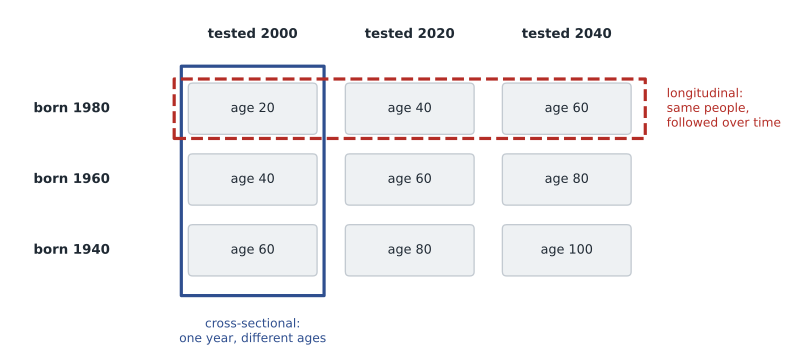
The distinction matters. Early cross-sectional studies suggested that intelligence declines steadily from early adulthood. Longitudinal research, such as the Seattle Longitudinal Study begun by K. Warner Schaie in 1956, showed that much of the apparent decline was a cohort effect: younger cohorts had more education. Many abilities hold steady until the sixties or later, as lesson 4 describes.
From conception to birth
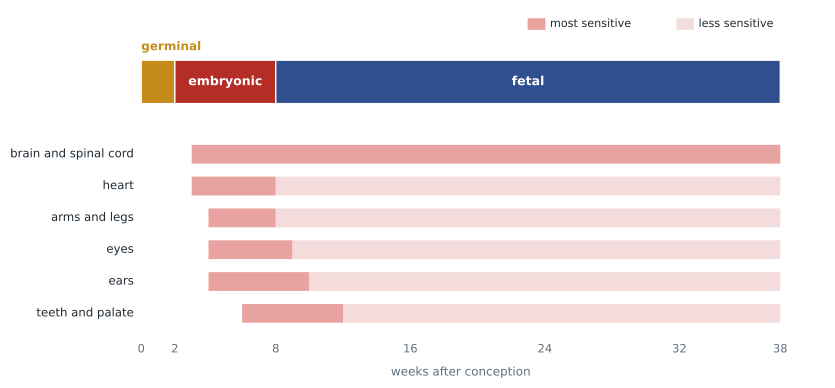
Prenatal development is usually divided into three periods. The germinal period covers roughly the first two weeks after conception. The fertilized egg, called a zygote, divides rapidly as it travels down the fallopian tube, and about a week after conception it implants in the wall of the uterus. Many zygotes never implant; a large share of conceptions end without the pregnancy ever being noticed.
The embryonic period runs from about the third through the eighth week. The embryo's cells differentiate into the major organs and structures: the neural tube that becomes the brain and spinal cord forms in the first month, the heart begins to beat, and arms, legs, eyes and ears take shape. Because so much is being built at once, this is the period of greatest vulnerability to harm. The fetal period runs from about the ninth week until birth. Organs grow and mature, the brain develops rapidly, and by around 22 to 24 weeks, the age of viability, a fetus born very early has some chance of survival with intensive care.
Teratogens and sensitive periods
A teratogen is any agent, such as a drug, chemical, infection or radiation, that can harm a developing embryo or fetus. Whether harm occurs depends on the dose, the timing and the genes of both parent and fetus. Timing matters because each organ has a sensitive period, the window when it is forming and most easily disrupted. The same exposure can cause limb defects in week 6 and no visible defect in week 30, though the brain remains vulnerable throughout.
The thalidomide disaster made the principle unforgettable. Thalidomide was sold in the late 1950s and early 1960s as a sedative and a treatment for morning sickness, including in Canada, where it remained available for several months after it was withdrawn in Germany. Taken during a narrow window early in pregnancy, it caused severe limb differences and other effects in thousands of children. The tragedy led to much stricter testing of medicines.
Alcohol is the most common preventable cause of developmental disability. Heavy drinking during pregnancy can cause fetal alcohol syndrome, with characteristic facial features, growth restriction and brain damage, and lower levels of exposure can cause a range of effects on learning, attention and behaviour without the facial features. In Canada, the umbrella diagnosis is fetal alcohol spectrum disorder (FASD), and the Canada FASD Research Network estimates that it affects about 4 in every 100 people. Because no safe level of alcohol in pregnancy has been established, Health Canada and Canada's Guidance on Alcohol and Health advise not drinking at all while pregnant or trying to become pregnant.
Other teratogens include tobacco smoke, which is linked to low birth weight and premature birth; some prescription medicines, which is why pregnant people are advised to check every drug with a pharmacist or physician; infections such as rubella and Zika; and high levels of stress hormones. Ruth recalls how often she was asked at the pharmacy whether a cold remedy was safe in pregnancy. Navarro notes that untreated illness can also harm a fetus, so the decision is about weighing risks, not simply avoiding all medicine.
The competent newborn
Newborns were once described as blank and passive. Research has shown that they arrive ready to learn about the people around them. They have reflexes that aid survival: the rooting reflex turns the head toward a touch on the cheek, the sucking reflex begins when something touches the lips, and the grasping reflex closes the hand around a finger. Most of these reflexes fade over the first months as the cortex matures.
Newborns' senses are already working, though vision is blurry. They prefer to look at face-like patterns over scrambled ones and turn toward the sound of human voices. In a classic 1980 study, Anthony DeCasper and William Fifer showed that newborns would change their sucking rate to hear a recording of their own mother's voice rather than another woman's, suggesting they had learned her voice in the womb. Newborns can also distinguish the smell of their own parent's milk within days.
How do researchers know what a baby who cannot speak perceives? One method uses habituation, the decrease in response to a repeated stimulus described in the first course. An infant is shown the same picture over and over until she looks at it less and less. Then a new picture is shown. If looking time recovers, a response called dishabituation, the infant must have noticed the difference. Marcus Lee writes a short simulation of a habituation experiment.
# Habituation: looking time falls by a fixed fraction each trial, then recovers for a new picture
look = 20.0  # seconds on the first trial
for trial in range(1, 7):
    print(f"trial {trial}: {look:.1f} s (same picture)")
    look *= 0.7
print(f"trial 7: {look * 2.5:.1f} s (new picture)")trial 1: 20.0 s (same picture) trial 2: 14.0 s (same picture) trial 3: 9.8 s (same picture) trial 4: 6.9 s (same picture) trial 5: 4.8 s (same picture) trial 6: 3.4 s (same picture) trial 7: 5.9 s (new picture)
Looking time falls from 20 seconds to under 4, then jumps when the picture changes. Researchers usually set a criterion, such as looking time dropping to half its starting value, before showing the test picture. Studies using this method show that infants a few months old can tell apart colours, shapes, speech sounds and even small numbers of objects.
The developing brain and body
At birth the brain has nearly all its neurons, but it is only about a quarter of its adult weight. Growth comes from the branching of dendrites, the formation of trillions of synapses and the myelination of axons. In the first years of life, synapses are produced far faster than they are needed, and then experience prunes them back: connections that are used are strengthened and kept, and unused ones are eliminated. This 'use it or lose it' process makes early experience important, but it continues for years, and in the frontal lobes into the twenties.
The importance of early experience is shown starkly by research on children raised in severely depriving orphanages. In the Bucharest Early Intervention Project, begun in 2000, Romanian children in institutional care were randomly assigned either to stay in care as usual or to move to foster families. Children placed in foster care, especially before about age two, showed better cognitive development and more secure relationships than those who remained in institutions. The study is also a reminder that children are resilient: many who suffered early deprivation made large gains after placement.
Motor development follows a predictable sequence: babies lift their heads before they sit, sit before they crawl and crawl before they walk, with most walking independently somewhere between about 9 and 17 months. The sequence reflects maturation of the nervous system and muscles, but timing varies with experience and culture. In some cultures where infants are massaged, exercised and carried upright, babies sit and walk earlier on average. When public health campaigns began advising that babies sleep on their backs to reduce the risk of sudden infant death, many infants began to crawl a little later, because they spent less time on their stomachs, but they reached later milestones normally.
Memory and temperament in infancy
Few adults remember anything before about age three or four, a phenomenon called infantile amnesia. Yet infants clearly learn and remember. In studies by Carolyn Rovee-Collier, three-month-olds learned that kicking a leg tied with a ribbon to a mobile made the mobile move. Days later, they kicked vigorously when they saw the same mobile, but not a different one. Infant memories are real, but they seem to depend on the context in which they were formed and are rarely retained into later childhood, perhaps because the hippocampus and language are still developing.
From the first weeks, babies differ in temperament, their characteristic emotional reactivity and intensity. In a long-running study begun in the 1950s, Alexander Thomas and Stella Chess classified about 40 out of 100 infants as easy, cheerful and regular in their routines; about 10 out of 100 as difficult, irritable and intense; and about 15 out of 100 as slow to warm up, cautious with new things; the rest did not fit neatly. Jerome Kagan later studied infants who reacted strongly to unfamiliar stimuli. Many became shy, inhibited children, although a sizeable minority did not, especially when parents gently encouraged them to approach new situations.
Ruth recognizes her own children. One twin cried at every new face; the other would go to anyone. 'They had the same parents and the same house,' she says, 'and they were different from the first week.' Navarro points out that twins share their environment yet often differ, which is one reason researchers believe temperament has a substantial biological basis. She adds that temperament is not destiny: a cautious child in a supportive family often becomes a thoughtful, socially skilled adult.
Worked problem
Choosing a research design
A researcher wants to know whether reading to babies improves their vocabulary at age three, and also whether vocabulary differs between children born before and after tablets became common. Which design fits each question?
Show solution
- The first question is about how a practice affects later outcomes in the same children, so follow children over time.
- Better still, because families who read more may differ in other ways, randomly assign some families to a reading program and compare vocabulary at age three.
- The second question is about cohort differences, so compare children of the same age born in different years.
- Be cautious with either answer: cohort comparisons cannot isolate one cause, because many things change between cohorts.
Answer: Use a longitudinal design, ideally an experiment with random assignment, for the first question, and a comparison of birth cohorts at the same age for the second.
Common mistakes
MistakeCross-sectional differences between age groups show what happens as people age.
InsteadThey may reflect cohort differences; longitudinal designs are needed to separate ageing from cohort.
MistakeA small amount of alcohol in pregnancy has been shown to be safe.
InsteadNo safe level has been established, so health agencies advise avoiding alcohol entirely.
MistakeNewborns cannot perceive or learn anything meaningful.
InsteadNewborns recognize voices and smells, prefer faces and learn rapidly.
MistakeEarly experience fixes development permanently.
InsteadEarly experience matters, but the brain remains plastic and children often recover after deprivation ends.
Summary and key terms
- Developmental psychology studies change and stability across the lifespan, asking about nature and nurture, continuity and stages, and stability and change.
- Cross-sectional studies confound age with cohort; longitudinal studies follow the same people but are slow and lose participants.
- Prenatal development has germinal, embryonic and fetal periods; the embryonic period is the most vulnerable to teratogens.
- Teratogens such as alcohol, thalidomide and tobacco cause harm depending on dose, timing and genes.
- Newborns have survival reflexes, prefer faces and recognize familiar voices; habituation methods reveal infant perception.
- The brain grows through synapse formation, pruning and myelination; early deprivation harms development, but placement in families helps.
- Infants remember in context, though infantile amnesia hides early memories; temperament differs from birth and is moderately stable.
- Cohort
- A group of people born around the same time who share historical experiences.
- Longitudinal study
- Research that follows the same people over time.
- Teratogen
- An agent such as a drug, chemical or infection that can harm prenatal development.
- Sensitive period
- A window of time when a structure or ability is especially open to influence or harm.
- Habituation
- A decrease in response to a repeated stimulus, used to study what infants perceive.
- Temperament
- A person's characteristic emotional reactivity and intensity, visible from infancy.
Practice problems
Work each problem on paper first, then reveal the answer to check.
Why might a cross-sectional study overestimate memory decline with age?
Show answer
Older cohorts may have had less education or different experiences, so differences between age groups may reflect cohort rather than ageing.
Why are most structural birth defects linked to exposures early in pregnancy?
Show answer
Most organs form during the embryonic period, which is their sensitive period.
In the habituation code, why is the new picture's looking time important?
Show answer
Recovery of looking time shows the infant noticed that the new picture is different.
What did the Bucharest Early Intervention Project add to earlier orphanage studies?
Show answer
Random assignment to foster care, which showed that family placement causes better outcomes, especially when early.
Lesson quiz · 5 questions
Score 60% or more to complete this lesson.
Create a free account to save your progress, take quizzes and earn a certificate.