
PSYC-105 · Lesson 12 of 12 · 21 min
Treatment: psychological and biomedical therapies
▶ Video coming soon A video version of this lesson is on the way.
On the last week of the term, Navarro brings in a guest: a clinical psychologist who works at a community mental health centre and has agreed to answer the class's questions. Fatima asks what actually happens in therapy. Owen asks whether apps work. Ruth asks how her brother's medication was chosen. Marcus asks how anyone knows whether a treatment works at all. 'Those four questions,' the psychologist says, 'are the whole field.' This lesson surveys the main psychological and biomedical treatments, what the evidence says about them and how people find care, and closes with a review of the course.
Who provides care
Many kinds of professionals treat psychological disorders. Psychiatrists are physicians who specialize in mental health and can prescribe medication. Clinical and counselling psychologists usually hold doctoral degrees and provide assessment and psychotherapy; in Canada, psychologists are regulated by provincial colleges, such as the College of Psychologists and Behaviour Analysts of Ontario, and they cannot prescribe medication. Social workers, counsellors, psychotherapists, psychiatric nurses and family physicians also provide much of the care, and peer support workers draw on their own lived experience.
Access is a major problem. In Canada, provincial health insurance covers visits to physicians and psychiatrists, but care from psychologists and other therapists is usually paid privately or through workplace benefits, which leaves many people without affordable therapy; some provinces have introduced publicly funded programs, such as Ontario Structured Psychotherapy, which offers free cognitive behavioural therapy for anxiety and depression. Waiting lists, cost and stigma mean that many people with disorders receive no treatment.
Psychodynamic and humanistic therapies
Psychoanalysis, as practised by Freud, aimed to bring unconscious conflicts into awareness through free association, dream analysis and interpretation of resistance and transference, the patient's feelings toward the therapist that echo earlier relationships. Classical psychoanalysis involved several sessions a week for years. Modern psychodynamic therapy is shorter and more focused. It still explores how past experiences and patterns of relating shape present difficulties, and trials show it is effective for depression and some other conditions, although it has been studied less than cognitive behavioural therapy.
Humanistic therapies aim to promote growth and self-understanding. Carl Rogers's person-centred therapy emphasizes the therapist's genuineness, acceptance and empathy. Rogers practised active listening: echoing, restating and clarifying what the client says, and acknowledging feelings, so that clients can understand themselves better. Research shows that empathy and a strong working relationship are among the best predictors of good outcomes across many therapies.
Behaviour therapies
Behaviour therapies apply learning principles from the first course to change problem behaviours directly. Exposure therapy treats anxiety by having people face what they fear, gradually and safely, until anxiety decreases, breaking the avoidance cycle described in lesson 11. In systematic desensitization, developed by Joseph Wolpe in the 1950s, people learn relaxation and then work up a hierarchy of feared situations. In modern exposure, a person with a fear of dogs might look at pictures, then watch a dog through a window, then stand in a room with a calm dog, then pet it, staying in each situation until fear subsides. Exposure can also be done in imagination or with virtual reality, which is useful for fears of flying or heights.
Exposure and response prevention is the leading psychological treatment for obsessive-compulsive disorder: people are exposed to triggers, such as touching a doorknob, and prevented from performing compulsions, such as washing, so that they learn the anxiety fades without them. Aversive conditioning pairs an unwanted behaviour with an unpleasant state and is now rarely used because of ethical concerns and limited effectiveness. Operant techniques, such as token economies in which desired behaviours earn tokens exchangeable for privileges, have been used in schools, hospitals and treatment programs.
Cognitive and cognitive behavioural therapies
Cognitive therapies target the thoughts that drive distress. Aaron Beck, working with depressed patients in the 1960s, found that they habitually interpreted events negatively, through errors such as all-or-nothing thinking, overgeneralizing from one event, catastrophizing and discounting positive experiences. Cognitive therapy teaches people to identify these automatic thoughts, examine the evidence for them and generate more balanced alternatives. Albert Ellis's rational emotive behaviour therapy similarly challenged irrational beliefs, such as 'I must be loved by everyone'.
Cognitive behavioural therapy, or CBT, combines cognitive techniques with behavioural ones such as exposure, activity scheduling and skills practice. It is structured, focused on present problems and typically lasts 12 to 20 sessions, with homework between sessions. CBT is the most extensively tested psychotherapy and is effective for depression, anxiety disorders, insomnia, eating disorders and many other conditions. For depression, behavioural activation, scheduling rewarding and meaningful activities to break the cycle of withdrawal, works about as well as full CBT in several trials and is simpler to deliver.
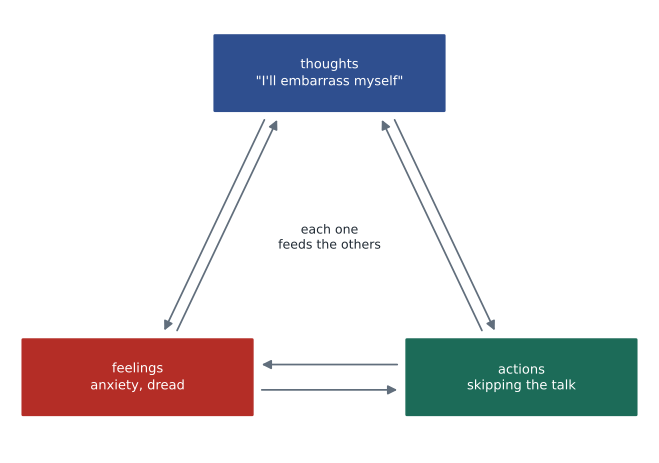
Newer approaches extend CBT. Dialectical behaviour therapy, developed by Marsha Linehan for people with borderline personality disorder and chronic suicidal behaviour, combines acceptance and change, teaching mindfulness, distress tolerance, emotion regulation and interpersonal skills; trials show it reduces self-harm. Acceptance and commitment therapy encourages people to accept difficult thoughts and feelings rather than fight them, and to act in line with their values. Mindfulness-based cognitive therapy reduces the risk of relapse in people with recurrent depression.
Group, family and digital therapies
Group therapy treats several people together, saving time and money and showing members that others share their problems. Family therapy treats the family as a system, on the view that one member's problems are linked to family patterns of communication and conflict; family-based treatment is the leading treatment for adolescents with anorexia nervosa. Self-help and support groups, such as Alcoholics Anonymous, offer mutual support, and research suggests that participation is associated with better outcomes for many people.
Owen's question about apps has a nuanced answer. Internet-delivered CBT, especially when guided by a therapist through brief messages, works about as well as face-to-face CBT for anxiety and depression in many trials. In Canada, some provinces offer guided online CBT programs free of charge. Unguided apps have smaller effects on average, many people stop using them, and most of the thousands of mental health apps available have never been tested. Video therapy sessions, which expanded rapidly during the COVID-19 pandemic, appear about as effective as in-person sessions for many people.
Does psychotherapy work?
In 1952, Hans Eysenck reviewed studies and claimed that people who received psychotherapy improved no more than those who did not, provoking decades of research. Today the answer is clear: psychotherapy works. Meta-analyses combining thousands of studies find that the average person who receives therapy is better off than about three quarters of comparable untreated people, a large effect. Marcus shows where that figure comes from, using a standard measure of effect size and the normal distribution.
from statistics import NormalDist
# Effect size d: the difference between treated and untreated averages, in standard deviations
for d in (0.3, 0.5, 0.8):
    share = NormalDist().cdf(d)
print(f"d = {d}: average treated person is better off than {share:.2f} of untreated people")d = 0.3: average treated person is better off than 0.62 of untreated people d = 0.5: average treated person is better off than 0.69 of untreated people d = 0.8: average treated person is better off than 0.79 of untreated people
An effect size of about 0.8, typical of many psychotherapy meta-analyses for common conditions, means that the average treated person scores better than about 79 out of 100 untreated people. The effect sizes for particular treatments and conditions vary, and published studies tend to overestimate effects because studies with small or null results are less likely to be published.
Do some therapies work better than others? For specific problems, yes: exposure-based treatments for phobias, panic and obsessive-compulsive disorder, and CBT for many anxiety conditions, have particularly strong evidence. For depression and general distress, many therapies produce broadly similar results when delivered well, a pattern sometimes called the Dodo bird verdict after the bird in Alice in Wonderland who declares that 'everybody has won, and all must have prizes'. Common factors may explain this: a strong therapeutic alliance, hope, a plausible rationale for the person's problems, a structured way to work on them and a caring relationship.
Not all popular treatments are supported. Recovered-memory techniques, which aim to uncover supposedly repressed memories of abuse, can create false memories, as research by Elizabeth Loftus and others showed. Critical incident debriefing, once routinely given to people right after a trauma, does not prevent posttraumatic stress disorder and may sometimes do harm. Evidence-based practice means combining the best available research with clinical expertise and the patient's values and preferences.
Biomedical therapies
Drug therapies are the most widely used biomedical treatments. Antidepressants, especially selective serotonin reuptake inhibitors, or SSRIs, such as fluoxetine and sertraline, increase the availability of serotonin at synapses by blocking its reuptake. They take several weeks to reach full effect, and side effects can include nausea, sleep changes and sexual problems. A large 2018 network meta-analysis by Andrea Cipriani and colleagues, combining 522 trials, found that all 21 antidepressants studied were more effective than placebo for adults with major depression, though the average advantage over placebo was modest and larger for more severe depression. For many people, combining medication and psychotherapy works best.
Anti-anxiety medications such as benzodiazepines act quickly by enhancing the effects of the inhibitory neurotransmitter GABA, but they can cause dependence and are generally recommended only for short-term use; SSRIs are usually preferred for long-term treatment of anxiety disorders. Antipsychotic drugs, which block dopamine receptors, reduce positive symptoms of schizophrenia; older ones can cause movement problems, and newer ones can cause weight gain and metabolic problems. Clozapine helps some people whose symptoms do not respond to other antipsychotics. Lithium, a simple salt whose mood-stabilizing effect was discovered by the Australian psychiatrist John Cade in 1949, remains one of the most effective treatments for bipolar disorder and reduces the risk of suicide, though blood levels must be monitored carefully.
Ruth asks how her brother's medication was chosen. The psychologist explains that prescribers weigh evidence for the condition, the person's history, side effects, other medical conditions and the person's preferences, and that finding the right medication and dose often takes several attempts. Medication decisions are made with a prescriber and should never be changed or stopped abruptly without medical advice.
Brain stimulation treatments are used mainly when other treatments have not worked. Electroconvulsive therapy, or ECT, delivers a brief electrical current to the brain under general anaesthesia and a muscle relaxant, producing a controlled seizure. It is far removed from its frightening portrayal in films and is one of the most effective treatments for severe depression that has not responded to other treatments, though it can cause memory problems around the treatment period. Repetitive transcranial magnetic stimulation uses magnetic pulses applied to the scalp and has modest benefits for some people with depression. Ketamine and the related drug esketamine, given under medical supervision, can rapidly reduce depressive symptoms in some people whose depression has resisted other treatments; research continues into their long-term effects, and into psychedelic-assisted therapies, which are still experimental.
Lifestyle factors are also treatments in their own right. Regular exercise, adequate sleep, time in nature, social connection and helping others all improve mood, and exercise has effects comparable to those of psychotherapy and medication for mild to moderate depression in some trials. These approaches are not substitutes for professional care when it is needed, but they support recovery and well-being for everyone.
Capstone: putting the course together
For the final class, Navarro asks the four students to apply what they have learned to a single case: a 19-year-old named Jordan, in the first year of college, who has stopped attending classes, sleeps most of the day, says he feels worthless and has withdrawn from friends since his parents' separation.
Fatima starts with the lifespan view from lessons 1 to 4: Jordan is in emerging adulthood, a period of identity exploration and instability, and the transition to college removes familiar supports. Marcus brings in stress and coping from lesson 6: a major life change and loss of support have combined with avoidant coping. Owen draws on lessons 8 and 9: Jordan may be attributing his struggles to personal failure rather than to an unusually hard situation, and withdrawal cuts him off from the social support that buffers stress.
Ruth applies lessons 10 and 11. Jordan's symptoms, lasting weeks and impairing his functioning, are consistent with major depression, although only a professional can diagnose it, and the diathesis-stress model suggests looking at both vulnerability, such as family history, and current stressors. She also notes the importance of asking Jordan directly about thoughts of suicide and making sure he knows about crisis support, including 9-8-8.
For treatment, the class proposes connecting Jordan with the college counselling centre for an assessment; behavioural activation or CBT, starting with small scheduled activities such as attending one class and having lunch with a friend; attention to sleep and exercise; and an evaluation for medication if symptoms are severe or do not improve. Navarro adds the most important point: Jordan's outlook is good. Depression is common, treatable and not a sign of weakness, and most people recover.
Worked problem
Matching treatments to problems
Suggest an evidence-based psychological treatment for each: (a) A woman avoids elevators because of intense fear. (b) A man spends hours a day checking that the stove is off. (c) A student with depression has stopped doing everything she used to enjoy. (d) An adolescent with anorexia nervosa lives with her parents.
Show solution
- (a) A specific phobia: exposure therapy, gradually and safely facing elevators.
- (b) Obsessive-compulsive disorder: exposure and response prevention, facing the urge to check without checking.
- (c) Depression with withdrawal: behavioural activation or CBT.
- (d) Anorexia nervosa in an adolescent: family-based treatment, alongside medical monitoring.
Answer: Exposure therapy, exposure and response prevention, behavioural activation or CBT, and family-based treatment, respectively.
Common mistakes
MistakeTherapy is just talking and doesn't really work.
InsteadMeta-analyses show large average benefits, comparable to many medical treatments.
MistakeAntidepressants work immediately.
InsteadSSRIs usually take several weeks to reach full effect.
MistakeECT is a cruel, outdated treatment.
InsteadModern ECT is given under anaesthesia and is highly effective for severe, treatment-resistant depression.
MistakeAll mental health apps are effective.
InsteadGuided internet CBT has good evidence, but most apps are untested and unguided apps have smaller effects.
Summary and key terms
- Psychiatrists, psychologists, social workers, counsellors, nurses, family physicians and peer workers provide care; access depends on funding and coverage.
- Psychodynamic therapy explores patterns from past relationships; humanistic therapy emphasizes empathy and acceptance.
- Behaviour therapies such as exposure and exposure and response prevention apply learning principles; CBT combines cognitive and behavioural techniques.
- DBT, ACT and mindfulness-based approaches extend CBT; group, family and guided internet therapies are effective for many problems.
- Psychotherapy works, with large average effects; specific treatments excel for specific problems, and common factors matter.
- Medications include antidepressants, anti-anxiety drugs, antipsychotics and lithium; brain stimulation such as ECT helps severe depression.
- Exercise, sleep and social connection support recovery; most people with common disorders improve with treatment.
- Exposure therapy
- Treatment that reduces fear by facing feared situations safely and gradually.
- Cognitive behavioural therapy
- A structured therapy that changes unhelpful thoughts and behaviours.
- Behavioural activation
- A treatment for depression that schedules rewarding and meaningful activities.
- Therapeutic alliance
- The working relationship and shared goals between therapist and client.
- SSRI
- A selective serotonin reuptake inhibitor, a common class of antidepressant.
- Electroconvulsive therapy
- A treatment that induces a brief, controlled seizure under anaesthesia, used for severe depression.
Practice problems
Work each problem on paper first, then reveal the answer to check.
Why does exposure therapy work for phobias?
Show answer
It breaks the avoidance cycle, allowing the person to learn that the feared situation is safe as anxiety subsides.
In the code, what does an effect size of 0.5 mean?
Show answer
The average treated person is better off than about 69 out of 100 untreated people.
What is the Dodo bird verdict?
Show answer
The finding that many well-delivered therapies for depression and general distress produce similar results.
Why are benzodiazepines generally used only short term?
Show answer
They can cause dependence.
Lesson quiz · 5 questions
Score 60% or more to complete this lesson.
Create a free account to save your progress, take quizzes and earn a certificate.