
PSYC-105 · Lesson 2 of 12 · 20 min
Childhood: cognitive development
▶ Video coming soon A video version of this lesson is on the way.
Ruth brings a short video to class. In it, one of her twins, at about four years old, watches her pour juice from a short, wide glass into a tall, thin one. Asked which glass has more juice, the child points confidently at the tall one, even though she watched every drop being poured. A year later, the same child, shown the same thing, rolls her eyes: 'It's the same juice. You just poured it.' Navarro pauses the video. 'Something changed in that year,' she says, 'and the man who made this little test famous spent his life trying to explain what.'
Cognitive development is the growth of thinking, reasoning, remembering and problem solving from infancy through adolescence. This lesson looks at the two most influential theories, those of Jean Piaget and Lev Vygotsky, at what later research has added and corrected, and at how children come to understand other minds and moral rules.
Piaget: children as scientists
Jean Piaget, a Swiss psychologist who began his career working on intelligence tests in Paris in the 1920s, became fascinated not by children's right answers but by their wrong ones. Children of the same age made the same kinds of mistakes, which suggested to him that they were not simply less knowledgeable than adults but thought in a different way. He spent decades observing children, including his own three, and proposed that cognitive development proceeds through a series of stages.
Piaget saw children as active builders of knowledge. They organize their experience into schemas, mental frameworks for understanding the world, such as a schema for 'dog'. New experiences are either fitted into existing schemas, a process he called assimilation, as when a toddler calls a cow a 'doggie', or they force schemas to change, called accommodation, as when the child learns that cows are a different kind of animal. Development, for Piaget, is a continual balancing of these two processes.
The four stages
In the sensorimotor stage, from birth to about age two, infants understand the world through their senses and actions. A key achievement is object permanence, the understanding that objects continue to exist when they cannot be seen. Piaget observed that young infants stopped searching when a toy was hidden under a cloth, as if out of sight meant out of existence, and that babies began searching for hidden objects at around eight months.
In the preoperational stage, from about two to seven, children use language and symbols, and pretend play flourishes, but their thinking is not yet logical in Piaget's sense. They are egocentric, meaning they have difficulty taking another person's perspective. In his three-mountains task, children were asked to choose a picture showing what a doll on the other side of a model landscape would see; preoperational children usually chose their own view. They also lack conservation, the understanding that quantity stays the same when shape or arrangement changes, which is exactly what Ruth's video shows.
In the concrete operational stage, from about seven to eleven, children reason logically about concrete objects and events. They grasp conservation, can classify objects in several ways at once and understand that operations can be reversed, so that pouring the juice back would restore the original level. In the formal operational stage, from about twelve, adolescents can reason about abstract and hypothetical ideas, test hypotheses systematically and think about thinking itself.
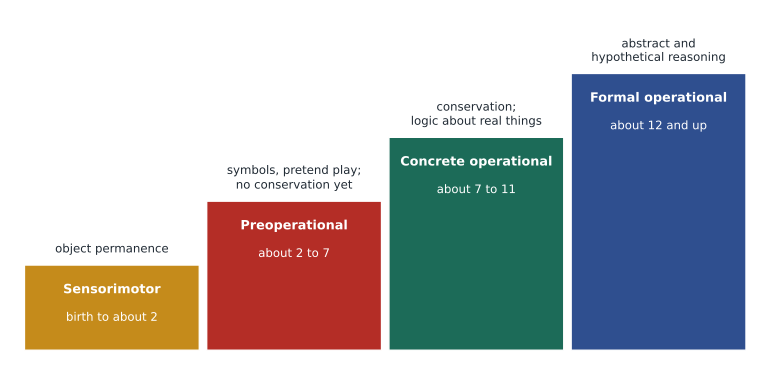
| Stage | Approximate ages | Key features |
|---|---|---|
| Sensorimotor | Birth to 2 | Learning through senses and actions; object permanence |
| Preoperational | 2 to 7 | Symbols and language; egocentrism; no conservation |
| Concrete operational | 7 to 11 | Conservation; logical reasoning about concrete objects |
| Formal operational | 12 and up | Abstract, hypothetical and systematic reasoning |
What later research changed
Piaget's observations have been replicated many times; children really do fail his conservation tasks at four and pass them at seven. But later researchers found that his methods often underestimated young children. In studies using looking time, the method described in lesson 1, Renée Baillargeon and others reported that infants of only a few months looked longer at 'impossible' events, such as a screen rotating through the space where a hidden box should be, which suggests some understanding that objects persist long before babies search for them. These findings are debated, because looking longer can have several explanations, but most researchers agree that infants know more than Piaget thought.
Similarly, preschoolers are less egocentric than the three-mountains task suggests. When tasks are simpler and more familiar, such as hiding a doll from a toy police officer, children of three or four can often take another's visual perspective. Formal operations, on the other hand, may arrive later and less completely than Piaget proposed: many adults reason abstractly in their own field but not in unfamiliar ones, and schooling strongly affects performance on formal tasks.
The biggest change concerns stages themselves. Children's abilities often develop unevenly: a child may conserve number before volume, or reason well about familiar materials and poorly about unfamiliar ones. Many researchers now favour information-processing approaches, which describe development as gradual increases in working memory capacity, processing speed and the use of strategies such as rehearsal. Still, Piaget's central insight, that children actively construct their understanding and think differently from adults, remains foundational, and his tasks are still used worldwide.
Vygotsky: learning with others
Lev Vygotsky, a Russian psychologist working in the 1920s and 1930s who died young in 1934, emphasized something Piaget treated as secondary: the social world. For Vygotsky, children learn through interaction with more skilled people, such as parents, teachers and older children, and through the tools of their culture, above all language. Thinking begins as conversation between people and gradually becomes internal. Young children often talk to themselves aloud while solving problems, and Vygotsky saw this private speech as a step toward inner speech and self-regulation.
Vygotsky's best-known idea is the zone of proximal development: the gap between what a child can do alone and what the child can do with help. Learning is most effective in that zone. Effective helpers provide scaffolding, support that is adjusted to the child's level and gradually withdrawn as competence grows, like the scaffolding around a building under construction. Fatima Haddad, who tutors high school chemistry, recognizes the idea immediately: she gives fewer hints each time a student solves a similar problem.
Navarro asks the class to compare the two theories. Piaget's child is a lone scientist, discovering the world through action; Vygotsky's child is an apprentice, learning through guided participation in culture. Most modern educators draw on both: children need hands-on exploration and they need skilled guidance pitched just beyond their current level.
Theory of mind
Around age four, children develop a theory of mind, the understanding that other people have beliefs, desires and intentions that may differ from their own and from reality. The classic test is the false-belief task. In a version developed by Heinz Wimmer and Josef Perner in 1983 and later popularized as the Sally-Anne task, a child sees a doll named Sally put a marble in a basket and leave. Another doll, Anne, moves the marble to a box. When Sally returns, where will she look for her marble?
Most three-year-olds say she will look in the box, where the marble really is. Most children by about four or five say she will look in the basket, because she did not see the marble moved and so holds a false belief. Children with older siblings and those whose parents talk often about thoughts and feelings tend to pass false-belief tasks earlier. Some studies using looking time or eye movements suggest that even toddlers show implicit sensitivity to false beliefs, a finding that has proved difficult to replicate consistently and remains under active investigation.
Theory of mind has wide consequences. It underlies deception, persuasion, empathy and the understanding of stories. Many autistic children pass false-belief tasks later than other children, and researchers once proposed that a theory-of-mind deficit explained autism. That view is now considered too simple: autistic people vary greatly, many pass such tasks, and difficulties in social understanding can run both ways, as non-autistic people also often misread autistic people's intentions.
Memory, attention and executive function
Children's memory improves dramatically through the school years, partly because working memory capacity grows and partly because children learn strategies. Young children rarely rehearse a list spontaneously; by about seven many do, and later they learn to organize material into categories. Children also develop metacognition, knowing about their own knowledge and memory, which lets them judge when they have studied enough.
Executive function is a set of skills that includes working memory, inhibitory control and cognitive flexibility, the ability to switch between rules. These skills develop gradually through childhood and adolescence along with the frontal lobes. A well-known study of self-control is the marshmallow test, in which preschoolers could eat one treat now or wait to receive two. Early follow-ups by Walter Mischel's team at Stanford reported that children who waited longer had better outcomes years later. But a larger and more diverse replication by Tyler Watts, Greg Duncan and Haonan Quan in 2018 found that the link was about half as strong as originally reported and shrank much further once family background and early abilities were taken into account.
Marcus writes a short calculation to show what a shrinking correlation means for prediction, using round values in the range reported for the uncontrolled and fully controlled links; the exact figures depend on the outcome measured. The square of a correlation gives the share of variation in one measure that is accounted for by the other.
# Share of variation explained = correlation squared
for label, r in [("first estimate", 0.28), ("after controls", 0.05)]:
print(f"{label}: r = {r}, share explained = {r * r:.4f}")first estimate: r = 0.28, share explained = 0.0784 after controls: r = 0.05, share explained = 0.0025
Even the stronger correlation explains less than a tenth of the variation in later achievement, and after controls the share is tiny. Navarro uses the example to make a point about popular psychology: a famous study can be real and still say much less about any individual child than headlines suggest. Waiting for a treat is affected by a child's trust that the promised reward will appear, and children from unpredictable environments may sensibly take what is offered.
Moral reasoning
Piaget also studied how children think about rules and fairness, and Lawrence Kohlberg extended this work in the 1950s and 1960s. Kohlberg posed moral dilemmas, the best known about a man named Heinz who must decide whether to steal a drug he cannot afford to save his dying wife. Kohlberg was interested less in the answer than in the reasoning behind it.
He described three levels. At the preconventional level, typical of young children, morality is based on avoiding punishment and gaining rewards. At the conventional level, typical of adolescents and many adults, it is based on gaining approval and upholding laws and social order. At the postconventional level, reached by a minority of adults, it is based on abstract principles such as justice and human rights, which may conflict with laws.
Kohlberg's theory has been criticized on several grounds. Carol Gilligan argued in 1982 that it emphasized justice over care and relationships and so undervalued reasoning more common in many women, although later studies found small gender differences in moral reasoning overall. Cross-cultural researchers noted that postconventional reasoning, as Kohlberg defined it, reflected Western individualist values. And moral reasoning predicts moral behaviour only modestly; people often act from intuition and emotion and explain their reasons afterward, a view developed by Jonathan Haidt. Children also show a sense of fairness and helping far earlier than Kohlberg's stages imply: toddlers spontaneously help adults who drop things.
Worked problem
Applying the theories to a classroom
Owen is helping at a summer day camp. A six-year-old insists that a ball of clay rolled into a long snake has 'more clay' than a ball of the same size. How might Piaget and Vygotsky each explain this, and what could Owen do?
Show solution
- Piaget: the child is in the preoperational stage and has not yet mastered conservation; she focuses on one dimension, length, and ignores thickness.
- Piaget would suggest hands-on experience: let her roll the snake back into a ball and compare with the original.
- Vygotsky: the task may be within her zone of proximal development, so guided questions could help her reach the answer.
- Owen could scaffold: 'It got longer. What happened to how thick it is? If we squash it back, will it be the same?'
- Either way, expect gradual change; one demonstration rarely produces lasting understanding.
Answer: Piaget explains the error as preoperational thinking and recommends exploration; Vygotsky suggests scaffolding within her zone of proximal development.
Common mistakes
MistakePiaget's stages begin and end at fixed ages.
InsteadThe ages are approximate, and abilities often develop gradually and unevenly across tasks.
MistakeInfants have no understanding that hidden objects still exist.
InsteadLooking-time studies suggest some understanding earlier than Piaget thought, though their interpretation is debated.
MistakeThe marshmallow test shows that self-control at four determines success in life.
InsteadLarger replications found much weaker links, which shrank further after accounting for family background.
MistakeMoral reasoning reliably predicts moral behaviour.
InsteadThe link is modest; intuition and emotion strongly shape what people actually do.
Summary and key terms
- Piaget described children as active builders of knowledge who use schemas, assimilation and accommodation.
- His four stages are sensorimotor, preoperational, concrete operational and formal operational.
- Later research shows that infants and preschoolers often know more than Piaget's tasks revealed and that development is less stage-like.
- Vygotsky emphasized social interaction, language, the zone of proximal development and scaffolding.
- Theory of mind, measured by false-belief tasks, typically emerges around age four or five.
- Executive function grows with the frontal lobes; the marshmallow test's long-term predictions proved weaker than first reported.
- Kohlberg described preconventional, conventional and postconventional moral reasoning; critics stress care, culture and intuition.
- Schema
- A mental framework for organizing and interpreting information.
- Object permanence
- The understanding that objects continue to exist when out of sight.
- Conservation
- The understanding that quantity stays the same despite changes in shape or arrangement.
- Zone of proximal development
- The range of tasks a child can do with help but not yet alone.
- Scaffolding
- Support adjusted to a learner's level and gradually withdrawn.
- Theory of mind
- Understanding that others have beliefs, desires and intentions of their own.
Practice problems
Work each problem on paper first, then reveal the answer to check.
A toddler calls every man with a beard 'Grandpa'. Is this assimilation or accommodation?
Show answer
Assimilation: new people are fitted into an existing schema.
Why does Ruth's four-year-old pick the tall glass?
Show answer
She lacks conservation and focuses on the height of the juice rather than both height and width.
What does a child who passes the Sally-Anne task understand?
Show answer
That Sally can hold a false belief different from reality and from what the child knows.
Using the code, what share of variation does a correlation of 0.28 explain?
Show answer
About 0.078, or less than a tenth.
Lesson quiz · 5 questions
Score 60% or more to complete this lesson.
Create a free account to save your progress, take quizzes and earn a certificate.